From Surf Wiki (app.surf) — the open knowledge base
SIS Building
Government office building in London, England
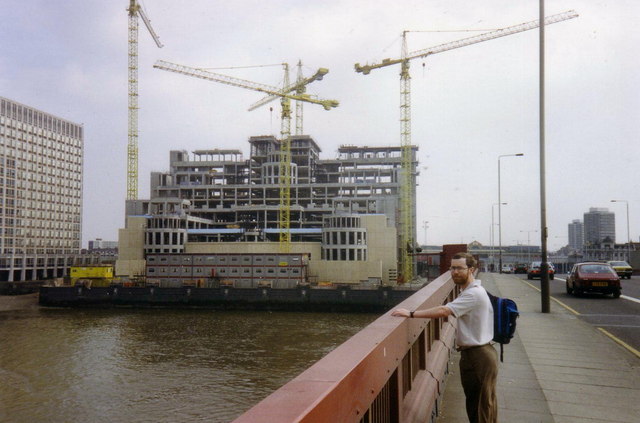
Government office building in London, England
| Field | Value | ||||||
|---|---|---|---|---|---|---|---|
| name | SIS Building | ||||||
| alternate_names | {{plainlist | ||||||
| * MI6 Building<ref>{{cite news | url | https://news.bbc.co.uk/2/hi/uk_news/937298.stm | title=MI6 attack weapon identified | date=22 September 2000 | access-date=12 March 2015 | publisher=BBC News | quote=Police are continuing extensive searches of the area around the MI6 building}} |
| * Legoland<ref>{{cite web | title | Spooks on Stella | work=The Guardian | url=https://www.theguardian.com/books/2004/jun/10/fiction.reviews | date=10 June 2004 | access-date=17 June 2008}} | |
| * Ceaușescu Towers<ref name | TelegSep2300 | ||||||
| * Babylon-on-Thames<ref name | Newsweek00 | ||||||
| * Vauxhall Trollop<ref name | TelegSep2400 | ||||||
| * The Ziggurat<ref>{{cite web | url | https://londonist.com/2011/11/top-10-spy-sites-in-london | title=Top 10 Spy Sites in London | date=22 November 2011 | website=londonist.com}}}} | ||
| image | SIS Building, Vauxhall Cross - geograph.org.uk - 4541871.jpg | ||||||
| image_size | 250px | ||||||
| caption | SIS Building viewed from Millbank with the River Thames in the foreground | ||||||
| architectural_style | Postmodern | ||||||
| client | Secret Intelligence Service (MI6) | ||||||
| owner | HM Government | ||||||
| address | 85 Albert Embankment, Vauxhall, Lambeth | ||||||
| location_town | London | ||||||
| location_country | United Kingdom | ||||||
| coordinates | |||||||
| completion_date | April 1994 | ||||||
| inauguration_date | 14 July 1994 | ||||||
| floor_area | 252497 sqft | ||||||
| architect | Terry Farrell and Partners | ||||||
| main_contractor | John Laing plc | ||||||
| public_transit | Vauxhall |
- MI6 Building
- Legoland
- Ceaușescu Towers
- Babylon-on-Thames
- Vauxhall Trollop
- The Ziggurat}} The SIS Building, also called the MI6 Building, at Vauxhall Cross houses the headquarters of the Secret Intelligence Service (SIS), also known as Military Intelligence, Section 6 (MI6), the United Kingdom's foreign intelligence agency. It is located at 85 Albert Embankment in Vauxhall, London, on the bank of the River Thames beside Vauxhall Bridge. The building has been the headquarters of the SIS since 1994.
History
Background
Previously based at 54 Broadway, the SIS relocated to Century House, a 22-storey office block on Westminster Bridge Road, Lambeth, near Lambeth North and Waterloo stations, in 1964. Its location at Century House was classified information, though The Daily Telegraph reported that it was "London's worst-kept secret, known only to every taxi driver, tourist guide and KGB agent". Century House was described as "irredeemably insecure" in a 1985 National Audit Office (NAO) report with security concerns raised in a survey; the modernist building was made largely of glass, and had a petrol station at its base. Security concerns combined with the remaining short leasehold and cost of modernising the building were important factors in moving to a new headquarters.
Design and construction
The site on which the SIS building stands had been the location of the Vauxhall Pleasure Gardens in the 19th century. Several industrial buildings were subsequently built on the site after the demolition of the pleasure gardens in the 1850s, including a glass factory, a vinegar works and a gin distillery. Archeological excavation of the site during building found the remains of 17th-century glass kilns, as well as barge houses and an inn called The Vine. Evidence was also found for a river wall on the site.
In 1983 the site was bought by property developers Regalian Properties. A competition to develop the site was won by architect Terry Farrell, with an urban village as Farrell's original proposal. A scheme of office blocks was subsequently developed for the site, with a government agency as their occupier. The building had been sold for £130 million in 1989, with construction planned to take three years, built by John Laing. SIS ultimately became the occupiers of the building. Farrell's design for the building was influenced by 1930s industrial modernist architecture such as Bankside and Battersea Power Stations and Mayan and Aztec religious temples.
Regalian approached the government in 1987 to assess their interest in the proposed building. In 1988 Prime Minister Margaret Thatcher approved the purchase of the new building for the SIS. The NAO put the final cost at £135.05 million for site purchase and the basic building or £152.6 million including the service's special requirements.
The site is rumoured to include a tunnel under the Thames from the building to Whitehall.
The numerous layers over which the building is laid out create 60 separate roof areas. Amenities for staff include a sports hall, gymnasium, aerobics studio, a squash court and a restaurant. The building also features two moats for protection.
The building was completed in April 1994 and officially opened by Queen Elizabeth II accompanied by Prince Philip, Duke of Edinburgh, on 14 July 1994.
Recent history

On 1 June 2007, the building and its curtilage were designated as a protected site for the purposes of Section 128 of the Serious Organised Crime and Police Act 2005. The effect of the act was to make it a specific criminal offence for a person to trespass onto the site.
In August 2010, two men from North Wales were arrested after a parcel bomb was found at the SIS building's postal handling centre.
The Queen visited Vauxhall Cross for a second time in February 2006, and Charles, Prince of Wales visited in July 2008. In June 2013, Prince Harry visited Vauxhall Cross and was given a briefing on intelligence by staff. During the Thames Diamond Jubilee Pageant, part of the celebrations for the Diamond Jubilee of Elizabeth II in 2012, the London Philharmonic Orchestra played the "James Bond Theme" as they passed the building. The Daily Telegraph wrote that "Even MI6 managed to join the party – just. Its headquarters at Vauxhall sported a few discreet rows of bunting. But its balconies remained empty."
The building was lit with pink lights to raise awareness of breast cancer in 2013. In January 2013, the building was briefly put into a state of alert after the Vauxhall helicopter crash.
Cultural influence
Architectural criticism

The SIS building was reviewed favourably by Deyan Sudjic in The Guardian in 1992; he described it as an "epitaph for the architecture of the eighties". Sudjic wrote that "It's a design which combines high seriousness in its classical composition with a possible unwitting sense of humour. The building could be interpreted equally plausibly as a Mayan temple or a piece of clanking art deco machinery", and added that the most impressive thing about Farrell's design was the way he had not "confined himself to a single idea" as the building "grows and develops as you move around it". In their 2014 Guide to London's Contemporary Architecture, Kenneth Allinson and Victoria Thornton wrote: Feargus O'Sullivan on the other hand mentioned the nickname "Ceaușescu Towers" for the building, referring to the architecture of Socialist Romania, and derided the whole neighbourhood of newly constructed buildings in Vauxhall as "Dubai-on-Thames".
James Bond films
Vauxhall Cross has featured in several recent James Bond films, where it is depicted as the home base of the fictional 00 Section and its associated Q Branch. The building was first featured in GoldenEye (1995), and was depicted as having been attacked in The World Is Not Enough (1999), Skyfall (2012), and Spectre (2015). For Skyfall, a 50 ft model of the building was constructed at Pinewood Studios.
References
References
- (22 September 2000). "MI6 attack weapon identified". BBC News.
- (21 September 2000). "'Rocket' theory over MI6 blast". BBC News.
- Watson-Smyth, Kate. (21 September 2000). "MI6 Building is Rocked by Two Explosions". The Independent.
- (10 June 2004). "Spooks on Stella". The Guardian.
- Philip Johnston. (22 September 2000). "The very public face of the secret service". The Daily Telegraph.
- Carla Power. (22 September 2000). "Mission: Possible". Newsweek.
- Alan Judd. (24 September 2000). "One in the eye for the Vauxhall Trollop". The Daily Telegraph.
- (22 November 2011). "Top 10 Spy Sites in London".
- Mitchell, Bob. (2003). "Jubilee Line Extension From Concept to Completion". Thomas Telford.
- "Buildings – SIS (MI6)". SIS.
- "Lords Hansard: Written Answers Thursday 20th April 1995". Hansard.
- (20 October 2015). "MI5 and MI6 Thames-side headquarters could be moved into other government buildings in Whitehall". The Independent.
- (12 May 2014). "Guide to London's Contemporary Architecture". Elsevier.
- 25 different types of glass were used in the building, with {{convert. 12000. m2. sqft
- [[Francis Wheen]]. "MI6's big secret: they're useless.", ''The Guardian'', 3 September, pg. 1
- "Explore life at SIS". Secret Intelligence Service.
- (21 September 2000). "MI6 building 'like a fortress'". CNN.
- "Queen visits Mi6.", ''The Times'', London, 15 July 1994, pg 2
- (21 September 2000). "'Rocket' theory over MI6 blast". BBC News.
- Kim Sengupta. (21 September 2000). "Missile launcher in MI6 attack was new to UK". The Independent.
- (21 September 2000). "MI6 missile attack: Irish dissidents suspected". The Guardian.
- (22 May 2007). "Home Office Circular 018 / 2007 (Trespass on protected sites – sections 128–131 of the Serious Organised Crime and Police Act 2005)". Home Office.
- James Meikle. (1 August 2010). "Two men held over MI6 and Downing Street parcel bombs". The Guardian.
- "Court Circular", ''The Times'', London, 11 February 2006, pg. 78
- "Court Circular", ''The Times'', London, 9 July 2008, pg. 55.
- Alice Philipson. (7 June 2013). "Prince Harry given briefing by MI6 secret agents". The Daily Telegraph.
- Neil Tweedie. (4 June 2012). "The Queen's Diamond Jubilee: Flotilla sails into history books on a river of goodwill". The Daily Telegraph.
- Gordon Rayner. (3 June 2012). "The Queen's Diamond Jubilee: Happy and glorious, the river Queen". The Daily Telegraph.
- "Iconic landmarks turn pink for breast cancer campaign". The Daily Telegraph.
- (16 January 2013). "Helicopter crash: 'miracle' of how so few died when fire rained down on the rush hour". The Daily Telegraph.
- Sudjic, Deyan. (19 June 1992). "The building of a not so secret service". The Guardian.
- (15 Dec 2017). "America's Passive-Aggressive New Embassy Arrives in London". The Atlantic.
- Philip French. (28 November 1999). "James'll fix it ... as usual". The Guardian.
- Philip French. (28 October 2012). "Skyfall – review". The Guardian.
This article was imported from Wikipedia and is available under the Creative Commons Attribution-ShareAlike 4.0 License. Content has been adapted to SurfDoc format. Original contributors can be found on the article history page.
Ask Mako anything about SIS Building — get instant answers, deeper analysis, and related topics.
Research with MakoFree with your Surf account
Create a free account to save articles, ask Mako questions, and organize your research.
Sign up freeThis content may have been generated or modified by AI. CloudSurf Software LLC is not responsible for the accuracy, completeness, or reliability of AI-generated content. Always verify important information from primary sources.
Report