From Surf Wiki (app.surf) — the open knowledge base
Sinking ships for wreck diving sites
Scuttling old ships to produce artificial reefs
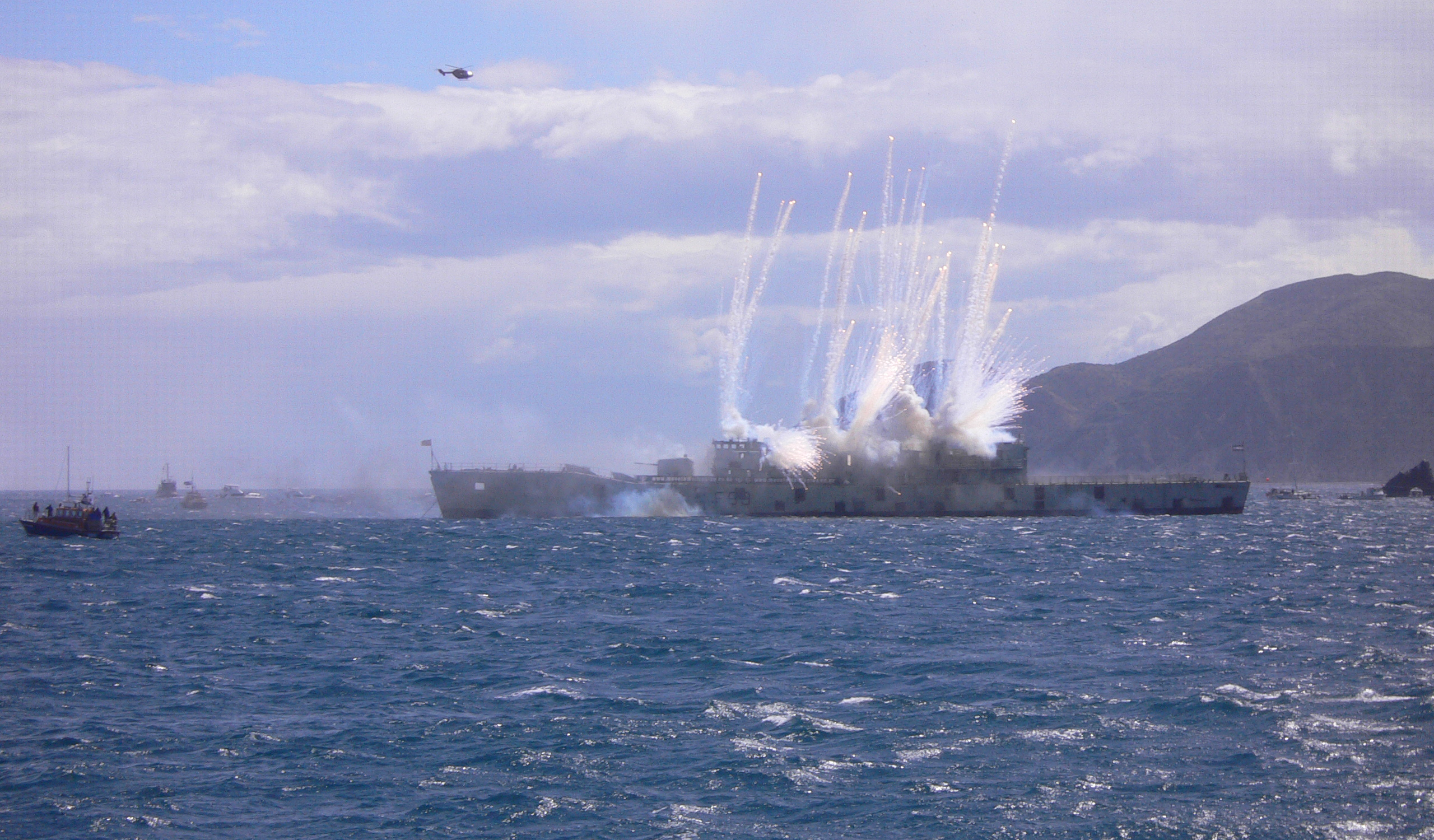
Scuttling old ships to produce artificial reefs
Sinking ships for wreck diving sites is the practice of scuttling old ships to produce artificial reefs suitable for wreck diving, to benefit from commercial revenues from recreational diving of the shipwreck, or to produce a diver training site.
To avoid undesirable ecological impact, and to maximise utility, the vessel should be selected and prepared, and the site chosen, with due consideration to the local environment.
Preparation
To prepare a hulk for sinking as a wreck site, several things must be done to make it safe for the marine environment and divers. To protect the environment, the ship is purged of all oils, hydraulic fluids, and dangerous chemicals such as PCBs. Much of the superstructure may be removed to prevent the hazard of it eventually caving in from corrosion. Similarly, the interior of the ship is gutted of components that corrode quickly, and would be dangerous to divers if they came loose. The ship is thoroughly cleaned, often with the help of volunteers interested in diving. A significant part of the cost of preparing and sinking the ship may be recovered from scrapping the contents of the ship, including valuable materials such as copper wiring. The hulk's suitability as a diving site may be enhanced by cutting openings in its hull and interior bulkheads, and removing doors and hatch covers to allow divers access at reduced risk.
Choice of site
Several factors influence the choice of site for recreational diving purposes, and these should take into consideration the possibly conflicting economic and ecological considerations.
- The wreck should not create a significant hazard to navigation.
- For maximum accessibility and diver safety, a shallow site in protected waters is preferred.
- To reduce cost of access, the site should be near to a suitable harbour or launching site, in a region where existing or planned recreational diving infrastructure is available.
- There may be a conflict of interests between groups which may profit from access to the wreck.
- Sites further offshore make shore dives impracticable or dangerous.
- Deeper water reduces access to less qualified divers, but increases risk for all divers.
- More protected waters reduce risk to all divers and increase the useful lifespan of the wreck as a diving attraction.
- Placement of the wreck will do some ecological damage. An ecological impact assessment should indicate acceptable long term consequences.
- The site will influence the marine organisms that will colonise the wreckage, and the rate at which they will grow. Some may be more desirable at a dive site than others.
- The site will influence the rate of silt deposition in and on the wreckage, which will affect safety and the local ecology.
Sinking

The preparation phase usually removes a significant amount of weight, so the ship floats higher in the water than normal. This may make it necessary to stabilise the vessel by filling some compartments with water as makeshift ballast tanks to prevent excessive rolling in port or during towing. The ship is towed to the sinking location, usually in waters shallow enough to allow access by numerous divers, but deep enough to be relatively unaffected by surface weather conditions. The ship is usually scuttled using shaped explosives, in a controlled demolition. The holes may be blown so that the heavier engine room and stern floods first, then the rest of the hull. The aim is to sink the ship in an upright position.
Reception
The sinking of ships as recreational dive sites can provide wreck diving opportunities where they previously did not exist, and can provide wrecks which are particularly suitable for penetration by less skilled and experienced divers, when they have been prepared for the purpose by removing potential hazards and contents which would contaminate the site or region. However, some divers see them as artificial, less interesting and less challenging, and prefer to explore the relatively unknown or mysterious surroundings of historic and significant wrecks which occurred outside planned scuttling events, considering them to be more authentic. Scuttling programs may relieve more culturally significant wreckage from overexploitation, particularly incidental damage by less competent divers, but do not remove the threat of illegal intentional damage by removal of artifacts by wreck-robbers, who will target wrecks where there are more likely to be artifacts worth stealing.
List of ships sunk for wreck diving
| Year | Vessel name | Location | Country/territory | ||
|---|---|---|---|---|---|
| 1942/1984 | Scirè | Haifa, Israel | Israel | ||
| 1944 | Jun'yō Maru | Samalona Island, South Sulawesi | Indonesia | ||
| 1968 | Palm Beach, Florida | United States | |||
| 1970 | Glen Strathallen | Plymouth Sound | United Kingdom | ||
| 1970 | {{ship | Mohawk | YT-17 | 2}} | Wrightsville Beach, North Carolina |
| 1972 | Key West, Florida | United States | |||
| 1974 | SS Theodore Parker | North Carolina | United States | ||
| 1975 | Wachapreague, Virginia | United States | |||
| 1978 | North Carolina | United States | |||
| 1980 | Oro Verde | Cayman Islands | |||
| 1980 | Isla Mujeres | Mexico | |||
| 1980 | Daytona Beach, Florida | United States | |||
| 1982 | Waianae, Hawaii | United States | |||
| 1982 | Grand Bahama Island | Bahamas | |||
| 1983 | Key West, Florida | United States | |||
| 1985 | {{ship | Eagle | freighter | 2}} | Florida |
| 1987 | Gulf of Mexico | United States | |||
| 1987 | Panama City, Florida | United States | |||
| 1987 | {{ship | Rainbow Warrior | 1955 | 2}} | Matauri Bay |
| 1987 | Florida | United States | |||
| 1987 | Florida | United States | |||
| 1987–2000 | Wreck Alley | San Diego, California | United States | ||
| 1988 | Myrtle Beach, South Carolina | United States | |||
| 1988 | Virginia | United States | |||
| 1988 | Stuart, Florida | United States | |||
| 1988 | North Carolina | United States | |||
| 1989 | Port St. Lucie, Florida | United States | |||
| 1989 | Ocean City, Maryland | United States | |||
| 1989 | YO-257 | Oahu, Hawaii | United States | ||
| 1990 | Morehead City, North Carolina | United States | |||
| 1990 | Destin, Florida | United States | |||
| 1990 | T-Barge | Durban | South Africa | ||
| 1990 | USCG Hollyhock | Florida | United States | ||
| 1990 | Fontao | Durban | South Africa | ||
| 1991 | MV G.B. Church | British Columbia | Canada | ||
| 1991–2001 | "Wreck Alley" – Marie L, Pat and Beata | British Virgin Islands | |||
| 1991 | New Jersey | United States | |||
| 1992 | Ċirkewwa | Malta | |||
| 1992 | North Carolina | United States | |||
| 1992 | British Columbia | Canada | |||
| 1994 | Nova Scotia | Canada | |||
| 1994 | SAS Pietermaritzburg, formerly | Miller's Point, Western Cape | South Africa | ||
| 1994 | Rottnest Island | Australia | |||
| 1994 | INS Sufa | Eilat, Israel | Israel | ||
| 1995 | MV Jean Escutia | Puerto Morelos | Mexico | ||
| 1995 | British Columbia | Canada | |||
| 1996 | Inganess Bay | British Virgin Islands | |||
| 1996 | MV Captain Keith Tibbetts (formerly Russian-built frigate 356) | Cayman Brac | Cayman Islands | ||
| 1996 | British Columbia | Canada | |||
| 1997 | Dunsborough, Western Australia | Australia | |||
| 1997 | British Columbia | Canada | |||
| 1998 | Tug No. 10 | Marsaskala | Malta | ||
| 1998 | {{ship | St. Michael | tugboat | 2}} | Marsaskala |
| 1998 | Um El Faroud | Qrendi | Malta | ||
| 1998 | Looe Key, Florida | United States | |||
| 1999 | Gozo | Malta | |||
| 1999 | Tutukaka Heads | New Zealand | |||
| 1999 | Cozumel | Mexico | |||
| 1999 | Qawra | Malta | |||
| 2000 | Stanegarth | Stoney Cove | United Kingdom | ||
| 2000 | San Diego, California | United States | |||
| 2000 | HaiTzuKuo, Xiaoliuqiu | Taiwan | |||
| 2000 | Puerto Morales | Mexico | |||
| 2000 | Tutukaka | New Zealand | |||
| 2001 | Veracruz | Mexico | |||
| 2001 | British Columbia | Canada | |||
| 2001 | Albany, Western Australia | Australia | |||
| 2002 | Yankalilla Bay, South Australia | Australia | |||
| 2002 | Florida | United States | |||
| 2002 | Mombasa | Kenya | |||
| 2003 | HTMS Khram (L-732) | Ko Phai | Thailand | ||
| 2003 | Chaikou, Green Island | Taiwan | |||
| 2003 | Quebec | Canada | |||
| 2003 | CS Charles L Brown | Sint Eustatius | Leeward Islands | ||
| 2003 | MV Camia 2 | Boracay island | Philippines | ||
| 2004 | Whitsand Bay, Cornwall | United Kingdom | |||
| 2004 | Morehead City, North Carolina | United States | |||
| 2004 | Hebat Allah | Hurghada, Red Sea | Egypt | ||
| 2005 | Mooloolaba, Queensland | Australia | |||
| 2005 | Wellington | New Zealand | |||
| 2006 | Xihwu Boeing 737 | British Columbia | Canada | ||
| 2006 | Florida | United States | |||
| 2006 | HTMS Kut (L-731) | Pattaya | Thailand | ||
| 2006 | Gozo | Malta | |||
| 2006 | Gozo | Malta | |||
| 2007 | {{ship | Maltese patrol boat | P29 | 2}} | Ċirkewwa |
| 2007 | USTS Texas Clipper | South Padre Island, Texas | United States | ||
| 2007 | Bay of Islands | New Zealand | |||
| 2007 | Delaware Bay | United States | |||
| 2009 | Key West, Florida | United States | |||
| 2009 | {{ship | Maltese patrol boat | P31 | 2}} | Comino |
| 2009 | Barwon Heads, Victoria | Australia | |||
| 2011 | West Bay, Grand Cayman | Cayman Islands | |||
| 2011 | Avoca Beach, New South Wales | Australia | |||
| 2011 | HTMS Prab (LCI-741) | Chumphon | Thailand | ||
| 2011 | HTMS Sattakut (LCI-742) | Koh Tao | Thailand | ||
| 2011 | Cape May, New Jersey | United States | |||
| 2012 | Lee County, Florida | United States | |||
| 2012 | HTMS Mataphon (LCT-761) | Ko Larn | Thailand | ||
| 2012 | HTMS Phetra (LCT-764) | Ko Man Nok | Thailand | ||
| 2012 | NRP Oliveira e Carmo (F489) | Algarve | Portugal | ||
| 2012 | NRP Zambeze (P1147) | Algarve | Portugal | ||
| 2012 | HTMS Chang, formerly | Ko Chang | Thailand | ||
| 2013 | NRP Hermenegildo Capelo (F481) | Algarve | Portugal | ||
| 2013 | NRP Almeida Carvalho (A527) | Algarve | Portugal | ||
| 2013 | T11 Coastal Patrol Ship | Ko Chang | Thailand | ||
| 2013 | Tug No. 2 | Sliema | Malta | ||
| 2014 | HTMS Kledkaeo (AKS-861) | Phi Phi Islands | Thailand | ||
| 2014 | MV Ærøsund | South Fionan Sea | Denmark | ||
| 2015 | British Columbia | Canada | |||
| 2015 | Checheng Township, Pingtung | Taiwan | |||
| 2015 | ARM Uribe (P121) | Rosarito Beach, Baja California | Mexico | ||
| 2016 | General Pereira D´Eça F477 | Porto Santo, Madeira | Portugal | ||
| 2016 | Vis | Kamenjak, Istra | Croatia | ||
| 2017 | Cape May, New Jersey | United States | |||
| 2017 | Fishing Trawler, Gal'Oz | Hertzliya, Israel | Israel | ||
| 2018 | Queensland | Australia | |||
| 2021 | {{ship | Maltese patrol boat | P33 | 2}} | Marsaskala |
| 2022 | Xatt l-Aħmar | Malta | |||
| 2023 | (P217) | K41 | East Timor |
References
- National Geographic channel, "The Ship Sinkers" --
References
- [https://web.archive.org/web/20010419185239/http://www.geocities.com/shipwrecks_magazine/rainbow.htm The Bombing of the Rainbow Warrior]
- (19 August 2013). "Hebat Allah". Red Sea Wreck Project.
- (4 April 2015). "HMCS Annapolis sunk to make artificial reef". CBC News.
- "Cordeca".
- "NRP General Pereira d'Eca F477".
- (31 July 2021). "Ara l-mument tal-għarqa tal-P33 fil-ponta taż-Żonqor". [[One Productions.
- (29 August 2022). "Watch: Tanker that ran aground off Qawra starts new life as a diving attraction". Times of Malta.
- (18 July 2023). "Timor Leste's Newest Shipwreck".
- (2008). "Wrecks of the Duane and Bibb". Advanced Diver Magazine Ezine.
- "The Cayman Islands Shipwreck Expo Directory Capt. Dan Berg's Guide to Shipwrecks information". Aquaexplorers.com.
- "ARSBC". Artificial Reef Society of British Columbia.
- Barnette, Michael C.. (2008). "[[Florida's Shipwrecks]]". Arcadia Publishing.
- "5 Star PADI IDC Centre, Kenya, Zanzibar". Buccaneer Diving.
- "BVI Dive Site: Wreck of the Inganess Bay". Bvidiving.com.
- "Charlie Brown Artificial Reef". Golden Rock Dive Center.
- "Cooper Island". Dive BVI.
- "Top wrecks of Malta & Gozo". John Liddiard.
- "MV Imperial Eagle & Kristu l-Bahhar". Subway Dive Centre.
- Edney, Joanne. (November 2006). "Impacts of Recreational Scuba Diving on Shipwrecks in Australia and the Pacific - A Review". Heritage Futures International.
- "Diving the wrecks off Malta and Gozo's Coastline.". Paradise Diving Malta.
- "HMAS Perth (II) - Royal Australian Navy". Navy.gov.au.
- "HMAS Swan (III) - Royal Australian Navy". Navy.gov.au.
- "The ''Spiegel Grove'' is believed to be the largest ever wreck deliberately sunk as a diving site". Fla-keys.com.
- (2009-05-27). "Vandenberg sinking this morning". MSNBC.
This article was imported from Wikipedia and is available under the Creative Commons Attribution-ShareAlike 4.0 License. Content has been adapted to SurfDoc format. Original contributors can be found on the article history page.
Ask Mako anything about Sinking ships for wreck diving sites — get instant answers, deeper analysis, and related topics.
Research with MakoFree with your Surf account
Create a free account to save articles, ask Mako questions, and organize your research.
Sign up freeThis content may have been generated or modified by AI. CloudSurf Software LLC is not responsible for the accuracy, completeness, or reliability of AI-generated content. Always verify important information from primary sources.
Report