From Surf Wiki (app.surf) — the open knowledge base
Single-line diagram
Simplest symbolic representation of an electric power system
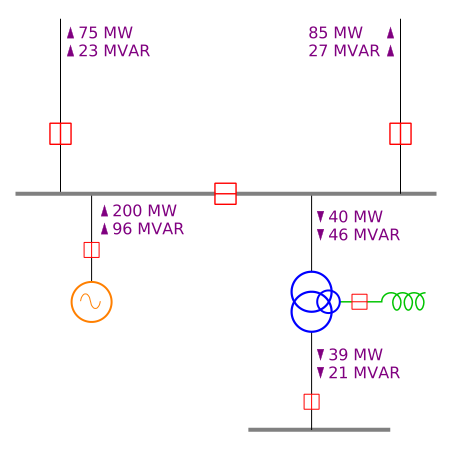
Simplest symbolic representation of an electric power system
In power engineering, a single-line diagram (SLD), also sometimes called one-line diagram, is the simplest symbolic representation of an electric power system. A single line in the diagram typically corresponds to more than one physical conductor: in a direct current system the line includes the supply and return paths, in a three-phase system the line represents all three phases (the conductors are both supply and return due to the nature of the alternating current circuits).
The single-line diagram has its largest application in power flow studies. Electrical elements such as circuit breakers, transformers, capacitors, bus bars, and conductors are shown by standardized schematic symbols. Instead of representing each of three phases with a separate line or terminal, only one conductor is represented.
It is a form of block diagram graphically depicting the paths for power flow between entities of the system. Elements on the diagram do not represent the physical size or location of the electrical equipment, but it is a common convention to organize the diagram with the same left-to-right, top-to-bottom sequence as the switchgear or other apparatus represented. A single-line diagram can also be used to show a high level view of conduit runs for a PLC control system.
Buses
The lines in the single-line diagram connect nodes – points in the system that are "electrically distinct" (i.e., there is nonzero electrical impedance between them). For sufficiently large systems, these points represent physical busbars, so the diagram nodes are frequently called buses. A bus corresponds to a location where the power is either injected into the system (e.g., a generator) or consumed (an electrical load). A steady-state of each bus can be characterized by its voltage phasor; the system state is defined by a vector of voltage phasors for all the buses. In a physical system the state is calculated through power system state estimation, since the end of the 20th century this process involves direct simultaneous measurements (synchrophasor) using the phasor measurement units.
Balanced systems
The theory of three-phase power systems tells us that as long as the loads on each of the three phases are balanced, the system is fully represented by (and thus calculations can be performed for) any single phase (so called per phase analysis).
A single-line diagram is usually used along with other notational simplifications, such as the per-unit system.
A secondary advantage to using a single-line diagram is that the simpler diagram leaves more space for non-electrical, such as economic, information to be included.
Unbalanced systems
When using the method of symmetrical components, separate single-line diagrams are made for each of the positive, negative and zero-sequence systems. This simplifies the analysis of unbalanced conditions of a polyphase system. Items that have different impedances for the different phase sequences are identified on the diagrams. For example, in general a generator will have different positive and negative sequence impedance, and certain transformer winding connections block zero-sequence currents. The unbalanced system can be resolved into three single line diagrams for each sequence, and interconnected to show how the unbalanced components add in each part of the system.
References
Sources
References
- Mukhtar Ahmad. (2013). "Power System State Estimation". Artech House.
- (4 February 2019). "Dynamics and Control of Electric Transmission and Microgrids". John Wiley & Sons.
- (30 May 2018). "Power Electronics and Power Systems". Springer International Publishing.
- (25 March 2013). "Power System Analysis". PHI Learning Pvt. Ltd..
This article was imported from Wikipedia and is available under the Creative Commons Attribution-ShareAlike 4.0 License. Content has been adapted to SurfDoc format. Original contributors can be found on the article history page.
Ask Mako anything about Single-line diagram — get instant answers, deeper analysis, and related topics.
Research with MakoFree with your Surf account
Create a free account to save articles, ask Mako questions, and organize your research.
Sign up freeThis content may have been generated or modified by AI. CloudSurf Software LLC is not responsible for the accuracy, completeness, or reliability of AI-generated content. Always verify important information from primary sources.
Report