From Surf Wiki (app.surf) — the open knowledge base
Simple cuboidal epithelium
Tissue type
Tissue type
| Field | Value |
|---|---|
| Name | Simple cuboidal epithelium |
| Image | Gray1133.png |
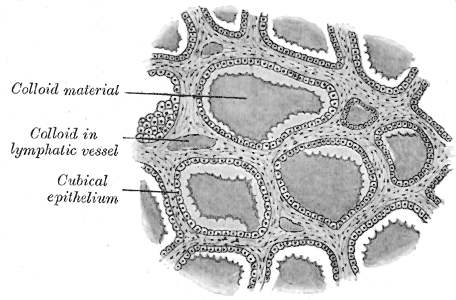
| Caption | Simple cuboidal epithelium in the pig kidney. The surfaces of the large and small collecting ducts (a and b), the circular structures, are surrounded by the simple cuboidal epithelium. |
Simple cuboidal epithelium is a type of epithelium that consists of a single layer of cuboidal (cube-like) cells which have large, spherical and central nuclei.
Simple cuboidal epithelium is found on the surface of ovaries, the lining of nephrons, the walls of the renal tubules, parts of the eye and thyroid, and in salivary glands.
On these surfaces, the cells perform secretion and filtration.
Location
Simple cuboidal cells are also found in renal tubules of nephrons, glandular ducts, and thyroid follicles. Simple cuboidal cells are found in single rows with their spherical nuclei in the center of the cells and are directly attached to the basal surface. Simple ciliated cuboidal cells are also present in the respiratory bronchioles. Germinal cuboidal epithelial lines the ovaries and seminiferous tubules of testes. They undergo meiosis to form gametes.
Functions
These cells provide protection and may be active (pumping material in or out of the lumen) or passive, depending on the location and cellular specialization.
Simple cuboidal epithelium commonly differentiates to form the secretory and duct portions of glands. They also constitute the germinal epithelium, which covers the ovary (but does not contribute to ovum production) and the internal walls of the seminiferous tubules in the male testes. These cells offer some protection and function in filtration and secretion.
References
References
This article was imported from Wikipedia and is available under the Creative Commons Attribution-ShareAlike 4.0 License. Content has been adapted to SurfDoc format. Original contributors can be found on the article history page.
Ask Mako anything about Simple cuboidal epithelium — get instant answers, deeper analysis, and related topics.
Research with MakoFree with your Surf account
Create a free account to save articles, ask Mako questions, and organize your research.
Sign up freeThis content may have been generated or modified by AI. CloudSurf Software LLC is not responsible for the accuracy, completeness, or reliability of AI-generated content. Always verify important information from primary sources.
Report