From Surf Wiki (app.surf) — the open knowledge base
Simon Sudbury
Archbishop of Canterbury from 1375 to 1381

Archbishop of Canterbury from 1375 to 1381
| Field | Value |
|---|---|
| name | Simon Sudbury |
| archbishop_of | Archbishop of Canterbury |
| Primate of All England | |
| image | Murder of Simon Sudbury - Froissart, Chroniques de France et d'Angleterre, Book II (c.1460-1480), f.172 - BL Royal MS 18 E I.jpg |
| caption | A 15th-century depiction of the murder of Archbishop Simon of Sudbury and Sir Robert Hales at the Tower of London. |
| appointed | 4 May 1375 |
| enthroned | Unknown |
| ended | 14 June 1381 |
| predecessor | William Whittlesey |
| successor | William Courtenay |
| consecration | 20 March 1362 |
| other_post | Bishop of London |
| birth_date | |
| death_date | 14 June |
| church | Catholic Church |
Primate of All England
Simon Sudbury ( – 14 June 1381) was Bishop of London from 1361 to 1375, Archbishop of Canterbury from 1375 until his death, and in the last year of his life Lord Chancellor of England. He met a violent death during the Peasants' Revolt in 1381.
Life
The son of Nigel Theobald, Simon of Sudbury (as he later became known) was born at Sudbury in Suffolk, studied at the University of Paris, and became one of the chaplains of Pope Innocent VI, one of the Avignon popes, who in 1356 sent him on a mission to Edward III of England.
In 1361 Sudbury was made Chancellor of Salisbury He was soon serving Edward III as an ambassador and in other ways. On 4 May 1375 he succeeded William Whittlesey as archbishop of Canterbury, and during the rest of his life was a partisan of John of Gaunt.
In July 1377, following the death of Edward III in June, Simon of Sudbury crowned the new king, Richard II, at Westminster Abbey, and in 1378 John Wycliffe appeared before him at Lambeth, but Sudbury only undertook proceedings against him under great pressure.
In January 1380, Sudbury became Lord Chancellor of England, and the insurgent peasants regarded him as one of the principal authors of their woes. Having released John Ball from his prison at Maidstone, the Kentish insurgents attacked and damaged the archbishop's property at Canterbury and Lambeth; then, rushing into the Tower of London, they seized the archbishop himself. So unpopular was Sudbury with the rebellious peasants that guards simply allowed the rebels through the gates, the reason being his role in introducing the third poll tax.
Death
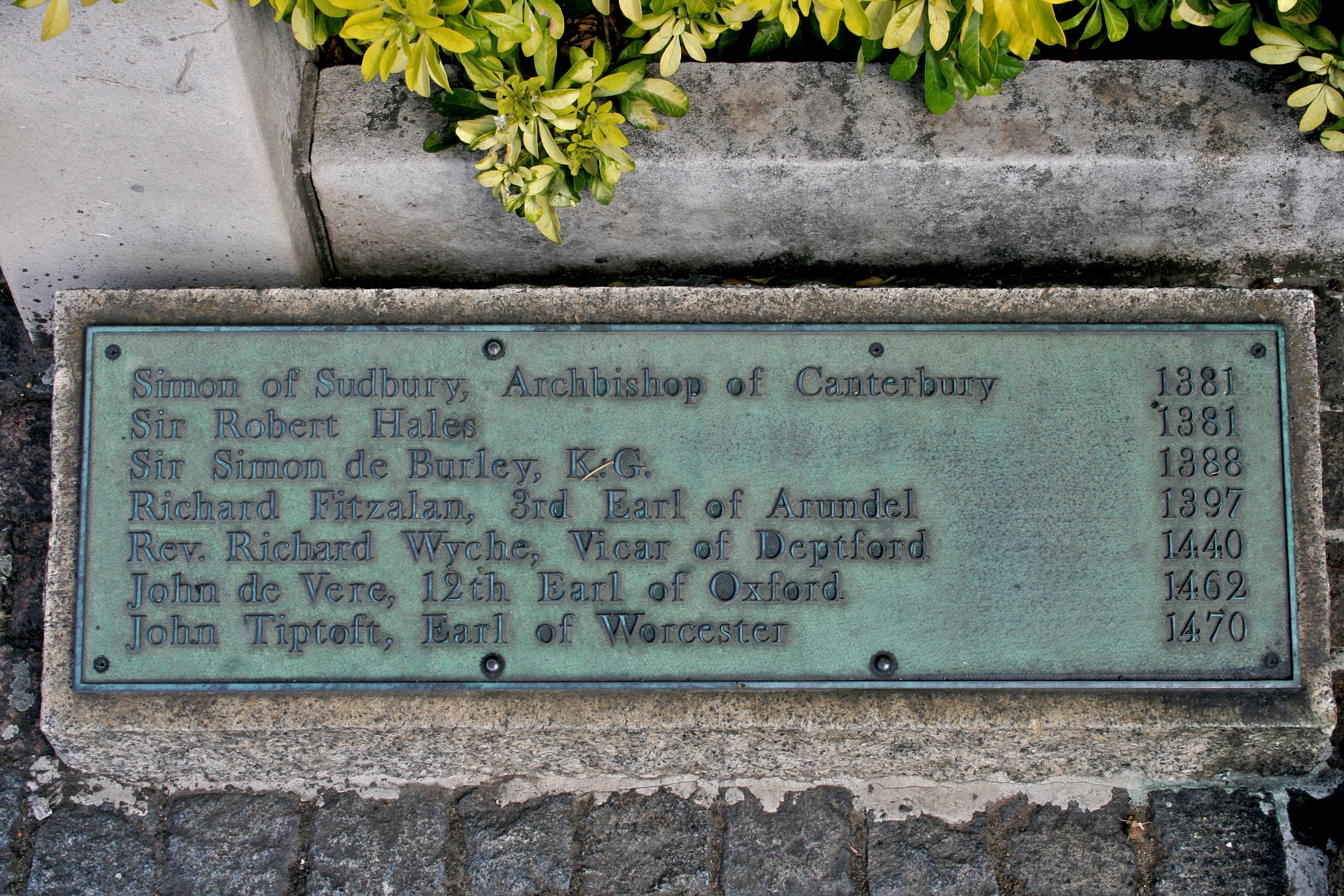
Sudbury, who was saying Mass in St John's Chapel, was dragged to Tower Hill together with Sir Robert Hales, the Lord High Treasurer. According to an account written by John Stow two centuries later, Sudbury was beheaded by eight frenzied sword blows to his neck, one of which also took off the fingers from one hand. His body lay in the open all day, but his severed head had his clerical hood nailed onto it and was fixed to a pole, then placed on London Bridge. His body was afterwards taken to Canterbury Cathedral, though his head was taken down after six days by William Walworth, the Lord Mayor of London, and was taken to Sudbury, where it is still kept at St Gregory's Church, which Sudbury had partly rebuilt.
In March 2011 a CT scan of Sudbury's mummified skull was performed at the West Suffolk Hospital to make a facial reconstruction, which was completed in September 2011 by forensics expert Adrienne Barker at the University of Dundee.
Sudbury's tomb in Canterbury Cathedral contains his corpse with a lead cannonball in place of the missing head. The stone sarcophagus lacks the original gilt copper effigy, which was destroyed during the English Reformation, but the elaborately carved stone canopy survives. By ancient tradition, the mayor of Canterbury places a wreath of red roses on the tomb at an annual civic service on Christmas Day, in recognition of Sudbury's good works for the city.
Arms
Sudbury's coat of arms was a talbot hound sejeant within a bordure engrailed, as is visible sculpted in stone on a wall in the nave of Canterbury Cathedral. The town of Sudbury uses a talbot hound sejeant in its arms in allusion to him.
Notes
Citations
References
References
- Walker, Simon. (2004). "Sudbury, Simon (c. 1316–1381)". Oxford University Press.
- Neale, John Preston. (1825). "Views of the most interesting collegiate and parochial churches in Great Britain". Longman.
- and in October that year the pope provided him to be [[Bishop of London]], Sudbury's consecration occurring on 20 March 1362.Fryde, et al. ''Handbook of British Chronology'' p. 258
- Fryde, et al. ''Handbook of British Chronology'' p. 233
- Fryde ''Handbook of British Chronology'' p. 86
- Sperling, Charles Fredirick Denne. (1896). "A Short History of the Borough of Sudbury, in the County of Suffolk, compiled from materials collected by W. W. Hodson". B R Martin.
- (17 March 2011). "Skull scan for Archbishop of Canterbury Simon Theobald". [[BBC Online]].
- (13 September 2011). "Face of Simon of Sudbury revealed by forensic artist.". [[BBC Online]].
- . (2015). ["Archbishop Sudbury"](http://www.canterbury-archaeology.org.uk/sudbury/4590809726). *Canterbury Historical and Archaeological Society*.
- [http://www.canterbury-archaeology.org.uk/sudbury/4590809726 See image]
- [https://www.sudburytowncouncil.co.uk/ See image of Sudbury town arms]
This article was imported from Wikipedia and is available under the Creative Commons Attribution-ShareAlike 4.0 License. Content has been adapted to SurfDoc format. Original contributors can be found on the article history page.
Ask Mako anything about Simon Sudbury — get instant answers, deeper analysis, and related topics.
Research with MakoFree with your Surf account
Create a free account to save articles, ask Mako questions, and organize your research.
Sign up freeThis content may have been generated or modified by AI. CloudSurf Software LLC is not responsible for the accuracy, completeness, or reliability of AI-generated content. Always verify important information from primary sources.
Report