From Surf Wiki (app.surf) — the open knowledge base
Silent Night
1818 Christmas carol
1818 Christmas carol
| Field | Value |
|---|---|
| name | Stille Nacht |
| Silent Night | |
| type | Christmas carol |
| image | Stille nacht.jpg |
| image_upright | 1.4 |
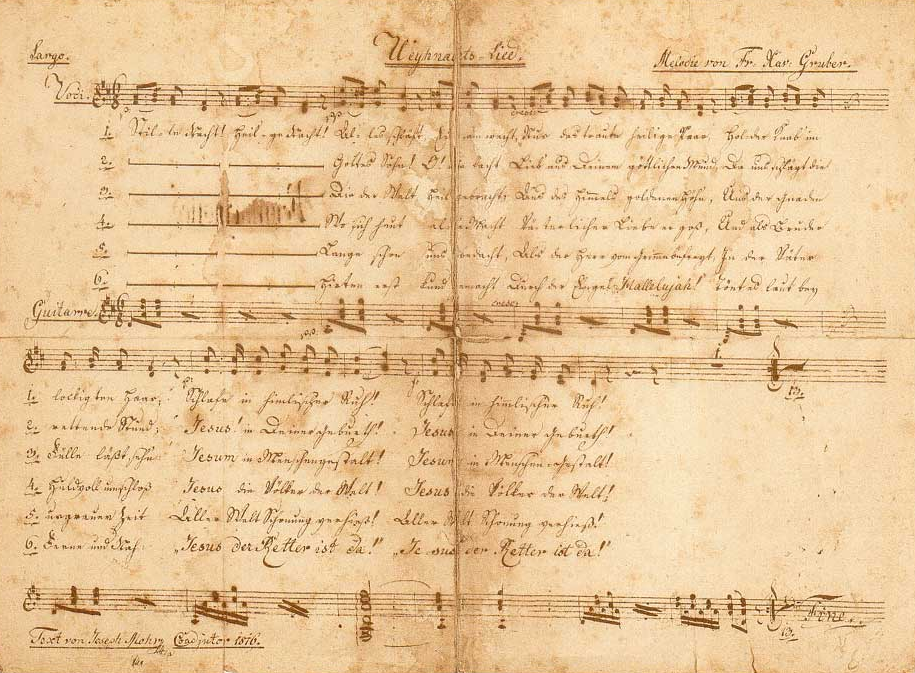
| caption | Autograph (c. 1860) of the carol by Franz Gruber |
| full_title | Silent Night, Holy Night |
| native_name | Stille Nacht, heilige Nacht |
| native_name_lang | de |
| text | Joseph Mohr |
| language | German |
| melody | Franz Xaver Gruber |
| performed | |
| published |
the Christmas carol
Silent Night
"Silent Night" () is a popular Christmas carol, composed in 1818 by Franz Xaver Gruber to lyrics by Joseph Mohr in Oberndorf bei Salzburg, Austria. It was declared an intangible cultural heritage by UNESCO in 2011. The song was first recorded in 1905 and has remained a popular success, appearing in films and multiple successful recordings, as well as being quoted in other musical compositions. It is one of the most recorded Christmas songs, with more than 137,000 known recordings.
Creation
Father Joseph Mohr, a young Catholic priest, had come to Oberndorf in 1817. In the aftermath of the Napoleonic Wars, he had written the poem "Stille Nacht" in 1816 at Mariapfarr, the home town of his father in the Salzburg Lungau region, where Joseph had worked as an assistant priest.
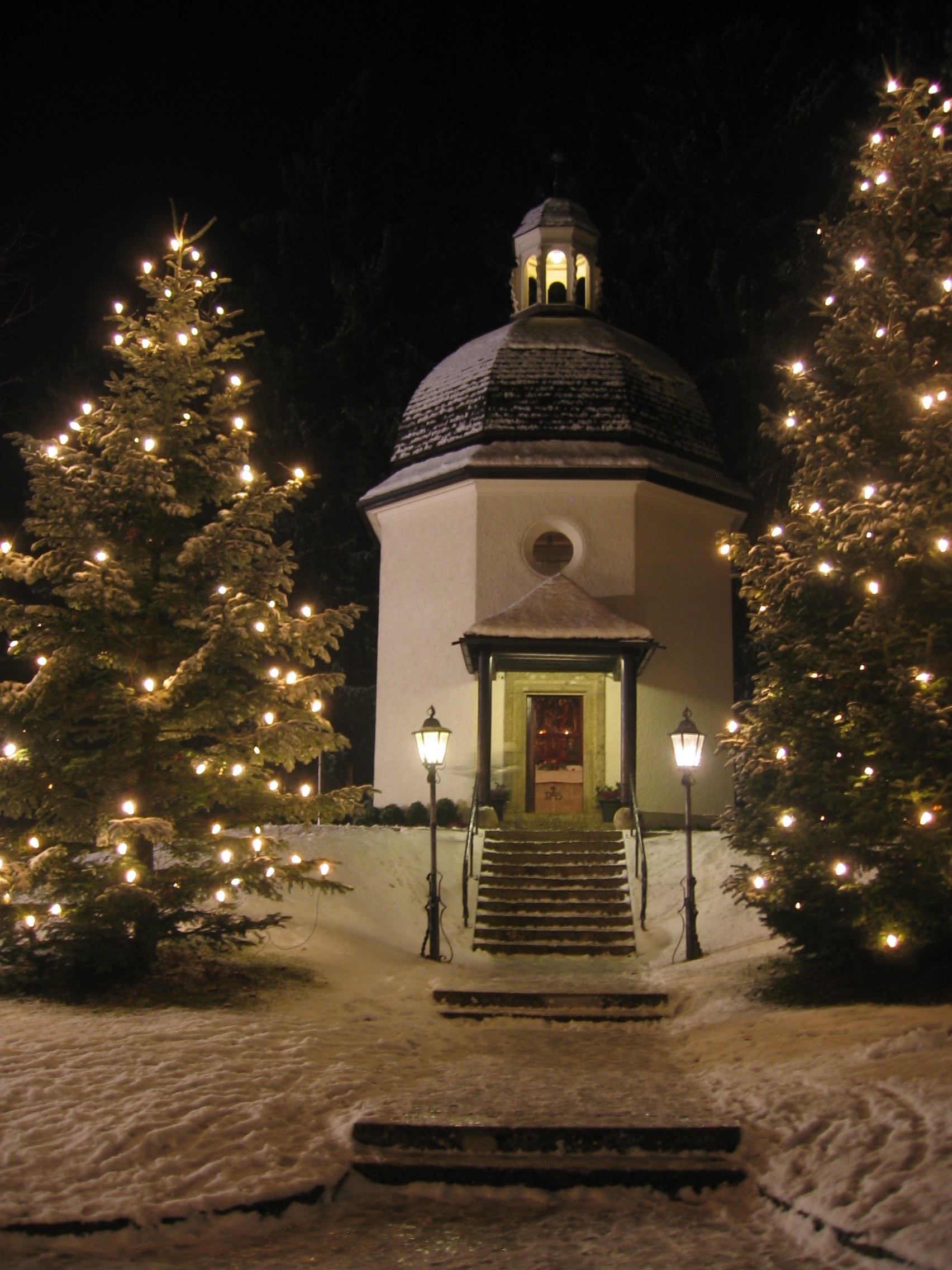
The melody was composed by Franz Xaver Gruber, schoolmaster and organist in the nearby village of , now part of Lamprechtshausen. On Christmas Eve, 1818, Mohr brought the words to Gruber and asked him to compose a melody and guitar accompaniment for that night's mass, after river flooding had possibly damaged the church organ. The church was eventually destroyed by repeated flooding and replaced with the Silent-Night-Chapel.
"Stille Nacht" was first performed on Christmas Eve, 1818, at the Nikolauskirche, the parish church of Oberndorf, a village in the Austrian Empire on the Salzach river in present-day Austria.
Subsequent History
According to Gruber, Karl Mauracher, an organ builder who serviced the instrument at the Oberndorf church, was enamoured of the song, and took the composition home with him to the Zillertal. From there, two travelling families of folk singers, the Strassers and the Rainers, included the tune in their shows. The Rainers were already singing it around Christmas 1819, and they once performed it for an audience that included Franz I of Austria and Alexander I of Russia, as well as making the first performance of the song in the U.S., in New York City in 1839. By the 1840s the song was well known in Lower Saxony and was reported to be a favourite of Frederick William IV of Prussia. During this period, the melody changed slightly to become the version that is commonly played today.
In 1995, a manuscript was discovered in Mohr's handwriting and dated by researchers as . It revealed that Mohr wrote the words in 1816 when he was assigned to a pilgrim church in Mariapfarr, Austria, and shows that the music was composed by Gruber in 1818. This is the earliest manuscript that exists and the only one in Mohr's handwriting.
In 2011, Silent Night was declared an intangible cultural heritage by UNESCO, because of its universal message of peace and its global cultural significance.
;Original melody: : \new Staff \new Voice="melody" \relative c'' { \set Staff.midiInstrument = #"acoustic guitar (nylon)" \autoBeamOff \tempo 4 = 60 \set Score.tempoHideNote = ##t \voiceOne \language "deutsch" \key d \major \time 6/8 a8. [ h16 ] a8 fis4 h8\rest a8. h16 a8 fis4 h8\rest e8. [ dis16 ] e8 cis4 h8\rest d8. [ cis16 ] d8 a4 h8\rest h4 h8 d8. [ cis16 ] h8 a8. h16 a8 fis4 h8\rest h4 h8 d8. [ cis16 ] h8 a8. h16 a8 fis4 h8\rest cis8. cis16 cis8 e8. d16 cis8 d4. ( fis4 ) h,8\rest d8. a16 fis8 a8. g16 e8 d4.~ d4 h'8\rest } \new Voice \relative c' { \voiceTwo \autoBeamOff %\omit "Rest_engraver" fis8. [ g16 ] fis8 d4 s8 fis8. g16 fis8 d4 s8 g8. [ fis16 ] g8 e4 s8 fis8. [ e16 ] fis8 fis4 s8 g4 g8 h8. [ a16 ] g8 fis8. g16 fis8 d4 s8 g4 g8 h8. [ a16 ] g8 fis8. g16 fis8 d4 s8 e8. e16 e8 g8. fis16 e8 fis4. ( a4 ) s8 fis8. fis16 d8 fis8. e16 cis8 d4.~ d4 } \new Lyrics \lyricsto "melody" { Stil -- le Nacht! Hei -- li -- ge Nacht! Al -- les schläft; ein -- sam wacht Nur das trau -- te hei -- li -- ge Paar. Hol -- der Knab’ im lok -- kig -- ten Haar, schla -- fe in himm -- li -- scher Ruh! __ Schla -- fe in himm -- li -- scher Ruh! __ }
The first edition was published by in 1833 in a collection of Four Genuine Tyrolean Songs, with the following musical text:
.jpg)
: \transpose c d \relative c'' { \key c \major \set Staff.midiInstrument = #"acoustic guitar (nylon)" \time 6/8 \set Score.tempoHideNote = ##t \tempo 4 = 60 \autoBeamOff g8.^"First edition" [a16] g8 e4. | g8. [a16] g8 e4. | d'4 d16. [b32] b4. | c4 c16. [g32] g4. | a4 a8 c8. b16 a8 | g8. a16 g8 e4. | a4 a8 c8. b16 a8 | g8. a16 g8 e4. | d'4 d8 f8.- d16 b8 | c4. (e4) r8 | c8. [g16] e8 g8. f16 d8 | c4.~ c4 r8 \bar "|." }
The contemporary version, as in the choral example below, is: score : \transpose c d \relative c'' { \key c \major \set Staff.midiInstrument = #"acoustic guitar (nylon)" \time 6/8 \set Score.tempoHideNote = ##t \tempo 4 = 60 \autoBeamOff g8.^"Contemporary" [(a16)] g8 e4. | g8. [a16] g8 e4. | d'4 d8 b4. | c4 c8 g4. | a4 a8 c8. [b16] a8 | g8. [a16] g8 e4. | a4 a8 c8. [b16] a8 | g8. [a16] g8 e4. | d'4 d8 f8.- [d16] b8 | c4. (e4) r8 | c8. [(g16)] e8 g8. [f16] d8 | c4.~ c4 r8 \bar "|." }
Translations
In 1859, the Episcopal priest John Freeman Young, then serving at Trinity Church, New York City, wrote and published the English translation that is most frequently sung today, translated from three of Mohr's original six verses. The version of the melody that is generally used today is a slow, meditative lullaby or pastorale, differing slightly (particularly in the final strain) from Gruber's original, which was a "moderato" tune in time and siciliana rhythm. Today, the lyrics and melody are in the public domain, although newer translations usually are not.
In 1998, the Silent Night Museum in Salzburg commissioned a new English translation by Bettina Klein of Mohr's German lyrics. For the most part, Klein preserves both Young's translation and the interpretive decisions that inform his word-choices. Yet Klein also attempts occasionally to restore Mohr's original phrasing, changing, for instance, Young's "Holy infant, so tender and mild" to Mohr's "Holy infant with curly hair" (Holder Knab' im lockigten Haar). However, she continues to interpret Mohr's traute heilige Paar as referring to Mary and the baby, whereas Mohr's use of the word traute can mean "espoused," thus suggesting perhaps that the "holy pair" represents Mary and Joseph watching (picking up Mohr's wacht) over the curly-haired infant/boy.
The carol has been translated into about 300 languages.
Lyrics
:{| !German lyrics !Young's English lyrics |- |{{Lang|de|Stille Nacht, heilige Nacht, Alles schläft; einsam wacht Nur das traute hochheilige Paar. Holder Knabe im lockigen Haar, Schlaf in himmlischer Ruh! Schlaf in himmlischer Ruh!
Stille Nacht, heilige Nacht, Hirten erst kundgemacht Durch der Engel Halleluja, Tönt es laut von fern und nah: Christ, der Retter ist da! Christ, der Retter ist da!
Stille Nacht, heilige Nacht, Gottes Sohn, o wie lacht Lieb' aus deinem göttlichen Mund, Da uns schlägt die rettende Stund'. Christ, in deiner Geburt! Christ, in deiner Geburt!}} All is calm, all is bright Round yon virgin mother and child! Holy infant, so tender and mild, Sleep in heavenly peace! Sleep in heavenly peace!
Silent night! Holy night! Shepherds quake at the sight! Glories stream from heaven afar, Heavenly hosts sing Alleluia! Christ the Saviour is born! Christ the Saviour is born!
Silent night! Holy night! Son of God, love's pure light Radiant beams from thy holy face With the dawn of redeeming grace, Jesus, Lord, at thy birth! Jesus, Lord, at thy birth! |}
In the second stanza, some English versions read "shepherds quail" rather than "shepherds quake."
A common fourth verse or alternative third verse is: Silent night, holy night, wondrous star, lend thy light; with the angels let us sing, Alleluia to our King; Christ the Saviour is born, Christ the Saviour is born!
Musical settings
The carol was arranged by various composers, such as Carl Reinecke, Gustav Schreck, Eusebius Mandyczewski, Malcolm Sargent, David Willcocks, Charles Mackerras, Philip Ledger, John Rutter, Stephen Cleobury, Jacob de Haan and Taylor Scott Davis.
Max Reger quotes the tune in the Christmas section of his organ pieces Sieben Stücke, Op. 145.
Alfred Schnittke composed an arrangement of "Stille Nacht" for violin and piano in 1978, as a holiday greeting for violinist Gidon Kremer. Due to its dissonant and nightmarish character, the miniature caused a scandal in Austria.
In film
Several theatrical and television films depict how the song was ostensibly written. Most of them report the organ breaking down at the church in Oberndorf, which appeared in a fictional story published in the U.S. in the 1930s.
- The Legend of Silent Night (1968) TV film directed by Daniel Mann
- Silent Night, Holy Night (1976) animated short film by Hanna-Barbera.
- Silent Mouse (1988) television special directed and produced by Robin Crichton and narrated by Lynn Redgrave.
- Buster & Chauncey's Silent Night (1998) direct-to-video animated feature
- Silent Night (2012) directed by Christian Vuissa
- The First Silent Night (2014), documentary narrated by Simon Callow
- Stille Nacht – ein Lied für die Welt (2018), music documentary created and directed by Hannes M. Schalle, narrated by Peter Simonischek. An English version, Silent Night – A Song for the World (2020), narrated by Hugh Bonneville, was released two years later.
On record charts
Several recordings of "Silent Night" have reached the record charts in various countries. These include:
- 1969–1979: Percy Sledge on the Dutch Charts
- 1972–1973: Tom Tomson on the Belgium Ultratop Flanders chart and on its Wallonia chart
- 1975–1976: The Cats on the Dutch Charts
- 1987: Argentine post-punk band Sumo (band) cover version is one of the most popular Christmas songs on Spotify Argentina 2025
- 1991–1992: Sinéad O'Connor on the Dutch Charts
- 1993: Enya No. 48 on the Australian Charts with an Irish language version of the song.
- 2007–2008: Josh Groban on the Norwegian Charts and on the U.S. Billboard Adult Contemporary Chart
- 2008: Glasvegas on the Swedish Charts
- 2009: Mariah Carey on the U.S. Billboard Digital Song Sales Chart
- 2010: Rene Kirby and Ryne Sandberg in American version of Silent Night (sung by Living Voices)
- 2011: The Temptations on the U.S. Billboard Holiday 100 chart.
- 2013–2014: Elvis Presley on the French Charts
- 2013–2014: Nat King Cole on the French Charts
- 2017: The Temptations on the Swedish Heatseeker (Sverigetopplistan) charts
References
References
- (17 December 2018). "It's the Bicentennial of 'Silent Night': The classic Christmas tune was first composed as a poem, and it was set to music for the first time in the winter of 1818". [[Smithsonian (magazine).
- "Österreichische UNESCO-Kommission – Nationalagentur für das Immaterielle Kulturerbe – Austrian Inventory".
- Berg, Marita. (15 December 2013). "Silent Night". [[Deutsche Welle]].
- (5 December 2017). "Christmas Classics From Mariah Carey & Wham! Among Most-Recorded Holiday Songs".
- Egan, Bill. (December 1999). "Silent Night, Holy Night". [[University of Groningen]].
- (4 August 2009). "Christmas carols". BBC.
- "Spreading of the Song Locally". Silent Night Association.
- "Origin of the Song". Silent Night Association.
- [http://www.henle.de/blog/en/2012/12/24/%e2%80%98silent-night%e2%80%99-revisited/ "Silent Night" revisited] {{Webarchive. link. (27 August 2016 by Norbert Müllemann, [[G. Henle Verlag]], 24 December 2012)
- Underwood, Byron Edward, "Bishop John Freeman Young, Translator of '{{Lang. de. Stille Nacht. The Hymn]]'', v. 8, no. 4, October 1957, pp. 123–132.
- Meredith Ellis Little (2001). [http://oxfordindex.oup.com/view/10.1093/gmo/9781561592630.article.25698 ''Siciliana''] {{Webarchive. link. (19 April 2016 . Grove Music Online. {{ISBN). 978-1561592630.
- [[Gerlinde Haid]] (1994). ''Siciliano als Typus weihnachtlicher Volksmusik''. 175 Jahre "Stille Nacht! Heilige Nacht!" (in German), pp. 135–146. Salzburg.
- [https://silent-night-museum.org/sounds/lyrics.htm "Silent night! Holy night!"], translated in 1998 by Bettina Klein, Silent Night Museum
- Ronald M. Clancy, [[William Studwell. William E. Studwell]]. ''Best-Loved Christmas Carols''. Christmas Classics Ltd, 2000. {{page missing. (December 2018)
- ''[[Evangelisches Gesangbuch]]'', hymn [https://www.evangeliums.net/lieder/liederbuch_evangelisches_gesangbuch.html no. 46] {{Webarchive. link. (14 December 2017 ; ''[[Gotteslob]]'', hymn [http://gotteslob.katholisch.de/?name=Stille+Nacht&sbid=&thema=&sortdir=ASC no. 249] {{Webarchive). link. (14 December 2017 (was 145))
- Young, John Freeman. (1887). "Great hymns of the church". New York : James Pott & Co..
- (1881). "Christmas Carols, Hymns, Etc.". F. Pitman.
- Ruffer, Tim. (2013). "Ancient and Modern Words Edition". Canterbury Press.
- (1878). "The Church Porch: A Service Book and Hymnal for Sunday Schools". E.P. Dutton & Co.
- "Silent Night, Holy Night".
- Guerrieri, Matthew. (20 December 2014). "With 'Stille Nacht', Schnittke couched protest in tradition". [[The Boston Globe]].
- Ross, Alex. (28 September 1992). "Connoisseur of Chaos: Schnittke".
- (27 December 2008). "Silent Night, Holy Night (TV Movie 1976)". IMDb.
- "Silent Mouse (1988)". Turner Classic Movies.
- "Buster and Chauncey's Silent Night". Turner Classic Movies.
- (21 October 2014). "''Silent Night'' | Movieguide | Movie Reviews for Christians". Movieguide.
- link. (25 December 2014 , production details)
- (15 December 2018). "Stille-Nacht-Film feierte im Salzburger 'Das Kino' Premiere". [[Salzburger Nachrichten]].
- "Stille Nacht – eine Friedensbotschaft geht um die Welt".
- Oganesyan, Natalie. (18 November 2020). "The Story of 'Silent Night', as Told and Sung by Kelly Clarkson, Josh Groban, Joss Stone and More, Set for CW Special". [[Variety (magazine).
- {{IMDb title. tt6045924. Silent Night – A Song for the World. (2018)
- "Percy Sledge – Silent Night".
- "Tom Tomson – Silent Night".
- "Tom Tomson – Silent Night".
- "The Cats – Silent Night".
- "Los jingles navideños más escuchados en Argentina y el impactante récord que rompió el país".
- "Sinéad O'Connor – Silent Night".
- "Enya – Oíche Chiúin (Silent Night)".
- "Josh Groban – Noche de Paz (Silent Night)".
- "Chart History: Josh Groban – Adult Contemporary".
- "Glasvegas – Silent Night (Noapte de Vis)".
- "Chart History: Mariah Carey – Digital Song Sales".
- "The Temptations Chart History: Holiday 100".
- "Elvis Presley – Silent Night (Chanson)".
- "Nat "King" Cole – Silent Night (Chanson)".
- "Veckolista Heatseeker, vecka 52, 2017". [[Sverigetopplistan]].
This article was imported from Wikipedia and is available under the Creative Commons Attribution-ShareAlike 4.0 License. Content has been adapted to SurfDoc format. Original contributors can be found on the article history page.
Ask Mako anything about Silent Night — get instant answers, deeper analysis, and related topics.
Research with MakoFree with your Surf account
Create a free account to save articles, ask Mako questions, and organize your research.
Sign up freeThis content may have been generated or modified by AI. CloudSurf Software LLC is not responsible for the accuracy, completeness, or reliability of AI-generated content. Always verify important information from primary sources.
Report