From Surf Wiki (app.surf) — the open knowledge base
Sikorsky CH-37 Mojave
1953 airlift helicopter series by Sikorsky

1953 airlift helicopter series by Sikorsky
| Field | Value |
|---|---|
| name | CH-37 Mojave |
| HR2S-1 Deuce | |
| image | File:H-37B Mojave US Army in flight (cropped).jpg |
| caption | H-37 Mojave of the US Army in flight |
| type | Cargo helicopter |
| national_origin | United States |
| manufacturer | Sikorsky Aircraft |
| first_flight | 18 December 1953 |
| introduction | July 1956 |
| retired | Late 1960s |
| status | Retired |
| primary_user | United States Army |
| more_users | United States Marine Corps |
| produced | |
| number_built | 154 |
| developed_into | Sikorsky S-60 |
| Westland Westminster |
HR2S-1 Deuce Westland Westminster
The Sikorsky CH-37 Mojave (company designation S-56) is an American large heavy-lift military helicopter of the 1950s. It entered service as the HR2S-1 Deuce with USMC in 1956, and as the H-37A Mojave with the U.S. Army that same year. In the early 1960s, the designation was standardized to CH-37 for both services, with the HR2S-1 redesignated as CH-37C specifically.
Developed in the early 1950s, with its first flight in 1953, it filled a 1950 Navy requirement for an assault helicopter that could carry up to 20 Marines and haul combat equipment. The design includes a front-loading ramp with side opening clam shell doors on the nose. It was powered by two radial piston engines. It served in active military service well into the 1960s, including in Indochina, before being replaced, and many ex-military models went onto civilian service in the 1970s. This was the biggest helicopter in the world to enter service at the time, and one of the earliest twin engine models. It was known for being noisy but earned a good reputation for reliability. The Navy also adapted it to carry a naval radar, with two entering service as HR2S-1W.
The design led to a production attempt as the Westland Westminster in the United Kingdom; prototypes were produced, but it did not go into full production. The S-56 was also the basis for the S-60 Skycrane helicopter prototype.
Design and development


The S-56 came into being as an assault transport for the United States Marine Corps (USMC), with a capacity of 26 fully equipped Marines. An order for the aircraft was placed in 1951 using the U.S. Navy/U.S. Marine Corps designation of the time of HR2S. The first prototype, the XHR2S-1 flew in 1953, and production deliveries of the HR2S-1 "Deuce" began in July 1956 to Marine Helicopter Squadron One (HMX-1), with a total of sixty aircraft being produced.
The HR2S-1 set three records in 1956: a speed record without payload of 162.7 mph (141.4 kts); an altitude record of 12,100 ft (3688.1 meters) with a 11,023 lbs (5000 kg) load; and a load carrying record of 13,227 lbs (6000 kg) to 6,561 feet (2000 meters).
The United States Army evaluated the prototype in 1954 and ordered 94 examples as the CH-37A, the first being delivered in summer 1956. All Marine Corps and Army examples were delivered by mid-1960. Army examples were all upgraded to CH-37B status in the early 1960s, being given Lear auto-stabilization equipment and the ability to load and unload while hovering. In the 1962 unification of United States military aircraft designations, the USMC examples were redesignated from HR2S-1 to CH-37C.
At the time of delivery, the CH-37 was the largest helicopter in the Western world and it was Sikorsky's first twin-engine helicopter. Two Pratt & Whitney R-2800 Double Wasp radial engines were mounted in outboard pods that also contained the retractable landing gear. This left the fuselage free for cargo, which could be loaded and unloaded through large clamshell doors in the nose. The early models could carry a payload of either three M422 Mighty Mites (a lightweight jeep-like vehicle) or 26 troops. For storage, the main rotor blades folded back on the fuselage and the tail rotor mast folded forward on the fuselage.
The CH-37 was one of the last heavy helicopters to use piston engines, which were larger, heavier and less powerful than the turboshaft engines employed in later military helicopters. This accounted for the CH-37's fairly short service life, all being withdrawn from service by the late 1960s, replaced in Army service by the distantly related CH-54 Tarhe and in the Marine Corps by the CH-53 Sea Stallion.
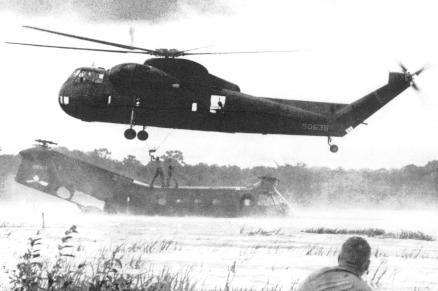
Six CH-37C's were deployed to Vietnam in September 1965 to assist in the recovery of downed U.S. aircraft, serving in this role from Marble Mountain Air Facility until May 14, 1967. They were very successful at this role, recovering over US$7.5 million worth of equipment, some of which was retrieved from behind enemy lines. The CH-37 was also used to recover film capsules descending from space by parachute.
A total of 154 were produced by the time production ended. Of those, 94 were H-37A, and 90 that were converted to H-37B (later CH-37A and B respectively). It remains the largest piston powered helicopter.
Variants


;XHR2S-1 :Prototype Assault Transport for the US Marine Corps, powered by two 1900 hp R-2800-54 engines, four built. ;HR2S-1 :Production model for USMC with modified engine nacelles, twin mainwheels and dorsal fin, redesignated CH-37C in 1962, 55 built (order for additional 36 cancelled). ;HR2S-1W :Airborne early warning aircraft for the US Navy, two built. ;H-37 :The H-37 followed the HR2S-1 in 1954 as an army helicopter. 94 were built between 1954 and 1960. It is credited with a maximum speed of 126 mph. ;H-37A Mojave :Military transport version of the HR2S for the US Army, changes included dorsal fin and modified rotor head fairing, redesignated CH-37A in 1962, 94 built. ;H-37B Mojave :All but four of the H-37As were modified with a redesigned cargo door, automatic stabilization equipment and crashproof fuel cells. Engine oil tank capacity was increased from 13.3 gallons to 30 gallons per engine. Rear split cargo door was replaced with a sliding cargo door. Later redesignated CH-37B. ;CH-37A: H-37A redesignated in 1962. ;CH-37B: H-37B redesignated in 1962. ;CH-37C: HR2S-1 redesignated in 1962. ;S-56: Sikorsky company designation for H-37.
Derivatives and related projects
;Sikorsky S-60 : a prototype "sky-crane" with a skeletal fuselage and a crew cockpit at the front. ;Westland Westminster : Unable to get government support for license production of the civil S-56, Westland Aircraft used the S-56 control systems, rotors and gearbox as the basis for the Westminster but used their own tubular frame and twin 2,900 hp Napier Eland turboshafts for power in a flying test rig. Due to vibration they changed to a six-bladed S-64 rotor. The private venture project was ended when Westland took over three British helicopter companies and their more advanced and funded projects.
Operators
;
- United States Army
- United States Marine Corps
- HMR(M)-461 1957–1966
- HMR(M)-462 1957–1965
- HMR(M)-463 1958–1959
Survivors
_(2).jpg)
- CH-37B (Army Ser. No. 55-0644) is on display at the United States Army Aviation Museum at Fort Novosel, Alabama.
- CH-37B (Army Ser. No. 58-1005) "Tired Dude" is on display at the Pima Air and Space Museum adjacent to Davis-Monthan Air Force Base in Tucson, Arizona.
- CH-37B (Army Ser. No. 57-1651) is on display at the U.S. Army Transportation Museum at Fort Eustis, Virginia.
- CH-37B (Army Ser. No. 58-0999) is on display at the Evergreen Aviation & Space Museum in McMinnville, Oregon.
- CH-37C (BuNo 145864) is on display at the National Museum of Naval Aviation at Naval Air Station Pensacola, Florida.
- CH-37B (Army Ser. No. 57-1646) is on display at the Classic Rotors Museum at the Ramona Airport, Ramona, California.
Specifications (CH-37 Mojave)

|prime units?=kts General characteristics
|max takeoff weight lb=31000 |max takeoff weight note= Powerplant
Performance
|never exceed speed kts= |never exceed speed note= |disk loading lb/sqft= |fuel consumption lb/mi= |power/mass=
References
References
- (July 2020). "Sikorsky Builds Marine Corps Heavy Lift". Published by the Igor I. Sikorsky Historical Archives, Inc..
- "Sikorsky XHR2S-1 {{!}} This Day in Aviation".
- (21 September 2018). "Vertical rewind: The original heavy lifter".
- (June 1954). "Three Jeeps Ride in the Marine Corps Biggest Helicopter". Hearst Magazines.
- "CH-37C (HR2S-1) Mojave".
- Vietnam Helicopter Pilots Association (VHPA) 2019. "The CH-37B 'Mojave' in Vietnam" https://www.vhpa.org/CH-37B.pdf
- Barrett, Claire. (2019-12-10). "The Army and Marines' Heavy Hauler Helicopter in Vietnam".
- Jenkins, Dennis R.. (2012). "Dressing for altitude: U.S. aviation pressure suits-- Wiley Post to space shuttle". National Aeronautics and Space Administration.
- "Sikorsky S-56 – Igor I Sikorsky Historical Archives".
- (2008-11-10). "Army Times 2008-11-10: Vol 69 Iss 17". Gannett Co., Inc..
- Polmar, Norman. (January 1998). "Historic aircraft: The biggest in the west". Naval History.
- "Sikorsky S-56 – Igor I Sikorsky Historical Archives".
- "Sikorsky CH-37 Mojave review". olive drab.com.
- "H-37 Mojave / HR2S". globalsecurity.org.
- "Marines and Helicopters 1946–1962". History and Museums Division,US Marine Corp.
- (20 March 2023). "Our Collection".
- "Sikorsky CH-37B".
- "Warbird Registry – Sikorsky CH-37 Mojave – A Warbirds Resource Group Site".
- Harding 1990, p.239.
- "The Incomplete Guide to Airfoil Usage".
- Swanborough and Bowers p. 437.
This article was imported from Wikipedia and is available under the Creative Commons Attribution-ShareAlike 4.0 License. Content has been adapted to SurfDoc format. Original contributors can be found on the article history page.
Ask Mako anything about Sikorsky CH-37 Mojave — get instant answers, deeper analysis, and related topics.
Research with MakoFree with your Surf account
Create a free account to save articles, ask Mako questions, and organize your research.
Sign up freeThis content may have been generated or modified by AI. CloudSurf Software LLC is not responsible for the accuracy, completeness, or reliability of AI-generated content. Always verify important information from primary sources.
Report