From Surf Wiki (app.surf) — the open knowledge base
Siege of Jerusalem (1099)
Christian conquest of the First Crusade
Christian conquest of the First Crusade
| Field | Value | |||
|---|---|---|---|---|
| conflict | Siege of Jerusalem (1099) | |||
| image | Counquest of Jeusalem (1099).jpg | |||
| image_size | 300px | |||
| caption | Taking of Jerusalem by the Crusaders, 15th July 1099 | |||
| painting by Émile Signol (1847), Palace of Versailles | ||||
| partof | the First Crusade | |||
| date | 7 June 1099 – 15 July 1099 | |||
| place | Jerusalem | |||
| result | Crusader victory | |||
| territory | Founding of the Kingdom of Jerusalem | |||
| combatant1 | Crusaders | |||
| combatant2 | Fatimid Caliphate | |||
| commander1 | {{unbulletedlist | |||
| commander2 | {{unbulletedlist | |||
| strength1 | Total 12,000–15,000{{bulletedlist | |||
| 2 siege towers, 1 battering ram, and several catapults<ref>{{harvnb | France | 1994 | pp | 346–350}}}} |
| strength2 | Total 3,000~4,500{{bulletedlist | |||
| Sizeable garrison of infantry and archers<ref>{{harvnb | Asbridge | 2004 | p | 300}} |
| 400 cavalry<ref name | "auto1"/ | |||
| 14 catapults<ref>{{harvnb | Rubenstein | 2011 | p | 297}}}} |
| casualties1 | ~3,000 killed and wounded | |||
| casualties2 | 3,000~70,000 Muslims and Jews massacred | |||
| map_type | Mediterranean | |||
| map_label | Jerusalem | |||
| map_size | 300 | |||
| map_caption | ||||
| map_relief | yes | |||
| coordinates |
painting by Émile Signol (1847), Palace of Versailles (1 month, 1 week and 1 day) | Godfrey of Bouillon | Raymond IV of Toulouse | Robert II of Normandy | Robert II of Flanders | Eustace III of Boulogne | Tancred of Galilee | Gaston IV of Béarn | Berenguer Ramon II | Guglielmo Embriaco}} | Iftikhar ad-Dawla}} | 11,000–12,000 infantry | 1,200–1,300 knights | 2 siege towers, 1 battering ram, and several catapults}} | Sizeable garrison of infantry and archers | 400 cavalry | 14 catapults}}
The siege of Jerusalem marked the successful end of the First Crusade, whose objective was the recovery of the city of Jerusalem and the Church of the Holy Sepulchre from Islamic control. The five-week siege began on 7 June 1099 and was carried out by the Christian forces of Western Europe mobilized by Pope Urban II after the Council of Clermont in 1095. The city had been out of Christian control since the Muslim conquest of the Levant in 637 and had been held for a century first by the Seljuk Turks and later by the Egyptian Fatimids. One of the root causes of the Crusades was the hindering of Christian pilgrimages to the Holy Land which began in the 4th century. A number of eyewitness accounts of the battle were recorded, including in the anonymous chronicle Gesta Francorum.
After Jerusalem was captured on 15 July 1099, thousands of Muslims and Jews were massacred by Crusader soldiers. As the Crusaders secured control over the Temple Mount, revered as the site of the two destroyed Jewish Temples, they also seized Al-Aqsa Mosque and the Dome of the Rock and repurposed them as Christian shrines. Godfrey of Bouillon, prominent among the Crusader leadership, was elected as the first ruler of Jerusalem.
Background
Muslim conquest of the Levant
At the Council of Piacenza in 1095, Pope Urban II received envoys from Byzantine emperor Alexios I Komnenos asking Latin Christians for assistance in liberating large parts of the Byzantine Empire from the Seljuks, who had conquered large parts of the region since 1070. Atsiz ibn Uwaq seized Jerusalem from the Fatimid Caliphate, making Christian pilgrimage to Jerusalem more difficult and suppressing a revolt in 1077 in a bloodbath. Responding to the call, Urban gave a sermon at the Council of Clermont in November 1095, which included a rousing call to arms for the conquest of the Holy Land and the return of the Church of the Holy Sepulchre in Jerusalem to Christian hands. His appeal marked the beginning of the Crusades, a religious war for God, in which he guaranteed participants a place in heaven.
Crusader routes
After the successful siege of Antioch in June 1098, the Crusaders remained in the area for the rest of the year. The papal legate Adhemar of Le Puy had died, and Bohemond of Taranto had claimed Antioch for himself. Baldwin of Boulogne remained in Edessa in Upper Mesopotamia, which had been captured earlier in 1098. There was dissent among the princes over what to do next; Raymond IV, Count of Toulouse, frustrated, left Antioch to capture the fortress at Maarat al-Numan in the Siege of Ma'arra.
By the end of 1098, the minor knights and infantry were threatening to march to Jerusalem without them. On 13 January 1099 Raymond began the march south along the coast of the Mediterranean, followed by Robert Curthose and Bohemond's nephew Tancred, who agreed to become his vassals. On their way, the Crusaders besieged Arqa but failed to capture it, abandoning the siege on 13 May. The Fatimids had attempted to make peace on the condition that the Crusaders did not continue towards Jerusalem. This was ignored. Iftikhar al-Dawla, the Fatimid governor of Jerusalem, was aware of the Crusaders' intentions, and he expelled Jerusalem's Christian inhabitants. The further march towards Jerusalem met no resistance.
Offensive
Fatimid preparations
Al-Dawla prepared the city for the siege. He prepared an elite troop of 400 Egyptian cavalrymen and expelled all Eastern Christians from the city for fear of being betrayed by them (in the siege of Antioch, an Armenian man, Firouz, had helped Crusaders enter the city by opening the gates). Al-Dawla poisoned all the water wells in the surrounding area and cut down all trees outside Jerusalem. 7 June 1099, the Crusaders reached the outer fortifications of Jerusalem, which the Fatimids had recaptured from the Seljuks the prior year. The city was guarded by a defensive wall stretching four kilometers long, which was three meters thick and 15 meters high. There were five major gates each guarded by a pair of towers.
Dual-front siege
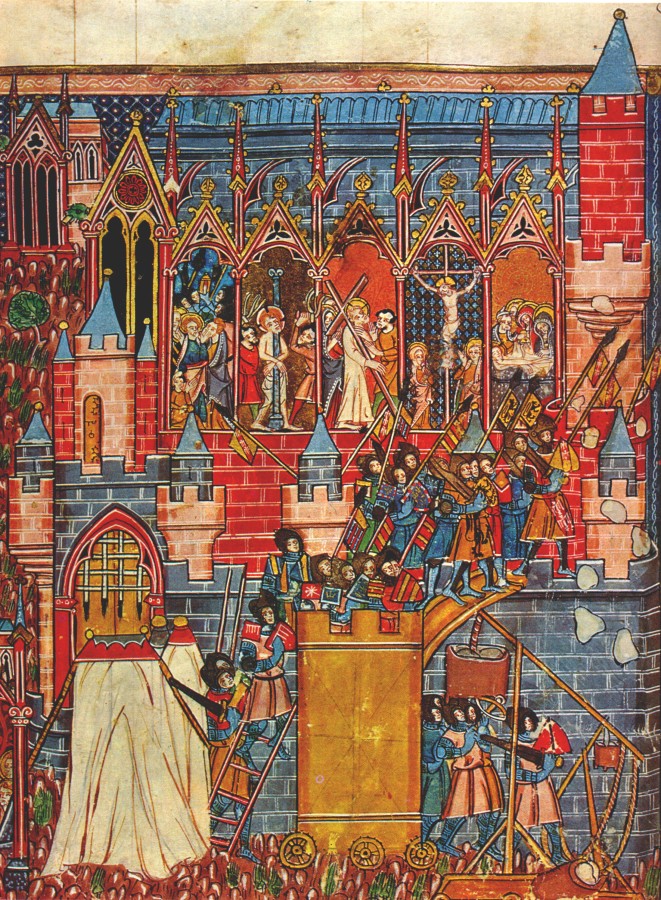
The Crusaders divided themselves into two large groups: Godfrey of Bouillon, Robert of Flanders and Tancred planned to besiege from north, while Raymond positioned his forces to the south. The Fatimids had to be prepared to fight on two fronts. After taking their positions, the Crusaders launched their first attack on 13 June; the main problem was that they had no access to wood for the construction of siege equipment, because all the trees had been cut down. However, Tancred had a vision of finding a stack of wood hidden in a cave, and they used it to make a ladder. A knight named Rainbold scaled the ladder to gain a foothold on the wall but was unsuccessful. Since that assault was a failure, the Crusaders retreated and did not make any attempt until they got their tools and equipment. The Crusaders faced many more difficulties such as the lack of water, the scorching summer heat of Palestine, and the shortage of food. By the end of June, word came that a Fatimid army was marching north from Egypt. The mounting pressure forced the Crusaders to act quickly.
Assault
On 17 June the Crusaders heard about the arrival of English and Genoese ships at the port of Jaffa. The English and Genoese sailors had brought all the necessary material with them for the construction of the siege equipment. Robert Curthose and Robert of Flanders procured timber from the nearby forests. Under the command of Guglielmo Embriaco and Gaston of Béarn, the Crusaders began the construction of their siege weapons. They constructed the siege equipment in almost three weeks. This included two massive wheel-mounted siege towers, a battering ram with an iron-clad head, and numerous scaling ladders and a series of portable wattle screens. The Fatimids kept an eye on the preparation by the Crusaders, and they set up their mangonels on the wall in the firing range once an assault began.
On 14 July the Crusaders launched their attack. Godfrey and his allies were positioned towards the northern wall, and their priority was to break through the outer curtain of the walls of the city. By the end of the day they penetrated the first line of defense. On the south Raymond's forces were met with ferocious resistance by the Fatimids. On 15 July the assault recommenced in the northern front; Godfrey and his allies gained success, and Ludolf of Tournai was the first to mount the wall. The Crusaders quickly gained a foothold on the wall, and as the city's defenses collapsed, waves of panic shook the Fatimids.
In the southwest area the Provencals managed to storm the city walls, which later led to the Crusaders calling the gate they built in this area Beaucaire Gate.
Aftermath
Crusaders enter Jerusalem
On 15 July the Crusaders made their way into the city through the Tower of David and began massacring large numbers of the inhabitants, Muslims and Jews alike. Governor al-Dawla managed to escape. The aftermath of the siege led to the mass slaughter of thousands of Muslims and Jews which contemporaneous sources suggest was savage and widespread and to the conversion of Muslim holy sites on the Temple Mount into Christian shrines. Historian Conor Kostick says that the number of people killed is a matter of debate, with the figure of 70,000 given by the Muslim historian Ibn al-Athir (writing c. 1200) considered to be a significant exaggeration; 40,000 is plausible, given the city's population had been swollen by refugees fleeing the advance of the crusading army.
Atrocities committed against the inhabitants of cities taken by storm after a siege were normal in ancient and medieval warfare by both Christians and Muslims. The Crusaders had already done so at Antioch, and Fatimids had done so themselves at Taormina, at Rometta, and at Tyre. However, it is speculated that the massacre of the inhabitants of Jerusalem, both Muslims and Jews, may have exceeded even these levels.
Muslims
Many Muslims sought shelter in the al-Aqsa Mosque or Dome of the Rock, both located on the Temple Mount. According to the Gesta Francorum, speaking only of the Temple Mount area, "...[our men] were killing and slaying even to the Temple of Solomon, where the slaughter was so great that our men waded in blood up to their ankles..." Raymond of Aguilers states: "In the Temple and porch of Solomon men rode in blood up to their knees and bridle reins." Writing about the Temple Mount area, Fulcher of Chartres—who was not an eyewitness to the Jerusalem siege because he had stayed with Baldwin in Edessa—says: "In this temple 10,000 were killed. Indeed, if you had been there you would have seen our feet coloured to our ankles with the blood of the slain. But what more shall I relate? None of them were left alive; neither women nor children were spared."
The eyewitness Gesta Francorum states that some people were spared: "When the pagans had been overcome, our men seized great numbers, both men and women, either killing them or keeping them captive, as they wished." Later the same source writes:
Raymond of Aguilers reports that some Muslims survived. After recounting the slaughter on the Temple Mount, he reports of some who "took refuge in the Tower of David, and, petitioning Count Raymond for protection, surrendered the Tower into his hands." These Muslims left with the Fatimid governor for Ascalon. A version of this tradition is also known to reported by Ibn al-Athir (10, 193–95), who recounts that after the city was taken and pillaged: "A band of Muslims barricaded themselves into the Oratory of David (Mihrab Dawud) and fought on for several days. They were granted their lives in return for surrendering. The Franks honored their word and the group left by night for Ascalon." One Cairo Geniza letter also refers to some Jewish residents who left with the Fatimid governor.
Tancred claimed the Temple quarter for himself and offered protection to some of the Muslims there, but he was unable to prevent their deaths at the hands of his fellow Crusaders. Additionally, the Crusaders claimed the Muslim holy sites of the Dome of the Rock and the al-Aqsa mosque as important Christian sites. They renamed them Templum Domini and Templum Salomonis, respectively. In 1141, the Templum Domini would be consecrated, and the Templum Solomonis would become the headquarters for the Knights Templar.
Albert of Aachen, who personally was not present but wrote using independent interviews conducted with survivors back in Europe, writes that even beyond the first round of slaughter that accompanied the fall of Jerusalem, there was another round, "On the third day after the victory judgement was pronounced by the leaders and everyone seized weapons and surged forth for a wretched massacre of all the crowd of gentiles which was still left...whom they had previously spared for the sake of money and human pity". The number killed is not specified, nor is this massacre related in any other contemporary sources.
Although the Crusaders killed many of the Muslim and Jewish residents, eyewitness accounts (Gesta Francorum, Raymond of Aguilers, and the Cairo Geniza documents) demonstrate that some Muslim and Jewish residents were allowed to live, as long as they left Jerusalem.
Jews

Rabbinic Jews had fought side-by-side with Muslim soldiers to defend the city, and as the Crusaders breached the outer walls, the Jews of the city retreated to their synagogue to "prepare for death".Saint Louis University Professor Thomas F. Madden, author of A Concise History of the Crusades in CROSS PURPOSES: The Crusades (Hoover Institute television show, 2007). According to the Muslim chronicle of Ibn al-Qalanisi, "The Jews assembled in their synagogue, and the Franks burned it over their heads." A contemporary Jewish communication confirms the destruction of the synagogue, though it does not corroborate that any Jews were inside it when it was burned. This letter was discovered among the Cairo Geniza collection in 1975 by historian Shelomo Dov Goitein. Historians believe that it was written just two weeks after the siege, making it "the earliest account on the conquest in any language." The letter of the Karaite elders of Ascalon from the Cairo Geniza indicates that some prominent Jews held for ransom by the Crusaders were freed when the Karaite Jewish community in Ascalon paid the cash ransom.
Eastern Christians
No eyewitness source refers to Crusaders killing Eastern Christians in Jerusalem, and early Eastern Christian sources (Matthew of Edessa, Anna Comnena, Michael the Syrian, etc.) make no such allegation about the Crusaders in Jerusalem. According to the Syriac Chronicle, all the Christians had already been expelled from Jerusalem before the Crusaders arrived. Presumably this would have been done by the Fatimid governor to prevent their possible collusion with the Crusaders.
The Gesta Francorum claims that on 9 August, two and a half weeks after the siege, Peter the Hermit encouraged all the "Greek and Latin priests and clerics" to make a thanksgiving procession to the Church of the Holy Sepulchre. This indicates that some Eastern Christian clergy remained in or near Jerusalem during the siege. In November 1100, when Fulcher of Chartres personally accompanied Baldwin on a visit to Jerusalem, they were greeted by both Greek and Syrian clerics and laity (Book II, 3), indicating an Eastern Christian presence in the city a year later.
Founding of the Latin Kingdom

On 17 July, a council was held to discuss who would be crowned the king of Jerusalem. On 22 July, Godfrey of Bouillon, who had played the most fundamental role in the city's conquest, was made Advocatus Sancti Sepulchri ("advocate" or "defender" of the Holy Sepulchre). He would not accept the title of king, saying that he refused to wear a crown of gold in the city where Christ wore a crown of thorns. Raymond had refused any title at all, and Godfrey convinced him to give up the Tower of David as well. Raymond then went on a pilgrimage, and in his absence Arnulf of Chocques, whom Raymond had opposed due to his own support for Peter Bartholomew, was elected the first Latin Patriarch on 1 August (the claims of the Greek Patriarch were ignored). On 5 August, Arnulf, after consulting the surviving inhabitants of the city, discovered the relic of the True Cross.
On 12 August Godfrey led an army, with the True Cross carried in the vanguard, against the Fatimid army at the Battle of Ascalon. The Crusaders were successful, but following the victory, the majority of them considered their crusading vows to have been fulfilled, and all but a few hundred knights returned home. Nevertheless, their victory paved the way for the establishment of the Kingdom of Jerusalem.
The siege quickly became legendary and in the 12th century it was the subject of the Chanson de Jérusalem, a major chanson de geste in the Crusade cycle.
Conclusion
The first Crusaders succeeded in their endeavor. Urban II had ignited the flame of holy war in the Council of Clermont. Many other crusades were launched through time for various reasons and motives. Jerusalem remained in Christian hands for almost a century until the Crusaders were defeated by Saladin at the Battle of Hattin in 1187, and three months later, the last defenders were expelled from the city.
References
Sources
- Conor Kostick, The Siege of Jerusalem, London, 2009.
- Rodney Stark, God's Battalions: The Case for the Crusades, New York, 2009.
- Hans E. Mayer, The Crusades, Oxford, 1965.
- Jonathan Riley-Smith, The First Crusade and the Idea of Crusading, Philadelphia, 1999.
- Frederic Duncalf, Parallel source problems in medieval history, New York, London : Harper & Brothers, 1912. via Internet Archive. See Chapter III for background, sources and problems related to the siege of Jerusalem.
- Sir Archibald Alison, Essays, Political, Historical, and Miscellaneous – vol. II, London, 1850.
- The Siege and Capture of Jerusalem: Collected Accounts Primary sources from the Internet Medieval Sourcebook.
- Climax of the First Crusade Detailed examanination by J. Arthur McFall originally appeared in Military History magazine.
- S.J. Allen, An Introduction to The Crusades, University of Toronto Press, 2017
References
- {{harvnb. France. 1994
- {{harvnb. Asbridge. 2004
- {{harvnb. France. 1994
- {{harvnb. France. 1994
- {{harvnb. Asbridge. 2004
- {{harvnb. Rubenstein. 2011
- {{harvnb. France. 1994
- The "massacre" at the sack of Jerusalem has become a commonplace motive in popular depictions, but the historical event is difficult to reconstruct with any certainty. Arab sources give figures of between 3,000 and 70,000 casualties (in [[Abu Bakr ibn al-Arabi]], and in [[Ali ibn al-Athir. Ibn al-Athir]], respectively). The latter figure is rejected as unrealistic as it is very unlikely that the city at the time had a total population of this order; medieval chroniclers tend to substantially exaggerate both troop strength and casualty figures; they cannot be taken at face value naively, and it is less than straightforward to arrive at realistic estimates based on them. For a further study of the Arab accounts, see: Hirschler, Konrad (2014). The Jerusalem Conquest of 492/1099 in the Medieval Arabic Historiography of the Crusades: From Regional Plurality to Islamic Narrative.
- Cline, Eric H.(2007) [2004]. ''Jerusalem Besieged: From Ancient Canaan to Modern Israel''. University of Michigan Press. pp. 159–160. {{ISBN. 978-0-472-03120-7.
- Allen, S. J.. (2017). "An introduction to the crusades". University of Toronto Press.
- Thomas F. Madden, ''The New Concise History of the Crusades'' at 33 (Rowman & Littlefield Pub., Inc., 2005). The Syriac Chronicle to 1234 is one source claiming that Christians were expelled from Jerusalem before the Crusaders' arrival. {{harv. Tritton. Gibb. 1933
- Asbridge, Thomas S.. (2005). "The first crusade : a new history : the roots of conflict between Christianity and Islam". Oxford University Press.
- Eisenstadt, David (March 1997).[https://www2.biu.ac.il/js/rennert/history_9.html Jerusalem in the Crusader Period]. Accessed 12 May 2023.
- Asbridge, Thomas S.. (2005). "The First Crusade : a new history : the roots of conflict between Christianity and Islam". Oxford University Press.
- (1921). "The First Crusade: The Accounts of Eyewitnesses and Participants". Princeton Univ..
- (1921). "The First Crusade: The Accounts of Eyewitnesses and Participants". Princeton Univ..
- Kostick, Conor. (2009). "The Siege of Jerusalem". Continuum.
- Hirschler, Konrad. (2014). "The Jerusalem Conquest of 492/1099 in the Medieval Arabic Historiography of the Crusades: From Regional Plurality to Islamic Narrative". Crusades13.
- (1992). "The Medieval Siege". The Boydell.
- (2012). "Jerusalem : the Biography". [[Vintage Books]].
- (1912). "Parallel Source Problems in Medieval History". Harper & Brothers.
- "''Gesta Francorum''".
- Raymond d'Aguilers. (1968). "Historia Francorum qui ceperunt Iherusalem".
- "Medieval Sourcebook:Raymond d'Aguiliers: Historia francorum qui ceperint Jerusalem".
- "Crusaders, Greeks, and Muslims by Sanderson Beck".
- Gabrieli, Francesco. (1984). "Arab Historians of the Crusades". University of California Press.
- Peters, Edward. (1998). "The First Crusade". University of Pennsylvania Press.
- (2013). "The Crusader Rebranding of Jerusalem's Temple Mount". Comitatus: A Journal of Medieval and Renaissance Studies.
- of Aachen, Albert. (2013). "History of the Journey to Jerusalem". Ashgate Publishing Limited.
- See also Thomas F. Madden, ''New Concise History'' at 34
- Muir, Ramsay. (1959). "Muir's historical atlas : mediæval & modern". G. Philip.
- [[Hamilton Alexander Rosskeen Gibb. Gibb, H. A. R]]. ''The Damascus Chronicle of the Crusades: Extracted and Translated from the Chronicle of Ibn Al-Qalanisi''. Dover Publications, 2003 ({{ISBN. 0486425193), p. 48
- [[Benjamin Z. Kedar. Kedar, Benjamin Z]]. "The Jerusalem Massacre of July 1099 in the Western Historiography of the Crusades." The Crusades. Vol. 3 (2004) ({{ISBN. 075464099X), pp. 15–76, p. 64. Edward Peters, ed. The First Crusade. 2nd ed. University of Pennsylvania, 1998, p. 264–272.
- Kedar: p. 63
- (1933). "The First and Second Crusades from an Anonymous Syriac Chronicle". [[Journal of the Royal Asiatic Society]].
- Thomas F. Madden. A Concise History of the Crusades, 1999, p. 35
- Gesta Francorum. Bk. 10.39, ed. R. Hill. London, 1962, p. 94.
- (1980). "The Latin Church in the Crusader States". Variorum Publications.
This article was imported from Wikipedia and is available under the Creative Commons Attribution-ShareAlike 4.0 License. Content has been adapted to SurfDoc format. Original contributors can be found on the article history page.
Ask Mako anything about Siege of Jerusalem (1099) — get instant answers, deeper analysis, and related topics.
Research with MakoFree with your Surf account
Create a free account to save articles, ask Mako questions, and organize your research.
Sign up freeThis content may have been generated or modified by AI. CloudSurf Software LLC is not responsible for the accuracy, completeness, or reliability of AI-generated content. Always verify important information from primary sources.
Report