From Surf Wiki (app.surf) — the open knowledge base
Sidney Myer Music Bowl
Outdoor performance venue in Melbourne, Australia
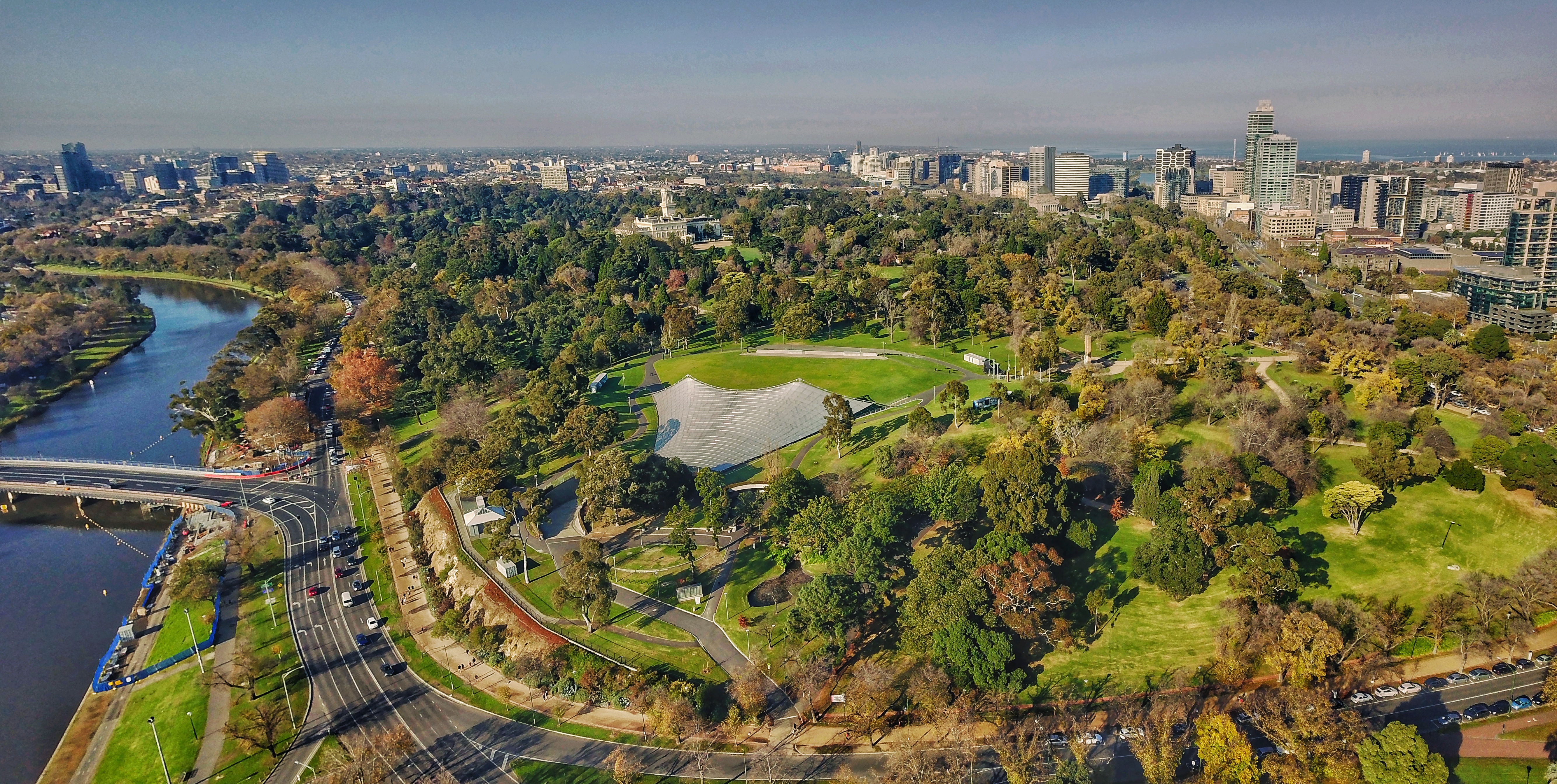
Outdoor performance venue in Melbourne, Australia
| Field | Value |
|---|---|
| name | Sidney Myer Music Bowl |
| image | Sidney Myer Music Bowl Aerial View.jpg |
| image_caption | Sidney Myer Music Bowl in September 2017 |
| city | Melbourne |
| country | Australia |
| coordinates | |
| broke_ground | 1958 |
| opened | 1959 |
| owner | Government of Victoria |
| operator | The Arts Centre |
| surface | Concrete, grass |
| architect | Barry Patten |
| general_contractor | John Holland |
| address | Kings Domain |
| tenants | |
| seating_capacity | Up to 10,000 (2,030 fixed seats) |
| website | |
| nrhp | {{Infobox designation list |
| embed | yes |
| designation1 | ANHL |
| designation1_date | |
| designation1_type | Historic |
| designation1_criteria | b, d, f, g, h |
| designation1_number | |
| designation2 | VICHR |
| designation2_offname | Sidney Myer Music Bowl |
| designation2_type | State Registered Place |
| designation2_date | |
| designation2_number | H1772 |
| designation2_free1name | Heritage Overlay number |
| designation2_free1value | HO908}} |
The Sidney Myer Music Bowl is an outdoor bandshell performance venue in Melbourne, Victoria, Australia. It is located in the lawns and gardens of Kings Domain on Linlithgow Avenue close to the Arts Centre and the Southbank entertainment precinct. It was opened by Prime Minister Robert Menzies on 12 February 1959.
History
The businessman and philanthropist Sidney Myer inspired the construction of the building after attending the Hollywood Bowl in Los Angeles. A violinist who enjoyed music, Myer established free open-air concerts with the Melbourne Symphony Orchestra in 1929, which were always well attended by Melburnians. These free concerts continue to this day, now being held at the bowl itself. There are usually three or four concerts a year.
Upon his death in 1934, the Sidney Myer Fund was established to continue the tradition of philanthropy begun by its founder. The design and construction of a music bowl for the people of Melbourne was decided upon and funded by the fund.
The venue was officially opened by Prime Minister Robert Menzies on 12 February 1959, and was attended by an audience of 30,000. Later that month over 70,000 people attended to hear the American evangelist Billy Graham.
The largest crowd ever for a concert event in Australia was The Seekers 1967 homecoming concert at the Sidney Myer Music Bowl which an estimated 200,000 people attended. The 2007 Guinness Book of World Records lists it as the greatest attendance at a concert in the Southern Hemisphere in history. This attendance is also included in The Australian Book of Records. Melburnians were celebrating the annual Moomba Festival, a free community festival, and many thousands were enjoying other attractions but are included in the crowd estimate. Since then, international performers have included: ABBA, AC/DC, Metallica, Wings, Blondie, the Beach Boys, Crowded House, Dire Straits, Neil Diamond, Bob Dylan, the Czech Philharmonic Orchestra, Merle Haggard, Pearl Jam, the Electric Light Orchestra, Paul McCartney, Midnight Oil, INXS, R.E.M., Kiri Te Kanawa, Daft Punk, Red Hot Chili Peppers and, in more recent times, Bon Jovi, Guns N' Roses, Soundgarden, Tool, Kanye West, Paramore, Neil Young, Lenny Kravitz, Swedish House Mafia, Blink-182, The Black Keys, Lorde, Afrojack, KSHMR, Will Sparks, Timmy Trumpet, Carnage, Axwell, The Cat Empire, David Byrne and The Chainsmokers.
In 1980, administration of the bowl was handed over to the Arts Centre Melbourne from the Sidney Myer Fund by Ken Myer, Sidney Myer's son. In 1984 a temporary ice-skating rink was created on the bowl's stage for use during winter months. The venue was closed for a major renovation in 2000 to bring the facilities up to an appropriate standard, and was reopened by the Premier of Victoria, Steve Bracks, at Carols by Candlelight on Christmas Eve, 2002. Recent works on the lawns extending from the seating and stage, and the construction of a fence and gates has reduced the total capacity to a little over 12,000.
50th anniversary celebrations
In 2009, the 50th anniversary of the Sidney Myer Music Bowl was celebrated. The Arts Centre put together a four-day commemorative program of free events. From 12 to 15 February, the festivities featured two concerts from the Melbourne Symphony Orchestra, including a recreation of their 1959 opening concert of the bowl and a romantic Valentine's Day program; a salute to 50 years of rock and roll at the bowl from RocKwiz and an afternoon picnic of family entertainment. There was also an informative exhibition at the St Kilda Road Foyer Gallery of the Arts Centre and a commemorative website depicting 50 years of the bowl.
Design and construction

The bowl's canopy consists of a thin membrane made out of half an inch of weather-proofed plywood sheeted on both sides with aluminium attached to a cobwebbed frame of steel cables and supported by 21.3 metre masts pivoted to the earth. The total area of the canopy is 4055 sqm. The main cable at the edge of the canopy comprises 7 ropes, each about 9 cm in diameter and 173 metres long, anchored deep into the ground in concrete blocks. Longitudinal cables hold up the roof and transverse cables hold it down.
Project design was by Yuncken Freeman and Griffiths and Simpson during 1956. The project architect was Barry Patten. Construction by John Holland commenced in 1958 with an innovative system of cables laced together and covered with aluminium faced plywood sandwich panels. To ensure the structure would be watertight yet aerodynamically stable and flexible, new construction techniques were developed. Ground anchors were required to be corrosion resistant. The shell also needed to be acoustically correct. Construction entailed input from a number of engineering and scientific organisations including the Aeronautical Research Laboratories and CSIRO Forest Products Division.
Structural design

Unlike the Hollywood Bowl's concrete shell structure in Los Angeles which inspired it, the Sidney Myer Music Bowl combined a tensile structural system with a free-form roof. The structural design predates by nearly 10 years noted German architect and engineer Frei Otto and his experiments in using lightweight tensile and membrane structures. Otto's design of Munich's Olympic Park for the 1972 Olympics and the temporary West German pavilion at Expo 67 in Montreal, Canada, were heavily influenced by Patten's design of the Myer Music Bowl.
Heritage listing
The Sidney Myer Music Bowl is registered on the Victorian Heritage list for its cultural importance to Victoria, its architectural importance as the largest, purpose-built, permanent outdoor performance venue in Australia and its engineering experimentation in new forms of construction involving use of membranes and a tensile structural system.
Design awards

In 1959 the building was awarded the R.S. Reynolds Memorial Prize for "a significant work of architecture, in which the creation of which aluminium has been an important contributing factor", awarded annually by Reynolds Metals Company, U.S.A. The prize included an aluminium sculpture.
In 2002 the building refurbishment was awarded the Melbourne Prize. In 2009 the Sidney Myer Music Bowl was awarded the Enduring Architecture Award. Later in the same year the project won the 2009 National Award for Enduring Architecture.
Capacity
There is a fixed seating area which can hold 2,030 people. Behind this area are sloping lawns which can accommodate up to 10,000. The stage area is 27.4 metres wide by 19.5 metres deep (27.4 x).
Major events
The bowl holds major events including Vision Australia's Carols by Candlelight, held every year on Christmas Eve, televised each year by the Nine Network.
Past major events held at The Bowl include Piknic Electronik, Music from the Home Front and Midsummer Festival.
Awards and nominations
Music Victoria Awards
The Music Victoria Awards are an annual awards night celebrating Victorian music. They commenced in 2006. Best Venue was introduced in 2016. ! Ref. |- | 2021 | Sidney Myer Music Bowl | Best Venue (Over 500 Capacity) | | |- | 2022 | Sidney Myer Music Bowl | Best Large Venue (Metro) | | |-
References
References
- "Sidney Myer Music Bowl". [[Government of Victoria]].
- [http://vhd.heritage.vic.gov.au/#detail_places;1528 "Sidney Myer Music Bowl"], Retrieved 28 February 2013
- [http://www.architecture.com.au/i-cms?page=1.3903.50.219.227 Sidney Myer Musical Bowl, Melbourne] [[Australian Institute of Architects]]
- link. (9 October 2004 on 4 June 2004. Retrieved 23 September 2011.)
- (2002). "The Seekers". Ice Productions.
- (2007). "International Who's Who in Popular Music". [[Routledge]].
- (1968). "Guinness Book of World Records". [[Sterling Publishing]].
- "The Australian Book Of Records".
- Arts Victoria: [http://www.arts.vic.gov.au/Arts_in_Victoria/Spaces_and_Places/Sidney_Myer_Music_Bowl "Sidney Myer Music Bowl"], Retrieved 28 February 2013
- Nimmervoll, Ed. "The Seekers". Howlspace: The Living History of Our Music (Ed Nimmervoll). White Room Electronic Publishing Pty Ltd.
- "None".
- (1994). "A Constant Challenge: A History of the John Holland Group 1949 - 1986". [[John Holland Group.
- (2018). "Up for the Challenge: The John Holland Story 1986 - 2016". John Holland.
- "Sidney Myer Music Bowl". Greatbuildings.com.
- Johnson, Tait. (18-20 May 2022). "Marketing Modernism with the R.S. Reynolds Memorial Prize".
- (11 July 2009). "All the awards, Victorian Architecture Awards, 2009".
- Cheng, Linda. (13 Feb 2019). "'A national story of creative technical achievement': Sidney Myer Music Bowl celebrates 60th anniversary".
- (30 October 2009). "Architecture Award Winners".
- "Past Evets".
- (11 November 2021). "Music Victoria Awards Reveals Line-up And Nominees for 2021".
- (9 December 2021). "Music Victoria Awards 2021 Winners".
- (13 December 2022). "Music Victoria Awards 2022 Winners".
This article was imported from Wikipedia and is available under the Creative Commons Attribution-ShareAlike 4.0 License. Content has been adapted to SurfDoc format. Original contributors can be found on the article history page.
Ask Mako anything about Sidney Myer Music Bowl — get instant answers, deeper analysis, and related topics.
Research with MakoFree with your Surf account
Create a free account to save articles, ask Mako questions, and organize your research.
Sign up freeThis content may have been generated or modified by AI. CloudSurf Software LLC is not responsible for the accuracy, completeness, or reliability of AI-generated content. Always verify important information from primary sources.
Report