From Surf Wiki (app.surf) — the open knowledge base
Sidewalk
Pedestrian path along the side of a road

Pedestrian path along the side of a road
pedestrian paths next to roads
Research commissioned for the Florida Department of Transportation, published in 2005, found that, in Florida, the Crash Reduction Factor (used to estimate the expected reduction of crashes during a given period) resulting from the installation of sidewalks averaged 74%. |access-date = 2008-03-24 |url-status = live |archive-url = https://web.archive.org/web/20080410063611/http://www.dot.state.fl.us/research-Center/Completed_Proj/Summary_SF/FDOT_BD015_04_rpt.pdf |archive-date = 2008-04-10 Research at the University of North Carolina for the U.S. Department of Transportation found that the presence or absence of a sidewalk and the speed limit are significant factors in the likelihood of a vehicle/pedestrian crash. Sidewalk presence had a risk ratio of 0.118, which means that the likelihood of a crash on a road with a paved sidewalk was 88.2 percent lower than one without a sidewalk. The authors wrote that "this should not be interpreted to mean that installing sidewalks would necessarily reduce the likelihood of pedestrian/motor vehicle crashes by 88.2 percent in all situations. However, the presence of a sidewalk clearly has a strong beneficial effect of reducing the risk of a 'walking along roadway' pedestrian/motor vehicle crash." The study does not count crashes that happen when walking across a roadway. The speed limit risk ratio was 1.116, which means that a 16.1-km/h (10-mi/h) increase in the limit yields a factor of (1.116)10 or 3. |access-date = 2008-03-24 |url-status = live |archive-url = https://web.archive.org/web/20080410063610/http://ntl.bts.gov/lib/19000/19900/19995/PB2003102002.pdf |archive-date = 2008-04-10
The presence or absence of sidewalks was one of three factors that were found to encourage drivers to choose lower, safer speeds.
On the other hand, the implementation of schemes which involve the removal of sidewalks, such as shared space schemes, are reported to deliver a dramatic drop in crashes and congestion too, which indicates that a number of other factors, such as the local speed environment, also play an important role in whether sidewalks are necessarily the best local solution for pedestrian safety.
In cold weather, black ice is a common problem with unsalted sidewalks. The ice forms a thin transparent surface film which is almost impossible to see, and so results in many slips by pedestrians.
Riding bicycles on sidewalks is discouraged since some research shows it to be more dangerous than riding in the street. Some jurisdictions prohibit sidewalk riding except for children. In addition to the risk of cyclist/pedestrian collisions, cyclists face increase risks from collisions with motor vehicles at street crossings and driveways. Riding in the direction opposite to traffic in the adjacent lane is especially risky.
Health
Main article: Obesity and walking
Since residents of neighborhoods with sidewalks are more likely to walk, they tend to have lower rates of cardiovascular disease, obesity, and other health issues related to sedentary lifestyles. Also, children who walk to school have been shown to have better concentration.
Social uses
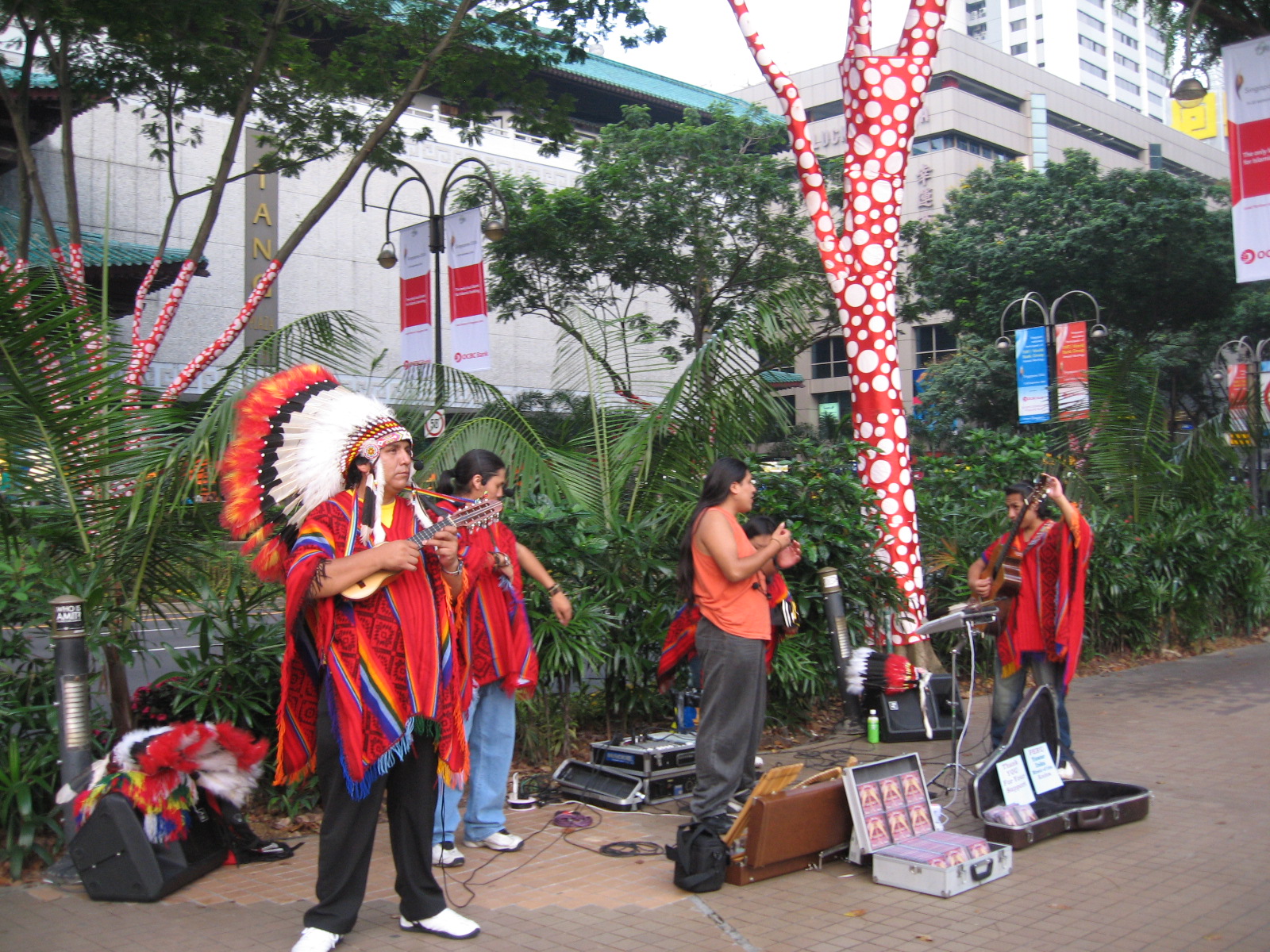
Some sidewalks may be used as social spaces with sidewalk cafés, markets, or busking musicians, as well as for parking for a variety of vehicles including cars, motorbikes and bicycles. Sidewalk surfing was often used in the early 1960s to describe skateboarding.)
Construction
Contemporary sidewalks are most often made of concrete in North America, while tarmac, asphalt, brick, stone, slab and (increasingly) rubber are more common in Europe. Different materials are more or less friendly environmentally: pumice-based trass, for example, when used as an extender is less energy-intensive than Portland cement concrete or petroleum-based materials such as asphalt or tar-penetration macadam. Multi-use paths alongside roads are sometimes made of materials that are softer than concrete, such as asphalt.
Some sidewalks may be built like a Meandering Sidewalk. The meandering sidewalk is the wavy sidewalk that veers back and forth at the side of the road, no matter how straight the street. These sidewalks are common in North America and are used to break up the monotonous alignments of city blocks.
Wood
In the 19th century and early 20th century, sidewalks of wood were common in some North American locations. They may still be found at historic beach locations and in conservation areas to protect the land beneath and around, called boardwalks.
Brick
Brick sidewalks are found in some urban areas, usually for aesthetic purposes. Brick sidewalks are generally consolidated with brick hammers, rollers, and sometimes motorized vibrators.
File:Brick sidewalk, EDS, Cambridge.jpg|Cambridge, Massachusetts File:Yeonamyulgeum-ro Sidewalk in Cheonan City 20270720.jpg|Cheonan, South Korea File:Verbanden.png|Four tessellations used in laying
Stone

Stone slabs called flagstones or flags are sometimes used where an attractive appearance is required, as in historic town centers.
For example, in Melbourne, Australia, bluestone has been used to pave the sidewalks of the CBD since the Gold rush in the 1850s because it proved to be stronger, more plentiful and easier to work than most other available materials.
Stone and concrete pavers
Pre-cast concrete pavers are used for sidewalks, often colored or textured to resemble stone. Sometimes cobblestones are used, though they are generally considered too uneven for comfortable walking.
Concrete
.jpg)
_near_Melarkey_Street_and_Nevada_State_Route_289_(Winnemucca_Boulevard)_in_Winnemucca,_Nevada.JPG)
In the United States and Canada, the most common type of sidewalk consists of a poured concrete "ribbon", examples of which from as early as the 1860s can be found in good repair in San Francisco, and stamped with the name of the contractor and date of installation. When Portland cement was first imported to the United States in the 1880s, its principal use was in the construction of sidewalks.
Today, most sidewalk ribbons are constructed with cross-lying strain-relief grooves placed or sawn at regular intervals, typically 5 ft apart. This partitioning, an improvement over the continuous slab ribbon, was patented in 1924 by Arthur Wesley Hall and William Alexander McVay, who wished to minimize damage to the concrete from the effects of tectonic and temperature fluctuations, both of which can crack longer segments. The technique is not perfect, as freeze-thaw cycles (in cold-winter regions) and tree root growth can eventually result in damage which requires repair.
In highly variable climates which undergo multiple freeze-thaw cycles, concrete blocks will be formed with separations, called expansion joints, to allow for thermal expansion without breakage. The use of expansion joints in sidewalks may not be necessary, as the concrete will shrink while setting.
Tarmac and asphalt
In the United Kingdom, Australia and France suburban sidewalks are also constructed of tarmac. In urban or inner-city areas sidewalks are most commonly constructed of slabs, stone, or brick depending upon the surrounding street architecture and furniture.
Gallery
File:Jalan MH Thamrin Menteng, Jakarta Pusat.jpg|Sidewalk with Tactile paving in Jalan M.H. Thamrin, Jakarta, Indonesia File:Ptpavement4.jpg|Sidewalk next to Paulista Avenue tiled with Portuguese pavement, in São Paulo, Brazil File:Kutná hora cobblestones3.jpg|Old sidewalk with granite curb in Kutná Hora, Czech Republic File:Sidewalk in March (12975257203).jpg|Sidewalk in Wasaga Beach, Ontario, Canada cleared after a snowfall File:Speightstown 007.jpg|Sidewalk market, Speightstown, Barbados File:Moscow, Kozitsky Lane.jpg|Overspill parking on the sidewalk in Moscow, Russia File:Oak Park Boulevard.jpg|Sidewalk with trees in Oak Park, Illinois, US File:Treelawn2.JPG|Sidewalk with a planted rain garden in the "tree lawn" or "road verge" zone File:Green space - tree - sidewalk - omar khayyam planetarium - Nishapur 11.JPG|Sidewalk in Nishapur, Iran near Mausoleum of Omar Khayyam File:Benoni Ekurhuleni.jpg|Sidewalk in Benoni, South Africa File:Union Sq bike parking jeh.JPG|Bicycle parking on a sidewalk File:Dog walking, Hospital Road, Omagh - geograph.org.uk - 1048920.jpg|Sidewalk in Omagh, Northern Ireland, UK File:Montreal, Quebec Sidewalk.jpg|A sidewalk in Montreal, Quebec, Canada File:Sure We Can Earthday clean 2021 1.jpg|Street sweepers clearing a New York sidewalk of dust and dirt using brooms File:Pavement with a bicycle priority lane in Taipei.jpg|Sidewalk with a bicycle priority lane in Taipei, Taiwan File:Cheonggyecheon stream with flowers and bridge at sunrise near Cheonggye Plaza in Seoul.jpg|Pedestrian walkway in Cheonggyecheon, Seoul
References
References
- "Definition of SIDEWALK". [[Merriam-Webster]].
- "Ontario Traffic Manual Book 1 - Introduction to the Ontario Traffic Manual". Ontario Traffic Council.
- "British Columbia Manual of Standard Traffic Signs & Pavement Markings". [[Government of British Columbia]].
- "Highways Act 1980 – Interpretation Section 329".
- "Parking on pavements". Lewisham Council.
- Cassidy, Frederic Gomes, and Joan Houston Hall (eds). (2002) ''Dictionary of American Regional English''. Cambridge, MA: Harvard University Press.
- Allan A. Metcalf. (2000). "How We Talk: American Regional English Today". Houghton Mifflin Harcourt.
- "Part II of II: Best Practices Design Guide - Sidewalk2 - Publications - Bicycle and Pedestrian Program - Environment - FHWA".
- "Walkway". Compact Oxford English Dictionary.
- "Inclusive mobility". Department for Transport.
- "Highways Act 1980 – Interpretation Section 329".
- Anastasia Loukaitou-Sideris, Renia Ehrenfeucht. (2009). "Sidewalks: Conflict and Negotiation Over Public Space". MIT Press.
- Anastasia Loukaitou-Sideris, Renia Ehrenfeucht. (2009). "Sidewalks: Conflict and Negotiation Over Public Space". MIT Press.
- "Georgian Colchester". British History.
- Linda Clarke. (2002). "Building Capitalism (Routledge Revivals): Historical Change and the Labour Process in the Production of Built Environment". Routledge.
- "city street scene manual".
- (April 2011). "Research Note: An Assessment of Urban Form and Pedestrian and Transit Improvements as an Integrated GHG Reduction Strategy". Washington State Department of Transportation.
- John N. Ivan, Norman W. Garrick and Gilbert Hanson. (November 2009). "Designing Roads That Guide Drivers to Choose Safer Speeds". Connecticut Transportation Institute.
- (2011-01-05). "Do you take unnecessary risks behind the wheel?". Which?.
- Lisa Aultman-Hall and Michael F. Adams, Jr.. (1998). "Sidewalk Bicycling Safety Issues". Transportation Research Record.
- (8 December 2010). "Bicycle sidepaths: Crash risks and liability exposure: Evidence from the research literature".
- "Crimes of the Heart". The Daily Beast.
- "The Link Between Kids Who Walk or Bike to School and Concentration". The Atlantic Cities.
- [[Iain Borden]], [https://www.bloomsbury.com/us/skateboarding-and-the-city-9781472583451/ ''Skateboarding and the City: a Complete History''], ([[Bloomsbury Publishing. Bloomsbury]], 2019), p. 9.
- Webster, George. (2011-10-13). "Green sidewalk makes electricity one footstep at a time". CNN.
- Robert W. Lesley. "What Cement Users Owe To The Public". The Cement Age: A Magazine Devoted to the Uses of Cement.
- Mario Theriault, ''Great Maritime Inventions – 1833–1950'', Goose Lane Editions, 2001, p. 73
- (January 1995). "Expansion Joints Not Needed in Sidewalk - Concrete Construction".
This article was imported from Wikipedia and is available under the Creative Commons Attribution-ShareAlike 4.0 License. Content has been adapted to SurfDoc format. Original contributors can be found on the article history page.
Ask Mako anything about Sidewalk — get instant answers, deeper analysis, and related topics.
Research with MakoFree with your Surf account
Create a free account to save articles, ask Mako questions, and organize your research.
Sign up freeThis content may have been generated or modified by AI. CloudSurf Software LLC is not responsible for the accuracy, completeness, or reliability of AI-generated content. Always verify important information from primary sources.
Report