From Surf Wiki (app.surf) — the open knowledge base
Sidestroke
Swimming stroke on one's side with asymmetric arm and leg motion
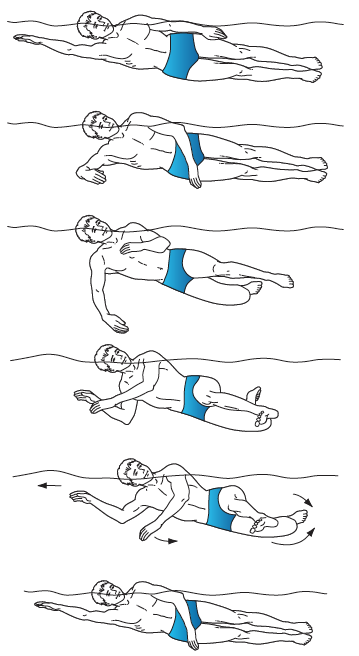
Swimming stroke on one's side with asymmetric arm and leg motion
The sidestroke is a swimming stroke, so named because the swimmer lies on one's side with asymmetric arm and leg motion. It is helpful as a lifesaving technique and is often used for long-distance swimming. The sidestroke allows the swimmer increased endurance because instead of working both arms and legs simultaneously in the same way, the side stroke uses them simultaneously but differently.
The hands act like oars, and do not waste any power by oblique action. In ordinary swimming on the right side, the left arm moves gently in the water, almost at rest. Then, when the used arm becomes tired, the swimmer turns on the other side, and the left arm works while the right arm rests.
The legs move in opposite directions with legs bent, and straighten as they come together. The kicking motion is exaggerated and slow, opening the legs wide to provide more thrust rather than the small, fast movement of flutter kick.
History
Sidestroke evolved in ancient times from swimmers who discovered that it was painful to swim breaststroke with the head above the water. The head naturally turned onto its side, which led to the shoulder dropping. The scissor kick became natural in this situation.
Modification
A modification of swimming on the side is the Trudgen stroke.
References
References
- Dunlap, Emily. (2009). "Aquatic Exercise for Rehabilitation and Training". Human Kinetics.
- Thomas, David G.. (2005). "Swimming: Steps to success". Human Kinetics.
- (1870). "Modern Out-door Amusements". Fredrick Warne & Co..
- Kenworthy, H.. (1846). "A Treatise on the Utility of Swimming". C. Hedgman.
- Thomas, David G.. (1990). "Advanced swimming: Steps to success". Leisure Press.
This article was imported from Wikipedia and is available under the Creative Commons Attribution-ShareAlike 4.0 License. Content has been adapted to SurfDoc format. Original contributors can be found on the article history page.
Ask Mako anything about Sidestroke — get instant answers, deeper analysis, and related topics.
Research with MakoFree with your Surf account
Create a free account to save articles, ask Mako questions, and organize your research.
Sign up freeThis content may have been generated or modified by AI. CloudSurf Software LLC is not responsible for the accuracy, completeness, or reliability of AI-generated content. Always verify important information from primary sources.
Report