From Surf Wiki (app.surf) — the open knowledge base
Sicanje
Tattooing custom prevalent among Catholics in Ottoman Bosnia and Herzegovina

Tattooing custom prevalent among Catholics in Ottoman Bosnia and Herzegovina
Sicanje, bocanje or bockanje was a traditional tattoo custom practiced mostly among Catholic Croat teenage girls and boys of Bosnia and Herzegovina, as well as the Croatian region of Dalmatia.
History

Tattooing of young girls and boys in Bosnia and Herzegovina is colloquially called sicanje, bocanje or bockanje, and it was a widespread custom mostly among Catholic Croats in the central regions. The custom is thought to predate the Slavic migrations to the Balkans and even Christianity. In the 1st century BC, the Greek historian Strabo wrote of tattooing among inhabitants of this area, namely Illyrians and Thracians, along with other customs. A similar practice was also present among Albanians and Vlach women from Greece, Macedonia and Herzegovina. Archaeologist Ćiro Truhelka researched these types of tattoos in the late 19th century, becoming one of the first to write about them and to illustrate them. In 1894, a Bosnian-based doctor named Leopold Glück published an article in Vienna titled Die Tätowirung der Haut bei den Katholiken Bosniens und der Herzegowina (The Tattooing of Skin Among the Catholics of Bosnia and Herzegovina) detailing the tattoos observed among the locals.
Women in some parts of the country tattooed their hands and other visible parts of the body (such as brow, cheeks, wrist, or below the neck) with Christian symbols and stećak ornaments. Boys were also tattooed with the same symbols mostly above the elbow on the right arm, chest, forehead, and pointer finger. This can be seen today, not only in Bosnia and Herzegovina but among ethnic Croats from Bosnia and Herzegovina living abroad. Children were tattooed from as early as the age of six, usually during the period between the feast of Saint Joseph in March to the feast of Saint John the Baptist in June.
The practice of tattooing on the Balkans, which also has been widespread among Albanians and also Vlach women probably predates the Slavic migrations to the Balkans, and consequently Christianity itself, tracing back to Paleo-Balkan peoples. The Eastern Orthodox Slavic population abhorred this practice.
Geographical extent in Bosnia and Herzegovina and Croatia
The practice of traditional tattooing was recorded in nearly all regions of Bosnia and Herzegovina were Croats live. Exceptions are the areas around Banja Luka, Derventa and parts of southern Herzegovina.
In Croatia, the practice of traditional tattooing was recorded in some villages of the Šibenik hinterland; this includes the municipalities of Muć, Kijevo, Unešić, Klis and Šibenik itself. It was also recorded in villages in southern Dalmatia bordering Bosnia and Herzegovina in the municipalities of Ston, Metković and in one Slavonian village in the municipality of Osijek.
Folk explanation of traditional tattooing
Many explanations for the practice of traditional tattooing among Croats of Bosnia and Herzegovina are recorded. The ethnologist Mario Petrić categorised the explanations into the following groups:
- A sign of Christianity
- A sign of Catholicism
- Prevention of conversions to Islam
- Decoration
- A sign for endurance of pain
- Other explanations (e.g.: Ottoman violence, mimicking Christ's suffering on the Cross, mutual recognition of Catholics, etc.)
Other recorded explanations include the hope of Catholic parents to recognise their children who were forcibly recruited as soldiers and other protective functions against forced and voluntary conversion to Islam.
Motifs
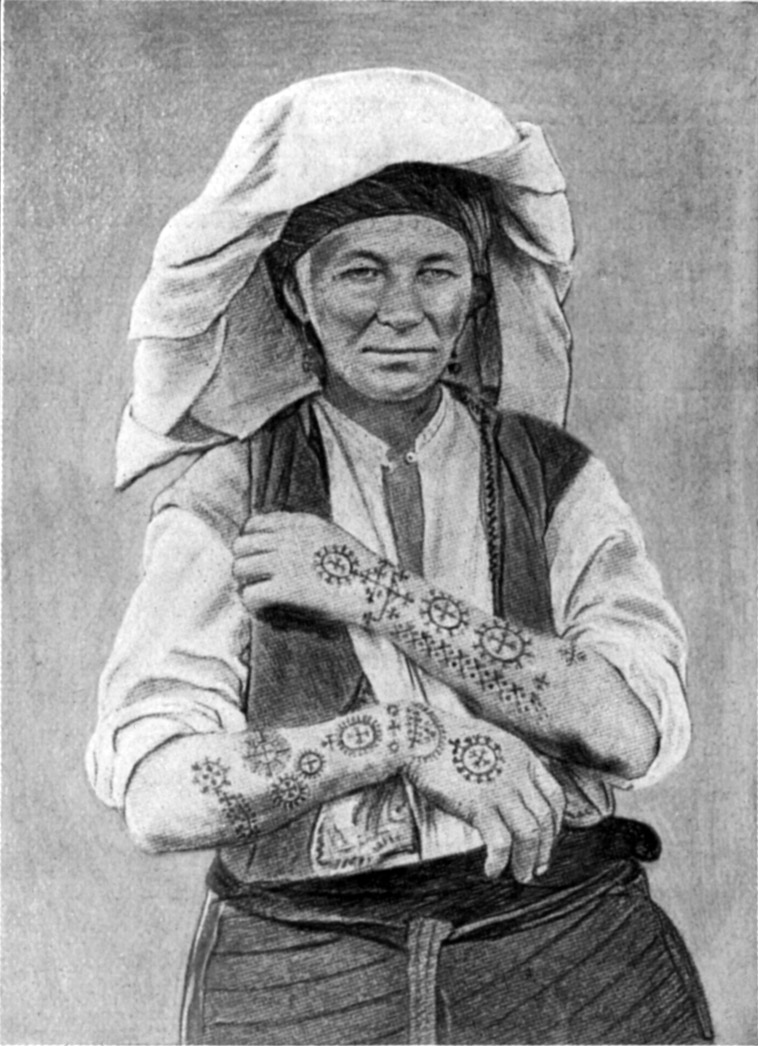
The most common and widespread symbols tattooed were the cross (križ), bracelet (narukvica), fence (ograda) and branches or twigs (grančica).
The cross had numerous variations, with one of the most common ones included small branch-like lines called "grančica" or "jelica" (pine tree). Bracelet-like designs were sometimes tattooed around the women's wrists, either with crosses or a fence-like motif. There were many non-Christian, or pagan symbols used, the most common consisting of circles believed to be connected to the traditional circle ("kolo") dances of the villages. The pagan and Christian symbols were mixed together indiscriminately, with the first originating from nature and family in Illyrian times, and the other with later adapted Christian meaning. The most common areas to tattoos were the arms and hands (including fingers), and on the chest and forehead..

Modern
The custom of tattooing young girls and boys died out after World War II in Yugoslavia with the establishment of the FPR Yugoslavia, and tattoos done by the traditional method are now only seen on old women. Today, there is a growing trend of modern tattoo artists utilising the traditional designs with contemporary tattooing methods in Croatia and Bosnia and Herzegovina.
In media
In 2013, a documentary titled Sicanje, bocanje, tetoviranje aired on Croatian television channel HRT 3. In 2011, Vice published an article titled "The Croatian Tattooed Grandma Cult" about the phenomena. Furthermore, Vice Serbia released a story and short film titled Tetovirane bake (Tattooed Grandmas), where they interview various Bosnian Croat women about their tattoos.
References
Bibliography
References
- (3 March 2021). "Traditional Croatian Tattoos: Meet the tattoo artist keeping tradition alive".
- (4 March 2018). "Traditional Croatian Tattoos".
- "Tradicionalno tetoviranje Hrvata u Bosni i Hercegovini - bocanje kao način zaštite od Osmanlija".
- ''The Early Age of Greece''; Cambridge University Press, p493-496
- "Татуировки балканских женщин: украшение, исповедание или оберег?".
- Marija Maračić. "The Tradition of Sicanje in Bosnia and Herzegovina".
- Ćiro Truhelka:''Die Tätowirung bei den Katholiken Bosniens und der Hercegovina'' (published in Wissenschaftliche Mittheilungen Aus Bosnien und der Hercegovina, herausgegeben vom Bosnisch-Hercegovinischen Landesmuseum in Sarajevo, redigiert von Dr. Moriz Hoernes, Vierter Band, Wien 1896)
- ''Albania and the Albanians: selected articles and letters 1903-1944'', by M. Edith Durham, Harry Hodgkinson, Bejtullah D. Destani
- "Oldest Tattoo Shop in Greece by Lars Krutak".
- Truhelka, Ciro. ''Wissenschaftliche Mittheilungen Aus Bosnien und der Hercegovina'': "Die Tätowirung bei den Katholiken Bosniens und der Hercegovina." Sarajevo; Bosnian National Museum, 1896.
- (26 May 2006). "THE AUSTRO-HUNGARIAN PERIOD IN BOSNIA AND HERZEGOVINACultural Politics in Bosnia and Herzegovina and the Creation of the Western Type of Art". Kakanien Revisited.
- (1894). "Die Tätowirung der Haut bei den Katholiken Bosniens und der Hereegovina.". Wissenschaftliche Mitteilungen aus Bosnien und der Herzegowina.
- "Croats in Bosnia and Herzegovina". CROATIA - overview of.
- (1 January 1955). "Customs and folkways of Jewish life". W. Sloane Associates.
- "Stari običaj 'križićanje' ili "sicanje" izumire". Večernji list.
- Haluga, Vesna. ''Znamen na koži - tradicijska tetovaža žena Hrvatica, katolkinja iz Bosne i Hercegovine'' Zagreb, 2023; P. 47
- {{harvnb. Lelaj. 2015. Norman. 2018
- Petrić, Mario. ''Običaj tatauiranja kod balkanskih naroda – karakteristike, uloga i porijeklo''. Sarajevo, 1973; P. 8-34
- Petrić, Mario. ''Običaj tatauiranja kod balkanskih naroda – karakteristike, uloga i porijeklo''. Sarajevo, 1973; P. 34
- Petrić, Mario. ''Običaj tatauiranja kod balkanskih naroda – karakteristike, uloga i porijeklo''. Sarajevo, 1973; P. 146
- Petrić, Mario. ''Običaj tatauiranja kod balkanskih naroda – karakteristike, uloga i porijeklo''. Sarajevo, 1973; P. 146
- Petrić, Mario. ''Običaj tatauiranja kod balkanskih naroda – karakteristike, uloga i porijeklo''. Sarajevo, 1973; P. 146
- Holbach, Maude M. ''Bosnia and herzegovina, some wayside wanderings'' London, 1910; P. 62
- Petrić, Mario. ''Običaj tatauiranja kod balkanskih naroda – karakteristike, uloga i porijeklo''. Sarajevo, 1973; P. 147
- Petrić, Mario. ''Običaj tatauiranja kod balkanskih naroda – karakteristike, uloga i porijeklo''. Sarajevo, 1973; P. 147
- Petrić, Mario. ''Običaj tatauiranja kod balkanskih naroda – karakteristike, uloga i porijeklo''. Sarajevo, 1973; P. 147
- Haluga, Vesna. ''Znamen na koži - tradicijska tetovaža žena Hrvatica, katolkinja iz Bosne i Hercegovine'' Zagreb, 2023; P. 48
- Jukić, Monika. ''Tradicionalno tetoviranje Hrvata u Bosni i Hercegovini – bocanje kao način zaštite od Osmanlija'' Zagreb, 2013; P. 211
- Čuturić, Leonard. ''Vjera Bosne [Vjerski život, običaji i pučka pobožnost bosanskih katolika prve polobive XX. stoljeća]'' Fojnica, 2017; P. 36
- Haluga, Vesna. ''Znamen na koži - tradicijska tetovaža žena Hrvatica, katolkinja iz Bosne i Hercegovine'' Zagreb, 2023; P. 47f.
- Petrić, Mario. ''Običaj tatauiranja kod balkanskih naroda – karakteristike, uloga i porijeklo''. Sarajevo, 1973; P. 135
- "A tatuaxe sicanje: Resistencia católica ou paganismo herdado?".
- Petrć, Mario. ''Običaj tatauiranja kod balkanskih naroda – karakteristike, uloga i porijeklo''. Sarajevo, 1973; P. 116
- "Traditional Croatian Tattoos".
- Petrić, Mario. ''Običaj tatauiranja kod balkanskih naroda – karakteristike, uloga i porijeklo''. Sarajevo, 1973; P. 116-139
- (30 December 2016). "Sa staricama odlazi i tradicija tetoviranja krsta u BiH". N1 Info.
- "Sicanje, bocanje: što se skriva iza tetovaža na rukama baka diljem Bosne i Hercegovine".
- (3 March 2021). "Traditional Croatian Tattoos: Meet the tattoo artist keeping tradition alive".
- "Sicanje, bocanje, tetoviranje (2013)".
- "The Croatian Tattooed Grandma Cult".
- "Tetovirane bake".
This article was imported from Wikipedia and is available under the Creative Commons Attribution-ShareAlike 4.0 License. Content has been adapted to SurfDoc format. Original contributors can be found on the article history page.
Ask Mako anything about Sicanje — get instant answers, deeper analysis, and related topics.
Research with MakoFree with your Surf account
Create a free account to save articles, ask Mako questions, and organize your research.
Sign up freeThis content may have been generated or modified by AI. CloudSurf Software LLC is not responsible for the accuracy, completeness, or reliability of AI-generated content. Always verify important information from primary sources.
Report