From Surf Wiki (app.surf) — the open knowledge base
Siachen Glacier
Glacier in the Karakoram range in the Himalayas
Glacier in the Karakoram range in the Himalayas
| Field | Value |
|---|---|
| name | Siachen Glacier |
| photo | Siachen Glacier Satellite Image, 1.jpg |
| photo_caption | Satellite imagery of the Siachen Glacier |
| type | Mountain glacier |
| location | Karakoram, Ladakh (controlled by India, claimed by Pakistan) |
| image_map | Kashmir map.svg |
| map | Karakoram#India Ladakh#India#Gilgit Baltistan#Pakistan#China Xinjiang Southern#China |
| map_caption | Location of the Siachen Glacier within the greater Karakoram region |
| label | Siachen Glacier |
| label_position | top |
| coordinates | |
| area | 2500 km2 |
| length | 76 km using the longest route as is done when determining river lengths or 70 km if measuring from Indira Col{{cite web |
| author | Dinesh Kumar |
| url | http://www.tribuneindia.com/2014/20140413/pers.htm |
| title | 30 Years of the World's Coldest War |
| work | The Tribune |
| location | Chandigarh, India |
| date | 13 April 2014 |
| access-date | 18 April 2014}} |
| mapframe | yes |
| mapframe-zoom | 9 |
| mapframe-wikidata | yes |
| access-date = 18 April 2014}} | mapframe-zoom = 9 | mapframe-wikidata = yes
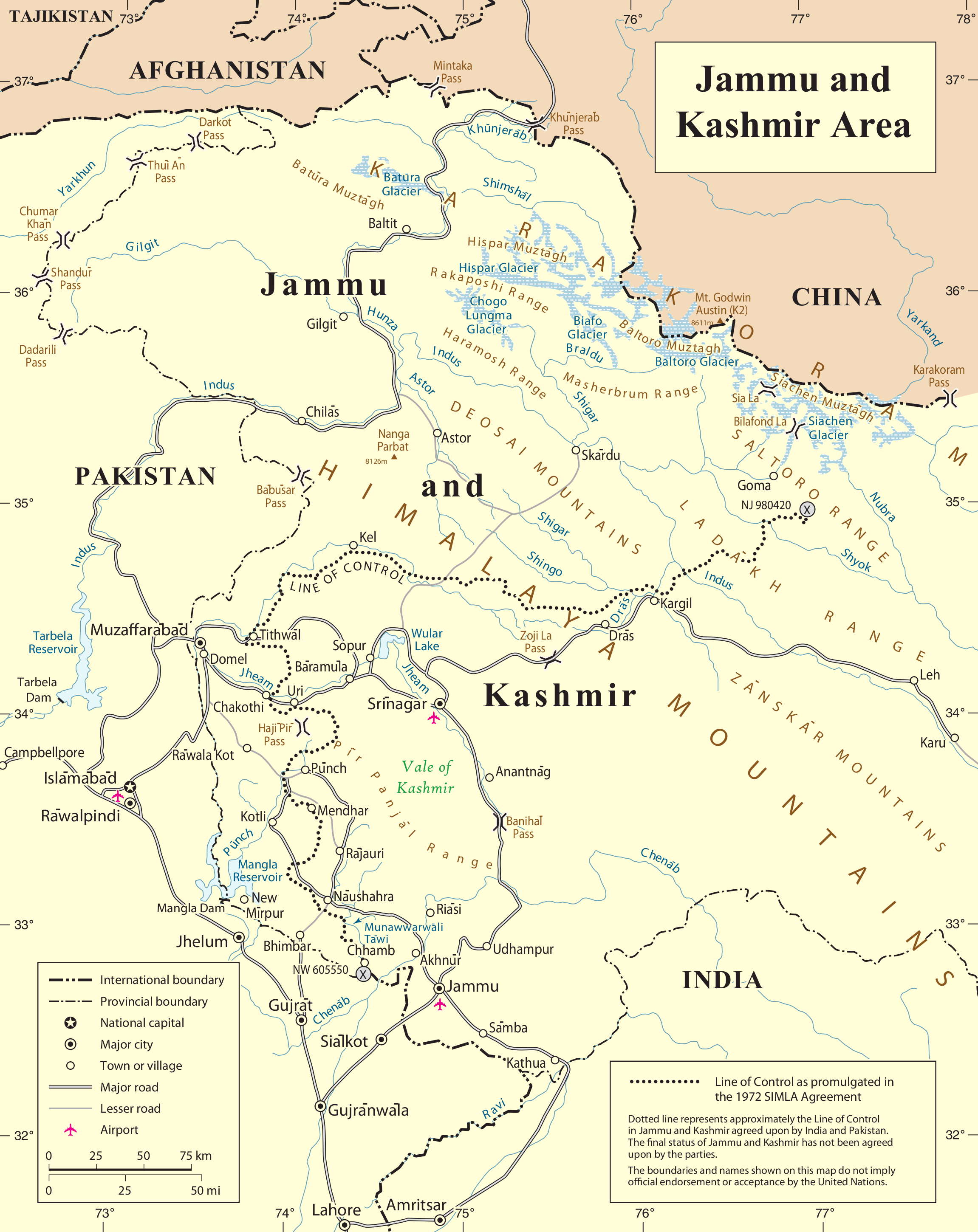
The Siachen Glacier is a glacier located in the eastern Karakoram range of the Himalayas, just northeast of the point NJ9842 where the Line of Control between India and Pakistan ends in northeastern Kashmir. At 76 km long, it is the longest glacier in the Karakoram and second-longest in the world's non-polar areas. It falls from an altitude of 5,753 m (18,875 ft) above sea level at its head at Indira Col on the India–China border down to 3,620 m (11,875 ft) at its terminus. The entire Siachen Glacier, with all major passes, has been under the administration of India as part of the union territory of Ladakh since 1984. Pakistan maintains a territorial claim over the Siachen Glacier and controls the region west of Saltoro Ridge, lying west of the glacier, with Pakistani posts located 1 km below more than 100 Indian posts on the ridge.
The Siachen Glacier lies immediately south of the great drainage divide that separates the Eurasian Plate from the Indian subcontinent in the extensively glaciated portion of the Karakoram sometimes called the "Third Pole". The glacier lies between the Saltoro Ridge immediately to the west and the main Karakoram range to the east. The Saltoro Ridge originates in the north from the Sia Kangri peak on the China border in the Karakoram range. The crest of the Saltoro Ridge's altitudes range from 5,450 to 7,720 m (17,880 to 25,330 feet). The major passes on this ridge are, from north to south, Sia La at 5,589 m (18,336 ft), Bilafond La at 5,450 m (17,880 ft), and Gyong La at 5,689 m (18,665 ft). The average winter snowfall is more than 1000 cm (35 ft) and temperatures can dip to -50 C. Including all tributary glaciers, the Siachen Glacier system covers about 700 km2.
Etymology


"Sia" in the Balti language refers to the rose family plant widely dispersed in the region. "Chen" refers to any object found in abundance. Thus the name Siachen refers to a land with an abundance of roses. The naming of the glacier itself, or at least its currency, is attributed to Tom Longstaff.
Dispute
Both India and Pakistan claim sovereignty over the entire Siachen region.{{Cite book
Aside from the Indian and Pakistani military presence, the glacier region is unpopulated. The nearest civilian settlement is the village of Warshi, 10 miles downstream from the Indian base camp. The region is also extremely remote, with limited road connectivity. On the Indian side, roads go only as far as the military base camp at Dzingrulma (), 72 km from the head of the glacier. The Indian Army has developed various means to reach the Siachen region, including the Manali-Leh-Khardung La-Siachen route. In 2012, Chief of Army Staff of the Indian Army General Bikram Singh said that the Indian Army should stay in the region for strategic advantages, and because a "lot of blood has been shed" by Indian armed personnel for Siachen. The present ground positions, relatively stable for over a decade, mean that India maintains control over all of the 76 km Siachen Glacier and all of its tributary glaciers, as well as all the main passes and heights of the Saltoro Ridge immediately west of the glacier, including Sia La, Bilafond La, Gyong La, Yarma La (6,100m), and (5,800m). Pakistan controls the glacial valleys immediately west of the Saltoro Ridge. According to TIME magazine, India gained over 1000 sqmi in territory because of its 1980s military operations in Siachen. India has categorically stated that India will not pull its army from Siachen until the 110-km long AGPL is first authenticated, delineated and then demarcated.

The 1949 Karachi agreement only carefully delineated the line of separation to point NJ9842, after which, the agreement states, the line of separation would continue "thence north to the glaciers". According to the Indian stance, the line of separation should continue roughly northwards along the Saltoro Range to the west of the Siachen glacier beyond NJ9842; international boundary lines that follow mountain ranges often do so by following the watershed drainage divide such as that of the Saltoro Range. The 1972 Simla Agreement made no change to the 1949 Line of Control in this northernmost sector.
Drainage

The glacier's melting waters are the main source of the Nubra River in the Indian region of Ladakh, which drains into the Shyok River. The Shyok in turn joins the 3000 kilometre-long Indus River which flows through Pakistan. Thus, the glacier is a major source of the Indus and feeds the largest irrigation system in the world.
Environmental issues
The glacier was uninhabited before 1984, and the presence of thousands of troops since then has introduced pollution and melting to the glacier. To support the troops, glacial ice has been cut and melted with chemicals.
Dumping of non-biodegradable waste in large quantities and the use of arms and ammunition have considerably affected the ecosystem of the region.
Glacial retreat
Preliminary findings of a survey by Pakistan Meteorological Department in 2007 revealed that the Siachen glacier has been retreating for the past 30 years and is melting at an alarming rate. The study of satellite images of the glacier showed that the glacier is retreating at a rate of about 110 metres a year and that the glacier size has decreased by almost 35 percent. In an eleven-year period, the glacier had receded nearly 800 metres, and in seventeen years about 1700 metres. It is predicted that the glaciers of the Siachen region will be reduced to about one-fifth of their 2011 size by 2035. In the twenty-nine-year period 1929–1958, well before the military occupation, the glacial retreat was recorded to be about 914 metres. One of the reasons theorized for the recent glacial retreat is chemical blasting, to construct camps and posts. In 2001 India laid oil pipelines (about 250 kilometres long) inside the glacier to supply kerosene and aviation fuel to the outposts from base camps. As of 2007, the temperature rise at Siachen was estimated at 0.2-degree Celsius annually, causing melting, avalanches, and crevasses in the glacier.
Waste dumping
The waste produced by the troops stationed there is dumped in the crevasses of the glacier. Mountaineers who visited the area while on climbing expeditions witnessed large amount of garbage, empty ammunition shells, parachutes etc. dumped on the glacier, that neither decomposes nor can be burned because of the extreme climatic conditions. About 1000 kg of waste is produced and dumped in glacial crevasses daily by Indian forces. The Indian army is said to have planned a "Green Siachen, Clean Siachen" campaign to airlift the garbage from the glacier, and to use biodigestors for biodegradable waste in the absence of oxygen and freezing temperatures. Almost forty percent (40%) of the waste left at the glacier is plastic and metal, including toxins such as cobalt, cadmium and chromium that eventually affect the water of the Shyok River (which ultimately enters the Indus River near Skardu). The Indus is used for drinking and irrigation. Research is being done by scientists of The Energy and Resources Institute, to find ways to successfully dispose of the garbage generated at the glacier using scientific means. Some scientists of the Defence Research and Development Organisation who went on an expedition to Antarctica are also working to produce a bacterium that can thrive in extreme weather conditions and can be helpful in decomposing the biodegradable waste naturally.
Fauna and flora
The flora and fauna of the Siachen region are also affected by the huge military presence. The region is home to rare species including snow leopard, brown bear and ibex that are at risk because of the military presence.
Border conflict
Main article: Siachen conflict
The glacier's region is the highest battleground on Earth, where Pakistan and India have fought intermittently since April 1984. Both countries maintain a permanent military presence in the region at a height of over 6000 m.
Both India and Pakistan have wished to disengage from the costly military outposts. India launched Operation Meghdoot to occupy Siachen Glacier in 1984. Then, due to the Pakistani incursions during the Kargil War in 1999, India abandoned plans to withdraw from Siachen, wary of further Pakistani incursions if they vacate the Siachen Glacier posts.
Prime Minister Manmohan Singh became the first Indian Prime Minister to visit the area, during which he called for a peaceful resolution of the problem. After that present Prime Minister Narendra Modi also visited this place. President of Pakistan Asif Ali Zardari also visited an area near the Siachen Glacier called Gayari Sector during 2012 with Pakistan Army Chief Gen. Ashfaq Parvez Kayani. Both of them showed their commitment to resolve the Siachen conflict as early as possible. In the previous year, the President of India, Abdul Kalam became the first head of state to visit the area.
Since September 2007, India has opened up limited mountaineering and trekking expeditions to the area. The first group included cadets from Chail Military School, National Defence Academy, National Cadet Corps, Indian Military Academy, Rashtriya Indian Military College and family members of armed forces officers. The expeditions are also meant to show to the international audience that Indian troops hold "almost all dominating heights" on the key Saltoro Ridge and to show that Pakistani troops are nowhere near the Siachen Glacier. Ignoring protests from Pakistan, India maintains that it does not need anyone's approval to send trekkers to Siachen, in what it says is essentially its own territory. In addition, the Indian Army's Army Mountaineering Institute (AMI) functions out of the region.
Peace Park proposal
.jpg)
The idea of declaring the Siachen region a "Peace Park" was presented by environmentalists and peace activists in part to preserve the ecosystem of the region badly affected by the military presence. In September 2003, the governments of India and Pakistan were urged by the participants of the 5th World Parks Congress held at Durban, to establish a peace park in the Siachen region to restore the natural biological system and protect species whose lives are at risk. Italian ecologist Giuliano Tallone said the ecological life was at serious risk, and proposed setting up a Siachen Peace Park at the conference. After a proposal of a transboundary Peace Park was floated, the International Mountaineering and Climbing Federation (UIAA) and the International Union for Conservation of Nature (IUCN) organised a conference at Geneva and invited Indian and Pakistani mountaineers (Mandip Singh Soin, Harish Kapadia, Nazir Sabir and Sher Khan).{{cite book|title=Incredible Himalayas|publisher=Indus Books|isbn=978-8173871795|pages=213–217|chapter-url=https://books.google.com/books?id=y5CXbqpzmhIC&pg=PA214
Sandia National Laboratories organised conferences where military experts and environmentalists from both India and Pakistan and also from other countries were invited to present joint papers. Kent L. Biringer, a researcher at Cooperative Monitoring Center of Sandia Labs suggested setting up Siachen Science Center, a high-altitude research centre where scientists and researchers from both the countries can carry out research activities related to glaciology, geology, atmospheric sciences and other related fields.
In popular culture
In the 2018 Hollywood movie Mission: Impossible – Fallout, a rogue agent plants nuclear bombs at the base of the Siachen Glacier. The scene was actually filmed in Preikestolen, Norway, due to the Indian government denying permission to film in Kashmir.
Notes
References
References
- Desmond/Kashmir, Edward W.. (31 July 1989). "The Himalayas War at the Top of the World".
- "The Tribune, Chandigarh, India – Opinions".
- Siachen Glacier is {{convert. 76. km. 77. km. 63. km
- (2 November 2014). "Siachen: The place of wild roses".
- North, Andrew. (12 April 2014). "Siachen dispute: India and Pakistan's glacial fight". BBC.
- (9 April 2012). "India gained control over Siachen in 1984".
- "Blog: The Siachen Story, Then And Now".
- Siddiqui, Naveed. (4 August 2020). "In landmark move, PM Imran unveils 'new political map' of Pakistan". Dawn.
- Gokhale, Nitin A. (2015). "Beyond NJ 9842: The SIACHEN Saga". Bloomsbury Publishing.
- Service, Tribune News. "Life & death in world's highest combat zone".
- (18 February 2016). "Siachen deaths harden resolve to hold glacier: Army chief".
- (13 July 2023). "The first GSI survey of the Siachen".
- (31 December 2021). "Kumar's line vs Hodgson's line: The 'Lakshman rekha' that started an India-Pakistan fight".
- (15 October 2022). "How India got Hodgson's Line erased and won the race to Siachen".
- "The 'cartographic nightmare' of the Kashmir region, explained".
- "The Tribune, Chandigarh, India - Opinions".
- (12 February 2016). "Siachen height provides military depth India can't afford to lose | India News".
- (26 April 2012). "Story of Saltoro – From Ababeel to Meghdoot".
- Rodriguez, Alex. (8 April 2012). "Avalanche buries Pakistan base; 117 soldiers feared dead". Los Angeles Times.
- Pubby, Manu. (18 September 2015). "Bleeding in Siachen: Pakistan losing 30 soldiers a year on highest battlefield". The Economic Times.
- "Rescue operations at Gayari Sector after Pakistan avalanche, Photo Gallery". NDTV.com.
- (31 July 2015). "33 Indian soldiers killed in Siachen since 2012: govt". Business Standard.
- Dinakar Peri. (11 December 2015). "In Siachen, 869 Army men died battling the elements". The Hindu.
- (26 February 2016). "Won't vacate Siachen, we can't trust Pakistan, says Manohar Parrikar | India News".
- (3 April 2016). "Here's how ISRO's space technology can save lives of soldiers at Siachen".
- (7 April 2012). "Kashmir's Siachen glacier a frigid outpost in India-Pakistan conflict". CBC Canada.
- "- News18".
- (29 August 1998). "World's highest, biggest junkyard". The Tribune.
- (22 April 2012). "The fight for Siachen". The Express Tribune.
- "Demilitarization of the Siachen Conflict Zone: Concepts for Implementation and Monitoring".
- Noorani, A. G.. (26 March 2016). "Settle Siachen".
- "India must continue to hold on to Siachen: Bikram Singh, Army Chief General". timesofindia-economictimes.
- Mohamed Nazeer. (24 November 2012). "Army should stay put in Siachen, says General Bikram Singh". The Hindu.
- Shukla, Ajai. (28 August 2012). "846 Indian soldiers have died in Siachen since 1984". Business Standard.
- "The Tribune, Chandigarh, India – Opinions".
- Wirsing, Robert. (13 December 1991). "Pakistan's security under Zia, 1977–1988: the policy imperatives of a peripheral Asian state". Palgrave Macmillan, 1991.
- Child, Greg. (1998). "Thin air: encounters in the Himalayas". The Mountaineers Books, 1998.
- (31 July 1989). "The Himalayas War at the Top of the World".
- W. P. S. Sidhu. (June 13, 2013). "Siachen: While the battle continues to rage, no settlement is in sight".
- Praveen Dass. "Bullish on Siachen". The Crest Edition.
- Raj Chengappa. (October 31, 1987). "Siachen glacier: Indian troops repulse major Pakistani offensive".
- P. ANIMA. (7 February 2014). "Riding on". The Hindu.
- "Army opposes Pakistan's demand for troop withdrawal from Siachen Glacier – Indian Express".
- "UN Map showing CFL as per Karachi Agreement – UN document number S/1430/Add.2".
- (13 April 2012). "Why India cannot afford to give up Siachen". Rediff.
- "Siachen Glacier Dispute – GKToday".
- H.C. Sadangi. (31 March 2007). "India's Relations with Her Neighbours". Isha Books.
- Rashid Faruqee. (November 1999). "Strategic Reforms for Agricultural Growth in Pakistan". World Bank Publications.
- "Environmental Impact of Siachen Conflict – DW – 01/05/2010".
- ActionAid. (2010). "Natural Resource Management in South Asia". Pearson Education.
- K.R. Gupta. (2008). "Global Warming (Encyclopaedia of Environment)". Atlantic Publishers & Distributors.
- Y. S. Rao. (3 November 2011). "Encyclopedia of Snow, Ice and Glaciers". Springer.
- Harish Kapadia. (March 1998). "Meeting the Mountains". Indus Publishing Company.
- Daniel Moran. (22 March 2011). "Climate Change and National Security: A Country-Level Analysis". Georgetown University Press.
- K.S. Gulia. (2 September 2007). "Discovering Himalaya : Tourism of Himalaya Region". Isha Books.
- (22 April 2012). "Snow white coffins of Siachen". The News Today.
- Asad Hakeem, Gurmeet Kanwal. (September 2007). "Demilitarization of the Siachen Conflict Zone: Concepts for Implementation and Monitoring". Sandia National Laboratories.
- Harish Kapadia. (30 November 1999). "Across Peaks & Passes in Ladakh, Zanskar & East Karakoram". Indus Publishing Company.
- (24 March 2007). "Military activity leads to melting of Siachen glaciers". Dawn.
- Neal A. Kemkar. (2006). "Environmental peacemaking: Ending conflict between India and Pakistan on the Siachen Glacier through the creation of a transboundary peace park". Stanford University School of Law.
- Kevin Fedarko. (1 February 2003). "The Coldest War". Mariah Media Network.
- Mahendra Gaur. (8 August 2006). "Indian Affairs Annual 2006". Kalpaz Publications.
- Supriya Bezbaruah. (1 November 2004). "Siachen Snow Under Fire". India Today.
- Emmanuel Duparcq. (11 April 2012). "Siachen tragedy – day 5: Bad weather dogs avalanche search efforts". The Express Tribune.
- Kamal Thakur. (1 November 2014). "16 Things You Should Know About India's Soldiers Defending Siachen". Topyaps.
- "How a tiny line on a map led to conflict in the Himalaya".
- (18 April 2012). "Pakistan wants resolution of Siachen issue: Kayani". The Express Tribune.
- [https://web.archive.org/web/20121024115859/http://articles.timesofindia.indiatimes.com/2007-09-13/india/27962396_1_glacial-heights-siachen-glacier-saltoro-ridge-audience-that-indian-troops India opens Siachen to trekkers] ''[[The Times of India]]'' 13 September 2007
- [https://web.archive.org/web/20121024115908/http://articles.timesofindia.indiatimes.com/2007-09-17/india/27962954_1_siachen-charuhas-joshi-mukund-deodhar India hits back at Pak over Siachen issue] ''[[The Times of India]]'' 17 September 2007
- Teresita C. Schaffer. (20 December 2005). "Kashmir: The Economics of Peace Building". Center for Strategic & International Studies.
- Isa Daudpota. (16 February 2007). "Exchange Siachen confrontation for peace". [[The Hindu]].
- Sujan Dutta. (14 June 2005). "Out of the box ideas for glacier: Siachen could become bio reserve or peace park". The Telegraph.
- Jim Thorsell. (September 2002). "Sites deferred by the Committee which may merit re-nomination". [[International Union for Conservation of Nature]].
- G. Tamburelli. (1 January 2007). "Biodiversity conservation and protected areas". Giuffrè.
- K. L. Biringer. (1 March 1998). "Siachen Science Center: A concept for cooperation at the top of the world (Cooperative Monitoring Center Occasional Paper No. SAND—98-0505/2, 589204)". Sandia National Laboratories.
- Wajahat Ali. (20 August 2004). "US expert at Sandia wants Siachen converted into Science Centre". Daily Times.
- (27 July 2018). "Tom Cruise's mission impossible...".
This article was imported from Wikipedia and is available under the Creative Commons Attribution-ShareAlike 4.0 License. Content has been adapted to SurfDoc format. Original contributors can be found on the article history page.
Ask Mako anything about Siachen Glacier — get instant answers, deeper analysis, and related topics.
Research with MakoFree with your Surf account
Create a free account to save articles, ask Mako questions, and organize your research.
Sign up freeThis content may have been generated or modified by AI. CloudSurf Software LLC is not responsible for the accuracy, completeness, or reliability of AI-generated content. Always verify important information from primary sources.
Report