From Surf Wiki (app.surf) — the open knowledge base
Shinjuku

| Field | Value |
|---|---|
| name | Shinjuku |
| native_name | 新宿区 |
| official_name | Shinjuku City |
| settlement_type | Special ward |
| image_flag | Flag of Shinjuku, Tokyo.svg |
| image_skyline | {{multiple image |
| border | infobox |
| total_width | 300 |
| perrow | 1/2/2 |
| image1 | Skyscrapers of Shinjuku 2009 January.jpg |
| image2 | Kabukicho red gate and colorful neon street signs at night, Shinjuku, Tokyo, Japan.jpg |
| image3 | Shinjuku Gyoen National Garden - sakura 3.JPG |
| image4 | Tokyo Metropolitan Government Building 2012.JPG |
| image5 | JRE-Shinjuku-STA South-entrance.jpg |
| image_caption | Clockwise from top: |
| image_seal | Emblem of Shinjuku, Tokyo.svg |
| image_map | Shinjuku-ku in Tokyo Prefecture Ja.svg |
| map_caption | Location of Shinjuku in Tokyo |
| pushpin_map | Japan |
| pushpin_label_position | |
| pushpin_map_caption | |
| coordinates | |
| coor_pinpoint | |
| coordinates_footnotes | tags -- |
| subdivision_type | Country |
| subdivision_name | Japan |
| subdivision_type1 | Region |
| subdivision_name1 | Kantō |
| subdivision_type2 | Prefecture |
| subdivision_name2 | Tokyo |
| established_title | |
| named_for | |
| seat_type | |
| leader_title | Mayor |
| leader_name | Kenichi Yoshizumi |
| leader_title1 | Tourism Ambassador |
| leader_name1 | Godzilla |
| leader_name2 | |
| total_type | |
| unit_pref | |
| area_magnitude | |
| area_total_km2 | 18.23 |
| population_footnotes | tags -- |
| population_total | 349385 |
| population_as_of | 1 October, 2020 |
| population_density_km2 | auto |
| population_demonym | |
| timezone1 | Japan Standard Time |
| utc_offset1 | +9 |
| area_code_type | |
| blank_name_sec1 | City Symbols |
| blank1_name_sec1 | - Tree |
| blank1_info_sec1 | Zelkova serrata |
| blank2_name_sec1 | - Flower |
| blank2_info_sec1 | Azalea |
| blank_name_sec2 | Phone number |
| blank_info_sec2 | 03-3209-1111 |
| blank1_name_sec2 | City Hall Address |
| blank1_info_sec2 | Kabukichō 1-4-1, Shinjuku-ku, Tokyo 160-8484 |
| website |
Shinjuku, officially called Shinjuku City, is one of the 23 special wards of Tokyo.
Since the end of World War II, Shinjuku has become a major secondary center of Tokyo (fukutoshin), rivaling the original city center in Marunouchi. Today, it is a major commercial and administrative center, housing the busiest railway station in the world (Shinjuku Station) as well as the Tokyo Metropolitan Government Building, the administrative center of the Tokyo Metropolitan Government.
As of 2025, the ward has an estimated population of 355,981, living in a total area of .
Since 2014, its mayor is Kenichi Yoshizumi, who does not belong to the Liberal Democratic Party, but supports the values and policies of the ruling party, is conservative and nationalist.
History
In 1634, during the Edo period, as the outer moat of the Edo Castle was built, a number of temples and shrines moved to the Yotsuya area on the western edge of Shinjuku. In 1698, Naitō-Shinjuku had developed as a new (shin) station (shuku or juku) on the Kōshū Kaidō, one of the major highways of that era. Naitō was the family name of a daimyō whose mansion stood in the area; his land is now a public park, the Shinjuku Gyoen. In 1898, the Yodobashi Water Purification Plant, the city's first modern water treatment facility, was built in the area that is now between the park and the train station.
In 1920, the town of Naitō-Shinjuku, which comprised large parts of present-day Shinjuku (the neighborhood, not the municipality), parts of Nishi-Shinjuku and Kabukichō were integrated into Tokyo City. Shinjuku began to develop into its current form after the Great Kantō Earthquake in 1923, since the seismically stable area largely escaped the devastation. Consequently, West Shinjuku is one of the few areas in Tokyo with many skyscrapers.
The Tokyo air raids from May to August 1945 destroyed almost 90% of the buildings in the area in and around Shinjuku Station. The pre-war form of Shinjuku and the rest of Tokyo was retained after the war because the roads and rails, damaged as they were, remained, and these formed the heart of Shinjuku in the post-war construction. Only in Kabuki-cho was a grand reconstruction plan put into action.
The present ward was established on March 15, 1947 with the merger of the former wards of Yotsuya, Ushigome, and Yodobashi. It served as part of the athletics 50 km walk and marathon course during the 1964 Summer Olympics. In March 1965, the Yodobashi Water Purification Plant closed and was replaced by skyscrapers in the following years.
The Sixties in Shinjuku
Shinjuku was the epicenter of new ideas and artistic avant-gardes in Tokyo in the 1960s, much like Greenwich Village in New York.
Cinema
The young directors of the Japanese New Wave used Shinjuku as the setting for several of their films, such as Nagisa Oshima's Diary of a Shinjuku Thief (1969), Koji Wakamatsu's Shinjuku Mad (screenplay by Masao Adachi), and Funeral Parade of Roses by Toshio Matsumoto.
In 1967, the Art Theatre Guild opened the Scorpio Theatre (Sasori-za) in the basement of its Art Theatre Shinjuku Bunka cinema. The Scorpio Theatre quickly established itself as an influential underground venue for angura theater, music, dance, and film. Its name, proposed by novelist Yukio Mishima, was inspired by Kenneth Anger's film Scorpio Rising (1963). It was at the Sasori-za that Mishima held the first screening of his film Patriotism (1966).
Theater
In 1967, the Modern Art Theater was opened in Shinjuku. Dubbed the "sensational cave," it offered nude shows, avant-garde and entertainment theater, film screenings, and performances. The theater laboratory "Ceiling Pier", which had Tadanori Yokoo as a founding member, also performed there. After the underground boom, the venue was used for striptease performances.
It was in Shinjuku, in the Hanazono shrine, that the first performances of the "Red Tent" (Jokyo Gekijo), the company founded by Juro Kara, took place.
Tatsumi Hijikata and the buto dancers were also closely associated to Shinjuku.
Places
Cafe Fugetsudo, founded by actor Goro Yokoyama, was a rallying point for artists, intellectuals, and homosexuals in the 1960s. Actor Takeshi Kitano, painter Taro Okamoto, transvestite actress Akihiro Miwa, poet Gozo Yoshimasu, and filmmaker Shuji Terayama frequented it.
In the Golden Gai, a small block located east of Kabukicho, many bars have been haunts of artists and protesters.
Folk Guerilla Concerts
In 1969, anti-war group Beheiren organized folk concerts in Shinjuku station. A batch of Japanese anti-Vietnam War activists gathered and were termed "folk guerrillas". In July, a fight with riot police led to the dispersal of the concerts and the arrests of musicians.
Demonstrations
On October 21, 1969, an anti-war demonstration was violently suppressed, so much so that the daily newspaper Asahi ran the following day's headline: "Guerrilla Warfare in the Heart of Shinjuku."
In 1991, the Tokyo Metropolitan Government moved from the Marunouchi district of Chiyoda to the current building in Shinjuku (the Tokyo International Forum stands at the former site vacated by the government).
Geography

Most of Shinjuku is occupied by the Yodobashi Plateau, the most elevated portion of which extends through most of the Shinjuku Station area. The Kanda River runs through the Ochiai and Totsuka areas near sea level, but the Toshima Plateau also builds elevation in the northern extremities of Totsuka and Ochiai. The highest point in Shinjuku is Hakone-san in Toyama Park, 44.6 m above sea level.
Shinjuku is surrounded by Chiyoda to the east; Bunkyo and Toshima to the north; Nakano to the west, and Shibuya and Minato to the south. Tokyo Special Wards Map

The current city of Shinjuku grew out of several separate towns and villages, which have retained some distinctions despite growing together as part of the Tokyo metropolis.
- East Shinjuku : the area east of Shinjuku Station between Higashi-Shinjuku Station and Shinjuku-sanchome Station, historically known as Naito-Shinjuku, houses the city hall and the flagship Isetan department store, as well as several famous districts :
- Kabukichō: the red-light district, renowned for its variety of bars, restaurants, and sex-related establishments near Seibu-Shinjuku Station.
- Golden Gai: an area of tiny shanty-style bars and clubs, where musicians, artists, journalists, actors and directors used to gather.
- Shinjuku Gyo-en: A large park, 58.3 hectares, blending Japanese traditional, English landscape and French formal style gardens.
- Shinjuku Ni-chōme: Tokyo's best-known gay district.
- Nishi-Shinjuku: The area west of Shinjuku Station, historically known as Yodobashi, is home to Tokyo's largest concentration of skyscrapers. Several of the tallest buildings in Tokyo are located in this area, including the Tokyo Metropolitan Government Building, KDDI Building and Park Tower.

- Ochiai: The northwestern corner of Shinjuku, extending to the area around Ochiai-minami-nagasaki Station and the south side of Mejiro Station, is largely residential with a small business district around Nakai Station.
- Ōkubo: The area surrounding Okubo and Shin-Okubo Station is best known as Tokyo's historic ethnic Korean neighborhood.
- Shinanomachi : A district reputed to be the headquarters of a Buddhist organization, which owns many buildings there.
- Totsuka: The northern portion of Shinjuku surrounding Takadanobaba Station and Waseda University, today commonly referred to as Nishi-Waseda. The Takadanobaba area is a major residential and nightlife area for students, as well as a commuter hub.
- Toyama: A largely residential and school area, in the east of Ōkubo and south of Waseda University, extending to the area around Nishi-Waseda Station, Gakushuin Women's College and Toyama Park.
- Ushigome: A largely residential area in the eastern portion of the city.
- Ichigaya: A commercial area in eastern Shinjuku, site of the Ministry of Defense.
- Kagurazaka: A hill descending to the Iidabashi Station area, once one of Tokyo's last remaining hanamachi or geisha districts, and currently known for hosting a sizable French community.
- Yotsuya: An upscale residential and commercial district in the southeast corner of Shinjuku. The Arakichō area is well known for its many small restaurants, bars, and izakaya.
"Shinjuku" is often popularly understood to mean the entire area surrounding Shinjuku Station, but the Shinjuku Southern Terrace complex and the areas to the west of the station and south of Kōshū Kaidō are part of the Yoyogi and Sendagaya districts of the special ward of Shibuya.
Districts and neighborhoods
;Ushigome Area
- Ageba-chō
- Akagishitamachi
- Akagimotomachi
- Babashitamachi
- Bentenchō
- Enokimachi
- Fukuromachi
- Haraikata-chō
- Haramachi
- Higashienokichō
- Higashigoken-chō
- Ichigayachōenjimachi
- Ichigayadaimachi
- Ichigayafunagawaramachi
- Ichigayahachiman-chō
- Ichigayahonmura-chō
- Ichigayakaga-chō
- Ichigayakōrachō
- Ichigayanakano-chō
- Ichigayasadohara-chō
- Ichigayasanai-chō
- Ichigayata-chō
- Ichigayatakajōmachi
- Ichigayayakuouji-chō
- Ichigayayamabushichō
- Ichigayayanagi-chō
- Iwato-chō
- Kaguragashi
- Kagurazaka
- Kaitaichō
- Kikuichō
- Kitamachi
- Kitayamabushichō
- Kōdachō
- Minamienokichō
- Minamimachi
- Minamiyamabushi-chō
- Nakamachi
- Nakazatochō
- Nandochō
- Nijūkimachi
- Nishigoken-chō
- Nishiwaseda*
- Saikuchō
- Shimomiyabi-chō
- Shinogawamachi
- Shiroganechō
- Suidōmachi
- Sumiyoshi-chō
- Tansumachi
- Tenjinmachi
- Tomihisa-chō
- Toyama*
- Tsukiji-chō
- Tsukudo-chō
- Tsukudohachimanchō
- Wakamatsumachi
- Wakamiyachō
- Waseda-chō
- Wasedaminamimachi
- Wasedatsurumaki-chō
- Wasedamachi
- Yamabuki-chō
- Yaraimachi
- Yochō-machi*
- Yokoteramachi ;Yodobashi Area
- Kamiochiai
- Kitashinjuku
- Nakai
- Nakaochiai
- Ōkubo
- Shimoochiai
- Takadanobaba
- Totsuka-chō
- Nishiochiai
- Nishishinjuku
- Hyakuninmachi
- Kabukichō*
- Shinjuku*
- Toyama*
- Nishiwaseda*
- Yochō-chō* ;Yotsuya Area
- Aizumichō
- Arakimachi
- Daikyōmachi
- Funamachi
- Kabukichō*
- Kasumigaokachō
- Katamachi
- Minamimotomachi
- Naitōchō
- Samonmachi
- Shinanomachi
- Shinjuku*
- Sugamachi
- Wakaba
- Yotsuya
- Yotsuyahonshiochō
- Yotsuyasakamachi
- Yotsuyasaneichō
Economy
The area surrounding Shinjuku Station is a major economic hub of Tokyo. Many companies have their headquarters or Tokyo offices in this area, including regional telephone operator NTT East, global camera and medical device manufacturer Olympus Corporation, electronics giant Seiko Epson, video game developer Square Enix, fast food chains McDonald's Japan and Yoshinoya, travel agency H.I.S., Subaru Corporation (Subaru), railway operator Odakyu Electric Railway, construction giants Taisei Corporation and Kumagai Gumi, medical equipment manufacturer Nihon Kohden, Enoki Films, navigation software company Jorudan, instant noodle giant Nissin Foods, automotive components manufacturer Keihin Corporation, and regional airline Airtransse. The station area also hosts numerous major retailers such as Isetan, Takashimaya, Marui, Bic Camera, Yodobashi Camera and Yamada Denki.
Northeastern Shinjuku has an active publishing industry and is home to the publishers Shinchosha and Futabasha. The main store of the Books Kinokuniya bookstore chain is also located in Shinjuku.
Demographics
| Nationality | Population (percentage) (2024) | |
|---|---|---|
| Japan | ||
| China | ||
| South Korea | ||
| Nepal | ||
| Vietnam | ||
| Myanmar | ||
| Others |
By 2012 people of Chinese citizenship became the most numerous foreign citizens in Shinjuku. Previously the most common citizenship was collectively those of North and South Korea.
Government and politics


Like the other special wards of Tokyo, Shinjuku has a status equivalent to that of a city. The current mayor is Kenichi Yoshizumi.
The ward council consists of 38 elected members; the Liberal Democratic Party and New Komeitō Party together currently hold a majority. The Democratic Party of Japan, Japanese Communist Party and the Social Democratic Party are also represented together with four independents. Shinjuku's city office is located on the southeastern edge of Kabukichō.
Shinjuku is also the location of the Tokyo Metropolitan Government. The governor's office, the metropolitan assembly chamber, and all administrative head offices are located in the Tokyo Metropolitan Government Building.
Elections
Public institutions
Libraries
Shinjuku operates several public libraries, including the Central Library (with the Children's Library), the Yotsuya Library, the Tsurumaki Library, Tsunohazu Library, the Nishi-Ochiai Library, the Toyama Library, the Kita-Shinjuku Library, the Okubo Library, and the Nakamachi Library. In addition there is a branch library, Branch Library of Central Library in the City Office, located in the city office.
Hospitals
There are several major hospitals located within the city limits:
- Center Hospital of the National Center for Global Health and Medicine
- Keio University Hospital
- Tokyo Women's Medical University
Cultural centers
Museums
- National Printing Bureau Banknote and Postage Stamp Museum
- National Museum of Nature and Science, Shinjuku Branch
- Shinjuku Historical Museum
- Tokyo Fire Department Museum
- Tokyo Toy Museum
Halls
- Tokyo Opera City
- Meiji Yasuda Life Hall
Transportation
Shinjuku is a major urban transit hub. Shinjuku Station sees an estimated 3.64 million passengers pass through each day, making it the busiest station in the world. It houses interchanges to three subway lines and three privately owned commuter lines, as well as several JR lines.
The southern half of this area surrounding the station and majority of the station are in fact located in the neighboring Shibuya ward.
Rail

A list of railway lines passing through and stations located within Shinjuku includes:
- JR East
- Yamanote Line: , , Shinjuku
- Chūō Line (Rapid), Chūō-Sōbu Line: , , Shinjuku,
- Saikyō Line, Shōnan-Shinjuku Line: Shinjuku
- Tokyo Metro
- Marunouchi Line: Yotsuya, , , , Shinjuku,
- Yūrakuchō Line: Ichigaya,
- Tōzai Line: , , Takadanobaba,
- Fukutoshin Line: , , Shinjuku-sanchōme
- Namboku Line: Iidabashi, Ichigaya, Yotsuya
- Tokyo Metropolitan Bureau of Transportation
- Toei Shinjuku Line: , Shinjuku-sanchōme, Shinjuku
- Toei Ōedo Line: , , , , , , , , Higashi-Shinjuku,
- Toden Arakawa Line: Omokagebashi, Waseda
- Odakyu Electric Railway Odawara Line: Shinjuku
- Keio Corporation Keio Line, Keio New Line: Shinjuku
- Seibu Railway Seibu Shinjuku Line: , Takadanobaba, , Nakai
Roads
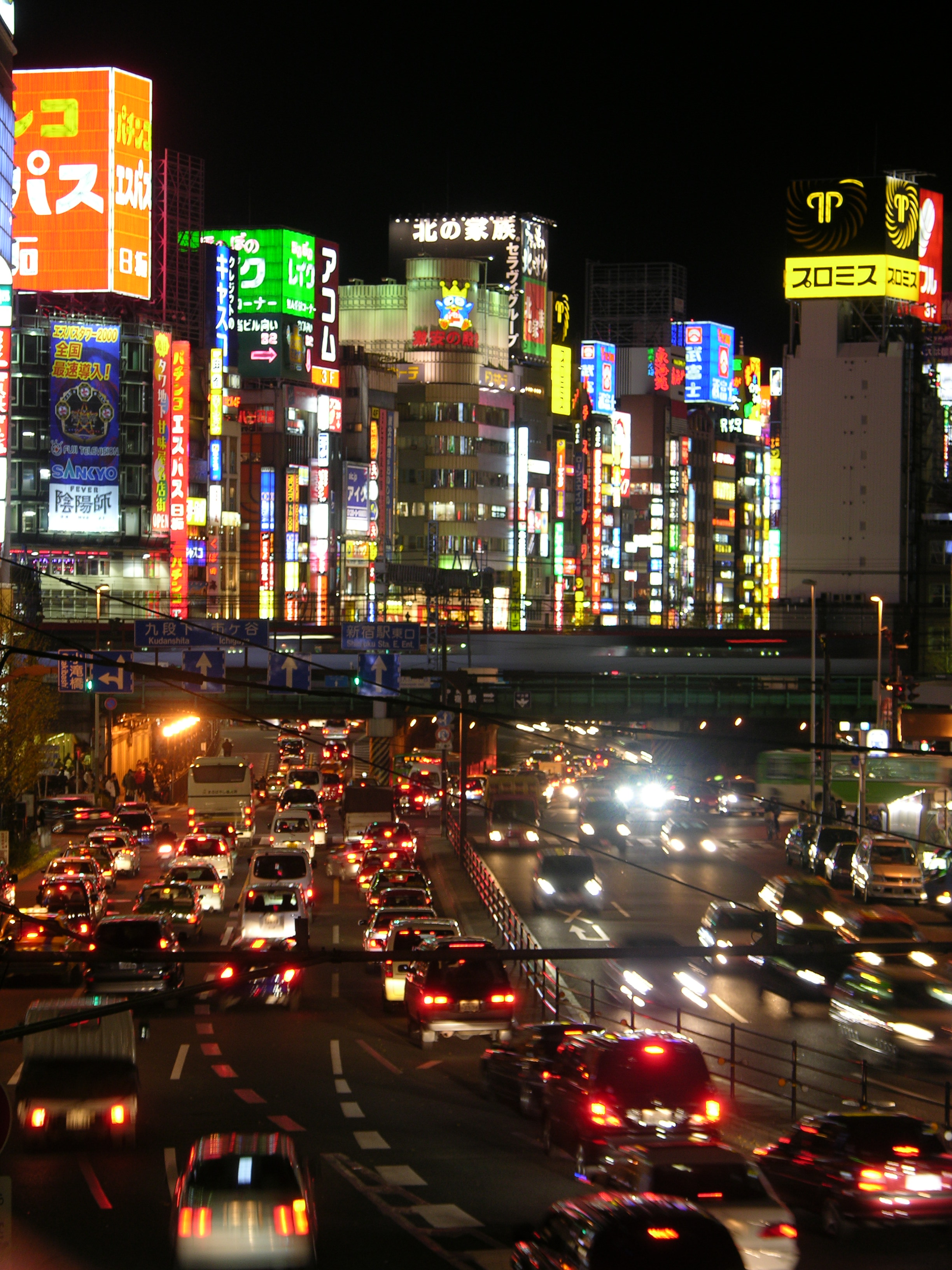
Shuto Expressway:
- No.4 Shinjuku Route (Miyakezaka JCT - Takaido)
- No.5 Ikebukuro Route (Takebashi JCT - Bijogi JCT)
National highways:
- National Route 20 (Shinjuku-dōri, Kōshū-kaidō)
Other major routes:
- Tokyo Metropolitan Route 8 (Mejiro-dōri, Shin-Mejiro-dōri)
- Tokyo Metropolitan Route 302 (Yasukuni-dōri, Ōme-kaidō)
- Tokyo Metropolitan Route 305 (Meiji-dōri)
Education
Colleges and universities
- Chuo University graduate school
- Gakushuin Women's College
- Keio University Medical College
- Kogakuin University
- Mejiro University
- Sophia University Mejiro Seibo Campus
- Tokyo Fuji University
- Tokyo Medical University
- Tokyo University of Science
- Tokyo Women's Medical University
- Waseda University
Moved:
- Lakeland University Japan (Sumida-ku)
Schools
High schools
Public high schools are operated by the Tokyo Metropolitan Government Board of Education.
- Shinjuku Yamabuki High School
- Tokyo Metropolitan Toyama High School
Closed:
Private schools:
- , private girls' school, affiliated with Gakushuin University and Gakushuin Women's College
- , private boys' school
- , private boys' school
- , private girls' school
- , private boys' school
- , private boys' school, affiliated with Waseda University
- Meijiro Kenshin Junior and Senior High School
Elementary and junior high schools
Main article: List of municipal schools in Shinjuku
Public elementary and junior high schools in Shinjuku are operated by the Shinjuku City (the Shinjuku Ward) Board of Education (新宿区教育委員会).
Notable people from Shinjuku-ku
- Shinzo Abe, Prime Minister of Japan
- Sugita Genpaku, physician and scholar
- Ichirō Hatoyama, Prime Minister of Japan
- Shinji Higuchi, filmmaker and storyboard artist
- Wakaba Higuchi, figure skater
- Minoru Kiuchi, politician
- Yoshiko Kuga, actress
- Tamiyo Kusakari, actress and ballet dancer
- Yuichiro Nagai, professional footballer
- Sanae Nakahara, actress
- Ken Ogata, actor
- Maya Okamoto, actress, voice actress and singer
- Mineho Ozaki, paralympic athlete
- Kōichi Satō, actor
- Takuma Sato, professional racing driver
- Shunsuke Shima, actor and voice actor
- Kaoru Sugita, actress and singer
- Jun Togawa, singer, musician and actress
- Kōsuke Toyohara, actor and singer
- Kyousei Tsukui, voice actor
- Takashi Ukaji, actor
- Atsuro Watabe, actor
- Koji Yamamoto, actor and singer
- Tatsuhiko Yamamoto, singer-songwriter and composer
- Takeshi Yoshioka, actor
- Kenichi Yoshizumi, politician and mayor of Shinjuku
Sister cities
Shinjuku has sister city agreements with several localities:
- GRC Lefkada, Greece
- DEU Mitte, Berlin, Germany
- PRC Dongcheng District, Beijing, China
- JPN Ina, Nagano, Japan
References
- Shinjuku Ward Office, History of Shinjuku
- Hiroo Ichikawa "Reconstructing Tokyo: The Attempt to Transform a Metropolis" in C. Hein, J.M. Diefendorf, and I. Yorifusa (Eds.) (2003). Building Urban Japan after 1945. New York: Palgrave.
References
- [http://www.city.shinjuku.tokyo.jp/foreign/english/aramashi/gaiyou/gaiyou.html Shinjuku City] {{webarchive. link. (2008-02-09)
- (9 April 2015). "Terrifying monster named Tokyo's new tourism ambassador". The Washington Post.
- "Population by District". Tokyo Statistical Yearbook.
- "Shinjuku City Outline - Foreign Language Top Page".
- [http://www.city.shinjuku.tokyo.jpn/foreign/english/aramashi/gaiyou/gaiyou.html Shinjuku City]{{Dead link. (May 2023)
- "Water Supply in Tokyo".
- [http://www.city.shinjuku.tokyo.jp/foreign/english/aramashi/rekishi/rekishi.html History of Shinjuku] {{webarchive. link. (2006-03-26)
- Ichikawa, 2003
- [http://www.la84foundation.org/6oic/OfficialReports/1964/or1964v2pt1.pdf 1964 Summer Olympics official report.] Volume 2. Part 1. p. 74.
- (7 October 2015). "Shinjuku Then and Now". GPlus Media Inc.
- (2021-02-12). "Tokyo rising: the story of Japan’s 'new wave'".
- "Visual Underground".
- Writer, Tadashi Yamauchi / Yomiuri Shimbun Staff. (2024-05-24). "Karagumi Theater Troupe Revives Beloved Play “Doro Ningyo;” Young Actors Carry on Performing Despite Playwright’s Death".
- Simone, Gianni. (April 10, 2018). "50 years of change".
- Parker, Clark. (2017-02-16). "(SJK1) Shinjuku Eastside Square, Fugetsudo, and the Greenwich Village of Tokyo".
- Michael, Chris. (2019-06-12). "Can 'guerrilla picnics' end Tokyo's 50-year war on public space?". The Guardian.
- (2019-10-22). "1969: Student Protesters Paralyze Tokyo in Anti-War Demonstrations (Published 2019)".
- "IV.資 料".
- "JapanVisitor Japan Travel Guide".
- "[http://www.epson.co.jp/e/company/head_office.htm Head Office & Japanese Facilities]." ''[[Seiko Epson]]''. Retrieved on January 13, 2009.
- (26 March 2015). "We tour Square Enix's awesome HQ since you probably never will".
- link. [[Yoshinoya]]
- "[http://www.his.co.jp/english/info.html Company Info]." [[H.I.S. (travel agency). H.I.S.]] Retrieved on March 11, 2010.
- "[http://www.fhi.co.jp/english/outline/inoutline/domestic/index.html] {{Webarchive. link. (July 15, 2012." [[Fuji Heavy Industries]] and [[Subaru]].)
- "[http://www.taisei.co.jp/english/profile/corp_data.html Corporate Data] {{Webarchive. link. (October 29, 2012 ." [[Taisei Corporation]]. Retrieved on February 20, 2012. "Head Office 1-25-1, Nishi-Shinjuku, Shinjuku-ku, Tokyo 163-0606")
- "[http://www.kumagaigumi.co.jp/english/corp/profile.html Corporate Profile] {{Webarchive. link. (December 9, 2017 ." [[Kumagai Gumi]]. Retrieved on August 30, 2017. "Headquarters 2-1, Tsukudo-cho, Shinjuku-ku, Tokyo 162-8557")
- "[http://www.nihonkohden.com/company/facts.html Key Facts]." [[Nihon Kohden]]. Retrieved on August 9, 2015.
- "[http://enoki-films.co.jp/index.html Home]." [[Enoki Films]]. Retrieved on March 23, 2014. "Enoki Bldg., No. 2, 1-30-10 Shinjuku, Shinjuku-ku, Tokyo 160-0022 Japan"
- "[http://www.jorudan.co.jp/english/access.html Headquarter]." [[Jorudan]]. Retrieved on January 7, 2011. "ZIP 160-0022 2-1-9 Shinjuku, Shinjuku-ku, Tokyo, Japan" ([http://www.jorudan.co.jp/english/image/map1.gif map])
- "[http://www.nissinfoods-holdings.co.jp/english/corp/over.html Company Profile]." [[Nissin Foods]]. Retrieved on August 15, 2009.
- "[https://www.keihin-corp.co.jp/english/company/outline.html Company Overview] {{Webarchive. link. (June 3, 2018 ." [[Keihin Corporation]]. Retrieved on May 23, 2018.)
- link. [[Airtransse]]
- link. [[Shinchosha]]. 〒162-8711 東京都新宿区矢来町71"
- link. [[Futabasha]]. 所在地 〒162-8540 東京都新宿区東五軒町3-28" ([http://www.futabasha.co.jp/company/image/map.gif GIF map of location]) ([http://www.futabasha.co.jp/company/image/map_futabasha.pdf PDF of location])
- "Resident nationalities of Shinjuku".
- (2018-07-25). "Chinatowns and Little Indias take shape in Tokyo". [[Nikkei Shimbun]].
- "Statistics Bureau Home Page".
- "Information on Everyday Living for Foreign Residents of Shinjuku City".
- "Description of Shinjuku".
This article was imported from Wikipedia and is available under the Creative Commons Attribution-ShareAlike 4.0 License. Content has been adapted to SurfDoc format. Original contributors can be found on the article history page.
Ask Mako anything about Shinjuku — get instant answers, deeper analysis, and related topics.
Research with MakoFree with your Surf account
Create a free account to save articles, ask Mako questions, and organize your research.
Sign up freeThis content may have been generated or modified by AI. CloudSurf Software LLC is not responsible for the accuracy, completeness, or reliability of AI-generated content. Always verify important information from primary sources.
Report