From Surf Wiki (app.surf) — the open knowledge base
Shimenawa
Lengths of laid rice straw or hemp rope used for ritual purification in Shinto
_by_Shunsai_Toshimasa_1889.jpg)
Lengths of laid rice straw or hemp rope used for ritual purification in Shinto
| Field | Value | |
|---|---|---|
| name | ja | |
| native_name | しめ縄 | |
| native_name_lang | ja | |
| image | Image:Hiyoshi-sha Okimura ac (3).jpg | |
| material | Hemp fiber/Straw | |
| <!-- | biggest | Izumo Taisha |
| width | 8 m | |
| long | 13.5 m | |
| weight | 5.2 kg-- | |
| location | Japan | |
| culture | Shinto |
are lengths of laid rice straw or hemp rope used for ritual purification in the Shinto religion.
ja vary in diameter from a few centimetres to several metres, and are often seen festooned with ja—traditional paper streamers. A space bound by ja typically indicates a sacred or ritually pure space, such as that of a Shinto shrine. ja are believed to act as a ward against evil spirits, and are often set up at a ground-breaking ceremony before construction begins on a new building. They are often found at Shinto shrines, ja gates, and sacred landmarks.
ja are also placed on ja, objects considered to attract spirits or be inhabited by them. These notably include being placed on certain trees, the spirits considered to inhabit them being known as ja. Cutting down these trees is thought to bring misfortune. In the case of stones considered to be inhabited by spirits, the stones are known as .
A variation of the ja are worn in sumo wrestling by ja (grand champions), during the entrance ceremony to debut as grand champion rank. In this instance, ja used by ja are seen as being living ja (a vessel capable of housing a spirit, known as ja when inhabited by a spirit), and are therefore visually distinguished as "sacred".
Shinto
ja originate in Shinto mythology as a hallowed sacrifice related to the Japanese gods called ja, and are used in various Shinto ceremonies. Aboriginal people in Japan have respected and revered ja since ancient times.
Origin of {{Transliteration|ja|shimenawa}}
The prototype of ja in Shinto is a rope of Amaterasu, Japan's "Heaven-shining great ja". According to "A popular dictionary of Shinto", Amaterasu hid in a cave called Amano-Iwato after an argument with her brother Susanoo. Therefore, the entire universe lost its luster. Other deities tried numerous ways to attract Amaterasu out of the cave. At the moment that Amaterasu left the cave, the ja Futo-tama used a magical rope that drew a line of demarcation between her and the cave, to avoid her returning to the cave. The rope became known as a ja. Because of the ja, the universe returned to its previous state.
Shinto shrines
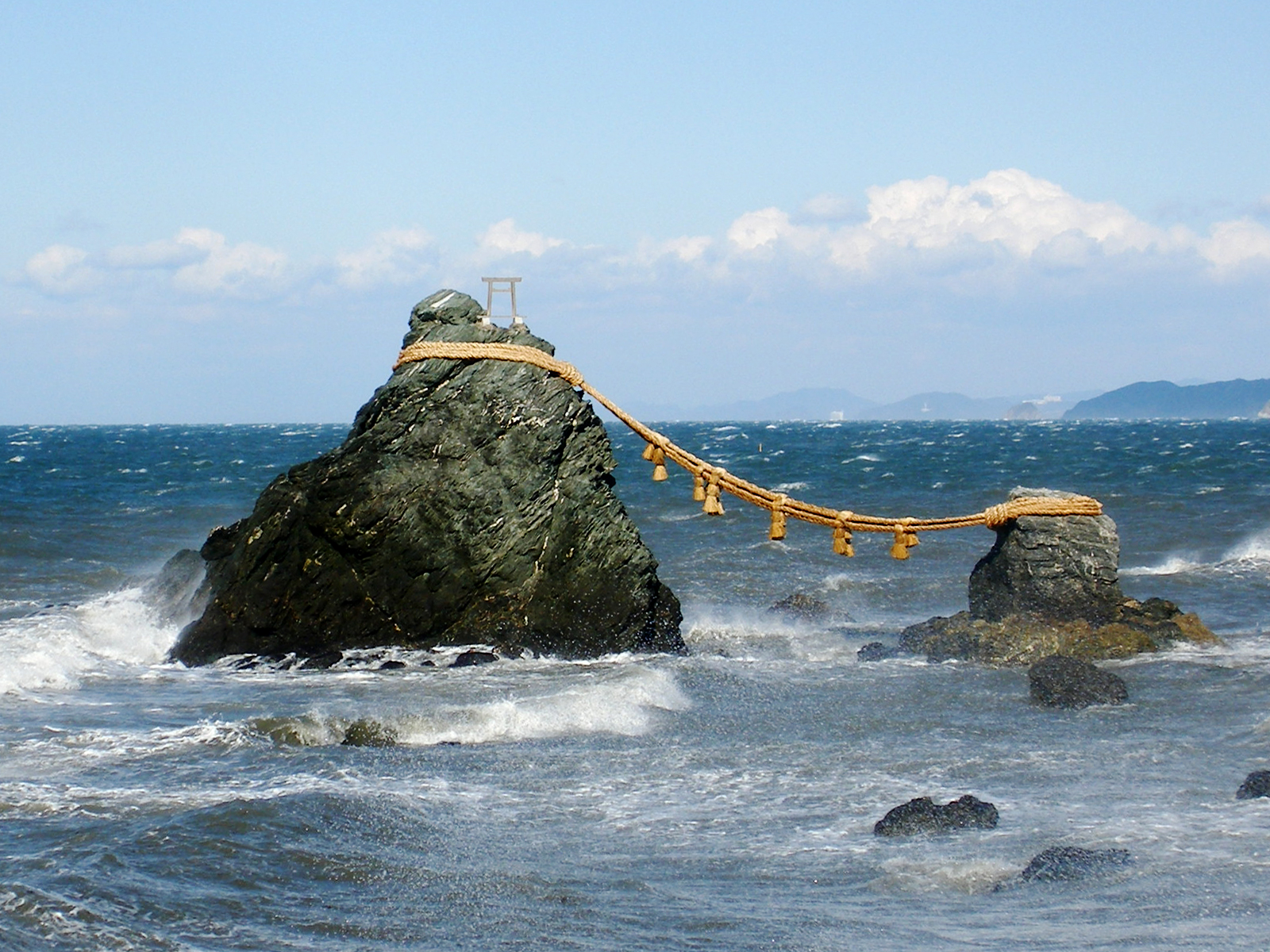
ja and nature have been a hallmark of Shinto shrines since in early times. The shrine in Shinto is a place for ja. Local people held rituals in shrines. Early shrines were not composed of classical buildings, with rocks, plants and ja instead marking their boundaries, as part of the Shinto respect for nature. In Shinto, all the sacred objects and nature were personified. Even a sword from a deceased Japanese warrior could be seen as the god because of its internal spirit and sense of awe. In modern-day society, there are still some sites that use ja to demarcate boundaries, such as the Nachi Falls in Kumano. A rock in Ise Bay is still connected by ja as well.
Types

ja usually appear in a shape similar to a twisted narrow rope with various decorations on it. Zig-zag paper and colorful streamers called ja commonly decorate ja. The size of ja differs from simple to complicated. In shrines, they are usually tapered and thick with a diameter of 6 ft.
Decorations
ja are decorated differently depending on the intended blessing and meaning.
- ja: a kind of bitter orange used to decorate ja. This combination is seen to bring good fortune and prosperity.
- ja or ja: folded white paper which stands for lightning, a symbol of fertility.
- Pine twigs: using pine twigs to decorate ja has a meaning of healthy growth for the next generation, as well as longevity of the elderly.
Biggest {{Transliteration|ja|shimenawa}} in Japan
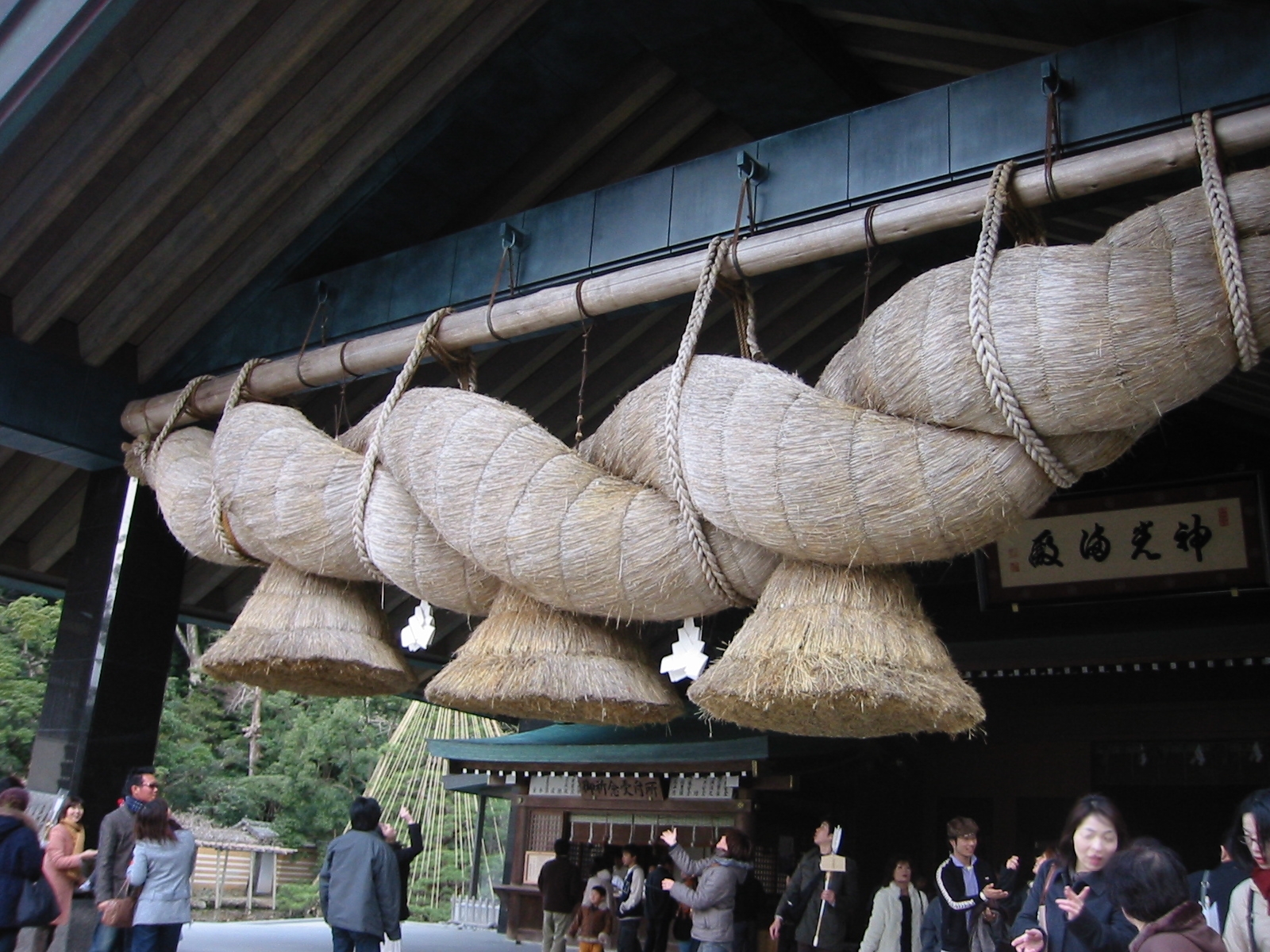
The biggest ja in Japan is located at Izumo Taisha Grand Shrine, which occupies over 27,000 sqm of land in Japan. The ja is 13.5 m in length and 8 m in width and was made by more than 800 indigenous people in Japan.
Use
In Mountain Opening Ceremony

ja are used in Japan's Mountain Opening Ceremony, which is held every May 1. There are over 100 Shinto believers who participate in this ceremony. It is a 2-hour journey that they climb from Akakura Mountain Shrine to Fudō Waterfall. The overall purpose is to carry the ja and fix it between two towering trees. When the ceremony is finished, people get together and celebrate.
In New Year's Celebration
In Japan's New Year celebration, ornaments such as ja decorate every household. During this time period, local residents usually hang it on the door in order to drive away evils.
{{Transliteration|ja|[[Hadaka Matsuri]]}}
ja are used in ja, Japan's Naked Festival. This festival has been held during the New Year period for more than 500 years. The festival's participants, who are all young men, wear nothing but a fundoshi in cold weather in order to show their strength and manliness. It also includes various activities such as 'jostling, climbing fighting with a wooden ball' as well as being sprayed with water. Sometimes these festivals are held in Shinto shrines. The participants put ja on the roof to wish them good luck for the upcoming year. ja are presented to the ja as a sacrifice in the shrine on New Year's day.
In sumo

Sumo, Japan's traditional national sport, still involves some elements of Shinto. Sumo matches are held in Shinto shrines, where the arena is demarcated by ja. Moreover, the grand champion (whose name, Yokozuna, means "horizontal rope" and refers to the ja) wears ja around his waist when making his entrance to the ring in a ceremony called ja.
Construction
Material and preparation process

Hemp fiber is the basic material used in the production of ja, and has been used since ancient times. In Shinto, hemp is regarded as a sacred food with a meaning of purity and fertility. After the Cannabis Control Act of 1948, when the growing of hemp was banned, straw began to be used instead as the raw material of ja. During the process of production, the straw stems are harvested between 70 and 80 days of growth, as beyond this, the quality of the fibre decreases as the plant starts to produce its seeds. After the ja straw is collected by machine, it is heated for more than 10 hours, to avoid the stems being dried by the sun. The best stems are then chosen by hand in order to create ja.
Related objects
{{Transliteration|ja|Heihaku}}
ja (also called ja or ja), a vertical wooden stick decorated with ja, cloth or metal called ja, usually in red or white, which is used priests in Shinto. People put ja in front of ja doors. In a procession called , ja are seen as a sacrifice for the gods or a symbol of the existence of the gods. In ancient times, people offered cloth to the Shinto shrines, similarly to today's processions. ja are also sometimes used in the way ja are. The stripes can also hang on the ja.
{{Transliteration|ja|Himorogi}}
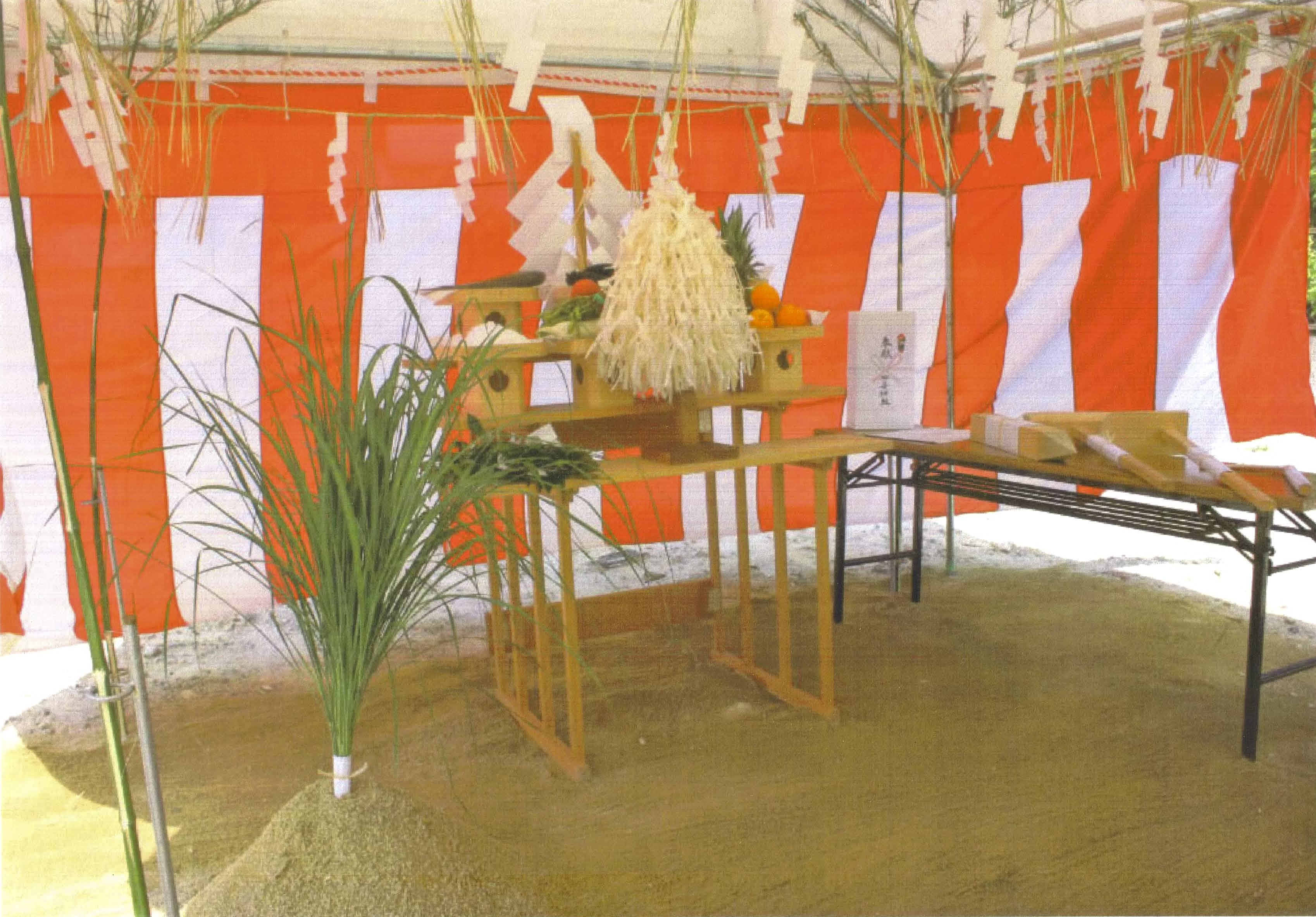
ja are the sacred spaces delimited by ja, which sometimes feature a cherry blossom tree surrounded by green plants appears, symbolising the seat of the gods.
{{Transliteration|ja|Kazari}}
Like ja, ja are also a New Year's decoration in Japan, consisting of a ja decorated with items related to rice like rice-cakes. The purpose of the ja is to bring good fortune to people.
{{Transliteration|ja|Kamidana}}
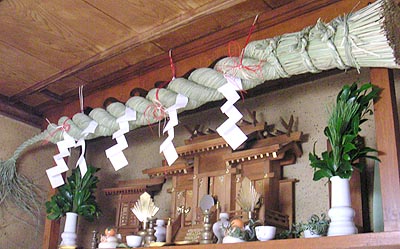
ja are a reduced version of ja used in daily life, and are thought to control rice, salt, and water which could bring people good luck. Therefore, it always appears in the business area such as restaurants as well as conventional industries. Places like the police stations and board ships will also feature ja.
Raijin
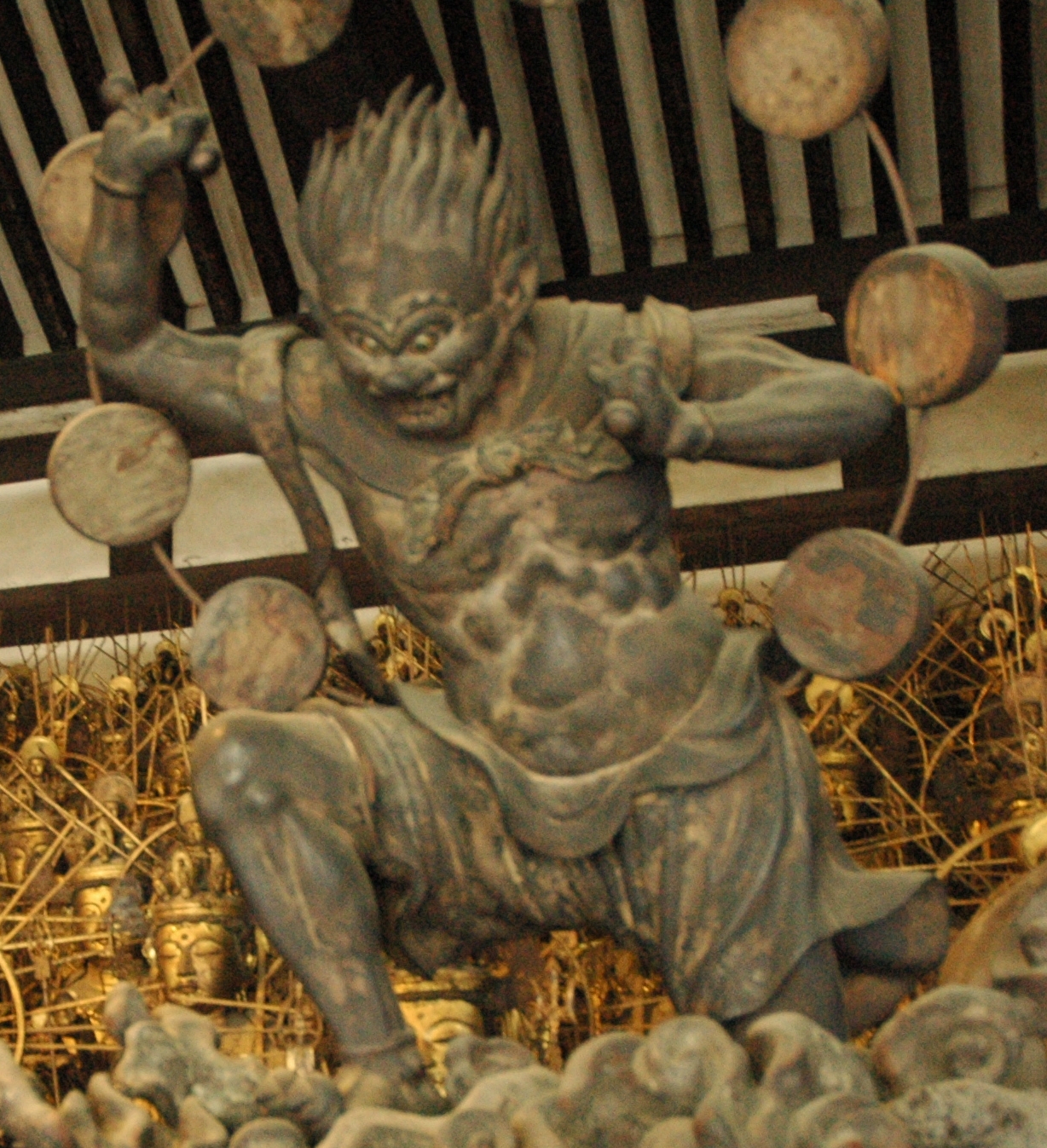
Raijin is the ja of thunder who also has power over drought. According to "A popular dictionary of Shinto", there is a custom in Japan which talks about ja and Raijin. Local residents in Japan's Kantō area put a ja between green bamboo after a bolt of lightning appears on the planted rice field out of gratitude to Raijin.
{{Transliteration|ja|Shinboku}}
A ja is a sacred tree located in a Shinto shrine sometimes indicated by ja. It also be seen as a god's ja. These trees surrounding the shrine are seen as part of the shrine itself.
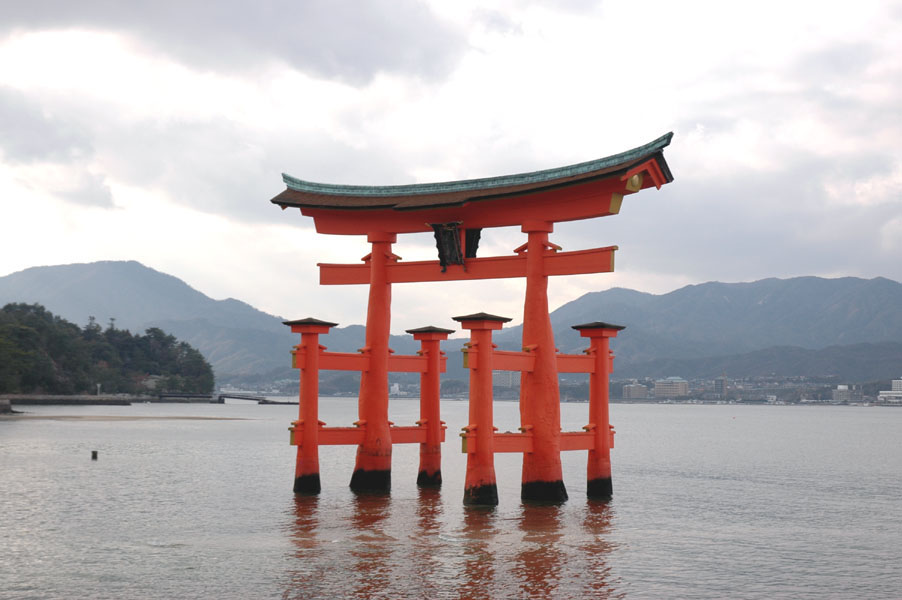
{{Transliteration|ja|Torii}}

ja are an archway composed of two round posts and two upper cross-beams. The ends of the cross-beams are typically curved, which is a symbol of a style called ja. There is an under-cross-beam just below the top individually.
ja first appeared in Japan at the time Chinese culture and Buddhism were introduced, though their exact origin, including the origin of their shape and name, is unknown; some researchers believe the name ja to have originally come from Sanskrit.
With the exception of the cross-beams, people also use ja to decorate ja. The type of ja using only ja as cross-beams is known as ja, which consist of only two posts and a ja; these ja are intended to be temporary instead of permanent.
In Japan, there are more than 20 different kinds of ja, varying from simple wood constructions to those made of concrete gates, typically used as gates to Shinto shrines. The style of ja is not strictly based on the style of shrine, and there could be more than one style of ja in one shrine.
Similar to ja, ja also have meaning in Shinto, representing a gate to the world, people, or any relationship. The purpose of ja and ja is the same, in bringing lost people to the ja-filled world.
In art
During the 2017 Yokohama Triennale, Indonesian artist Joko Avianto's artwork, "The border between good and evil is terribly frizzy", was displayed in the center of the hall in the Yokohama Museum of Art. The name, taken from the quote "The border between good and evil is terribly fuzzy" by Czech novelist Milan Kundera, changed 'fuzzy' to 'frizzy' because of the twisted, ja-inspired shape of his artwork. Avianto took the meaning of ja to separate 'the sacred and the profane', or 'the ideal and the secular', as inspiration in his work, using it to symbolise the boundary between 'the earth and heaven'.
{{Transliteration|ja|Shimenawa}} production in Taiwan

Taiwan's Miaoli County began to produce ja for export to Japan in 1998. In the late 1990s, Japanese manufacturers visited Taiwan and found the high quality of straw as well as the relatively low cost of producing it. However, as there were no local residents who knew how to make ja, the Japanese started to provide free classes for them to study the skills for producing ja. The ja industry in Taiwan developed rapidly, with many large ja factories appeared in Taiwan in the late 1990s. However, due to industrial disruption, most factories were forced to shut down a few years later, and only one factory was left to continue production. Other remaining factories chose to hand over the work to other Southeast Asian countries, particularly Vietnam, for a lower cost production. Later in 2005, a large number of ja orders were transferred back to Taiwan because buyers in Japan found that the quality of ja produced in Vietnam was poorer compared to those produced in Taiwan.
The craftsmen in Taiwan harvest the straw to make ja, while Japanese manufacturers provide samples or finished products to the customers according to their orders.
Image gallery
File:Izumo-taisha01nt3200.jpg File:Shimenawa at Izumo-Taisha.png File:Fuba Hachimangu 01.JPG File:Aoi Torblick.jpg File:Shimenawa-Meigetsuin.jpg File:Yuki_Shrine_-_giant_Sugi.jpg File:Syouhouji5851.jpg File:Meotoiwa.jpg File:注連縄.JPG File:Sacred straw rope at New Year's,shimenawa,katori-city,japan.jpg
References
References
- "Mie gov't rejects cannabis cultivation request for Shinto rituals".
- Cf. Kasulis (2004:17-23).
- "[http://ojisanjake.blogspot.jp/2010/03/shimenawa-rock.html Shimenawa & Rock]", ''[http://ojisanjake.blogspot.jp/ More glimpses of unfamiliar Japan],'' Thursday, March 18, 2010
- Bocking, Brian. (1995). "A Popular Dictionary of Shinto". Curzon Press.
- Swanson, Paul L. (2004-05-01). "Review of: Ellen Schattschneider, Immortal Wishes: Labor and Transcendence on a Japanese Sacred Mountain". Japanese Journal of Religious Studies.
- Evans, Marcus. (2014-05-01). "Shinto: An Experience of Being at Home in the World With Nature and With Others". Masters Theses & Specialist Projects.
- (2019). "Bauhaus Futures". The MIT Press.
- Jiao, Yupeng. (2020-11-17). "Rural Wandering Martial Arts Networks and Invulnerability Rituals in Modern China". Martial Arts Studies.
- Price, Stephanie. (2020-09-11). "Cannabis, hemp, CBD: the Japanese cannabis landscape".
- China (Taiwan), Ministry of Foreign Affairs, Republic of. (2009-02-01). "Hanging in There".
- Kasulis, Thomas P.. (2004-08-31). "Shinto". University of Hawaii Press.
- "Joko Avianto at the Yokohama Triennale 2017. Nafas Art Magazine".
This article was imported from Wikipedia and is available under the Creative Commons Attribution-ShareAlike 4.0 License. Content has been adapted to SurfDoc format. Original contributors can be found on the article history page.
Ask Mako anything about Shimenawa — get instant answers, deeper analysis, and related topics.
Research with MakoFree with your Surf account
Create a free account to save articles, ask Mako questions, and organize your research.
Sign up freeThis content may have been generated or modified by AI. CloudSurf Software LLC is not responsible for the accuracy, completeness, or reliability of AI-generated content. Always verify important information from primary sources.
Report