From Surf Wiki (app.surf) — the open knowledge base
Shiloh National Military Park
Historic Civil War site in Hardin County, Tennessee
Historic Civil War site in Hardin County, Tennessee
| Field | Value |
|---|---|
| name | Shiloh National Military Park |
| photo | Shiloh Church.jpg |
| photo_caption | Shiloh Church replica |
| map | Tennessee#Mississippi#USA |
| relief | 1 |
| location | Shiloh, Hardin County, Tennessee & Corinth, Mississippi, US |
| nearest_city | Savannah, Tennessee |
| coordinates | |
| area_acre | 9324 |
| area_ref | |
| established | December 27, 1894 |
| visitation_num | 371,735 |
| visitation_year | 2023 |
| governing_body | National Park Service |
| website | Shiloh National Military Park |
Shiloh National Military Park preserves the American Civil War Shiloh and Corinth battlefields. The main section of the park is in the unincorporated community of Shiloh, about 9 mi south of Savannah, Tennessee, with additional areas located in the city of Corinth, Mississippi, 23 mi southwest of Shiloh and the Parker's Crossroads Battlefield in the city of Parkers Crossroads, Tennessee. The Battle of Shiloh (April 6–7, 1862) began a six-month struggle for the key railroad junction at Corinth. Afterward, Union forces marched from Pittsburg Landing to take Corinth in a May siege, then withstood an October Confederate counter-attack.
The visitor center provides exhibitions, films and a self-guided auto-tour.
Shiloh battlefield
Main article: Battle of Shiloh
The Battle of Shiloh was one of the first major battles in the Western Theater of the American Civil War. The two-day battle, April 6–7, 1862, involved about 65,000 Union troops under Ulysses S. Grant and Don Carlos Buell and 44,000 Confederates under Albert Sidney Johnston (killed in the battle) and P.G.T. Beauregard. The battle resulted in nearly 24,000 killed, wounded, and missing. The two days of fighting did not end in a decisive tactical victory for either side—the Union held the battlefield but failed to pursue the withdrawing Confederate forces. However, it was a decisive strategic defeat for the Confederate forces that had massed to oppose Grant's and Buell's invasion through Tennessee. After the Battle of Shiloh, the Union forces proceeded to capture Corinth and the critical railroad junction there.
The battlefield is named after Shiloh Methodist Church, a small log church near Pittsburg Landing, Tennessee. Pittsburg Landing is the point on the Tennessee River where the Union forces landed for the battle; they referred to the battle as "The Battle of Pittsburg Landing".
Image:Iowa Monument, Shiloh National Military Park.JPG|Iowa Monument File:Sunken Road, Shiloh National Military Park.JPG|The Sunken Road Image:Confederate Memorial Shiloh National Military Park.jpg| Confederate Memorial Image:Union Cemetery, Shiloh National Military Park.JPG|Shiloh National Cemetery
Park information
- Total area: 3,997 acre
- Federal area: 3,942 acre
- Nonfederal area: 55 acre
The Shiloh National Military Park was established on December 27, 1894. In 1904, Basil W. Duke was appointed commissioner of Shiloh National Military Park by President Theodore Roosevelt. There were requests of local farmers who had grown tired of their pigs rooting up the remains of soldiers that had fallen during the battle, insisting that the federal government do something about it. The park was transferred from the War Department to the National Park Service on August 10, 1933. As with all historic areas administered by the National Park Service, the military park was listed on the National Register of Historic Places on October 15, 1966. On September 22, 2000, sites associated with the Corinth battlefield (see First and Second Battles of Corinth) were added to the park. The Siege and Battle of Corinth Sites was designated a National Historic Landmark on May 6, 1991. The National Park Travelers Club held its 2013 convention at Shiloh. As of early 2024, the American Battlefield Trust and its federal, state and local partners have acquired and preserved 1,554 acres of the battlefield in more than 26 different transactions since 2001. Most of this land has been sold or conveyed to the National Park Service and incorporated into the park.
Visitor center
Permanent exhibitions, films, displays and self-guided 12-mile auto-tour, stopping at the Peach Orchard, the Hornet's Nest and General Johnston's death site.
Shiloh National Cemetery
Shiloh National Cemetery is in the northeast corner of the park adjacent to the visitor center and bookstore. Buried within its 20.09 acre are 3,584 Union dead (of whom 2,357 are unknown), who were re-interred in the cemetery created after the war, in 1866. There are two Confederate dead interred in the cemetery. The cemetery operations were transferred from War Department to the National Park Service in 1933. An unknown number of Confederate dead are interred in mass graves in the park.
Shiloh Indian Mounds Site
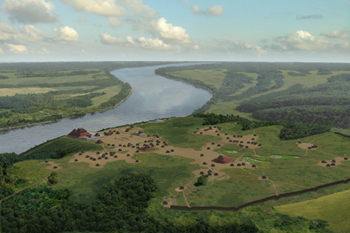
The Shiloh battlefield has within its boundaries the well preserved prehistoric Shiloh Indian Mounds Site, which is also a National Historic Landmark. The site was inhabited during the Early Mississippian period from about 1000 to 1450.
References
- The National Parks: Index 2001–2003. Washington: U.S. Department of the Interior.
References
- {{NPS area. (2020)
- "Park Anniversaries".
- Known Southern History
- "Siege and Battle of Corinth Sites". National Park Service.
- (January 8, 1991). ["National Register of Historic Places Registration: Siege and Battle of Corinth Sites"]({{NHLS url). National Park Service.
- "National Park Travelers Club 2013 Convention Preview". NPTC.
- [https://www.battlefields.org/preserve/saved-land] [[American Battlefield Trust]] "Saved Land" webpage. Accessed June 9, 2024.
- {{GNIS. 1323947. Shiloh National Cemetery at {{coord. 35. 09. 02. N. 88. 19. 12. W. source:GNIS
- Paul D. Welch. (2005). "Archaeology at Shiloh Indian Mounds, 1899–1999". University of Alabama Press.
This article was imported from Wikipedia and is available under the Creative Commons Attribution-ShareAlike 4.0 License. Content has been adapted to SurfDoc format. Original contributors can be found on the article history page.
Ask Mako anything about Shiloh National Military Park — get instant answers, deeper analysis, and related topics.
Research with MakoFree with your Surf account
Create a free account to save articles, ask Mako questions, and organize your research.
Sign up freeThis content may have been generated or modified by AI. CloudSurf Software LLC is not responsible for the accuracy, completeness, or reliability of AI-generated content. Always verify important information from primary sources.
Report