From Surf Wiki (app.surf) — the open knowledge base
Shield volcano
Low-profile volcano usually formed almost entirely of fluid lava flows
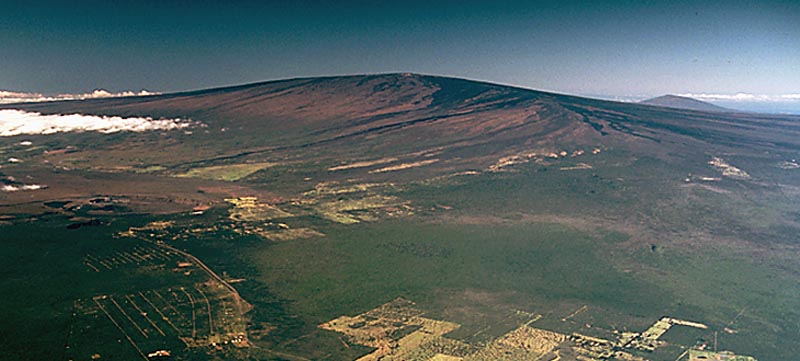
Low-profile volcano usually formed almost entirely of fluid lava flows

A shield volcano is a type of volcano named for its low profile, resembling a shield lying on the ground. It is formed by the eruption of highly fluid (low viscosity) lava, which travels farther and forms thinner flows than the more viscous lava erupted from a stratovolcano. Repeated eruptions result in the steady accumulation of broad sheets of lava, building up the shield volcano's distinctive form.
Shield volcanoes are found wherever fluid, low-silica lava reaches the surface of a rocky planet. However, they are most characteristic of ocean island volcanism associated with hot spots or with continental rift volcanism. They include the largest active volcanoes on Earth, such as Mauna Loa. Giant shield volcanoes are found on other planets of the Solar System, including Olympus Mons on Mars and Sapas Mons on Venus.
Etymology
The term 'shield volcano' is taken from the German term Schildvulkan, coined by the Austrian geologist Eduard Suess in 1888 and which had been calqued into English by 1910.
Geology
Structure
Shield volcanoes are distinguished from the three other major volcanic types—stratovolcanoes, lava domes, and cinder cones—by their structural form, a consequence of their particular magmatic composition. Of these four forms, shield volcanoes erupt the least viscous lavas. Whereas stratovolcanoes and lava domes are the product of highly viscous flows, and cinder cones are constructed of explosively eruptive tephra, shield volcanoes are the product of gentle effusive eruptions of highly fluid lavas that produce, over time, a broad, gently sloped eponymous "shield". an example of a felsic shield is the Ilgachuz Range in British Columbia, Canada. Shield volcanoes are similar in origin to vast lava plateaus and flood basalts present in various parts of the world. These are eruptive features which occur along linear fissure vents and are distinguished from shield volcanoes by the lack of an identifiable primary eruptive center.
Active shield volcanoes experience near-continuous eruptive activity over extremely long periods of time, resulting in the gradual build-up of edifices that can reach extremely large dimensions. With the exclusion of flood basalts, mature shields are the largest volcanic features on Earth. The summit of the largest subaerial volcano in the world, Mauna Loa, lies 4169 m above sea level, and the volcano, over 60 mi wide at its base, is estimated to contain about 80000 km3 of basalt. The mass of the volcano is so great that it has slumped the crust beneath it a further 8 km. Accounting for this subsidence and for the height of the volcano above the sea floor, the "true" height of Mauna Loa from the start of its eruptive history is about 17170 m. Mount Everest, by comparison, is 8848 m in height. In 2013, a team led by the University of Houston's William Sager announced the discovery of Tamu Massif, an enormous extinct submarine volcano, approximately 450 by in area, which dwarfs all previously known volcanoes on Earth. However, the extents of the volcano have not been confirmed. Although Tamu Massif was initially believed to be a shield volcano, Sanger and his colleagues acknowledged in 2019 that Tamu Massif is not a shield volcano.
Shield volcanoes feature a gentle (usually 2° to 3°) slope that gradually steepens with elevation (reaching approximately 10°) before flattening near the summit, forming an overall upwardly convex shape. These slope characteristics have a correlation with age of the forming lava, with in the case of the Hawaiian chain, steepness increasing with age, as later lavas tend to be more alkali so are more viscous, with thicker flows, that travel less distance from the summit vents. In height they are typically about one twentieth their width. Although the general form of a "typical" shield volcano varies little worldwide, there are regional differences in their size and morphological characteristics. Typical shield volcanoes found in California and Oregon measure 3 to in diameter and 1500 to in height,
Rift zones are a prevalent feature on shield volcanoes that is rare on other volcanic types. The large, decentralized shape of Hawaiian volcanoes as compared to their smaller, symmetrical Icelandic cousins
Eruptive characteristics
Most of what is currently known about shield volcanic eruptive character has been gleaned from studies done on the volcanoes of Hawaii Island, by far the most intensively studied of all shields because of their scientific accessibility; the island lends its name to the slow-moving, effusive eruptions typical of shield volcanism, known as Hawaiian eruptions. These eruptions, the least explosive of volcanic events, are characterized by the effusive emission of highly fluid basaltic lavas with low gaseous content. These lavas travel a far greater distance than those of other eruptive types before solidifying, forming extremely wide but relatively thin magmatic sheets often less than 1 m thick. Low volumes of such lavas layered over long periods of time are what slowly constructs the characteristically low, broad profile of a mature shield volcano.
Also unlike other eruptive types, Hawaiian eruptions often occur at decentralized fissure vents, beginning with large "curtains of fire" that quickly die down and concentrate at specific locations on the volcano's rift zones. Central-vent eruptions, meanwhile, often take the form of large lava fountains (both continuous and sporadic), which can reach heights of hundreds of meters or more. The particles from lava fountains usually cool in the air before hitting the ground, resulting in the accumulation of cindery scoria fragments; however, when the air is especially thick with pyroclasts, they cannot cool off fast enough because of the surrounding heat, and hit the ground still hot, accumulating into spatter cones. If eruptive rates are high enough, they may even form splatter-fed lava flows. Hawaiian eruptions are often extremely long-lived; Puʻu ʻŌʻō, a cinder cone of Kīlauea, erupted continuously from January 3, 1983, until April 2018.
Flows from Hawaiian eruptions can be divided into two types by their structural characteristics: pāhoehoe lava which is relatively smooth and flows with a ropey texture, and ʻaʻā flows which are denser, more viscous (and thus slower moving) and blockier. These lava flows can be anywhere between 2 and thick. Aā lava flows move through pressure— the partially solidified front of the flow steepens because of the mass of flowing lava behind it until it breaks off, after which the general mass behind it moves forward. Though the top of the flow quickly cools down, the molten underbelly of the flow is buffered by the solidifying rock above it, and by this mechanism, aā flows can sustain movement for long periods of time. Pāhoehoe flows, in contrast, move in more conventional sheets, or by the advancement of lava "toes" in snaking lava columns. Increasing viscosity on the part of the lava or shear stress on the part of local topography can morph a pāhoehoe flow into an ʻaʻā one, but the reverse never occurs.
Although most shield volcanoes are by volume almost entirely Hawaiian and basaltic in origin, they are rarely exclusively so. Some volcanoes, such as Mount Wrangell in Alaska and Cofre de Perote in Mexico, exhibit large enough swings in their historical magmatic eruptive characteristics to cast strict categorical assignment in doubt; one geological study of de Perote went so far as to suggest the term "compound shield-like volcano" instead. Most mature shield volcanoes have multiple cinder cones on their flanks, the results of tephra ejections common during incessant activity and markers of currently and formerly active sites on the volcano.
The Hawaiian shield volcanoes are not located near any plate boundaries; the volcanic activity of this island chain is distributed by the movement of the oceanic plate over an upwelling of magma known as a hotspot. Over millions of years, the tectonic movement that moves continents also creates long volcanic trails across the seafloor. The Hawaiian and Galápagos shields, and other hotspot shields like them, are constructed of oceanic island basalt. Their lavas are characterized by high levels of sodium, potassium, and aluminium.
Features common in shield volcanism include lava tubes. Lava tubes are cave-like volcanic straights formed by the hardening of overlaying lava. These structures help further the propagation of lava, as the walls of the tube insulate the lava within. Lava tubes can account for a large portion of shield volcano activity; for example, an estimated 58% of the lava forming Kīlauea comes from lava tubes.
In some shield volcano eruptions, basaltic lava pours out of a long fissure instead of a central vent, and shrouds the countryside with a long band of volcanic material in the form of a broad plateau. Plateaus of this type exist in Iceland, Washington, Oregon, and Idaho; the most prominent ones are situated along the Snake River in Idaho and the Columbia River in Washington and Oregon, where they have been measured to be over 1 mi in thickness.
Calderas are a common feature on shield volcanoes. They are formed and reformed over the volcano's lifespan. Long eruptive periods form cinder cones, which then collapse over time to form calderas. The calderas are often filled up by progressive eruptions, or formed elsewhere, and this cycle of collapse and regeneration takes place throughout the volcano's lifespan.
Interactions between water and lava at shield volcanoes can cause some eruptions to become hydrovolcanic. These explosive eruptions are drastically different from the usual shield volcanic activity and are especially prevalent at the waterbound volcanoes of the Hawaiian Isles.
File:Aa large.jpg|Aa advances over solidified pāhoehoe on Kīlauea, Hawaii File:Pahoeoe fountain original.jpg|A pāhoehoe lava fountain on Kīlauea erupts File:Erta-ale lac-de-lave 2001.jpg|A lava lake in the caldera of Erta Ale, an active shield volcano in Ethiopia File:Pāhoehoe lava meets Pacific.jpg|Pāhoehoe flows enter the Pacific Ocean on Hawaii island File:Puu Oo cropped.jpg|Puʻu ʻŌʻō, a parasitic cinder cone on Kīlauea, lava fountaining at dusk in June 1983, near the start of its eruptive cycle File:Thurston Lava Tube, Big Island.jpg| Nāhuku, a lava tube on Hawaii island, now a tourist attraction in the Hawaiʻi Volcanoes National Park
Distribution
Main article: List of shield volcanoes
Shield volcanoes are found worldwide. They can form over hotspots (points where magma from below the surface wells up), such as the Hawaiian–Emperor seamount chain and the Galápagos Islands, or over more conventional rift zones, such as the Icelandic shields and the shield volcanoes of East Africa. Although shield volcanoes are not usually associated with subduction, they can occur over subduction zones. Many examples are found in California and Oregon, including Prospect Peak in Lassen Volcanic National Park, as well as Pelican Butte and Belknap Crater in Oregon. Many shield volcanoes are found in ocean basins, such as Kīlauea in Hawaii, although they can be found inland as well—East Africa being one example of this.
Hawaiian–Emperor seamount chain
The largest and most prominent shield volcano chain in the world is the Hawaiian–Emperor seamount chain, a chain of hotspot volcanoes in the Pacific Ocean. The volcanoes follow a distinct evolutionary pattern of growth and death. The chain contains at least 43 major volcanoes, and Meiji Seamount at its terminus near the Kuril–Kamchatka Trench is 85 million years old.
The youngest part of the chain is Hawaii, where the volcanoes are characterized by frequent rift eruptions, their large size (thousands of km3 in volume), and their rough, decentralized shape. Rift zones are a prominent feature on these volcanoes and account for their seemingly random volcanic structure.
The chain includes Mauna Loa, a shield volcano which stands 4170 m above sea level and reaches a further 13 km below the waterline and into the crust, approximately 80000 km3 of rock. Kīlauea, another Hawaiian shield volcano, is one of the most active volcanoes on Earth, with its most recent eruption occurring in 2021.
Galápagos Islands
The Galápagos Islands are an isolated set of volcanoes, consisting of shield volcanoes and lava plateaus, about 1100 km west of Ecuador. They are driven by the Galápagos hotspot, and are between approximately 4.2 million and 700,000 years of age. The Galápagos Islands are perched on a large lava plateau known as the Galápagos Platform. This platform creates a shallow water depth of 360 to at the base of the islands, which stretch over a 174 mi diameter.
Cerro Azul is a shield volcano on the southwestern part of Isabela Island and is one of the most active in the Galapagos, with the last eruption between May and June 2008. The Geophysics Institute at the National Polytechnic School in Quito houses an international team of seismologists and volcanologists whose responsibility is to monitor Ecuador's numerous active volcanoes in the Andean Volcanic Belt and the Galapagos Islands. La Cumbre is an active shield volcano on Fernandina Island that has been erupting since April 11, 2009.
The Galápagos islands are geologically young for such a big chain, and the pattern of their rift zones follows one of two trends, one north-northwest, and one east–west. The composition of the lavas of the Galápagos shields are strikingly similar to those of the Hawaiian volcanoes. They do not form the same volcanic "line" associated with most hotspots. They are not alone in this regard; the Cobb–Eickelberg Seamount chain in the North Pacific is another example of such a delineated chain. In addition, there is no clear pattern of age between the volcanoes, suggesting a complicated, irregular pattern of creation. How the islands were formed remains a geological mystery, although several theories have been proposed.
Iceland

Located over the Mid-Atlantic Ridge, a divergent tectonic plate boundary in the middle of the Atlantic Ocean, Iceland is the site of about 130 volcanoes of various types. Icelandic shield volcanoes are generally of Holocene age, between 5,000 and 10,000 years old. The volcanoes are also very narrow in distribution, occurring in two bands in the West and North Volcanic Zones. Like Hawaiian volcanoes, their formation initially begins with several eruptive centers before centralizing and concentrating at a single point. The main shield then forms, burying the smaller ones formed by the early eruptions with its lava.
Icelandic shields are mostly small (~15 km3), symmetrical (although this can be affected by surface topography), and characterized by eruptions from summit calderas. They are composed of either tholeiitic olivine or picritic basalt. The tholeiitic shields tend to be wider and shallower than the picritic shields. They do not follow the pattern of caldera growth and destruction that other shield volcanoes do; caldera may form, but they generally do not disappear.
Turkey
Bingöl Mountains are one of the shield volcanoes in Turkey.
East Africa
In East Africa, volcanic activity is generated by the development of the East African Rift and from nearby hotspots. Some volcanoes interact with both. Shield volcanoes are found near the rift and off the coast of Africa, although stratovolcanoes are more common. Although sparsely studied, the fact that all of its volcanoes are of Holocene age reflects how young the volcanic center is. One interesting characteristic of East African volcanism is a penchant for the formation of lava lakes; these semi-permanent lava bodies, extremely rare elsewhere, form in about 9% of African eruptions.
The most active shield volcano in Africa is Nyamuragira. Eruptions at the shield volcano are generally centered within the large summit caldera or on the numerous fissures and cinder cones on the volcano's flanks. Lava flows from the most recent century extend down the flanks more than 30 km from the summit, reaching as far as Lake Kivu. Erta Ale in Ethiopia is another active shield volcano and one of the few places in the world with a permanent lava lake, which has been active since at least 1967, and possibly since 1906. and Mount Marsabit in Kenya.
Extraterrestrial shield volcanoes

Shield volcanoes are not limited to Earth; they have been found on Mars, Venus, and Jupiter's moon, Io.
The shield volcanoes of Mars are very similar to the shield volcanoes on Earth. On both planets, they have gently sloping flanks, collapse craters along their central structure, and are built of highly fluid lavas. Volcanic features on Mars were observed long before they were first studied in detail during the 1976–1979 Viking mission. The principal difference between the volcanoes of Mars and those on Earth is in terms of size; Martian volcanoes range in size up to 14 mi high and 370 mi in diameter, far larger than the 6 mi high, 74 mi wide Hawaiian shields. The highest of these, Olympus Mons, is the tallest known mountain on any planet in the solar system.
Venus has over 150 shield volcanoes which are much flatter, with a larger surface area than those found on Earth, some having a diameter of more than 700 km. Although the majority of these are long extinct it has been suggested, from observations by the Venus Express spacecraft, that many may still be active.
References
References
- (2003). "Volcanism". Springer.
- (2004). "Morphometric properties of Martian volcanoes". Journal of Geophysical Research.
- (1994). "Sapas Mons, Venus: evolution of a large shield volcano". Earth, Moon, and Planets.
- Douglas Harper. (2010). "Shield volcano". Douglas Harper.
- [https://www.oed.com/view/Entry/178068?redirectedFrom=shield+volcano#eid22885288 "Shield volcano"] at [[Oxford English Dictionary]]
- John Watson. (1 March 2011). "Principal Types of Volcanoes". United States Geological Survey.
- Although the term is generally applied to [[basaltic]] shields, it has also at times been applied to rarer [[wikt:scutiform. scutiform]] volcanoes of differing magmatic composition—principally [[pyroclastic shield]]s, formed by the accumulation of fragmentary material from particularly powerful explosive eruptions, and rarer [[felsic]] lava shields formed by unusually fluid felsic magmas. Examples of pyroclastic shields include [[Billy Mitchell (volcano). Billy Mitchell]] volcano in [[Papua New Guinea]] and the [[Purico complex]] in [[Chile]];{{cite gvp
- {{cite gvp
- (1990). "Volcanoes of North America: United States and Canada". [[Cambridge University Press]].
- "Shield Volcanoes". University of North Dakota.
- J.G. Moore. (1987). "Volcanism in Hawaii".
- (20 August 1998). "How High is Mauna Loa?". Hawaiian Volcano Observatory – United States Geological Survey.
- Navin Singh Khadka. (28 February 2012). "Nepal in new bid to finally settle Mount Everest height". BBC News.
- Brian Clark Howard. (5 September 2013). "New Giant Volcano Below Sea Is Largest in the World".
- Sanger, W.. (2019). "Oceanic plateau formation by seafloor spreading implied by Tamu Massif magnetic anomalies". Nature Geoscience.
- (1992). "Morphology of the Island of Hawaii". GSA Today.
- "How Volcanoes Work: Shield Volcanoes". San Diego State University.
- Hasenaka, T.. (October 1994). "Size, distribution, and magma output rate for shield volcanoes of the Michoacán-Guanajuato volcanic field, Central Mexico". [[Journal of Volcanology and Geothermal Research]].
- (September 2013). "A new model for the growth of basaltic shields based on deformation of Fernandina volcano, Galápagos Islands". [[Earth and Planetary Science Letters]].
- (2003). "Geochemistry of Lavas from the Emperor Seamounts, and the Geochemical Evolution of Hawaiian Magmatism from 85 to 42 Ma". Journal of Petrology.
- Topinka, Lyn. (28 December 2005). "Description: Shield Volcano". USGS.
- "How Volcanoes Work: Basaltic Lava". San Diego State University.
- Gerardo Carrasco-Núñeza. (30 November 2010). "Evolution and hazards of a long-quiescent compound shield-like volcano: Cofre de Perote, Eastern Trans-Mexican Volcanic Belt". [[Journal of Volcanology and Geothermal Research]].
- (4 October 2008). "Summary of the Pu'u 'Ō 'ō-Kupaianaha Eruption, 1983-present". United States Geological Survey - Hawaii Volcano Observatory.
- (17 July 2009). "VHP Photo Glossary: Shield volcano". USGS.
- Topinka, Lyn. (18 April 2002). "Description: Lava Tubes and Lava Tube Caves". USGS.
- (2006). "The changing Earth : exploring geology and evolution". Brooks/Cole.
- (8 September 1995). "Evolution of Hawaiian Volcanoes". Hawaiian Volcano Observatory - United States Geological Survey.
- Regelous, M.. (2003). "Geochemistry of Lavas from the Emperor Seamounts, and the Geochemical Evolution of Hawaiian Magmatism from 85 to 42 Ma". [[Journal of Petrology]].
- "How Volcanoes Work: Galapagos Shield Volcanoes". San Diego State University.
- "Volcanoes". Galapagos Online Tours and Cruises.
- "Volcanoes of South America: Galápagos Islands". Smithsonian National Museum of Natural History.
- "Volcanic Galapagos: Formation of an Oceanic Archipelago". University of Oregon.
- [http://www.igepn.edu.ec/ Institute for Geophysics at National Polytechnic School ]
- (October 22, 2015). "Galapagos volcano erupts, could threaten wildlife".
- Bailey, K.. (30 April 1976). "Potassium-Argon Ages from the Galapagos Islands". [[Science (journal).
- (2006). "Holocene shield volcanoes in Iceland". University of Göttingen.
- Rossi, M. J.. (1996). "Morphology and mechanism of eruption of postglacial shield volcanoes in Iceland". [[Bulletin of Volcanology]].
- Lyn Topinka. (2 October 2003). "Africa Volcanoes and Volcanics". United States Geological Survey.
- "Menengai". Smithsonian National Museum of Natural History.
- (1999). "Space Encyclopedia". Dorling Kindersley.
- Watson, John. (February 5, 1997). "Extraterrestrial Volcanism". United States Geological Survey.
- (1973). "An Overview of Geological Results from Mariner 9". [[Journal of Geophysical Research]].
- Carr, M.H., 2006, The Surface of Mars, Cambridge, 307 p.
- "Large Shield Volcanoes". Oregon State University.
- Nancy Atkinson. (8 April 2010). "Volcanoes on Venus May Still Be Active". [[Universe Today]].
This article was imported from Wikipedia and is available under the Creative Commons Attribution-ShareAlike 4.0 License. Content has been adapted to SurfDoc format. Original contributors can be found on the article history page.
Ask Mako anything about Shield volcano — get instant answers, deeper analysis, and related topics.
Research with MakoFree with your Surf account
Create a free account to save articles, ask Mako questions, and organize your research.
Sign up freeThis content may have been generated or modified by AI. CloudSurf Software LLC is not responsible for the accuracy, completeness, or reliability of AI-generated content. Always verify important information from primary sources.
Report