From Surf Wiki (app.surf) — the open knowledge base
Sherwood Forest
Royal forest in Nottinghamshire, England

Royal forest in Nottinghamshire, England
| Field | Value |
|---|---|
| iucn_category | IV |
| iucn_ref | |
| photo | Sherwood Forest, May, 2017-5.jpg |
| map | England |
| relief | yes |
| county | Nottinghamshire |
| country | England |
| coordinates | |
| governing_body | Royal Society for the Protection of Birds (RSPB), Nottinghamshire County Council, Forestry England |
| website | https://visitsherwood.co.uk/ |
Geological
Sherwood Forest consists of the remnants of an ancient Royal Forest in Nottinghamshire, in the East Midlands region of England. It is associated with the legend of Robin Hood. The forest was proclaimed by William the Conqueror and mentioned in the Domesday Book in 1086. The reserve has the highest concentration of ancient trees in Europe.
Today, Sherwood Forest National Nature Reserve encompasses 424.75 ha, surrounding the village of Edwinstowe and the site of Thoresby Hall. The reserve contains more than a thousand ancient oaks which are known to be more than 500 years old, with the Major Oak being twice that age. Sherwood Forest is within an area which used to be called "Birch Lund", which is Viking in origin, now known as Birklands. The oak trees from Sherwood Forest were used to build the roof of St Paul's Cathedral in London and 1st Viscount Nelson's naval fleet.
Etymology
Sherwood originally was named Sciryuda in 958 AD, meaning the "woodland belonging to the shire". Its name is derived from its status as the shire (or sher) wood of Nottinghamshire, which extended into several neighbouring counties (shires), bordered to the west by the River Erewash and the Forest of East Derbyshire.
Prehistory
The area has been wooded since the end of the Last Glacial Period (as attested by pollen sampling cores). This was about 10,000 years ago.
Evidence of flint tools have shown use in Sherwood Forest by prehistoric hunter gatherers. During the Iron Age and Roman periods human habitation and farming was common. In the 9th century farming made an impact on Sherwood's landscape.
History
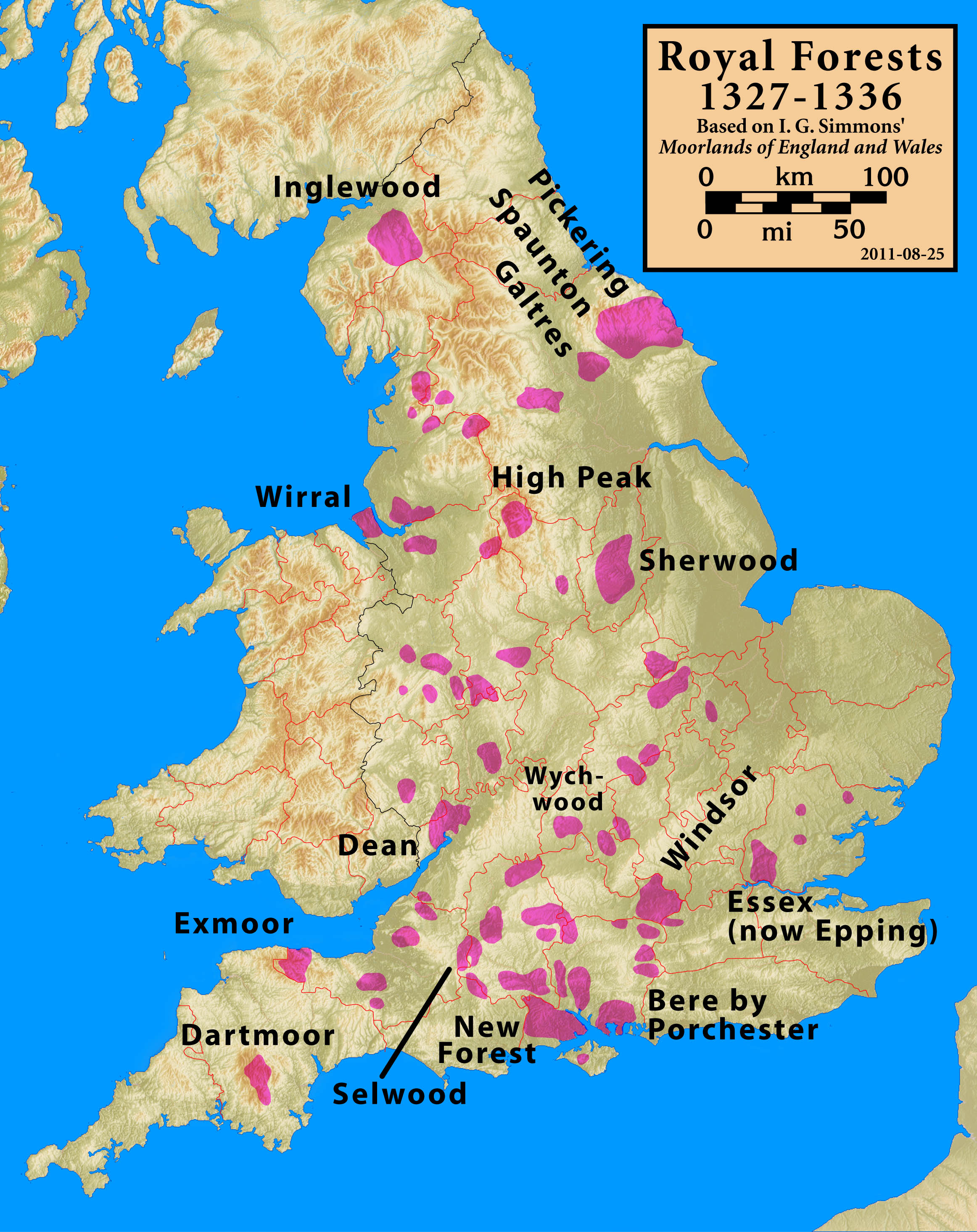
During Roman Britain various camps were discovered in parts of Sherwood Forest. It is to this that two remains of Roman villas were identified in nearby Mansfield Woodhouse by Major Hayman Rooke in 1787.
Sherwood Forest was first recorded as being named Sciryuda in 958 AD.
King Edwin of Northumbria in 633 AD was killed at Hatfield Chase in a battle against his Mercian rival King Penda of Mercia and his body was carried into the forest and buried/hidden in St Mary's Church, Edwinstowe. His head was later buried in York and his body in Whitby. The village of Edwinstowe takes its name from King Edwin of Northumbria.
In 1066, in the invasion of England, William the Conqueror made Sherwood Forest a Royal Hunting Forest. When the Domesday Book was compiled in 1086, the forest covered perhaps a quarter of Nottinghamshire (approximately 19,000 acres or 7,800 hectares) in woodland and heath subject to the forest laws.
The earliest notice of the forest at Sherwood was at the time of Henry II when William Peverel the Younger answered the plea of the forest, to which he profited and controlled the area.
During the 12th and 13th centuries Christian Monastic Orders had established large estates within Sherwood Forest. Three Abbeys were founded Rufford Abbey, Newstead Abbey and Thurgarton Priory.
Sherwood Forest was frequently visited by the Mercian Kings.The forest became popular with King John and Edward I. The remains of a hunting lodge can be found at Kings Clipstone named King John's Palace. Prior to King John reluctantly signing the Magna Carta at Runnymede in 1215, the Forest Laws came with much displeasure to the ruling classes of the forest.

After the dissolution of the monasteries by Henry VIII in 1536, the land of Sherwood was sold and granted into private ownership which was converted into house estates. James I in the 1600s visited the forest, as did Charles I and Charles II brought back under control the management of Sherwood Forest.
Sherwood Forest in 1623 had a narrow escape from a fire which broke out. The only record of this occurrence is written in a letter which is preserved in the British Museum.
In the 17th and 18th centuries Charles II and then Queen Anne sold large areas of Sherwood Crown Land to private owners who built the estates of Thoresby Hall, The former Clumber House, Welbeck Abbey and Worksop Manor. These estates became known as the Dukeries. Newstead Abbey was converted into a country House and Rufford Abbey was partially demolished and converted into a country House.
Mansfield anciently became pre-eminent in importance among the towns of the forest.
Geology
Sherwood Forest is established over an area underlain by the Permian and Triassic age New Red Sandstone. The larger part of the Forest is found across the outcrop of pebbly sandstones known as the Chester Formation. The regional dip is a gentle one to the east, hence younger rocks are found in that direction and older ones exposed to the west. The local stratigraphy is (uppermost/youngest at top):
- Mercia Mudstone Group
- Tarporley Siltstone Formation (siltstones, mudstones and sandstones)
- including Retford Member (mudstones)
- Tarporley Siltstone Formation (siltstones, mudstones and sandstones)
- Sherwood Sandstone Group
- Chester Formation (pebbly sandstones)
- Lenton Sandstone Formation
- Edlington Formation (mudstones and sandstones)
The sandstone is an aquifer providing a local water supply. Quaternary deposits include river sands and gravels, river terrace deposits and some scattered mid-Pleistocene glacial till. There are 41 local geodiversity sites within the Sherwood NCA; these are largely quarries and river sections.
Management and conservation
The Sherwood Forest Trust is a small charity that covers the ancient royal boundary and current national character area of Sherwood Forest. Its aims are based on conservation, heritage and communities but also include tourism and the economy.
Nottinghamshire County Council and Forestry England jointly manage the ancient remnant of forest north of the village of Edwinstowe, providing walks, footpaths and a host of other activities.
This central core of ancient Sherwood is a Site of Special Scientific Interest (SSSI) called Birklands and Bilhaugh, NNR and Special Area of Conservation (SAC). It is a very important site for ancient oaks, wood pasture, invertebrates and fungi, as well as being linked to the legends of Robin Hood.
During the Second World War parts of Sherwood Forest were used extensively by the military for ammunition stores, POW camps and training areas. Oil was produced at Eakring. After the war, large ammunition dumps were abandoned in the forest and were not cleared until 1952, with at least 46,000 tons of ammunition in them.
Part of the forest was opened to the public as a country park in 1969 by Nottinghamshire County Council, which manages a small part of the forest under lease from the Thoresby Estate. In 2002 a portion of Sherwood Forest was designated a national nature reserve by English Nature. In 2007 Natural England officially incorporated the Budby South Forest, Nottinghamshire's largest area of dry lowland heath, into the Nature Reserve, nearly doubling its size from 220 to.
A new Sherwood Forest Visitor Centre was authorised in 2015. In August 2018 the Royal Society for the Protection of Birds (RSPB) opened the new development with a shop and café, having been granted permission to manage the woods in 2015. Part of an agreement with Natural England was that the land where the existing 1970s visitor centre was located would be restored to wood pasture.
Some portions of the forest retain many very old oaks, especially in the portion known as the Dukeries, south of the town of Worksop, which was so called because it used to contain four ducal residences, as well as a number of other country estates.
The River Idle, a tributary of the Trent, is formed in Sherwood Forest from the confluence of several minor streams.
Image:Sherwood forest park.JPG|View of the Forest looking northeast Image:Sherwood Forest - panoramio (3).jpg|Sherwood Forest File:An area of heathland within Sherwood Forest - geograph.org.uk - 6357738.jpg|Oak Tree Heath, Sherwood Forest File:Sherwoodglade.jpg|Birch trees in Sherwood Forest
Tourism

Sherwood attracts around 350,000 tourists annually, many from other countries. Each August the nature reserve hosts a week-long Robin Hood Festival. This event recreates a medieval atmosphere and features the major characters from the Robin Hood legend. The week's entertainment includes jousters and strolling players dressed in medieval attire, in addition to a medieval encampment complete with jesters, musicians, rat-catchers, alchemists and fire eaters.
The Sherwood Forest Art and Craft Centre is in the former coach house and stables of Edwinstowe Hall. The centre contains art studios and a cafe and hosts special events, including craft demonstrations and exhibitions.
Other tourist destinations nearby
- Thoresby Hall, and park
- Rufford Abbey country park. Rufford Abbey is owned by English Heritage with the park managed by Parkwood Outdoors.
- Clumber Park is a former estate of Clumber House. The park is owned by the National Trust.
- Sherwood Pines Forest Park which also houses a Go Ape site. Adjacent is Center Parcs UK and Ireland Sherwood Forest.
Image:Edwinstowe - Sherwood Forest Art & Craft Centre.jpg|Sherwood Forest Art and Craft Centre Image:Thoresby Hall - geograph.org.uk - 1533497.jpg|Thoresby Hall Image:Rufford Abbey.jpg|Rufford Abbey Image: Clumber Bridge, Clumber Park - geograph.org.uk - 3699677.jpg|Clumber Park Image:Track at Culloden Plantation, Sherwood Pines Forest Park - geograph.org.uk - 6890913.jpg|Sherwood Pines Forest Park
Nearest towns/cities to Sherwood Forest
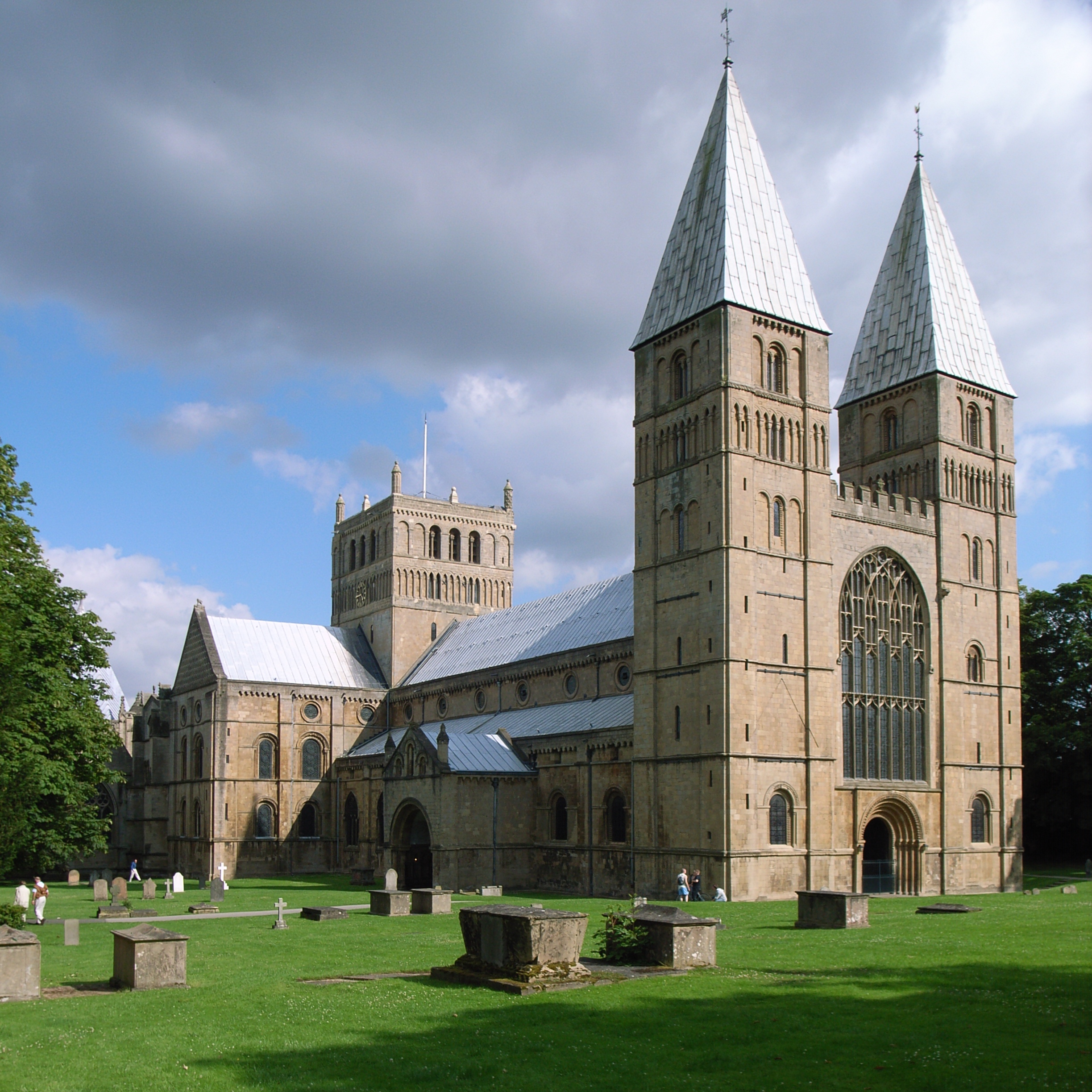
- Mansfield
- Newark on Trent
- Nottingham
- Southwell, Nottinghamshire
- Southwell
- Worksop
Major Oak
Main article: Major Oak
.jpg)
Sherwood Forest is home to the Major Oak, an oak tree between 800 and 1,000 years old, and since the Victorian era, its limbs have been partially supported by scaffolding. The Major Oak was identified by Major Hayman Rooke in 1790. It is believed that the Major Oak took the name of Major Hayman Rooke. The Major Oak used to be named the Cockpen Tree, after the cockfighting that once took place beneath it.
Samplings of the Major Oak have been planted in the US ambassadors' Winfield House in London.
According to the legend, Robin Hood and his outlaws used this tree to hide from the Sheriff of Nottingham.
The Major Oak was featured on the 2005 BBC TV programme Seven Natural Wonders as one of the natural wonders of the Midlands.
Parliament Oak

The Parliament Oak is situated in Sherwood Forest near Market Warsop. It is reputed that King John in 1212 and King Edward I in 1290 had impromptu parliaments at the tree.
Thynghowe
Main article: Thynghowe
Thynghowe, an important Danelaw meeting place where people came to resolve disputes and settle issues, was lost to history until its rediscovery in 2005–06 by local history enthusiasts amidst the old oaks of an area known as the Birklands. Experts believe it may also yield clues about the boundary of the ancient Anglo-Saxon kingdoms of Mercia and Northumbria.
English Heritage inspected the site, confirming that it was known as 'Thynghowe' in 1334 and 1609.
Politics
The forest gives its name to the Parliamentary constituency of Sherwood Forest (formerly Sherwood before the 2023 Periodic Review of Westminster constituencies). This is represented by one member of parliament.
References
References
- "Sherwood Forest - Terrestrial and Inland Waters Protected Areas". [[Protected Planet]].
- "Sherwood Forest: A Brief History of Invertebrate Recording". Eakring Birds.
- (1 October 2014). "Corporate Report: Nottinghamshire's National Nature Reserve". Natural England.
- "Sherwood Forest NNR". Natural England.
- "History of Sherwood Forest, Robin Hood and Major Oak". Nottinghamshire County Council.
- "The Oaks".
- "[https://www.nottinghamshire.gov.uk/culture-leisure/country-parks/history-of-sherwood-forest-robin-hood-and-major-oak History of Sherwood Forest, Robin Hood and Major Oak]". Nottinghamshire County Council. Retrieved on 4 April 2025.
- "[https://www.nottinghamshire.gov.uk/culture-leisure/country-parks/history-of-sherwood-forest-robin-hood-and-major-oak History of Sherwood Forest, Robin Hood and Major Oak]". Nottinghamshire County Council. Retrieved on 8 April 2025.
- White, Robert (1875). [https://archive.org/details/worksopthedukery01whit/page/n12/mode/1up ''Worksop, "The Dukery", and Sherwood Forest'']. Retrieved on 3 May 2025.
- "[https://www.nottinghamshire.gov.uk/culture-leisure/country-parks/history-of-sherwood-forest-robin-hood-and-major-oak History of Sherwood Forest, Robin Hood and Major Oak]". Nottinghamshire County Council. Retrieved on 8 April 2025.
- retrieved on 5 April 2025
- Edwinstowe Village, the Dukeries and Beyond,https://visitsherwood.co.uk/at-the-visitor-centre/edwinstowe-village/, Sherwood Forest, retrieved on 20 April 2025
- St Marys Church, Edwinstowe, https://southwellchurches.nottingham.ac.uk/edwinstowe/hhistory.php , Church History - Southwell & Nottingham Church History Project, retrieved 14 November 2025
- "History of Sherwood - Visit Nottinghamshire".
- Robert White,The Dukery, and Sherwood Forest, (1875) retrieved in the 8th April 2023
- Robert White, The Dukery and Sherwood Forest,1875,retrieved on 11 April 2025
- "[https://www.nottinghamshire.gov.uk/culture-leisure/country-parks/history-of-sherwood-forest-robin-hood-and-major-oak History of Sherwood Forest, Robin Hood and Major Oak]". Nottinghamshire County Council. Retrieved on 4 May 2025.
- "[https://www.nottinghamshire.gov.uk/culture-leisure/country-parks/history-of-sherwood-forest-robin-hood-and-major-oak History of Sherwood Forest, Robin Hood and Major Oak]". Nottinghamshire County Council. Retrieved on 8 April 2025.
- Gaunt, A. (2012). The Future of Sherwood's past. https://www.mercian-as.co.uk/magnacarta.html . Mercian Archaeological Services. access-date 2025.05.25
- [https://www.nottinghamshire.gov.uk/culture-leisure/country-parks/history-of-sherwood-forest-robin-hood-and-major-oak History of Sherwood Forest, Robin Hood and Major Oak]". Nottinghamshire County Council. Retrieved on 4 May 2025 retrieved on the 8th April 2023
- William Horner Gloves, The history of Mansfield,1894, retrieved on 11 April 2025
- [https://www.nottinghamshire.gov.uk/culture-leisure/country-parks/history-of-sherwood-forest-robin-hood-and-major-oak History of Sherwood Forest, Robin Hood and Major Oak]". Nottinghamshire County Council. Retrieved on 4 May 2025 retrieved on the 8th April 2023
- St Mary’s Church Edwinstowe, https://southwellchurches.nottingham.ac.uk/edwinstowe/hhistory.php, Southwell Churches, access-date 7 May 2025
- William Horner Groves, The History of Mansfield, (1894) retrieved on the 8th April 2023
- Reed, Michael. (1990). "The Landscape of Britain: From the Beginnings to 1914". Routledge.
- "GeoIndex Onshore". British Geological Survey.
- "NCA profile 49. Sherwood". Natural England.
- "Home - The Sherwood Forest Trust Nottinghamshire". The Sherwood Forest Trust Nottinghamshire.
- "Sherwood Forest". nottinghamshire.gov.uk.
- "Magic Map Application". defra.gov.uk.
- "Nottinghamshire's National Nature Reserve". naturalengland.org.uk.
- "Birklands and Bilhaugh". defra.gov.uk.
- "Sherwood Forest in World War II".
- Levine, Joshua. (2015). "The Secret History of the Blitz". Simon & Schuster.
- "Ammunition, Sherwood Forest: 21 Mar 1950: House of Commons debates".
- (21 March 2007). "Sherwood Forest to double in size". BBC News.
- [https://www.bbc.co.uk/news/uk-england-nottinghamshire-33879214 RSPB chosen to build Nottinghamshire's Sherwood Forest visitor centre]; {{Webarchive. link. (4 December 2020 . [[BBC News]] Nottingham, 12 August 2015. Retrieved 3 June 2020)
- [https://www.bbc.co.uk/news/uk-england-nottinghamshire-35851097 Sherwood Forest project: Plans for £5.3m visitor centre unveiled]; {{Webarchive. link. (15 September 2019 . [[BBC News]] Nottingham, 19 March 2016. Retrieved 3 June 2020)
- (27 August 2018). "New Sherwood Forest visitor centre opens". BBC News.
- (27 August 2018). "New £5m Sherwood Forest centre opens". BBC News.
- Visit Sherwood, Robin Hood Festival, cite web https://www.visitsherwood.co.uk/home/robin-hood-festival-2023/ retrieved on the 10th April 2023
- "Sherwood Forest Art and Craft Centre".
- Thoresby Park web http://whatsonatthoresby.co.uk/ retrieved on the 10th April 2023
- Rufford Abbey Country Park, Parkwood Outdoors, cite web https://www.parkwoodoutdoors.co.uk/centre/rufford-abbey retrieved on the 10th April 2023
- Townsley, Richard,16/02/2023,The Man who Made the Major Oak, https://visitsherwood.co.uk/celebrating-the-man-who-made-the-major-oak/ , Visit Sherwood,access-date=8/05/2025
- Book E Sloan, The Landscape studies of Hayman Rooke (1723-1806) - Antiquarianism, Archrology and Natural History in the 18th Century,2019,access date on 8 May 2025
- Hight J, 2011, Britain's Tree Story, The history and legends of Britain's ancient trees, National Trust Books, p32, ISBN 9781907892202
- Sapling grown from Sherwood Forest's Major Oak planted in US Ambassador's garden in London 2023. Mansfield Ashfield Chad, retrieved on the 3 April 2025
- "Seven Man Made Wonders, Midlands - Sherwood Forest and the Major Oak". BBC Homepage, 28 October 2014, Archived retrieved on 3 April 2025
- History & Legend. Sherwood Forest Trust. 2025. URl https://sherwoodforest.org.uk/history-legend/. retrieved on the 5 April 2025
- Richard Moss. (25 April 2008). "Amateur Archaeologists Find Ancient 'Thyng' In Sherwood Forest". Culture24.
- "Thynhowe". english Heritage.
- [https://www.bbc.co.uk/news/uk-england-nottinghamshire-45297589 New £5m Sherwood Forest visitor centre opens] {{Webarchive. link. (23 March 2019 ''[[BBC News]] Nottingham'', 27 August 2018 Retrieved 3 June 2020)
- "East Midlands {{!}} Boundary Commission for England".
This article was imported from Wikipedia and is available under the Creative Commons Attribution-ShareAlike 4.0 License. Content has been adapted to SurfDoc format. Original contributors can be found on the article history page.
Ask Mako anything about Sherwood Forest — get instant answers, deeper analysis, and related topics.
Research with MakoFree with your Surf account
Create a free account to save articles, ask Mako questions, and organize your research.
Sign up freeThis content may have been generated or modified by AI. CloudSurf Software LLC is not responsible for the accuracy, completeness, or reliability of AI-generated content. Always verify important information from primary sources.
Report