From Surf Wiki (app.surf) — the open knowledge base
Shepherd moon
Satellite associated with a planetary ring
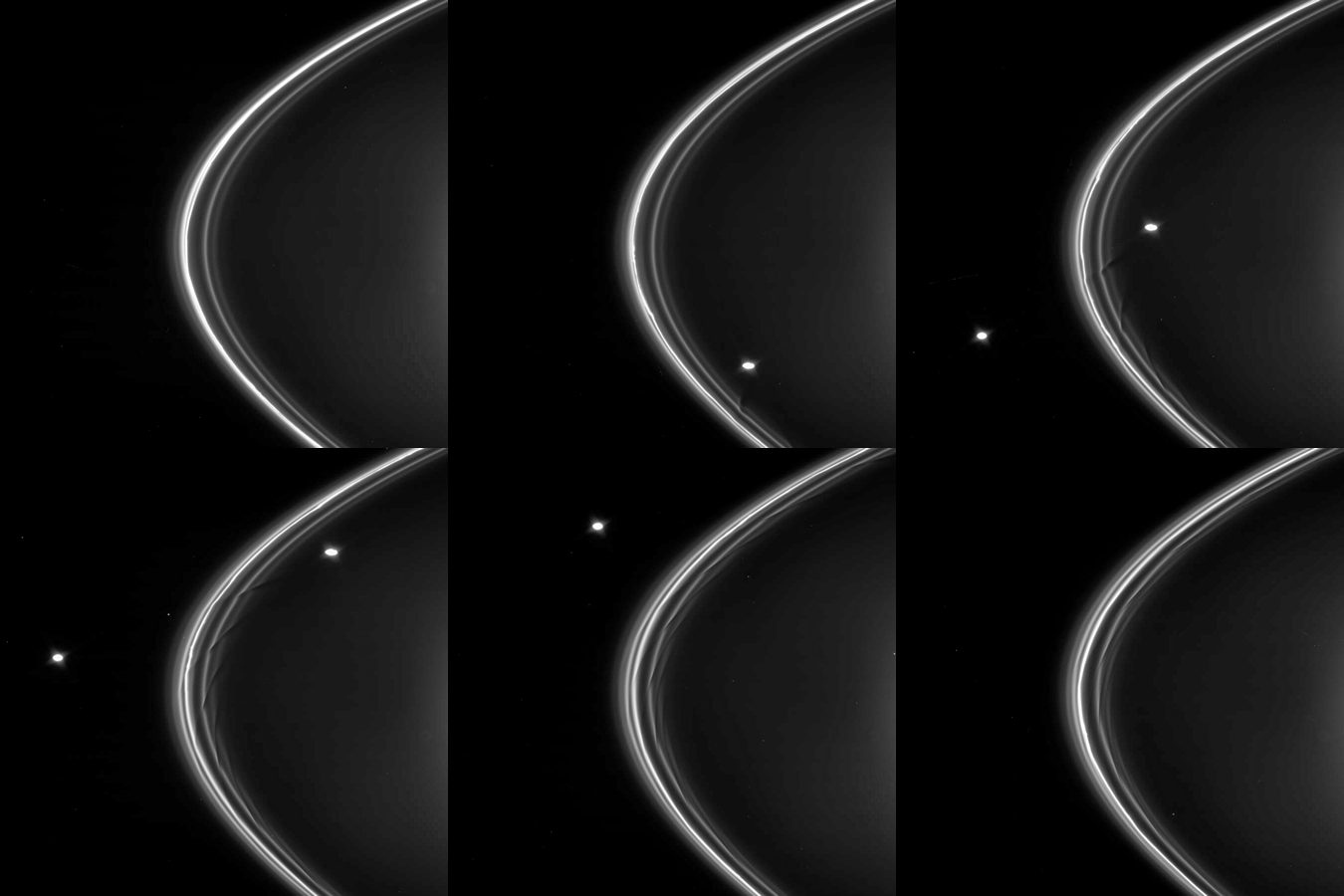
Satellite associated with a planetary ring

A shepherd moon is a small natural satellite that clears a gap in planetary ring material or keeps particles within a ring contained. The name is a result of their limiting the "herd" of the ring particles as a shepherd.
Due to their gravitational influence, shepherd moons deflect ring particles from their original orbits due to proximity or through orbital resonances. This can carve gaps in the ring system, such as the Encke Gap maintained by Saturn's moon Pan, or lead to the confining of narrow ringlets, such as Saturn's F ring.
Discovery
The existence of shepherd moons was theorized in early 1979. Observations of the rings of Uranus show that they are very thin and well defined, with sharp gaps between rings. To explain this, Goldreich and Tremaine suggested that two small satellites that were undetected at the time might be confining each ring. The first images of shepherd satellites were taken later that year by Voyager 1.
Examples
Jupiter
Several of Jupiter's small innermost moons, namely Metis and Adrastea, are within Jupiter's ring system and are also within Jupiter's Roche limit. It is possible that these rings are composed of material that is being pulled off these two bodies by Jupiter's tidal forces, possibly facilitated by impacts of ring material on their surfaces.
Saturn
The complex ring system of Saturn has several such satellites. These include Prometheus (F ring), Daphnis (Keeler Gap), Pan (Encke Gap), Janus, and Epimetheus (both A ring).
Uranus
Uranus also has shepherd moons on its ε ring, Cordelia and Ophelia. They are interior and exterior shepherds, respectively. Both moons are well within Uranus's synchronous orbit radius, and their orbits are therefore slowly decaying due to tidal deceleration.
Neptune
Neptune's rings are very unusual in that they first appeared to be composed of incomplete arcs in Earth-based observations, but Voyager 2's images showed them to be complete rings with bright clumps. It is thought that the gravitational influence of the shepherd moon Galatea and possibly other as-yet undiscovered shepherd moons are responsible for this clumpiness.
Minor planets
Rings around some centaurs have been identified. Chariklo's rings are remarkably well-defined and are suspected to either be very young or kept in place by a shepherd moon similar in mass to the rings. Chiron is also thought to have rings similar in form to those of Chariklo.
Exoplanets
A major gap in the circumstellar disk or large ring system of the free-floating brown dwarf or rogue planet J1407b at about 61 million km (0.4 AU) from its center is considered to be indirect evidence of the existence of an exomoon (or exoplanet) with mass up to 0.8 Earth masses.
References
References
- (1979). "Towards a theory for the Uranian rings.". Nature.
- "Voyager 1".
- (2007). "Introduction to Planetary Science: The Geological Perspective". Springer.
- "On the masses and motions of mini-moons: Pandora's not a".
- "NASA - Cassini Finds New Saturn Moon That Makes Waves".
- Showalter, Mark R.. (1991-06-27). "Visual detection of 1981S13, Saturn's eighteenth satellite, and its role in the Encke gap". Nature.
- (2015-10-01). "How Janus' Orbital Swap Affects the Edge of Saturn's A Ring?". Icarus.
- Esposito, Larry W.. (2002-01-01). "Planetary rings". Reports on Progress in Physics.
- Karkoschka, Erich. (2001-05-01). "Voyager's Eleventh Discovery of a Satellite of Uranus and Photometry and the First Size Measurements of Nine Satellites". Icarus.
- Miner, Ellis D.. (2007). "Planetary Ring System". Springer Praxis Books.
- (1998). "Neptune's Partial Rings: Action of Galatea on Self-Gravitating Arc Particles". Science.
- (April 2014). "A ring system detected around the Centaur (10199) Chariklo". Nature.
- (2015). "Possible ring material around centaur (2060) Chiron". Astronomy & Astrophysics.
- (January 22, 2015). "Modeling giant extrasolar ring systems in eclipse and the case of J1407b: sculpting by exomoons?". The Astrophysical Journal.
- (2019). "Mean motion resonances with nearby moons: an unlikely origin for the gaps observed in the ring around the exoplanet J1407b". Monthly Notices of the Royal Astronomical Society.
- (January 2020). "ALMA and NACO observations towards the young exoring transit system J1407 (V1400 Cen)". [[Astronomy & Astrophysics]].
This article was imported from Wikipedia and is available under the Creative Commons Attribution-ShareAlike 4.0 License. Content has been adapted to SurfDoc format. Original contributors can be found on the article history page.
Ask Mako anything about Shepherd moon — get instant answers, deeper analysis, and related topics.
Research with MakoFree with your Surf account
Create a free account to save articles, ask Mako questions, and organize your research.
Sign up freeThis content may have been generated or modified by AI. CloudSurf Software LLC is not responsible for the accuracy, completeness, or reliability of AI-generated content. Always verify important information from primary sources.
Report