From Surf Wiki (app.surf) — the open knowledge base
Shear force
Coplanar forces acting on the same body in opposite directions
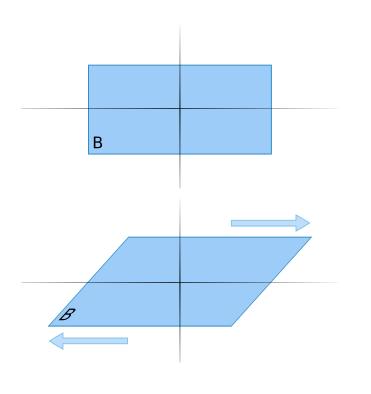
Coplanar forces acting on the same body in opposite directions

In solid mechanics, shearing forces are unaligned forces acting on one part of a body in a specific direction, and another part of the body in the opposite direction. When the forces are collinear (aligned with each other), they are called tension forces or compression forces. Shear force can also be defined in terms of planes: "If a plane is passed through a body, a force acting along this plane is called a shear force or shearing force."
Force required to shear steel
This section calculates the force required to cut a piece of material with a shearing action. The relevant information is the area of the material being sheared, i.e. the area across which the shearing action takes place, and the shear strength of the material. A round bar of steel is used as an example. The shear strength is calculated from the tensile strength using a factor which relates the two strengths. In this case 0.6 applies to the example steel, known as EN8 bright, although it can vary from 0.58 to 0.62 depending on application.
EN8 bright has a tensile strength of 800MPa and mild steel, for comparison, has a tensile strength of 400MPa.
To calculate the force to shear a 25 mm diameter bar of EN8 bright steel; : area of the bar in mm2 = (12.52)(π) ≈ 490.8mm2 : 0.8kN/mm2 × 490.8mm2 = 392.64kN ≈ 40tonne-force : 40tonne-force × 0.6 (to change force from tensile to shear) = 24tonne-force
When working with a riveted or tensioned bolted joint, the strength comes from friction between the materials bolted together. Bolts are correctly torqued to maintain the friction. The shear force only becomes relevant when the bolts are not torqued.
A bolt with property class 12.9 has a tensile strength of 1200MPa (1MPa = 1N/mm2) or 1.2kN/mm2 and the yield strength is 0.90 times tensile strength, 1080MPa in this case.
A bolt with property class 4.6 has a tensile strength of 400MPa (1MPa = 1N/mm2) or 0.4 kN/mm2 and yield strength is 0.60 times tensile strength, 240MPa in this case.
References
References
- William A. Nash. (1 July 1998). "Schaum's Outline of Theory and Problems of Strength of Materials". McGraw-Hill Professional.
This article was imported from Wikipedia and is available under the Creative Commons Attribution-ShareAlike 4.0 License. Content has been adapted to SurfDoc format. Original contributors can be found on the article history page.
Ask Mako anything about Shear force — get instant answers, deeper analysis, and related topics.
Research with MakoFree with your Surf account
Create a free account to save articles, ask Mako questions, and organize your research.
Sign up freeThis content may have been generated or modified by AI. CloudSurf Software LLC is not responsible for the accuracy, completeness, or reliability of AI-generated content. Always verify important information from primary sources.
Report