From Surf Wiki (app.surf) — the open knowledge base
Shatapatha Brahmana
Ancient commentary on the Śukla (white) Yajurveda
Ancient commentary on the Śukla (white) Yajurveda
The Shatapatha Brahmana (, , abbreviated to 'SB') is a commentary on the Śukla Yajurveda. It is attributed to the Vedic sage Yajnavalkya. Described as the most complete, systematic, and important of the Brahmanas (commentaries on the Vedas), it contains detailed explanations of Vedic sacrificial rituals, symbolism, and mythology.
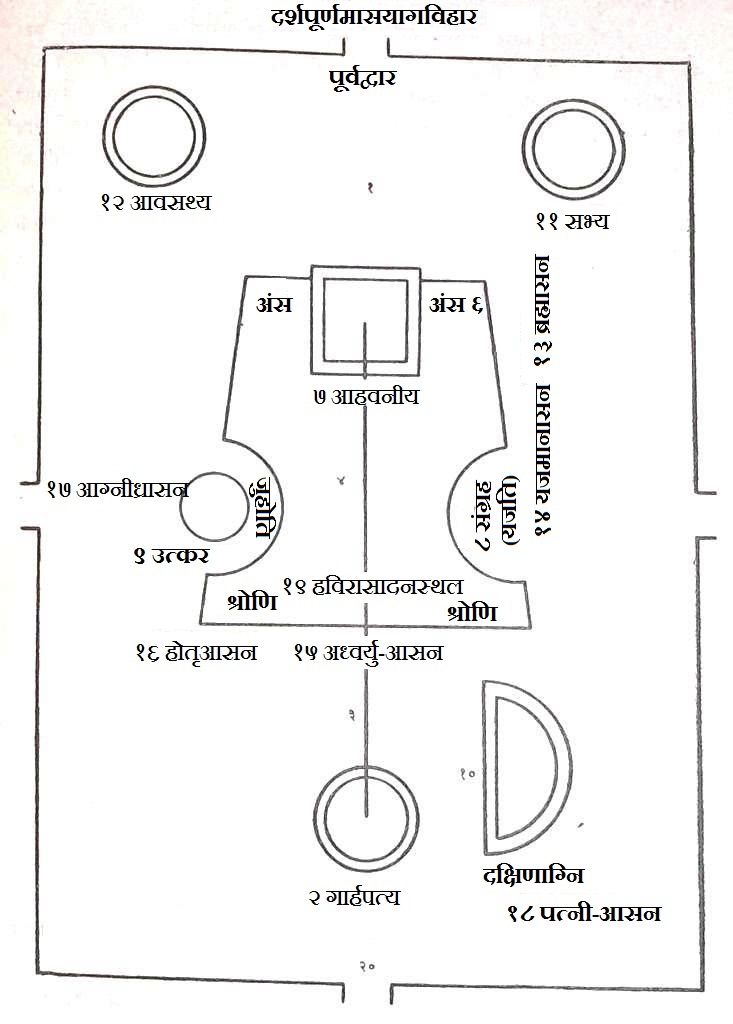
Particularly in its description of sacrificial rituals (including construction of complex fire-altars).
The Shatapatha Brahmana is also considered significant in the development of Vaishnavism as the origin of several Puranic legends and avatars of Vishnu. Notably, all of them (Matsya, Kurma, Varaha, Narasimha, and Vamana) are listed as the first five avatars in the Dashavatara (the ten principal avatars of Vishnu).
There are two versions (recensions) available of this text. They are the Madhyandina recension and the Kanva recension. This article focuses exclusively on the Madhyandina version of the Shatapatha Brahmana.
Nomenclature
The ''''Shatapatha Brahmana'''' (Sanskrit शतपथब्राह्मण) can be loosely translated as 'Brahmana of one hundred paths':
- ''''Brahmana'''' (Sanskrit ब्राह्मण) means 'explanations of sacred knowledge or doctrine'.
- ''''Shatapatha'''' (Sanskrit शतपथ) means 'having a hundred paths' or 'proceeding in a hundred ways'.
Kanda and Adhyâya
- ''''Kanda'''' (or 'Khanda', Sanskrit खंड), means 'chapter', 'division of a book', or more loosely 'book'. It also means 'praise' and 'water'.
- ''''Adhyâya'''' (Sanskrit अध्याय), means 'chapter' (of a book), 'lesson', 'reading' and 'lecture'.
In relation to the Shatapatha Brahmana, a reference such as '14.1.2' means 'Kanda 14, Adhyaya 1, Brahmana 2', or in English, 'Book 14, Chapter 1, Explanation 2'. The addition of a fourth digit at the end (e.g. 17.7.3**.11**) refers to the verse number.
Date
Arthur Berriedale Keith states that linguistically, the Shatapatha Brahmana belongs to the later part of the Brāhmaṇa period of Vedic Sanskrit (8th-6th century BCE). M. Witzel dates this text to the 7th–6th century BCE. Jan N. Bremmer dates it to around 700 BCE. J. Eggeling (translator of the Vājasaneyi mādhyandina recension into English), dates the final written version of the text to 300 BCE, although he states that some elements are 'far older, transmitted orally from unknown antiquity'.
There are claims of dating the text much further back than the said ranges, and scholars have extensively rejected such claims; Witzel criticizes it for "faulty reasoning" and taking "a rather dubious datum and us[ing] it to reinterpret Vedic linguistic, textual, ritual history while neglect[ing] all the other contradictory data." According to Witzel, the Shatapatha Brahmana does not contain precise contemporary astronomical records, but rather only approximate naked-eye observations for ritual concerns which likely reflect oral remembrances of older time periods; furthermore, the same general observations are recorded in the Babylonian MUL.APIN tablets of c. 1000 BCE. The Shatapatha Brahmana contains clear references to the use of iron, so it cannot be dated earlier than c. 1200–1000 BCE, while it reflects cultural, philosophical, and socio-political developments that are later than other Iron Age texts (such as the Atharvaveda) and only slightly earlier than the time of the Buddha (c. 5th century BCE)
Content and recensions
According to the Indira Gandhi National Centre for the Arts (IGNCA), the Shatapatha Brahmana survives in two recensions:
| Divisions | Madhyandina Recension | Kanva Recension |
|---|---|---|
| Kāṇḍas | 14 | 17 |
| Adhyāyas | 100 | 104 |
| Prapathakas | 68 | - |
| Brahmanas | 436 | 435 |
| Kandikas | 7179 | 6806 |
| The Madhyandina recension is known as the Vājasaneyi mādhyandina śākhā, and is ascribed to Yājñavalkya Vājasaneya. |
The 14 books of the Madhyandina recension can be divided into two major parts. The first 9 books have close textual commentaries, often line by line, of the first 18 books of the corresponding samhita of the Śukla (white) Yajurveda. The remaining 5 books of the Shatapatha cover supplementary and ritualistically newer material; the content of the 14th and last book constitutes the Bṛhad-Āraṇyaka Upaniṣad. The IGNCA also provides further structural comparison between the recensions, noting that the 'names of the Kandas also vary between the two (versions) and the sequence in which they appear':
| Kanda | Madhyandina No. | Kanva No. |
|---|---|---|
| Ekapat | 2 | 1 |
| Haviryajna | 1 | 2 |
| Udhari | – | 3 |
| Adhvara | 3 | 4 |
| Graha | 4 | 5 |
| Vajapeya | – | 6 |
| Sava | 5 | – |
| Rajasuya | – | 7 |
| Ukhasambharana | 6 | 8 |
| Hastighata | 7 | 9 |
| Citi | 8 | 10 |
| Sagniciti (Saciti) | – | 11 |
| Sanciti | 9 | – |
| Agnirahasya | 10 | 12 |
| Astadhyayi | 11 | 13 |
| Madhyama | 12 | 14 |
| Asvamedha | 13 | 15 |
| Pravarghya | – | 16 |
| Brhadaranyaka | 14 | 17 |
The IGNCA adds that 'the division of Kandika is more rational in the Kanva text than in the other... The name 'Shatapatha', as Eggeling has suggested, might have been based on the number of Adhyayas in the Madhyandina which is exactly one hundred. But the Kanva recension, which has one hundred and four Adhyayas is also known by the same name. In Indian tradition words like 'sata' and 'sahasra', indicating numbers, do not always stand for exact numbers'.
Brihadaranayaka Upanishad
Main article: Brihadaranyaka Upanishad
The Brihadaranyaka Upanishad forms the concluding part of the last Kanda, known as 'Aranyaka' of both recensions of the Shatapatha Brahmana. Swami Madhavananda states that this Upanishad is 'the greatest of the Upanishads... not only in extent; but it is also the greatest in respect of its substance and theme. It is the greatest Upanishad in the sense that the illimitable, all-embracing, absolute, self-luminous, blissful reality – the Brhat or Brahman, identical with Atman, constitutes its theme'.
Significance in science
Astronomy
In relation to sacrifice and astronomical phenomena detailed in texts such as the Shatapatha Brahmana (e.g. sacrifices performed during the waxing and waning of the moon), N. Aiyangar states the fact that 'the Vedic people had a celestial [i.e. astronomical] counterpart of their sacrificial ground is clear', and cites an example of the YajnaVaraha sacrifice in relation to the constellation of Orion. Roy elaborates further on this example, stating that when 'the sun became united with Orion at the vernal equinox...[this] commenced the yearly [YajnaVaraha] sacrifice'. The vernal (March) equinox marks the onset of spring, and is celebrated in Indian culture as the Holi festival (the spring festival of colours).
A.A. Macdonell adds that the Shatapatha in particular is notable as – unlike the Samhitas – in it the Earth was 'expressly called circular (parimandala)'.
Mathematics


P. N. Sinha states that the number 1,000 represents 'the thousand Maha yugas of every Kalpa' (about 4.32 billion years), illustrated by the 1,000 hoods of the Naga Vasuki/Ananta on which the Earth is supported. According to F. Staal, layering, size, and configuration of bricks to construct sacrificial altars – real and symbolic – as detailed in texts such as the Shatapatha Brahmana had numerous rules, with Staal adding - in relation to similarities with ancient Greek, Babylonian, and Chinese geometry:
Manuscripts and Translations
All English translations of the Madhyandina School recension are by Julius Eggeling in five volumes. The English translation of the Kanva School recension by W.E. Caland in 3 volumes has not been found or listed; another English translation by the Indira Gandhi National Centre for the Arts (IGNCA) in at least seven volumes has been listed (only the first five volumes can be previewed).
| Sanskrit | Sanskrit-English Transliteration | English | Madhyandina | Kanva |
|---|---|---|---|---|
| archive.org: Volume 1, Volume 2, Volume 3, Volume 4, Volume 5, Volume 6, Volume 7 | gretil.sub.uni-goettingen.de: Kanda 1, Kanda 2, Kanda 3, Kanda 4, Kanda 5, Kanda 6, Kanda 7, Kanda 8, Kanda 9, Kanda 10, Kanda 11, Kanda 12 (not available), Kanda 13, Kanda 14 (unknown author; e-texts; all Sanskrit e-texts are here). | archive.org: Volume 1, Volume 2, Volume 3, Volume 4, Volume 5 (Part of the Sacred Books of the East; translated by Julius Eggeling) | ||
| vedicheritage.gov.in: Volume 1, Volume 2 | Sacred-Texts.com: Volumes 1–5 (Hypertext version of the same the Sacred Books of the East version, translated by Julius Eggeling) | |||
| Wisdomlib.org: Kandas 1–14 (E-text version of the translation by Julius Eggeling, complete with introduction, footnotes, and corrections) | ||||
| vedicheritage.gov.in: Kandas 1–16 (Audio) | gretil.sub.uni-goettingen.de: Adhyayas 1–6 (and Mula text, extracted from commented version) | Google Books: Volume 1, Volume 2, Volume 3, Volume 4, Volume 5; No previews: Volume 6, Volume 7 | ||
| archive.org: Brihadaranyaka Upanishad (Khanda 17; Swami Madhavananda) |
Footnotes
References
References
- "Sanskrit Dictionary for Spoken Sanskrit: 'Shatapatha'".
- "Sanskrit Dictionary for Spoken Sanskrit: 'Brahmana'".
- "Monier-Williams Sanskrit-English Dictionary – b (brahmana)".
- "Sanskrit Dictionary for Spoken Sanskrit: 'Shatapatha'".
- "Sanskrit Dictionary for Spoken Sanskrit: 'Kanda'".
- "Sanskrit Dictionary for Spoken Sanskrit: 'Adhyaya'".
- Keith, ''Aitareya Āraṇyaka'', p. 38 (Introduction): "by common consent, the Shatapatha is one of the youngest of the great Brāhmaṇas"; footnotes: "Cf. Macdonell, Sanskrit Literature, pp. 203, 217. The Jaiminiya may be younger, cf. its use of ''ādi'', Whitney, P.A.O.S, May 1883, p.xii."
- [http://www.people.fas.harvard.edu/~witzel/Erdosy1995.pdf "Early Indian history: Linguistic and textual parametres."] in The Indo-Aryans of Ancient South Asia, edited by G. Erdosy (1995), p. 136
- Jan N. Bremmer. (2007). "The Strange World of Human Sacrifice". Peeters Publishers.
- [http://www.sacred-texts.com/hin/sbr/index.htm The Shatapatha Brahmana]. Sacred Books of the East, Vols. 12, 26, 24, 37, 47, translated by Julius Eggeling [published between 1882 and 1900]
- Witzel, Michael. (2001). "Autochthonous Aryans? The Evidence from Old Indian and Iranian Texts". Electronic Journal of Vedic Studies.
- "Śatapatha-Brahmana 1".
- "Satapatha Brahmana Part 1 (SBE12): First Kânda: I, 4, 1. Fourth Adhyâya. First brâhmana".
- Arts, Indira Gandhi National Centre for the. (1994). "काण्वशतपथब्राह्मणम्". Motilal Banarsidass Publ..
- "Brhadaranyaka-Upanisad, with Samkara's commentary".
- Madhavananda, Swami Tr. (1934). "The Brihadaranyaka Upanishad".
- Madhavananda, Swami Tr. (1934). "The Brihadaranyaka Upanishad".
- Narayan Aiyangar. (1901). "Essays On Indo Aryan Mythology".
- Macdonell, Arthur Anthony. (1897). "Vedic mythology". Strassburg : Karl J. Trübner.
- "Sanskrit Dictionary for Spoken Sanskrit: 'parimandala'".
- (1901). "A study of the Bhagavata Purana; or, Esoteric Hinduism". Benares : Printed by Freeman & co., ltd..
- "4: Mathematics in the service of religion: I. Vedas and Vedangas".
- Knipe, David M.. (2015-04-01). "Vedic Voices: Intimate Narratives of a Living Andhra Tradition". Oxford University Press.
- Staal, Frits. (2008). "Discovering the Vedas: Origins, Mantras, Rituals, Insights". Penguin Books India.
- Arthur Anthony Macdonell. (1912). "Vedic Index Of Names And Subjects Vol.ii".
- Roy, Janmajit. (2002). "Theory of Avatāra and Divinity of Chaitanya". Atlantic Publishers & Dist.
- Dowson, John. (1888). "A classical dictionary of Hindu mythology and religion, geography, history, and literature". London : Trübner.
- W.j. Wilkins. (1913). "Hindu Mythology Vedic And Puranic".
- Ghose, Sanujit. (2004). "Legend of Ram: Antiquity to Janmabhumi Debate". Bibliophile South Asia.
- Soifer, Deborah A.. (1991-11-08). "The Myths of Narasimha and Vamana: Two Avatars in Cosmological Perspective". SUNY Press.
- "Sanskrit Dictionary: 'gharma'".
- "Satapatha Brahmana Part V (SBE44): Fourteenth Kânda: XIV, 1, 1. First Adhyâya, First Brâhmana".
- Eggeling, Julius. (1885). "The Satapatha-brahmana Pt. 2".
- "Satapatha Brahmana Part 1 (SBE12): First Kânda: I, 6, 2. Second Brâhmana".
- Macdonell, Arthur Anthony. (1897). "... Vedic mythology". Strassburg : Karl J. Trübner.
- "Satapatha-Brahmana 6".
- "Satapatha Brahmana Part III (SBE41): Sixth Kânda: VI, 1, 1. First Adhyâya. First Brâhmana".
- "Satapatha-Brahmana 7".
- "Satapatha Brahmana Part III (SBE41): Seventh Kânda: VII, 5, 1. Fifth Adhyâya. First Brâhmana".
- Swami Parmeshwaranand. (2001-01-01). "Encyclopaedic Dictionary of Puranas". Sarup & Sons.
- "Satapatha Brahmana Part 1 (SBE12): First Kânda: I, 8, 1. Eighth Adhyâya. First Brâhmana".
- "Satapatha Brahmana Part V (SBE44): Twelfth Kânda: XII, 7, 3. Third Brâhmana".
- "RigVeda Book X Hymn LXXIII, 'Indra' (Sanskrit and Transliteration)".
- "RigVeda Book X Hymn LXXIII, 'Indra'".
- "Satapatha Brahmana Part 1 (SBE12): First Kânda: I, 2. 5. Fifth Brâhmana".
- Eggeling, Julius. (1882). "The Satapatha-brahmana Pt. 1".
- "Rig Veda: Rig-Veda Book 1: HYMN XXII. Aśvins and Others".
- "Rig Veda: Rig-Veda Book 1: HYMN CLIV. Viṣṇu".
- "Satapatha Brahmana Part III (SBE41): Sixth Kânda: VI, 7, 4. Fourth Brâhmana".
- "Bhagavad Gita (Chapter 3, Verse 14)".
- "Satapatha-Brahmana 14".
- "Satapatha Brahmana Part V (SBE44): Fourteenth Kânda: XIV, 1, 2. Second Brâhmana".
- Keith, Arthur Berriedale. (1928). "The Religion And Philosophy Of The Veda And Upanishads 01".
- "Rig Veda: Rig-Veda, Book 8: HYMN LXVI. Indra.".
- "The Rig Veda in Sanskrit: Rig Veda Book 8: Hymn 77".
- "Satapatha-Brahmana 5".
- "Satapatha Brahmana Part III (SBE41): Fifth Kânda: V, 4, 3. Third Brâhmana".
This article was imported from Wikipedia and is available under the Creative Commons Attribution-ShareAlike 4.0 License. Content has been adapted to SurfDoc format. Original contributors can be found on the article history page.
Ask Mako anything about Shatapatha Brahmana — get instant answers, deeper analysis, and related topics.
Research with MakoFree with your Surf account
Create a free account to save articles, ask Mako questions, and organize your research.
Sign up freeThis content may have been generated or modified by AI. CloudSurf Software LLC is not responsible for the accuracy, completeness, or reliability of AI-generated content. Always verify important information from primary sources.
Report