From Surf Wiki (app.surf) — the open knowledge base
Shams Tabrizi
Persian poet (1185–1248)

Persian poet (1185–1248)
| Field | Value | |
|---|---|---|
| name | Shams Tabrīzī | image = Miniature of Shams Tabrizi by Hossein Behzad, dated 1963.jpg |
| caption | Persian miniature of Shams Tabrizi by Hossein Behzad, dated 1963 | |
| birth_date | 1185 | |
| birth_place | Tabriz, Seljuk Empire | |
| death_date | ||
| death_place | Khoy, Mongol Empire | |
| resting_place | Khoy, Iran | |
| occupation | Weaver, Poet, Philosopher, Teacher, | |
| imagesize | 220px |
Shams Tabrīzī (1185–1248) was a Persian
- dervish and poet, best known for his companionship with Rumi.
He is referenced with great reverence and grief in Rumi's poetic collection, in particular Divan-i Shams-i Tabrīzī. Tradition holds that Shams taught Rumi in seclusion in Konya for a period of forty days, before fleeing for Damascus. The tomb of Shams-i Tabrīzī was recently nominated to be a UNESCO World Heritage Site.
Life
According to Sipah Salar, a devotee and intimate friend of Rumi who spent forty days with him, Shams was the son of the Imam Ala al-Din. In a work entitled Manāqib al-'arifīn (Eulogies of the Gnostics), Aflaki names a certain 'Ali as the father of Shams-i Tabrīzī and his grandfather as Malikdad. Apparently basing his calculations on Haji Bektash Veli's Maqālāt (Conversations), Aflaki suggests that Shams arrived in Konya at the age of sixty years. However, various scholars have questioned Aflaki's reliability.
Shams received his education in Tabriz and was a disciple of Baba Kamal al-Din Jumdi. Before meeting Rumi, he apparently traveled from place to place weaving baskets and selling girdles for a living. Despite his occupation as a weaver, Shams received the epithet of "the embroiderer" (zarduz) in various biographical accounts including that of the Persian historian Dawlatshah Samarqandi. This however, is not the occupation listed by Haji Bektash Veli in the Maqālat and was rather the epithet given to the Isma'ili Imam Shams al-Din Muhammad, who worked as an embroiderer while living in anonymity in Tabriz. The transference of the epithet to the biography of Rumi's mentor suggests that this Imam's biography must have been known to Shams-i Tabrīzī's biographers. The specificities of how this transference occurred, however, are not yet known.
Shams' first encounter with Rumi
On 15 November 1244, a man in a black suit from head to toe came to the famous inn of Sugar Merchants of Konya. His name was Shams Tabrizi. He was claiming to be a travelling merchant. As it was said in Haji Bektash Veli's book, "Makalat", he was looking for something which he was going to find in Konya. Eventually he found Rumi riding a black horse.
One day Rumi was reading next to a large stack of books. Shams Tabriz, passing by, asked him, "What are you doing?" Rumi scoffingly replied, "Something you cannot understand." (This is knowledge that cannot be understood by the unlearned.) On hearing this, Shams threw the stack of books into a nearby pool of water. Rumi hastily rescued the books and to his surprise they were all dry. Rumi then asked Shams, "What is this?" To which Shams replied, "Mowlana, this is what you cannot understand." (This is knowledge that cannot be understood by the learned.)
A second version of the tale has Shams passing by Rumi who again is reading a book. Rumi regards him as an uneducated stranger. Shams asks Rumi what he is doing, to which Rumi replies, "Something that you do not understand!" At that moment, the books suddenly catch fire and Rumi asks Shams to explain what happened. His reply was, "Something you do not understand."
After several years with Rumi in Konya, Shams left and settled in Khoy. As the years passed, Rumi attributed more and more of his own poetry to Shams as a sign of love for his departed friend and master. In Rumi's poetry Shams becomes a guide towards Allah's (Creator) love for mankind; Shams was a sun ("Shams" means "Sun" in Arabic) shining the Light of Sun as guide for the right path dispelling darkness in Rumi's heart, mind, and body on earth.
Death
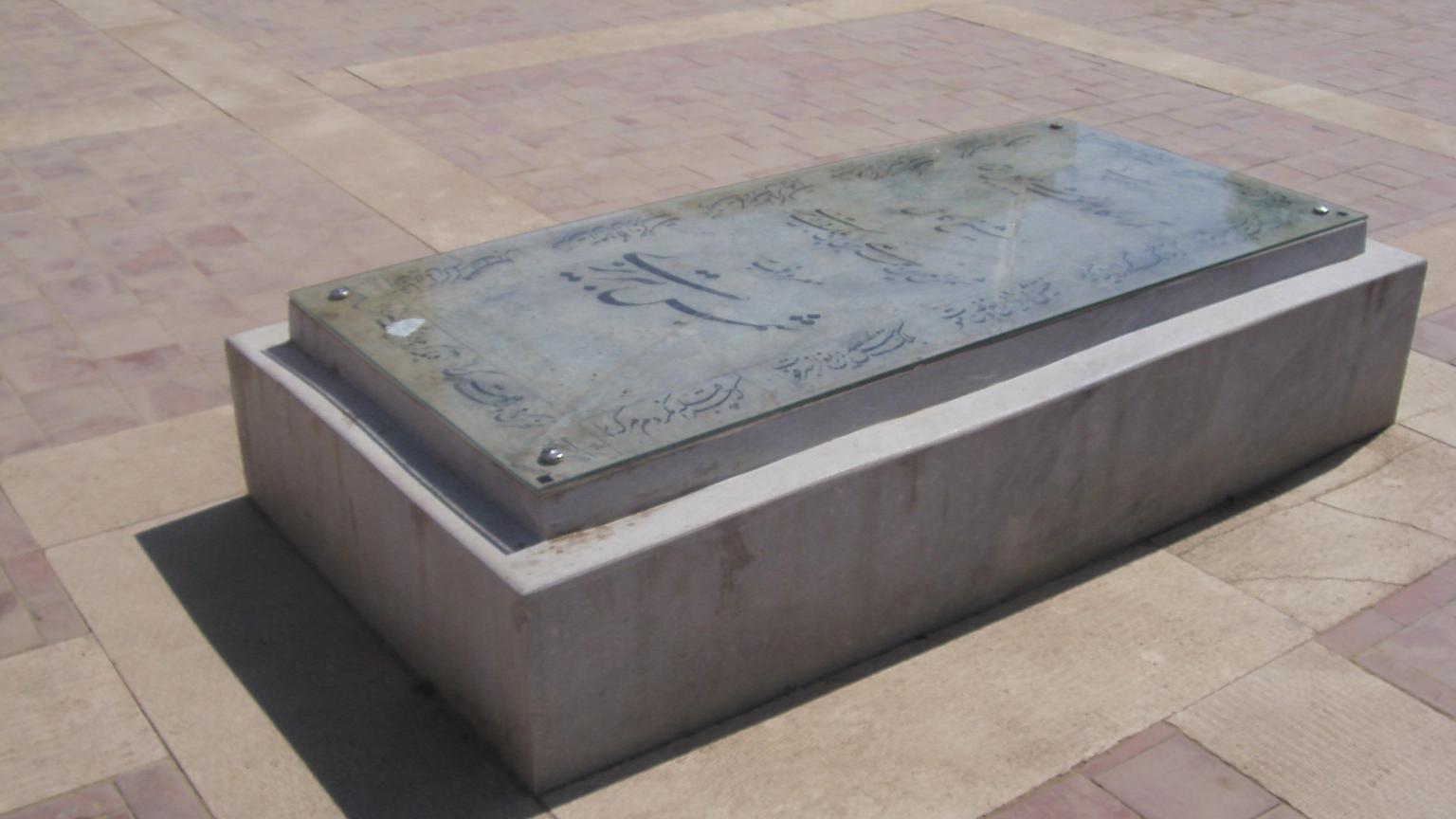
Shams Tabrizi's tomb in Khoy, beside a tower monument in a memorial park, has been nominated as a World Cultural Heritage Center by UNESCO.
Discourse of Shams Tabrīzī

Some excerpts from the Maqalat provide insight into the thoughts of Shams:
- Blessing is excess, so to speak, an excess of everything. Don't be content with being a faqih (religious scholar), say I want more – more than being a Sufi (a mystic), more than being a mystic – more than each thing that comes before you.
- A good man complains of no-one; he does not look to faults.
- Joy is like pure clear water; wherever it flows, wondrous blossoms grow…Sorrow is like a black flood; wherever it flows it wilts the blossoms.
- *And the Persian language, how did it happen? With so much elegance and goodness such that the meanings and elegance that is found in the Persian language is not found in Arabic.*Shams al-Din Tabrizi, Maqalat-e Shams-e Tabrizi, ed. Mohammad-Ali Movahhed (Tehran: Sahami, Entesharat-e Khwarazmi, 1990). Note: This is a two volume edition. Actual quote: زبان پارسی را چه شده است؟ بدین لطیفی و خوبی، که آن معانی و لطافت که در زبان پارسی آمده است و در تازی نیامده است»
Also found in: William Chittick, "Me and Rumi: The Autobiography of Shams-i Tabrīzī", Annotated and Translated. (Louisville, KY: Fons Vitae, 2004)
- The meaning of the Book of God is not the text, it is the man who guides. He is the Book of God, he is its verses, he is scripture.
An array of mystical poetry, laden with devotional sentiments and strong 'Alid inclinations, has been attributed to Shams-i Tabrīzī across the Persian Islamic world. Scholars such as Gabrielle van den Berg have sometimes questioned whether these were really authored by Shams-i Tabrīzī. However, later scholars have pointed out that it may instead be a question of whether the name Shams-i Tabriz has been used for more than one person. Van den Berg suggests that this identification is the pen name of Rumi. However she acknowledges that, despite the large number of poems attributed to Shams, that comprise the devotional repertoire of the Ismailis of Badakhshan, an overwhelming majority of these cannot be located in any of the existing works of Rumi. Rather, as Virani observes, some of these are located in the "Rose Garden of Shams" (Gulzār-i Shams), authored by Mulukshah, a descendant of the Ismaili Pir Shams, as well as in other works.
Notes
References
References
- Ibrahim Gamard, Rumi and Islam: Selections from his stories and poems, Pg Introduction xix
- Virani, Shafique N. The Ismailis in the Middle Ages: A History of Survival, A Search for Salvation (New York: Oxford University Press), 2007, p. 51.
- ''A History of Persian Philosophy'', Vol II; M.M. Sharif. Page 824
- https://www.amazon.com/dp/1851682147 Franklin Lewis, ''Rumi, Past and Present, East and West'', pp. 154–161.
- (2016-07-22). "Shams Tabrizi". Iran Territory.
- (2016-07-22). "Rumi: Mystical Friendship – Humanity Healing Network". Humanity Healing Network.
- "CHN | News".
- Franklin Lewis, [[Rumi]] Past and Present, East and West, Oneworld Publications, 2000
Shams al-Din Tabrizi, Maqalat-e Shams-e Tabrizi, ed. Mohammad-Ali Movahhed (Tehran: Sahami, Entesharat-e Khwarazmi, 1990) Note: This is a two-volume edition - Virani, Shafique N.. (2007). "The Ismailis in the Middle Ages: A History of Survival, A Search for Salvation". Oxford University Press.
- Virani, Shafique N. The Ismailis in the Middle Ages: A History of Survival, A Search for Salvation (New York: Oxford University Press), 2007, p. 52.
This article was imported from Wikipedia and is available under the Creative Commons Attribution-ShareAlike 4.0 License. Content has been adapted to SurfDoc format. Original contributors can be found on the article history page.
Ask Mako anything about Shams Tabrizi — get instant answers, deeper analysis, and related topics.
Research with MakoFree with your Surf account
Create a free account to save articles, ask Mako questions, and organize your research.
Sign up freeThis content may have been generated or modified by AI. CloudSurf Software LLC is not responsible for the accuracy, completeness, or reliability of AI-generated content. Always verify important information from primary sources.
Report