From Surf Wiki (app.surf) — the open knowledge base
Shamisen
Japanese plucked stringed instrument

Japanese plucked stringed instrument


The , also known as or ja (all meaning "three strings"), is a three-stringed traditional Japanese musical instrument derived from the Chinese instrument zh. It is played with a plectrum called a bachi.
The Japanese pronunciation is usually ja but sometimes ja when used as a suffix, according to regular sound change (e.g. ja). In Western Japanese dialects and several Edo period sources, it is both written and pronounced as ja.
The construction of the ja varies in shape, depending on the genre in which it is used. The instrument used to accompany kabuki has a thin neck, facilitating the agile and virtuosic requirements of that genre. The one used to accompany puppet plays and folk songs has a longer and thicker neck instead, to match the more robust music of those genres.
Construction

View A shows the neck and head of a ja. View B shows the neck and head of a ja.]] The ja is a plucked stringed instrument. Its construction follows a model similar to that of a guitar or a banjo, with a neck and strings stretched across a resonating body. The neck of the ja is fretless and slimmer than that of a guitar or banjo. The body, called the , resembles a drum, having a hollow body that is covered front and back with skin, in the manner of a banjo. The skin used depends on the genre of music and the skill of the player. Traditionally, skins were made using dog or cat skin, with cat skin favored for finer instruments; though use of animal skins was common throughout the 20th century, use of these skins gradually fell out of favor, starting around the mid 2000s, due to social stigma and the decline of workers skilled in preparing these particular skins. Contemporary ja skins are often prepared with synthetic materials, such as plastic.
The , or neck of the ja, is usually divided into three or four pieces that fit and lock together, with most ja made to be easily disassembled. The neck of the ja is a singular rod that crosses the drum-like body of the instrument, partially protruding at the other side of the body and acting as an anchor for the strings. The pegs used to wind the strings are long, thin and hexagonal in shape; though they were traditionally fashioned out of ivory, due to scarcity and trading regulations regarding and constricting the sale of ivory, many are now constructed from other materials, such as wood and plastic.
The three strings of the shamisen are made of either silk (traditionally) or nylon. They are stretched between the pegs at the head of the instrument, and a cloth tailpiece anchored at the end of the rod which protrudes on the other side of the body. The strings are stretched across the body, raised from it by means of a bridge, or , which rests directly on the taut skin. The lowest string is purposefully laid lower at the nut of the instrument in order to create a buzz, a characteristic timbre known as ja (somewhat reminiscent of the "buzzing" of a sitar, which is called Jivari). The upper side of the ja (when on the player's lap) is almost always protected by a cover known as a ja, and players often wear a little band of cloth on their left hand to facilitate sliding up and down the neck, known as a ja. The head of the instrument known as a ja may also be protected by a cover. The material of the strings will depend on the skill of the player. Traditionally, silk strings are used. However, silk breaks easily over a short time, so this is reserved for professional performances. Students often use nylon or 'tetron' strings, which last longer than silk, and are also less expensive.
Variations in construction and playing method

The construction of the ja varies in shape and size, depending on the genre in which it is used. The ja used will also be different according to genre, if it is used at all. ja are classified according to size and genre. There are three basic sizes: ja, ja and ja. Examples of ja genres include ja, ja, ja, ja, ja, ja, ja, ja, ja and ja.
ja used for traditional genres of Japanese music, such as ja, ja, and ja, adhere to very strict standards. Purists of these genres demand that the ja be made of the correct wood, the correct skin, and are played with the correct ja, with little room for variation. The ja, on the other hand, has lent itself to modern use, and is used in modern genres such as jazz and rock. As a more open instrument, variations of it exist for show. The tuning pegs, which are usually fashioned out of ivory, and ja which are fashioned from a combination of ivory and tortoise-shell for example, are sometimes made of acrylic material to give the ja a more modern, flashy look. Recently, avant-garde inventors have developed a ja with electric pickups to be used with amplifiers, like the electric guitar.
{{transliteration|ja|Hosozao}}
The , as its Japanese name implies, is the smallest kind of ja. The body is small and particularly square-shaped, with a particularly thin neck, which tapers away from the strings just as it approaches the body. Generally, the ja is used in ja, the shorter and thinner neck facilitating the agile and virtuosic requirements of kabuki. ja built especially for ja ensembles are often simply known as ja. The ja is also often used in ja, where it is plucked with the fingernails.
{{transliteration|ja|Chuzao}}
The is a size up from the ja. As its name implies, the neck is slightly thicker. As the neck approaches the body of the instrument, the distance between the strings and the fingerboard is maintained, unlike the ja, where it tapers off. The fingerboard ends abruptly, and the rest of the neck curves sharply into the body of the instrument. The pronounced curve that occurs just before the neck meets the body is called . The result is an extended fingerboard that gives the ja a higher register than the ja. The ja is favored for ja-style playing, with a broader, more mellow timbre. It is also an "all-round" instrument that can be used across many genres.
{{transliteration|ja|Futozao}}
The ja is used in the robust music of ja (the music of ja), ja, and ja. In these genres, a thicker neck facilitates the greater force used in playing the music of these styles. The ja of ja is quite a recent innovation, and is purposefully constructed in a much larger size than traditional style ja, and its neck is much longer and thicker than the traditional ja or ja.
{{transliteration|ja|Heike shamisen}}
The is a ja particularly fashioned for the performance of the song ja, a folk tune originating from Shimonoseki, Yamaguchi Prefecture. The neck of the ja is about half the length of most ja, giving the instrument the high range needed to play ja. The use of more typical ja is possible, but they must be properly adjusted with a capo device to raise their pitch to make them suitable for use. Today the strings are made out of steel to make a better sound and the drum heads are made out of plastic to avoid breakage in a performance.
Variations in {{transliteration|ja|bachi}}
The , the plectrum used to play the ja, also differ in size, shape, and material from genre to genre.
The ja used for ja can be made out of three possible materials: wood, plastic, or ivory. While many ja teachers generally do not approve of the use of plastic, if ivory is unattainable and wood is still out of price range, plastic is considered acceptable for use.
ja are made entirely out of plastic or ivory, plastic and tortoiseshell (ja), or ivory and tortoiseshell. ja are the easiest to identify as they are the longest, the widest, and also have a deep indentation where the tortoiseshell meets the handle. There are sometimes also ja that are made with a buffalo horn handle. The material, however, makes no difference in the sound.
The ja style uses the heaviest and thickest ja, though the ja is wider.
The ja used for ja is the smallest, and is almost always tipped with tortoiseshell.
Other structural variations
The , or bridge, can be fashioned out of aged bamboo, ivory, ox-bone (ja), rosewood, buffalo horn, ja wood, any combination of the above, or plastic for the student level. ja come in many heights. The higher the ja, the louder the sound will be, and the harder it is to control a rapid ja. Higher ja are not considered suitable for beginners.

The ja used for ja use a height between 3.2 and 3.6. ja for ja are fashioned out of only three materials: ivory, bone, and plastic. Ivory is the most expensive and produces the most desirable sound and amplification, but due to its high price tag is normally only used in performances. Ox-bone or ja is the most popular ja material for practice and with students who are performing. Because of ivory's volume and vibration, it is normally used by a teacher or ja (lead ja), so that the other players can follow their tone and signals. Plastic ja are increasingly harder in the modern day, as the material is considered to produce an undesirable sound when compared to ja. ja is not much more expensive than plastic, and most teachers openly express their displeasure with plastic ja and require ja.
The ja used for ja vary between 2.6 and 2.8, though other heights can be specially ordered. ja for ja are made out of a few select materials, such as yellow or black water buffalo horn (ja), which are the standard for ja. Blackwater buffalo horn does not have a significant sound difference when cut in the ja style, and is far less popular. Yellow ja is the most widely used for ja-style ja, both in practice and performance. Plastic is available because of the higher price tag of ja. Many people believe that for ja, there is not a great sound difference between the two, but there is a high change in vibration. Plastic makes a deader sound, which is not the most favorable for ja. ja is used from time to time in practice, but never for ja performances.
ja used for both ja and ja are typically 2.6 in height, though sometimes 2.7 or 2.8. ja are very easily identifiable due to their unique structure and use of two different materials. ja are very thin in width, and are not very high. The base is usually made of either bamboo, smoked bamboo, or a wood of some kind, while the top half in which the strings pass through can be made of ivory, bone, or tortoiseshell. Because of the thickness of both the strings and neck of the ja, the ja bridge in general tends to be longer than the others. Both the ja (the highest ja made, fashioned out of black buffalo horn) and the ja (which resembles the ja exactly, save for its width) are sometimes confused with the ja.
Variations in playing

In most genres, the ja strings are plucked with a ja. The sound of a ja is similar in some respects to that of the American banjo, in that the drum-like ja, amplifies the sound of the strings. As in the clawhammer style of American banjo playing, the ja is often used to strike both string and skin, creating a highly percussive sound. When playing on the ja, and occasionally in other genres, the ja is plucked with the fingers. Sometimes, the ja is bowed with a violin bow, similar to the ja, a similar instrument.
Tuning

The ja is played and tuned according to genre, with the nomenclature of the nodes in an octave also varying according to genre. A number of ja styles exist across Japan, and tunings, tonality and notation vary to some degree. Three of the most commonly recognized tunings across all genres are , , and .
{{transliteration|ja|Honchoushi}}
ja means "home tuning" or "base tuning", and is called so because other tunings are considered to derive from it. For ja, the first and third strings are tuned an octave apart, while the middle string is tuned to the equivalent of a fourth, in Western terms, from the 1st string. The most commonly used tuning is C-F-C. An example of a song that uses this tuning is ja.
{{transliteration|ja|Niagari}}
ja means "raised two" or "raised second", referring to the fact that the pitch of the second string is raised (from ja), increasing the interval of the first and second strings to a fifth (conversely decreasing the interval between the second and third strings to a fourth). The most commonly used tuning is C-G-C. An example of a song that uses this tuning is ja.
{{transliteration|ja|Sansagari}}
ja means "lowered three" or "lowered third", referring to tuning the ja to ja and lowering the 3rd string (the string with the highest pitch) down a whole step, so that the instrument is tuned in fourths, e.g. C-F-B♭. An example of a song in this tuning is ja.
Instead of having a set tuning, such as on a guitar (i.e. E, A, D, G, B, E) or a violin (i.e. G, D, A, E), the ja is tuned according to the register of the singer, or simply to the liking of the player. The ja player can tune the ja to whatever register desired, so long as the above conventions are followed.
Musical notation

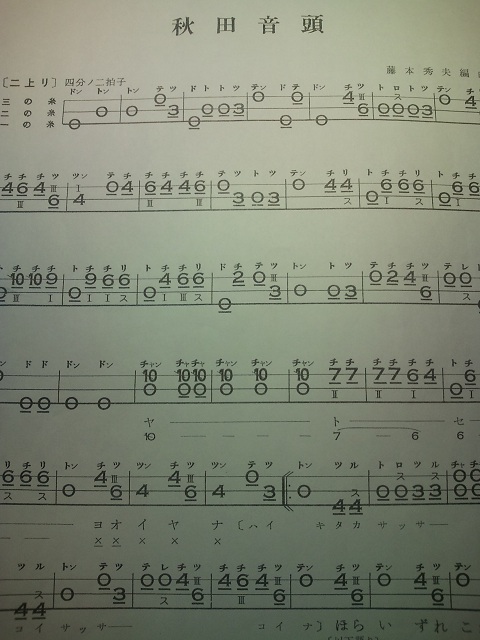
Music for the ja can be written in Western music notation, but is more often written in tablature notation. While tunings might be similar across genres, the way in which the nodes on the neck of the instrument (called in Japanese) are named is not. As a consequence, tablature for each genre is written differently. For example, in the ja style, nodes on the ja are labeled from 0, the open string called "0". However, in the ja style, nodes are subdivided and named by octave, with "1" being the open string and first note in an octave, starting over at the next octave. The nodes are also labeled differently for ja-style ja. To add to the confusion, sometimes nodes can be "sharped", and since the names of nodes and their positions are different for each genre, these will also vary. Consequently, students of one genre of ja will find it difficult to read tablature from other genres of ja, unless they are specially trained to read these kinds of tablatures.
Tablature can be written in traditional Japanese vertical right-to-left notation, or it can be written in Western style horizontal left-to-right notation, which resembles modern guitar tablature. In traditional vertical notation, Chinese characters and older symbols for dynamics are used, however notation from Western style music notation, such as Italian names for dynamics, time signature and the fermata have been imported. What tuning a work calls for is usually indicated on the tablature.
History and genres
The Japanese ja originated from the Chinese zh (). The zh was introduced through the Ryūkyū Kingdom (Okinawa) in the 16th century, where it developed into the Okinawan , from which the ja ultimately derives. It is believed that the ancestor of the ja was introduced in the 16th century through the port city of Sakai, near Osaka.
The ja can be played solo or with other ja, in ensembles with other Japanese instruments, with singing such as ja, or as an accompaniment to drama, notably kabuki and ja. Both men and women traditionally played the ja.
The most famous and perhaps most demanding of the narrative styles is ja, named after Takemoto Gidayū (1651–1714), who was heavily involved in the ja puppet-theater tradition in Osaka. The ja and its plectrum are the largest of the ja family, and the singer-narrator is required to speak the roles of the play, as well as to sing all the commentaries on the action. The singer-narrator role is often so vocally taxing that the performers are changed halfway through a scene. There is little notated in the books (ja) of the tradition except the words and the names of certain appropriate generic ja responses. The ja player must know the entire work perfectly in order to respond effectively to the interpretations of the text by the singer-narrator. From the 19th century, female performers known as ja or ja also carried on this concert tradition.
In the early part of the 20th century, blind musicians, including Shirakawa Gunpachirō (1909–1962), Takahashi Chikuzan (1910–1998), and sighted players such as Kida Rinshōei (1911–1979), evolved a new style of playing, based on traditional folk songs (ja) but involving much improvisation and flashy fingerwork. This style – now known as ja, after the home region of this style in the north of Honshū – continues to be relatively popular in Japan. The virtuosic ja style is sometimes compared to bluegrass banjo.
is a style of ja historically developed by and mostly performed by geisha and ja. Its name literally means "little song", which contrasts with the musical genre of ja found in ja and kabuki; though both ja and geisha training to play the ja will also learn ja and will occasionally perform ja at banquets, the vast majority of musical performances seen at the parties and events they attend are ja.
is a more classical style of ja music.
{{transliteration|ja|Shamisen}} in non-traditional genres
- Takeshi Terauchi & Bunnys utilized ja played by Michiya Mihashi in combo with their instrumental rock group on their single ja with "Dark Eyes".
- Japanese rock musician Miyavi has also played the ja on various occasions, incorporating its use in albums and during concerts (e.g. during the debut live of superband S.K.I.N concert at the 2007 Anime Expo convention at Long Beach, California on June 29, 2007).
- American ja player and guitarist Kevin Kmetz leads a rock band called God of Shamisen, which is based in Santa Cruz, California, and also plays the instrument with the band Estradasphere.
- Japanese traditional and jazz musician Hiromitsu Agatsuma incorporates a diverse mix of genres into his music. He arranged several jazz standards and other famous western songs for the shamisen on his album Agatsuma Plays Standards in 2008. His previous recordings, such as Beyond from 2004, displayed traditional Japanese styles mixed with funk, techno and rock. | access-date =7 February 2017}}
- Noriko Tadano is a ja player born and raised in Japan, who now resides in Australia. She has collaborated with a wide variety of musicians from genres such as blues, jazz, folk, experimental and electronic music. Tadano has performed in collaborations at a number of world festivals. Tadano performed in the blues duo 'George & Noriko' on season 6 of Australia's Got Talent, making it to the finals.
- Wagakki Band is a Japanese folk-rock fusion band that features various traditional Japanese instruments including the shamisen, played by Beni Ninagawa.
- Japanese metal group Ryujin has used the shamisen in some of their songs.
- Takeharu Kunimoto was a shamisen player who performed and recorded bluegrass music in addition to traditional Japanese music.{{Cite web |date=2016-02-24 |title=Takeharu Kunimoto – An Appreciation
References
Bibliography
References
- (2013). "Music of the peoples of the world". Schirmer, Cengage Learning.
- Dalby, Liza. (2000). "Geisha". Vintage Random House.
- (29 December 2016). "Shamisen faces crisis as cat skins fall from favor". The Japan Times.
- (2008). "Composing for Japanese instruments". University of Rochester Press.
- "Shamisen KATOH".
- Leiter, Samuel L.. (2007). "Encyclopedia of Asian Theatre: A-N". Greenwood Press.
- (1983). "Kodansha encyclopedia of Japan, Volume 7".
- Malm, William P.. (2000). "Traditional Japanese music and musical instruments, Volume 1". Kodansha International.
- Picken, Laurence E. R.. (2006). "Music from the Tang Court: Some Ancient Connections Explored, Volume 7". Cambridge University Press.
- Lande, Liv. (2007). "Innovating musical tradition in Japan: Negotiating transmission, identity, and creativity in the Sawai Koto School".
- "YouTube".
- "YouTube".
- "S.K.I.N. debut concert live report at JAME".
- "God of Shamisen interview | ALARM Magazine".
- "上妻宏光 三味線プレイヤー Hiromitsu Agatsuma Official Website".
- (2017-10-25). "Kāpiti Coast's one-day festival Coastella announces its line-up".
- (2017-08-01). "Powell Street Festival's George and Noriko: how the Japanese Blues Cowboy met the Tsugaru Shamisen Player".
- "Womadelaide".
- (2017-08-01). "Powell Street Festival's George and Noriko: how the Japanese Blues Cowboy met the Tsugaru Shamisen Player".
- (27 April 2014). "Guest - Wagakki Band".
- (21 January 2020). "Wagakki Band - 焔 (Homura) + 暁ノ糸 (Akatsuki no Ito) / 1st JAPAN Tour 2015 Hibiya Yagai Ongakudo".
This article was imported from Wikipedia and is available under the Creative Commons Attribution-ShareAlike 4.0 License. Content has been adapted to SurfDoc format. Original contributors can be found on the article history page.
Ask Mako anything about Shamisen — get instant answers, deeper analysis, and related topics.
Research with MakoFree with your Surf account
Create a free account to save articles, ask Mako questions, and organize your research.
Sign up freeThis content may have been generated or modified by AI. CloudSurf Software LLC is not responsible for the accuracy, completeness, or reliability of AI-generated content. Always verify important information from primary sources.
Report