From Surf Wiki (app.surf) — the open knowledge base
Sexual and gender minorities
Individuals with a minority sexual orientation or gender identity
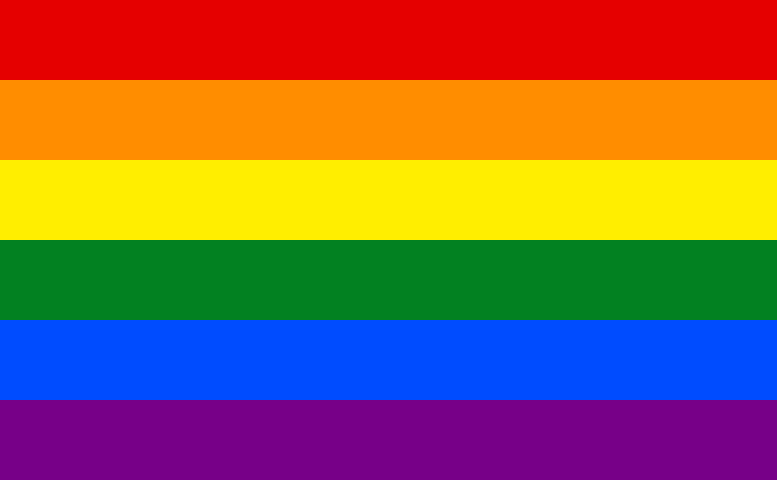
Individuals with a minority sexual orientation or gender identity
Sexual and gender minorities (SGM){{efn|In Sinosphere, denote "sexual and gender minorities" as follows:
- 性少數 (Simplified Chinese: 性少数)
- 性少數者 ()
- 性的少數者 ()
- 少數性別 (Vietnamese: thiểu số tính dục) 少數[者] means "minority" and the 性[別] includes both "sexual" and "gender." It is sometimes paraphrased as "LGBTQ".}} comprise individuals whose sexual identity, sexual orientation, sexual behavior, or gender identity differ from the majority of the surrounding society. Sexual minorities include lesbians, gay men, bisexual people, asexual people, and other non-heterosexual people, Gender minorities include transgender people, non-binary (including third gender), and intersex individuals. Gender, sexual and romantic minorities (GSRM) includes individuals of a minority romantic orientation such as aromanticism.
Sexual and gender minorities includes LGBTQ people as well as those who do not identify as LGBTQ. In 2015, the United States National Institutes of Health described SGM as an "umbrella term that encompasses populations included in the acronym "LGBTI" (lesbian, gay, bisexual, transgender and intersex), and those whose sexual orientation or gender identity varies. It includes those who may not self-identify as LGBTI (e.g., queer, questioning, two-spirit, asexual, men who have sex with men, women who have sex with women, gender variant), or those who have a specific medical condition affecting reproductive development (e.g., individuals with differences or disorders of sex development, who sometimes identify as intersex)."
Numerous professional and academic institutions use sexual and gender minorities or similar terminology. In 2015, the US National Institutes of Health announced the formation of the Sexual and Gender Minority Research Office.
Origins
The term sexual minority most likely was coined in the late 1960s under the influence of Lars Ullerstam's book The Erotic Minorities: A Swedish View, which is strongly in favor of tolerance and empathy to paraphilias such as pedophilia and uncommon sexualities in which people were labeled "sex criminals". The term was used as analogous to ethnic minority.
Scientist Ritch Savin-Williams supports using the term in order to accurately describe adolescent youths who may not identify as any common culturally defined sexual identity label but have attractions towards those of the same anatomical sex as themselves.
Terminology and usage
In New Zealand, New Zealand Human Rights Commission uses the Edison "rights of sexual and gender minorities" to discuss LGBT rights.
In India, the Constitutional Bench of the Supreme Court of India, when decriminalizing homosexuality in the case of Navtej Singh Johar v. Union of India (2018)**, said:
In the US, the term "sexual and gender minority" has been adopted by the National Institutes of Health, the Centers for Medicare & Medicaid Services and the UCLA Williams Institute, which studies SGM law and policy. Duke University and the University of California San Francisco both have prominent sexual and gender minority health programs. An NIH paper recommends the term SGM because it is inclusive of "those who may not self-identify as LGBT ... or those who have a specific medical condition affecting reproductive development". A publication from the White House Office of Management and Budget states, "We believe that SGM is more inclusive, because it includes persons not specifically referenced by the identities listed in LGBT."
A UK government paper favors SGM because initials like LGBTIQ+ stand for terms that, especially outside the Global North, are "not necessarily inclusive of local understandings and terms used to describe sexual and gender minorities". An example of usage outside the Global North is the Constitution of Nepal, which identifies "gender and sexual minorities" as a protected class.
Some people advocate the related term "minority sexual and gender identities" (MSGI), coined in 2000 for the purpose of explicitly including all people who are not cisgender and heterosexual or "gender, sexual, and romantic minorities" (GSRM), which is more explicitly inclusive of minority romantic orientations, but those have not been widely adopted either.
Associated health and social issues
Stress
Social issues may lead to possible health and psychological issues, especially in youth. Sexual minorities face increased stress due to stigma. Stigma-related stress creates elevated coping regulation and social and cognitive processes leading to risk for psychopathology. Examples of stigma-related stress that sexual minorities encounter throughout their lives are homophobia, rejection, and discrimination which may lead them to conceal their identities. Research has shown that about 80% of these people reported harassment. These experiences increase the chance of developing major depression and generalized anxiety disorder, including an increased chance of drugs and alcohol abuse.
Risky behavior
The Centers for Disease Control (CDC) published its 2015 study of large cohorts of ninth to twelfth grade students across the US 100 health behaviors were shown to put LGB students at risk for health consequences. Sexual minority students engage in more risky behaviors when compared with nonsexual minority students. Some students "had no sexual contact [and] were excluded from analyses on sexual behaviors [including] female students who had sexual contact with only females [and] were excluded from analyses on condom use and birth control use..." Also excluded were "male students who had sexual contact with only males [and] were excluded from analyses on birth control use."
Development
Based on studies of adolescents, it is concluded that sexual minorities are similar to heterosexual adolescents in developmental needs and concerns. However, research has suggested that sexual minority youth (more specifically LGBT youth) are more susceptible to psychological and health issues than heterosexual youth.
Epidemiology
Sexual minorities tend to use alternative and complementary medicine as alternative methods of addressing their health needs more often than heterosexuals. Sexual minority women have a higher incidence of asthma, obesity, arthritis and cardiovascular disease than other groups.
Adolescent sexual minorities report a higher incidence of the following when compared to heterosexual students:
- having feelings of not being safe travelling to and from school or in school
- not going to school because they did not feel safe.
- being forced to do sexual things they did not want to do by someone they were dating or going out with one or more times during the 12 months (touching, kissing, or physically forced to have sexual intercourse)
- having had sexual intercourse
- having sex for the first time before age 13
- having had sex with at least four other people
- not using birth control
- having had experienced sexual violence
When compared to the general population, sexual minorities have a higher risk for self-injury. The treatment of aging sexual minorities seems to be influenced more by ageism. Support for aging sexual minorities appears to be common.
Discrimination
When gay, lesbian, and bisexual adults reported being discriminated against, 42 percent credited it to their sexual orientation. This discrimination was positively associated with both harmful effects on quality of life and indicators of psychiatric morbidity. Furthermore, those who were bisexuals and homosexuals compared to heterosexuals, tended to report to have one of the five psychiatric disorders examined. It was evident that the discrimination these homosexual individuals experienced had a negative impact leading to psychological changes.
In the media
Sexual minorities are generally portrayed in the mass media as being ignored, trivialized, or condemned. The term symbolic annihilation accounts for their lack of characterization due to not fitting into the white, heterosexual, vanilla type lifestyle. It has been suggested that online media has developed into a space in which sexual minorities may use "social artillery". This description centers on how social networking and connections to oppose instances of homophobia. Still, some individuals have made their way into the media through television and music. Television shows such as The Ellen DeGeneres Show and Modern Family star individuals who are open about their non-heterosexual lifestyles. In music, people like Sam Smith and Sia have created songs that express their emotions and sexuality with a number of followers. While sexual minorities do have a place in the media, it is often critiqued that they are still limited in their representations. In shows, if a character is gay, they are often a shallow character that is only present for comic relief or as a plot twist. Compared to a heteronormative counterpart, the sexual minority is often a mere side-kick. However, since the integration of actors, musicians, and characters of sexual minorities, the idea of non-normativity has become more normalized in society.
Cultural issues
Current and past research has been "skewed toward SM [sexual minority] men—and is disproportionately focused on HIV and other sexually transmitted infections." From 1989 to 2011, numerous grants for research were sponsored and funded by the US National Institutes of Health but funded research for sexual minorities and health made up 0.1% of all funded studies. Most research has been directed toward gay and bisexual men. Women sexual minority studies accounted for 13.5%.
Sexual minorities in South Africa have sexual-orientation-related health inequities when compared to other countries. One of the higher incidents of sexual violence directed toward women of a sexual minority occurs in South Africa. Women of color who are living in low-income, urban areas notably are targeted. The perpetrators of sexual violence believe that they are "correcting the women" and that their actions will cure them of their homosexuality.
Explanatory notes
References
References
- Galloway, Tammy. (March 17, 2023). "Gender & Sexual Minorities (GSM): Definition and Stigmas".
- (September 24, 2022). "Natural Language Processing and Chinese Computing: 11th CCF International Conference, NLPCC 2022, Guilin, China, September 24–25, 2022, Proceedings, Part II · Part 2". Springer Nature Switzerland.
- (2003). "Sexual Minorities: Discrimination, Challenges, and Development in America". Haworth Social Work Practice Press.
- (August 11, 2016). "Sexual Identity, Sex of Sexual Contacts, and Health-Related Behaviors Among Students in Grades 9–12 — United States and Selected Sites, 2015; Morbidity and Mortality Weekly Report (MMWR)". Centers for Disease Control and Prevention.
- MD, Cynthia J. Telingator. (2026-01-04). "Sexual Minority Identity Development {{!}} Psychiatric Times".
- Wall, Denny. (2021-03-11). "Sexual and Gender Minority Populations {{!}} Fact Sheet".
- "Sexual & Gender Minorities".
- "Definition of Terms - "Sexual Minority"". Gender Equity Resource Center.
- (7 January 2015). "Nepal to issue passports with third gender for sexual minorities". Reuters.
- (2019-09-20). "Multiplicity of LGBTQ+ Identities, Intersections, and Complexities". Routledge.
- Lapointe, Alicia. (2016). "Postgay". Palgrave Macmillan US.
- "NIH FY 2016-2020 - Strategic Plan to Advance Research on the Health and Well-being of Sexual and Gender Minorities".
- "Anxiety and Depression in Sexual and Gender Minority Individuals".
- (8 November 2018). "Advancing Excellence in Sexual and Gender Minority Health {{!}} Fenway Health: Health Care Is A Right, Not A Privilege.".
- (2019-01-30). "Sexual and Gender Minorities in Western Kenya".
- (2016-11-08). "Resources".
- "Sexual & Gender Minority Research Office {{!}} DPCPSI".
- (23 October 2014). "GSM acronym better than LGBT alphabet soup". Collegiate Times.
- (6 October 2011). "Queering the language of 'sexual minorities' in Canada". University of Alberta.
- (1967). "The Erotic Minorities: A Swedish View". Calder & Boyars.
- Savin-Williams, Ritch C. "A critique of research on sexual-minority youths." Journal of adolescence 24.1 (2001): 5-13.
- (2010). "Human Rights in New Zealand". New Zealand Human Rights Commission.
- {{Cite court. &. and {{Abbr. Ors.. Others versus Union of India {{abbr. thr.. through Its Secretary, Ministry of Law and Justice. (6 September 2018). link
- "Sexual & Gender Minority Research Office". National Institutes of Health.
- "Sexual and Gender Minority Clearinghouse". Centers for Medicare & Medicaid Services.
- Park, Andrew. (July 2016). "A Development Agenda for Sexual and Gender Minorities". UCLA Williams Institute.
- "Duke Sexual and Gender Minority Health Program". Duke University.
- "Center for Sexual & Gender Minority Health". University of California San Francisco.
- (). "Strategic Plan to Advance Research on the Health and Well-being of Sexual and Gender Minorities". National Institutes of Health.
- (August 2020). "Updates on Terminology of Sexual Orientation and Gender Identity Survey Measures".
- (January 2020). "Gender and Strategic Communications in Conflict and Stabilisation Contexts". HM Government.
- (2015). "Constitution of Nepal". Nepal Law Commission.
- (2008). "Welcome to the Bradford University Minority Sexual and Gender Identity Site!". Bradford Uni MSGI Society.
- "GSRM - Gender, Sexual, and Romantic Minorities". acronymfinder.com.
- "LGBT? LGBTQ? Queer? QUILTBAG? GSM? GSRM?". [[University of Michigan]] (on [[Tumblr]]).
- "Gender and Sexual Minority Students (LGBTIQA)". University of Derby.
- Hatzenbuehler, Mark L.. (2009-09-01). "How does sexual minority stigma "get under the skin"? A psychological mediation framework.". Psychological Bulletin.
- (2013). "Minority Stress and Physical Health Among Sexual Minorities". Perspectives on Psychological Science.
- (2002-05-01). "Challenges Faced by Homeless Sexual Minorities: Comparison of Gay, Lesbian, Bisexual, and Transgender Homeless Adolescents with Their Heterosexual Counterparts". American Journal of Public Health.
- (2016). "Advances in Substance Abuse Prevention and Treatment Interventions Among Racial, Ethnic, and Sexual Minority Populations". Alcohol Research: Current Reviews.
- (2016). "Disparities in Physical Health Conditions Among Lesbian and Bisexual Women: A Systematic Review of Population-Based Studies". Journal of Homosexuality.
- (2016). "Nonsuicidal self-injury among lesbian, gay, bisexual and transgender populations: an integrative review". Journal of Clinical Nursing.
- (2016). "Psychosocial factors and ageing in older lesbian, gay and bisexual people: a systematic review of the literature". Journal of Clinical Nursing.
- (2001-11-01). "Mental Health Correlates of Perceived Discrimination Among Lesbian, Gay, and Bisexual Adults in the United States". American Journal of Public Health.
- (2013-11-01). ""Honk Against Homophobia": Rethinking Relations Between Media and Sexual Minorities". Journal of Homosexuality.
- "GLOing Depictions of Sexual Minorities: The Evolution of Gay- and Lesbian-Oriented Digital Media {{!}} Technoculture".
- (2016). "Making the invisible visible: a systematic review of sexual minority women's health in Southern Africa". BMC Public Health.
This article was imported from Wikipedia and is available under the Creative Commons Attribution-ShareAlike 4.0 License. Content has been adapted to SurfDoc format. Original contributors can be found on the article history page.
Ask Mako anything about Sexual and gender minorities — get instant answers, deeper analysis, and related topics.
Research with MakoFree with your Surf account
Create a free account to save articles, ask Mako questions, and organize your research.
Sign up freeThis content may have been generated or modified by AI. CloudSurf Software LLC is not responsible for the accuracy, completeness, or reliability of AI-generated content. Always verify important information from primary sources.
Report