From Surf Wiki (app.surf) — the open knowledge base
Seven Wonders of the Ancient World
Remarkable constructions of classical antiquity

Remarkable constructions of classical antiquity
The Seven Wonders of the Ancient World, also known as the Seven Wonders of the World or simply the Seven Wonders, is a list of seven notable structures present during classical antiquity, first established in the 1572 publication Octo Mundi Miracula using a combination of historical sources.
The seven traditional wonders established by the Octo Mundi Miracula are the Great Pyramid of Giza, the Colossus of Rhodes, the Lighthouse of Alexandria, the Mausoleum at Halicarnassus, the Temple of Artemis, the Statue of Zeus at Olympia, and the Hanging Gardens of Babylon. Using modern-day countries, two of the wonders were located in Greece, two in Turkey, two in Egypt, and one in Iraq. Of the seven wonders, only the Pyramid of Giza, which is also by far the oldest of the wonders, remains standing, while the others have been destroyed over the centuries. Remains exist from the Lighthouse, Temple of Artemis and the Mausoleum – either in situ or in museums. There is scholarly debate over the exact nature of the Hanging Gardens, and there is doubt as to whether they existed at all.
All known ancient and classical lists of wonders differ from the Octo Mundi Miracula version. The first known list of seven wonders dates back to the 2nd–1st century BC; at least 8 full lists and 10 partial lists are known. Three other wonders appear more than twice across these lists: the Walls of Babylon, the Palace of Cyrus the Great, and the Pergamon Altar.
Background
Alexander the Great's conquest of much of the western world in the 4th century BC gave Hellenistic travellers access to the civilizations of the Egyptians, Persians, and Babylonians. Impressed and captivated by the landmarks and marvels of the various lands, these travellers began to list what they saw to remember them.
Instead of "wonders", the ancient Greeks spoke of "theamata" (θεάματα), which means "sights", in other words "things to be seen" (Τὰ ἑπτὰ θεάματα τῆς οἰκουμένης [γῆς] Tà heptà theámata tēs oikoumenēs [gēs]). Later, the word for "wonder" ("thaumata" θαύματα, "wonders") was used. Hence, the list was meant to be the ancient world's counterpart of a travel guidebook.
Known lists
The first reference to a list of seven such monuments was given by Diodorus Siculus; he did not provide the list itself, mentioning only the Walls of Babylon and the Pyramids. The epigrammist Antipater of Sidon, who lived around or before 100 BC, gave a list of seven "wonders", including six of the present list (substituting the walls of Babylon for the Lighthouse of Alexandria):
I have gazed on the walls of impregnable Babylon along which chariots may race, and on the Zeus by the banks of the Alpheus, I have seen the hanging gardens, and the Colossus of the Helios, the great man-made mountains of the lofty pyramids, and the gigantic tomb of Mausolus; but when I saw the sacred house of Artemis that towers to the clouds, the others were placed in the shade, for the sun himself has never looked upon its equal outside Olympus.
Another ancient writer who, perhaps dubiously, identified himself as Philo of Byzantium, wrote a short account entitled The Seven Sights of the World. Earlier and later lists by the historian Herodotus () and the poet Callimachus of Cyrene (), housed at the Museum of Alexandria, survive only as references.
The listing of seven of the most marvellous architectural and artistic human achievements continued beyond the Ancient Greek times to the Roman Empire, the Middle Ages, the Renaissance and to the modern age. The Roman poet Martial and the Christian bishop Gregory of Tours had their versions. included the Temple of Solomon, the Pharos of Alexandria, and Noah's Ark.
German classical scholar Wilhelm Heinrich Roscher's list of 18 known classical lists of wonders, both complete and incomplete, published in 1906, showed only two of the 18 lists being identical – and considered the second was simply a later copy of the first. Roscher’s list of lists is shown below; none of the lists match the modern "canonical" seven (shown in bold). The 18 lists contain 82 names, with a total of 22 distinct buildings or places:
| Complete | Incomplete | Number | Antipater | Hyginus | Madrid(a) | Heraclitus(a) | Gregory | Anthol.VIII | Anthol.IX | Ampelius | Diodorus | Strabo | Eustathius | Valerius | Plutarch | Pausanias | Lucian | Heraclitus(b) | Philo | Madrid(b) |
|---|---|---|---|---|---|---|---|---|---|---|---|---|---|---|---|---|---|---|---|---|
| I. Babylon walls | 10 | |||||||||||||||||||
| II. Pyramids | **** | **** | **** | **** | **** | **** | **** | **** | **** | **** | 10 | |||||||||
| III. Mausoleum | **** | **** | **** | **** | **** | **** | **** | **** | **** | 9 | ||||||||||
| IV. Colossus | **** | **** | **** | **** | **** | **** | **** | **** | **** | **** | **** | 11 | ||||||||
| V. Artemis tem. | **** | **** | **** | **** | **** | **** | **** | **** | 8 | |||||||||||
| VI. Zeus sta. | **** | **** | **** | **** | **** | **** | 6 | |||||||||||||
| VII. Cyrus' palace | 4 | |||||||||||||||||||
| VIII. Thebes (Eg) | 2 | |||||||||||||||||||
| IX. Cyzicus temple | 2 | |||||||||||||||||||
| X. Heraclea theatre | 1 | |||||||||||||||||||
| XI. Delos | 2 | |||||||||||||||||||
| XII. Thebes (Gr) | 2 | |||||||||||||||||||
| XIII. Hanging Gdns. | **** | **** | **** | **** | **** | 5 | ||||||||||||||
| XIV. Capitoline | 2 | |||||||||||||||||||
| XV. Pergamon altar | 3 | |||||||||||||||||||
| XVI. Lighthouse | **** | **** | **** | 3 | ||||||||||||||||
| XVII. Chalke gate | 1 | |||||||||||||||||||
| XVIII. Zeus tem. | 1 | |||||||||||||||||||
| XIX. Myra thea. | 1 | |||||||||||||||||||
| XX. Asclepius San. | 1 | |||||||||||||||||||
| XXI. Parion altar | 1 | |||||||||||||||||||
| XXII. Athena statue | 1 | |||||||||||||||||||
| Number | 7 | 7 | 7 | 7 | 7 | 7 | 7 | 7 | 2 | 3 | 4 | 1 | 1 | 2 | 2 | 5 | 5 | 5 |
Modern historians, working on the premise that the original Seven Ancient Wonders List was limited in its geographic scope, also had their versions to encompass sites beyond the Hellenistic realm—from the Seven Wonders of the Ancient World to the Seven Wonders of the World. The "seven wonders" label has spawned innumerable versions among international organizations, publications and individuals based on different themes—works of nature, engineering masterpieces, constructions of the Middle Ages, etc. Its purpose has also changed from just a simple travel guidebook or a compendium of curious places to a list of sites to defend or preserve.
Canonical seven wonders
Main article: Octo Mundi Miracula
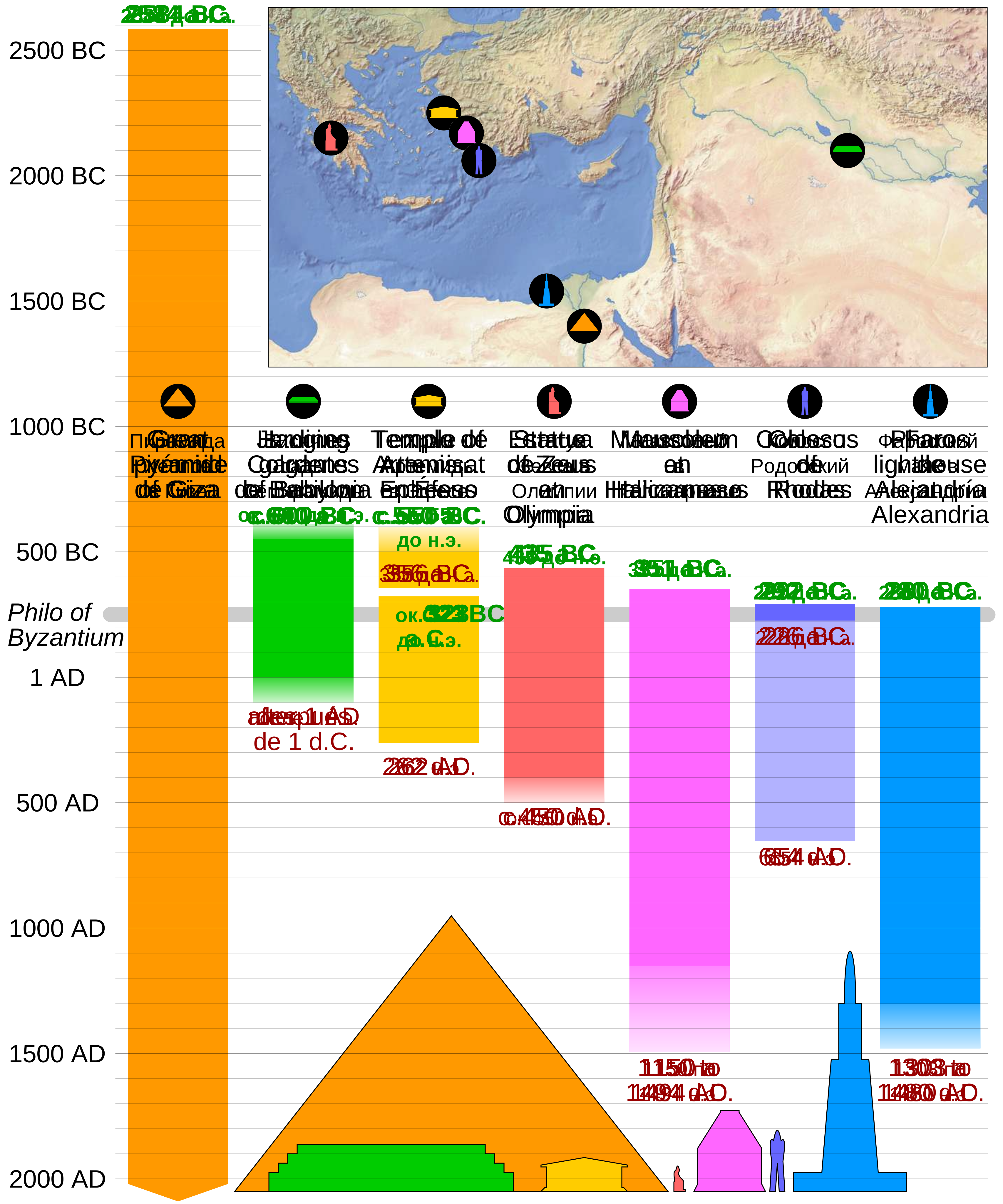
The modern canonical list was first established in the 1572 publication Octo Mundi Miracula using a combination of historical sources.
The list covered only the Mediterranean and Middle Eastern regions, which then comprised the known world for the Greeks. The primary accounts from Hellenistic writers also heavily influenced the places included in the wonders list. Five of the seven entries are a celebration of Greek accomplishments in construction, the exceptions being the Pyramids of Giza and the Hanging Gardens of Babylon.
The Colossus of Rhodes was the last of the seven to be completed, after 280 BC, and the first to be destroyed, by an earthquake in 226/225 BC. It was therefore already in ruins by the time the list was compiled, and all seven wonders existed simultaneously for less than 60 years.
Of the canonical wonders, the only one that has survived to the present day is the Great Pyramid of Giza. Its brilliant white stone facing had survived intact until around 1300 AD, when local communities removed most of the stonework for building materials. The existence of the Hanging Gardens has not been proven, though theories abound. Records and archaeology confirm the existence of the other five wonders. The Temple of Artemis and the Statue of Zeus were destroyed by fire, while the Lighthouse of Alexandria, the Colossus, and tomb of Mausolus were destroyed by earthquakes. Among the surviving artifacts are sculptures from the tomb of Mausolus and the Temple of Artemis, currently kept in the British Museum in London.
The revival of Greco-Roman artistic styles caught the imagination of European artists and travellers. Paintings and sculptures alluding to the canonical list were made, while significant numbers of adventurers travelled to the actual sites to personally witness the wonders. Legends circulated to further complement the superlatives of the wonders.
| Name | Date of construction | Builders | Date of destruction | Cause of destruction | Modern location | Modern status | Image | Great Pyramid of Giza | Hanging Gardens of Babylon | |||
|---|---|---|---|---|---|---|---|---|---|---|---|---|
| (existence unresolved) | Statue of Zeus at Olympia | Temple of Artemis at Ephesus | Mausoleum at Halicarnassus | Colossus of Rhodes | Lighthouse of Alexandria | |||||||
| 25842561 BC | Egyptians | Still in existence, majority of façade gone | Giza Necropolis, Egypt | |||||||||
| Standing | [[File:Pyramide Kheops.JPG | 100px | frameless]] | |||||||||
| BC (evident) | Babylonians or Assyrians | After 1st century AD | Unknown | Hillah or Nineveh, Iraq | ||||||||
| No trace | ||||||||||||
| 466456 BC (temple) | ||||||||||||
| 435 BC (statue) | Greeks(Phidias) | 5th6th centuries AD | Disassembled and reassembled at Constantinople; later destroyed by fire | Olympia, Greece | ||||||||
| No trace of statue; remains of the Temple of Zeus | [[File:Workshop of Phidias.jpg | 100px | frameless]] | |||||||||
| BC; and again in 323 BC | Greeks, Lydians | 356 BC (by Herostratus) | ||||||||||
| AD 262 (by the Goths) | Arson by Herostratus, plundering | Near Selçuk, Turkey | ||||||||||
| Remains of the temple | [[File:Templo-Artemisa-Efeso-2017.jpg | 100px | frameless]] | |||||||||
| 351 BC | last = Kostof | first = Spiro | title = A History of Architecture | publisher = Oxford University Press | year = 1985 | location = Oxford | page = 9 | isbn = 0-19-503473-2}} Persians, Carians | ||||
| (Satyros and Pythius of Priene) | 12th15th century AD | Earthquakes | Bodrum, Turkey | |||||||||
| Remains of the Mausoleum, including at the British Museum | [[File:The ruins of the Mausoleum at Halicarnassus.jpg | 100px | frameless]] | |||||||||
| 292280 BC | Greeks | |||||||||||
| (Chares of Lindos) | 226 BC | Destroyed by earthquake | Rhodes, Greece | |||||||||
| No trace | ||||||||||||
| BC | Greeks, Ptolemaic Egyptians | AD 13031480 | Destroyed by earthquake | Alexandria, Egypt | ||||||||
| Remains found underwater in 1994 | [[File:AlexLighthouse01.jpg | 100px | frameless]] |
References
References
- {{harvnb. Clayton. Price. 2013
- {{harvnb. Tobin. 2011
- "The Seven Wonders of the Ancient World".
- "History of the Past: World History".
- Paul Lunde. (May–June 1980). "The Seven Wonders". Saudi Aramco World.
- Clayton, Peter. (1990). "The Seven Wonders of the Ancient World". Routledge.
- "Bibliotheca Historica, Books I-V". Perseus Project, Tufts University.
- (2013-08-21). "The Seven Wonders of the Ancient World". Routledge.
- "Greek Anthology, Volume III". Perseus Project, Tufts University.
- (1843). "Biographical Dictionary Volume III". Society for the Diffusion of Useful Knowledge.
- (2012-02-17). "Book IX: Epigram 58".
- (2019-08-23). "Philo of Byzantium, On the Seven Wonders of the World: an English translation and some notes".
- Reflecting the rise of Christianity and the factor of time, nature and the hand of man overcoming Antipater's seven wonders, Roman and Christian sites began to figure on the list, including the [[Colosseum]], [[Noah's Ark]], and [[Solomon's Temple]]. In the 6th century, a list of seven wonders was compiled by St. [[Gregory of Tours]]: the listClayton, Peter and Price, Martin: The Seven Wonders of the Ancient World (Routledge, 1988), pp. 162–163.
- {{harvnb. Roscher. 1906: [[:File:Table of original sources for the Seven Wonders of the Ancient World (table 1).jpg. Roscher’s list of Complete lists]] and [[:File:Table of original sources for the Seven Wonders of the Ancient World (table 2).jpg. Roscher’s list of Incomplete lists]]. Note that the Lighthouse (Φάρος), number XVI, only appears in 3 of the 18 lists, alongside few of the other "canonical" wonders. The hanging gardens, number XIII, is shown separately from the walls of Babylon in Antipater of Sidon's list, but appears as the only Babylonian monument in the other 5 lists where it is mentioned.
- [[Palatine Anthology]], [https://www.attalus.org/poetry/antipater2.html IX 58]: “I have set eyes on the wall of lofty Babylon on which is a road for chariots, and the statue of Zeus by the Alpheius, and the hanging gardens, and the colossus of the Sun, and the huge labour of the high pyramids, and the vast tomb of Mausolus ; but when I saw the house of Artemis that mounted to the clouds, those other marvels * lost their brilliancy, and I said, " Lo, apart from Olympus, the Sun never looked on anything so grand."”
- [https://topostext.org/work/206 ''Fabulae'' 223]: “SEVEN WONDERS OF THE WORLD: The temple of Diana at Ephesus which the Amazon Otrera, wife of Mars, made. The Monument of King Mausolus made of marble blocks, 80 feet high, 1,340 feet around. The bronze statue of the Sun at Rhodes, which is colossal, being 90 feet high. The statue of Olympian Jove which Phidias made, a seated statue of gold and ivory, 60 feet high. The palace of Cyrus the King in Ecbatana, which Memnon made, of many colored and shining white stones bound with gold. The wall in Babylon, which Semiramis, daughter of Dercetis, made, of baked brick and bitumen, bound with iron, 25 feet broad, 60 feet high, and 300 stades in circuit. The pyramids in Egypt, whose shadow isn't seen, 60 feet high.”
- Unger, Robert August. (1839). "Thebana paradoxa: sex libris". Lippert.
- Peri Apiston: [https://archive.org/details/mythographigrae01festgoog/page/n148/mode/1upMythographi graeci 3:2], section 321, page 88-89: "II. Τὰ ἑπτὰ θεάματα. α’ ὁ ἐν Ὀλυμπίᾳ Ζεὺς πήχεων λς’. β’ ὁ τῆς Ἐφεσίας Ἀρτέμιδος ναός. γ’ ὁ ἐν Δήλῳ κεράτινος βωμός, ὃς λέγεται γενέσθαι ἐκ θυμάτων τοῦ θεοῦ μιᾶς ἡμέρας δεξιῶν κεράτων. δ’ τὸ Μαυσωλεῖον τὸ ἐν Ἁλικαρνασσῷ. ε’ αἱ ἐν Αἰγύπτῳ πυραμίδες, ὧν ἡ μείζων πήχεις ἔχει υ’.ϛ’ τὰ Βαβυλώνια τεῖχη. ζ’ ὁ ἐν Ῥόδῳ κολοσσὸς πήχεων ο’, ὃν ἐποίησε Χάρης ὁ Λίνδιος. Τινὲς δὲ τάττουσι καὶ τὸν ἐν Ἐπιδαύρῳ Ἀσκληπιὸν καὶ τὸν ἐν Παρίῳ βωμὸν. καὶ τοὺς κρεμαστοὺς κήπους καὶ τὴν ἱσταμένην Ἀθηνᾶν ἐν Ἀθήναις καὶ τὰ Κύρου βασίλεια. [https://academic.oup.com/book/3623/chapter/144953879 Appendix II Translation of Anonymous, Peri Apiston]: II. The seven wonders. 1. The statue of Zeus at Olympia, 36 cubits tall. 2. The temple of Artemis at Ephesus. 3. The altar of horn at Delos, said to have been created from the right horns of victims sacrificed to the god in a single day. 4. The Mausoleum at Halicarnassus. 5. The pyramids of Egypt, of which the largest is 400 cubits tall. 6. The walls of Babylon. 7. The Colossus of Rhodes, 70 cubits tall, which Chares of Lindus built. Some include on this list also the Asclepion at Epidauros, the altar at Parion, the hanging gardens, the standing Athena statue in Athens, and the palace of Cyrus.
- Oration XX, p. 359.
- ''Palatine Anthology'', [https://anthologiagraeca.org/passages/urn:cts:greekLit:tlg7000.tlg001.ag:8.177/ Book VIII Epigram 177]: “ These are the seven wonders of the world: a wall, a statue, gardens, pyramids, a temple, another statue, a tomb. The eighth was I, this vast tomb rising high above these rocks; and among the dead I am most celebrated, owing to the greed of thy furious hand, murderer.”
- ''Palatine Anthology'', [https://topostext.org/work/534#8.177 Book IX Epigram 656]: “I surpass the celebrated wonders of the Italian land. Beauty of the Capitolian hall, give place to thy betters, even though thy roof of bronze dazzles the eye. Hide, Pergamus, thy splendid ornament, the grove of Rufinus, narrow now beside the halls of this limitless palace; and thou, Cyzicus, no longer sing of thy noble temple of Hadrian standing fast on the long cliff. The pyramids are not capable of vying with me, or the colossus, or the Pharos; I alone surpass a great legion of buildings. My prince himself, after his victory over the Isaurians, completed me, the house of the Dawn, shining with gold, on all sides exposed to the breezes of the four winds.”
- [[s:translation:Liber Memorialis%238. Wonders of the World. Wonders which are on Earth]] ''Liber Memorialis'', ch. 8.
- ''Bibliotheca Historica'' 1.63; 2.11; 18.4.
- ''Geographica'', pp. 652, 656, 738.
- [https://archive.org/details/commentariiadhom01eust/page/332/mode/1up ''Commentary on the Odyssey'', pp. 1623, 10]: “(Vers. 190.) βαθέϊ ἔτετυκτο πέλωμον, εἰλήφασιν οἱ μεθ’ Ὅμηρον φαίνεσθαι τινα ἐν κόσμῳ λέγειν τὰ παραδόξα θεάματα, οἷος ὁ τοῦ Μαυσωλοῦ τάφος, ὁ ἐν Ἐφέσῳ ναὸς τῆς Ἀρτέμιδος, ὁ Βαβυλῶνος κῆπος, αἱ ἐν Αἰγύπτῳ πυραμίδες καὶ ἕτερα.”; translation: “(Verse 190) “A deep and vast cavern was built. Those after Homer have taken this to mean that he was describing one of the marvels of the world — such as the tomb of Mausolus, the temple of Artemis at Ephesus, the gardens of Babylon, the pyramids of Egypt, and other such wonders.”
- ''Factorum et dictorum memorabilium'' IX 4.6; in [[Pliny the Elder. Pliny]], ''Natural History'' 36.30.
- ''Moralia'', ''De sollertia animalium'' 35.
- ''[[Description of Greece]]'' 4.31.5 “Round Messene is a wall, the whole circuit of which is built of stone, with towers and battlements upon it. I have not seen the walls at Babylon or the walls of Memnon at Susa in Persia, nor have I heard the account of any eye-witness; but the walls at Ambrossos in Phocis, at Byzantium and at Rhodes, all of them the most strongly fortified places, are not so strong as the Messenian wall.”
- ''Icaromenippus'' 12.
- ''On the Seven Wonders'' (''De septem miraculis'').
- 1 Βαβυλῶνος τεῖχος (''Babylonos teichos'').
- 6 ''Murus in Babylonia (Semiramidis)''.
- 2 Βαβυλῶνος τεῖχη (''Babylonos teiche'').
- 6 Βαβυλῶνος τεῖχη (''Babylonos teiche'').
- 3 τεῖχη Βαβυλῶνος (''teiche Babylonos'').
- 1 τεῖχος (Schol. τὸ ἐν Βαβέλ.) (''teichos [to en Babel]'').
- 6 ''Murus Babyloniae, Memnon aedific.''
- ὀβελίσκος ἐν Βαβυλ. (obelisk in Babylon)
- τὰ Βαβυλ. τεῖχη (''ta Babyl. teiche'').
- ''Mauern v. Babylon''.
- 5 πυραμίδες (''pyramidēs'').
- 7 ''Pyramides''.
- 1 πυραμίδες (''pyramidēs'').
- 5 πυραμίδες (''pyramidēs'').
- 4 πυραμίδες (''pyramidēs'').
- 4 πυραμίδες (''pyramidēs'').
- 7 ''Pyramides''.
- πυραμίδες (''pyramidēs'').
- αἱ ἐν Αἰγύπτῳ πυραμίδες (''hai en Aigyptō pyramidēs'').
- ''Pyramiden''.
- 6 μνῆμα Μαυσωλεῖου (''mnēma Mausōleiou'').
- 2 ''Monumentum Mausoli''.
- 4 Μαυσωλείου τάφος (''Mausōleiou taphos'').
- 4 τὸ Μαυσωλεῖον (''to Mausōleion'').
- 4 Μαυσωλείου τάφος (''Mausōleiou taphos'').
- 7 τάφος (Schol. ὁ Μαυσωλεῖος) (''taphos [ho Mausōleios]'').
- ὁ Μαυσωλείου τάφος (''ho Mausōleiou taphos'').
- ὁ Μαυσωλείου τάφος (''ho Mausōleiou taphos'').
- ''Mausoli sepulcrum''.
- 4 Ἡλίου κολοσσός (''Hēliou kolossos'').
- 3 ''Rhodi signum Solis''.
- 5 Κολοσσὸς ἐν Ῥόδῳ (''Kolossos en Rhodō'').
- 7 ὁ ἐν Ῥόδῳ κολοσσός (''ho en Rhodō kolossos'').
- 5 Κολοσσὸς χαλκός (''Kolossos chalkos'').
- 2 ἄγαλμα (Schol. ὁ ἐν Ῥόδῳ κολοσσός) (''agalma [ho en Rhodō kolossos]'').
- 5 Κολοσσὸς (''Kolossos'').
- 4 ''Rhodi colossic. signum Solis''.
- ὁ τοῦ Ἡλίου κολοσσός (''ho tou Hēliou kolossos'').
- ὁ Ῥοδίων κολοσσός (''ho Rhodiōn kolossos'').
- ''Koloss v. Rhodos''.
- 7 Ἐφεσίης δόμος (''Ephesies domos'').
- 1 ''Ephesi Dianae Templum, quod fec. Amazon''.
- 2 δ’ Ἐφεσίαις Ἄρτε. ναός (''d’ Ephesiais Arte. naos'').
- 6 Ναὸν Ἀρτέμιδος (''Naon Artemis'').
- 5 ναός (Schol. ἡ ἐν Ἐφέσῳ) (''naos [hē en Ephesō]'').
- 3 ''Aedis Dianae Epheso, quam const. Amason'' (vgl. § 12).
- ὁ ἐν Ἐφέσῳ ναὸς τῆς Ἀρτέμιδος (''ho en Ephesō naos tēs Artemis'').
- ''Artemision v. Ephesos''.
- 2 τὸν ἐν Ὀλυμπίᾳ Δία (''ton en Olympiā Dia'').
- 4 ''Signum Iovis Olympii''.
- 1 ὁ ἐν Ὀλυμπίᾳ Ζεύς (''ho en Olympiā Zeus'').
- 7 Κίλια ἐμμετρεῖν δυνάμενον (''Kilia emmetrein dunamenon'').
- 6 ἄγαλμα (Schol. Ζεύς) (''agalma [Zeus]'').
- ''Zeus von Olympia''.
- 5 ''Domus Cyri in Ecbatanis, q. fec. Memnon''.
- 5 ''Domus Cyri regis etc.''
- τὰ Μεμνόνεια ἐν Σούσοις τεῖχη (''Memnonian walls in Susa''), see Hyginus: “The palace of Cyrus the King in Ecbatana, which Memnon made”.
- 5 τὰ Κύρου βασίλεια (''ta Kyrou basileia'').
- 3 Ἑκατόμπυλον Θῆβας (''Hekatompylon Thēbas'').
- 2 Θῆβαι Αἰγύπτου (''Thēbai Aigyptou'').
- 6 Ναὸς ἐν Κέρκυρα (''Naos en Kerkyra'').
- 3 Ἄρμασμον ἐν Κερκύρᾳ ναός (''Armasmon en Kerkyrā naos'').
- 7 Θησαυρὸς Ἡρακλέους (''Thēsauros Hērakleous'').
- 3 ὁ ἐν Δήλῳ κεχρυσούς βωμός (''ho en Dēlō kechrysous bōmos'').
- ὁ κεχρυσούς βωμός (Delos) (''ho kechrysous bōmos'').
- 1 Ἑκατόμπυλον Θῆβας (''Hekatompylon Thēbas'').
- 5 Ἑκατόμπυλον Θῆβας (''Hekatompylon Thēbas'').
- 3 κήπων αἴσθημα (''kēpōn aisthēma'').
- 3 κῆποι (Schol. οἱ ἐν Κολοσσαῖς) (''kēpoi [hoi en Kolossais]'').
- ὁ κρεμαστὸς κῆπος (''ho kremastos kēpos'').
- ὁ Βαβυλώνιος κῆπος (''ho Babylōnios kēpos'').
- 3 οἱ κρεμαστοὶ κῆποι (''hoi kremastoi kēpoi'').
- 1 Καπιτωλίς στήλη (''Kapitolīs stēlē'').
- 4 Ῥώμης Καπιτώλιον (''Rhōmēs Kapitōlion'').
- 2 Ῥουφίνου ἄγαλμα (ἐν Περγάμῳ) (''Rhophinou agalma [en Pergamō]'').
- 2 ''Pergamo ara marmorea magna''.
- 3 Ῥοσίνου ἄγαλμα ἐν τῇ Περγάμῳ (''Rhosinou agalma en tē Pergamō'').
- 6 Φάρος (''Pharos'').
- 1 τέχνος Φάρου (''technos Pharou'').
- 1 τέχνος Φάρου (''technos Pharou'').
- 7 Χαλκῆ (''Chalkē'') in Byzanz.
- 1 ''Olympiae templ. Iovis?''
- Θέατρον Λυκίας τῶν Μύων ὃπερ κατέσκαψεν Ἰσμαὴλ γένος (''The theater of the Lycians at Myra, which was destroyed by the Ishmaelites.'')
- Ἐπιδαύρῳ Ἀσκληπιὸν (''Epidauros Asclepion'')
- 2 ὁ ἐν Παφίῳ βωμός (''ho en Paphio bōmos'').
- 4 ἡ ἱερὰ Ἀθήναις Ἐλαφηβολίων (''hē hiera Athēnais Elaphēboliōn'').
- (1995). "The New Encyclopædia Britannica Micropædia Volume 10". Encyclopædia Britannica, Inc..
- [[Stephanie Dalley]] (2013), ''The Mystery of the Hanging Garden of Babylon: an elusive World wonder traced.'' OUP {{ISBN. 978-0-19-966226-5
- "Wonders of Europe".
- link. (2024-05-21 , In ''The Seven Wonders of the Ancient World'', Edited by Peter Clayton and Martin Price, Routledge, New York, pp. 38 ff. {{ISBN). 0-415-05036-7).
- Kostof, Spiro. (1985). "A History of Architecture". Oxford University Press.
- Gloag, John. (1969). "Guide to Western Architecture". The Hamlyn Publishing Group.
This article was imported from Wikipedia and is available under the Creative Commons Attribution-ShareAlike 4.0 License. Content has been adapted to SurfDoc format. Original contributors can be found on the article history page.
Ask Mako anything about Seven Wonders of the Ancient World — get instant answers, deeper analysis, and related topics.
Research with MakoFree with your Surf account
Create a free account to save articles, ask Mako questions, and organize your research.
Sign up freeThis content may have been generated or modified by AI. CloudSurf Software LLC is not responsible for the accuracy, completeness, or reliability of AI-generated content. Always verify important information from primary sources.
Report