From Surf Wiki (app.surf) — the open knowledge base
Seven hills of Istanbul
Turkish geographic features
Turkish geographic features
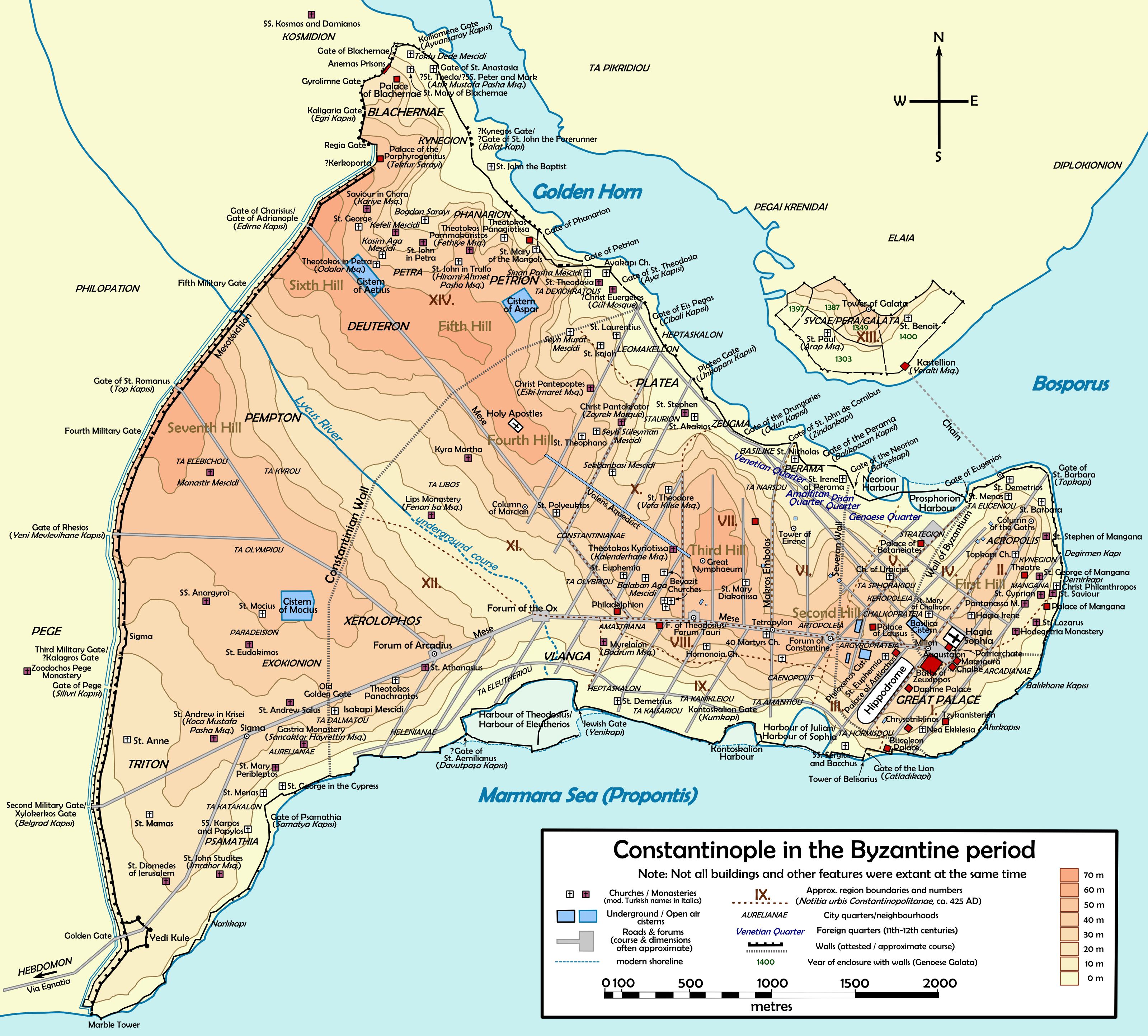
Istanbul is known as the City on the Seven Hills (). The city has inherited this denomination from Byzantine Constantinople which – consciously following the model of Rome – was also built on seven hills.
The seven hills of Istanbul
The seven hills, all located in the area within the walls, first appeared when the valleys of the Golden Horn and the Bosphorus were opened up during the Secondary and Tertiary periods. In the Ottoman Age, as in the earlier Byzantine period, each hill was surmounted by monumental religious buildings (churches under the Byzantines, imperial mosques under the Ottomans).
Ist
The first hill on which the ancient city of Byzantium was founded, begins from Seraglio Point and extends over the whole area containing Hagia Sophia, the Sultan Ahmed Mosque and Topkapı Palace.
IInd
On the second hill are to be found the Nuruosmaniye Mosque, Grand Bazaar and Column of Constantine. The second hill is divided from the first by a fairly deep valley running from Babiali on the east Eminönü.
IIIrd
The third hill is now occupied by the main buildings of Istanbul University, the Bayezid II Mosque to the south and the Süleymaniye Mosque to the north. The southern slopes of the hill descend to Kumkapi and Langa.
IVth
The fourth hill on which stood the Church of the Holy Apostles and, subsequently, the Fatih Mosque, slopes down rather steeply to the Golden Horn on the north and, rather more gently, to Aksaray on the south.
Vth
On the fifth hill is the Mosque of Sultan Selim. The fifth and the sixth hills are separated by the valley running down on the west to Balat on the shore of the Golden Horn.
VIth
On the sixth hill is the Mihrimah Sultan Mosque. The districts include Edirnekapı and Ayvansaray. Its gentle slopes run out beyond the line of the defense walls.
VIIth
The seventh hill, known in Byzantine times as the Xērolophos (), or "dry hill," it extends from Aksaray to the Theodosian Walls and the Marmara. It is a broad hill with three summits producing a triangle with apices at Topkapı, Aksaray, and Yedikule. It was divided from the rest of the city by the Lycus creek.
References
Bibliography
- {{cite book
This article was imported from Wikipedia and is available under the Creative Commons Attribution-ShareAlike 4.0 License. Content has been adapted to SurfDoc format. Original contributors can be found on the article history page.
Ask Mako anything about Seven hills of Istanbul — get instant answers, deeper analysis, and related topics.
Research with MakoFree with your Surf account
Create a free account to save articles, ask Mako questions, and organize your research.
Sign up freeThis content may have been generated or modified by AI. CloudSurf Software LLC is not responsible for the accuracy, completeness, or reliability of AI-generated content. Always verify important information from primary sources.
Report