From Surf Wiki (app.surf) — the open knowledge base
Seven-arm octopus
Species of cephalopod
Species of cephalopod
|Alloposus mollis (Verrill, 1880) |?Octopus alberti (Joubin, 1895) |Alloposus pacificus (Ijima & Ikeda, 1902) |Heptopus danai (Joubin, 1929) |Alloposus hardyi (Robson, 1930) |?Alloposina albatrossi (Robson, 1932)
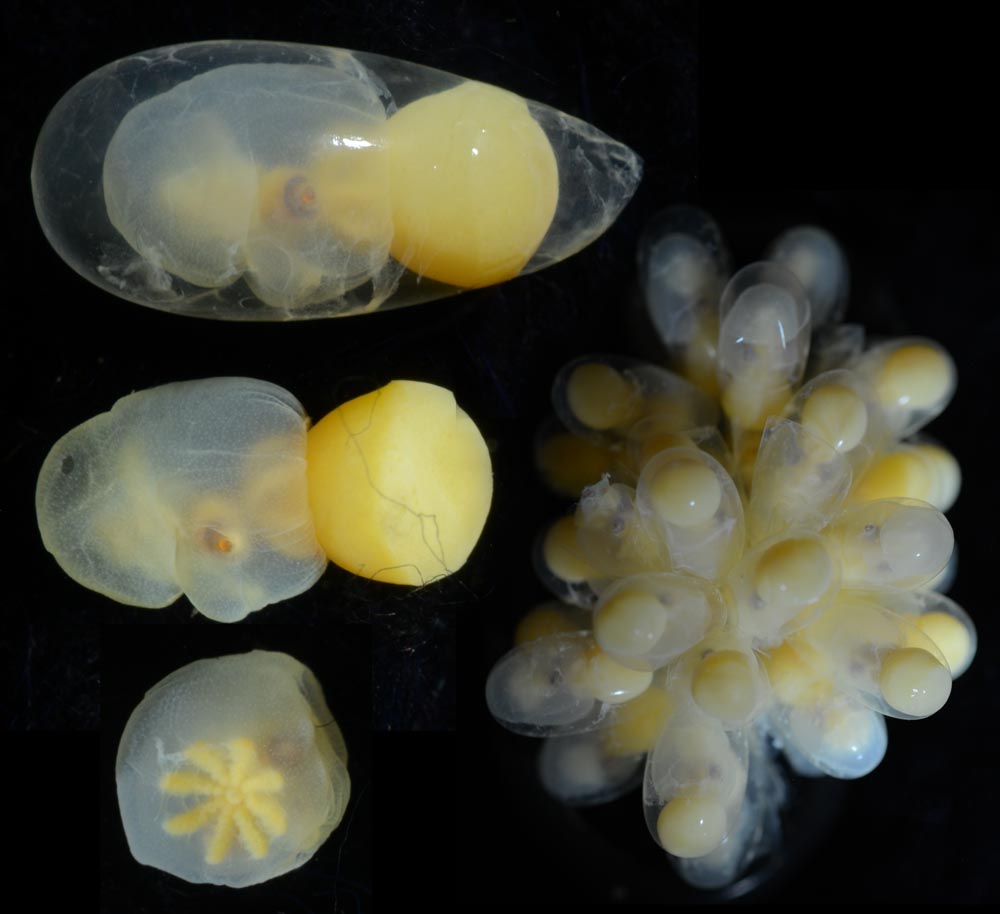
The seven-arm octopus (Haliphron atlanticus), also known as the blob octopus or sometimes called septopus, is one of the two largest known species of octopus; the largest specimen ever discovered had an estimated total length of 3.5 m and mass of 75 kg. The only other similarly large extant species is the giant Pacific octopus, Enteroctopus dofleini.
The genera Alloposina (Grimpe, 1922), Alloposus (Verrill, 1880) and Heptopus (Joubin, 1929) are junior synonyms of Haliphron, a monotypic genus in the monotypic family Alloposidae, part of the superfamily Argonautoidea in the suborder Incirrata of the order Octopoda.
Description
The seven-arm octopus is so named because in males, the hectocotylus (a specially modified arm used in egg fertilization) is coiled in a sac beneath the right eye. Due to this species' thick, gelatinous tissue, the arm is easily overlooked, giving the appearance of just seven arms. However, like other octopuses, it actually has eight.
Distribution
H. atlanticus is found worldwide in tropical and temperate waters.
The type specimen was collected in the Atlantic Ocean at (west of the Azores). It is deposited at the University of Copenhagen Zoological Museum.
Since then, several specimens have been caught throughout the Atlantic, as far as the Azores archipelago and near South Georgia Island.
In 2002, a single specimen of giant proportions was caught by fishermen trawling at a depth of 920 m off the eastern Chatham Rise, New Zealand. This specimen, the largest of this species and of all octopuses, was the first validated record of Haliphron from the South Pacific. It had a mantle length of 0.69 m, a total length of 2.90 m, and a weight of 61.0 kg, although it was incomplete.
There have also been multiple sightings of H. atlanticus in Monterey Bay in the Northeast Pacific Ocean.
Ecology
Isotopic, photographic and video evidence have shown complex interactions between H. atlanticus and jellyfish and other gelatinous zooplankton, from feeding to protection, respectively.
Predators of H. atlanticus include the blue shark, sperm whale, and swordfish.
Beak morphology
References
References
- Allcock, L.. (2014). "''Haliphron atlanticus''".
- Julian Finn. (2017). "''Haliphron'' Steenstrup, 1859". Flanders Marine Institute.
- (2023-03-02). "About Live Science".
- "Seven-arm octopus". [[Monterey Bay Aquarium Research Institute]].
- "Current Classification of Recent Cephalopoda".
- (2017). "Deep-sea seven-arm octopus hijacks jellyfish in shallow waters". Marine Biodiversity.
- (2015). "Habitat and trophic ecology of Southern Ocean cephalopods from stable isotope analyses". Marine Ecology Progress Series.
- (Dec 11, 2025). "Giant, rare 7-armed sea creature spotted in California's Monterey Bay". SFGate.com.
- (May 2001). "Observations on the biology and ecology of the blue shark in the North-east Atlantic". Journal of Fish Biology.
- (29 October 1998). "Diet of the Hawaiian monk seal (''Monachus schauinslandi'') from the Northwestern Hawaiian islands during 1991 to 1994". Marine Biology.
- (5 April 2019). "Diet and mitochondrial DNA haplotype of a sperm whale (''Physeter macrocephalus'') found dead off Jurong Island, Singapore". PeerJ.
- (11 May 2009). "Cephalopod Species in the Diet of a Sperm Whale (Physeter Catodon) Stranded at Penzance, Cornwall". Journal of the Marine Biological Association of the United Kingdom.
- (1 September 2006). "Food and feeding ecology of Northeast Atlantic swordfish ( Xiphias gladius ) off the Bay of Biscay". ICES Journal of Marine Science.
This article was imported from Wikipedia and is available under the Creative Commons Attribution-ShareAlike 4.0 License. Content has been adapted to SurfDoc format. Original contributors can be found on the article history page.
Ask Mako anything about Seven-arm octopus — get instant answers, deeper analysis, and related topics.
Research with MakoFree with your Surf account
Create a free account to save articles, ask Mako questions, and organize your research.
Sign up freeThis content may have been generated or modified by AI. CloudSurf Software LLC is not responsible for the accuracy, completeness, or reliability of AI-generated content. Always verify important information from primary sources.
Report