From Surf Wiki (app.surf) — the open knowledge base
Service drop
Overhead electrical line running from a utility pole

Overhead electrical line running from a utility pole
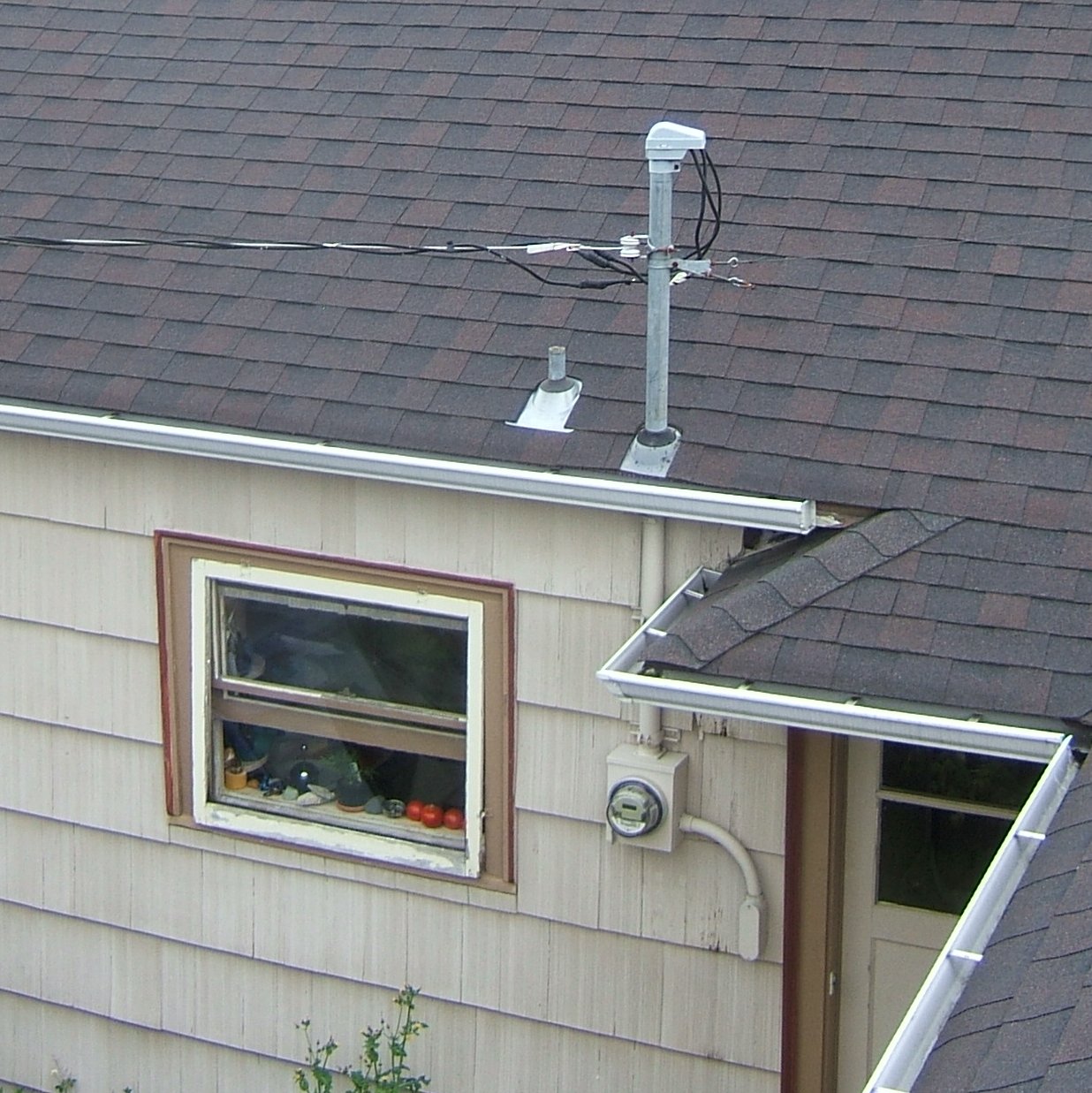
In electric power distribution, a service drop is an overhead electrical line running from a utility pole to a customer's building or other premises. It is the point where electric utilities provide power to their customers. The customer connection to an underground distribution system is usually called a "service lateral". Conductors of a service drop or lateral are usually owned and maintained by the utility company, but some industrial drops are installed and owned by the customer.
At the customer's premises, the wires usually enter the building through a weatherhead that protects against entry of rain and snow, and drop down through conduit to an electric meter which measures and records the power used for billing purposes, then enters the main service panel. The utility's portion of the system ends, and the customer's wiring begins, at the output socket of the electric meter. The service panel will contain a "main" fuse or circuit breaker, which controls all of the electric current entering the building at once, and a number of smaller fuses/breakers, which protect individual branch circuits. There is always provision for all power to be cut off by operating either a single switch or small number of switches (maximum of six in the United States, for example); when circuit breakers are used this is provided by the main circuit breaker.
Residential
North American
In North America, the 120/240 V split phase system is used for residential service drops.{{cite book
European
In many European countries and other countries that use European systems, three-phase service drops are often used for domestic residences. The use of three-phase power allows longer service drops to serve multiple residences, which is economical with the higher density of housing in Europe. The service drop consists of three phase wires and a neutral wire which is grounded. Each phase wire provides around 230 V to loads connected between it and the neutral. Each of the phase wires carries 50 Hz alternating current which is 120° out of phase with the other two. Several slightly different voltage standards have been used in the past as well: 220Y380, 230Y400 and 240Y415, with plans for future "harmonization" towards 230Y400. In this notation, the first number is the voltage between a phase wire and neutral, and the second number, after the "Y", is the line voltage (between any two-phase wires).
Other countries, such as the UK and Ireland, generally provide a single phase and neutral per house, with every third house on the same phase.
Australian

In Australian service drops, to avoid having unprotected cables within the building up to the service panel main switch, a fuse for each phase is provided at the point-of-attachment, at the weatherhead - called a "raiser bracket" in Australia - or on the outside of the building.
One or more removable ceramic "fuse holders", containing an appropriately sized service fuse for each phase protects all cables beyond this point. These fuses may be removed and replaced by the supply authority in the event of a fault causing them to "operate".
This box is termed a "Fused Overhead Line Connector Box" (FOLCB).
Commercial and industrial
Commercial and industrial service drops can be much bigger, and are usually three phase. In the US, common services are 120Y/208 (three 120 V circuits 120 degrees out of phase, with 208 V line-to-line), 240 V three-phase, and 480 V three-phase. 600 V three-phase is common in Canada, and 380-415 V or 690 V three-phase is found in European and many other countries. Generally, higher voltages are used for heavy industrial loads, and lower voltages for commercial applications.
In North America where single-phase distribution transformers for service drops are the norm, three-phase service drops are often constructed using three single-phase transformers, wired in a Y configuration. This is called a transformer bank.
Underground
Service conductors for a customer may be run underground, from a padmount transformer to a customer's meter.
References
References
- Carson Dunlop "Electrical Systems" Dearborn Real Estate, 2003 {{ISBN. 0-7931-7932-7 page 24
- National Fire Protection Association. (2017). "NFPA 70 National Electrical Code". NFPA.
This article was imported from Wikipedia and is available under the Creative Commons Attribution-ShareAlike 4.0 License. Content has been adapted to SurfDoc format. Original contributors can be found on the article history page.
Ask Mako anything about Service drop — get instant answers, deeper analysis, and related topics.
Research with MakoFree with your Surf account
Create a free account to save articles, ask Mako questions, and organize your research.
Sign up freeThis content may have been generated or modified by AI. CloudSurf Software LLC is not responsible for the accuracy, completeness, or reliability of AI-generated content. Always verify important information from primary sources.
Report