From Surf Wiki (app.surf) — the open knowledge base
Service Availability Forum

| Field | Value |
|---|---|
| name | Service Availability Forum |
| type | Private 501(c)(6) |
| foundation | 2001 |
| location | Beaverton, Oregon, USA |
| industry | Technology |
| homepage | https://www.associationvoice.com/16627 |
|
The Service Availability Forum (SAF or SA Forum) is a consortium that develops, publishes, educates on and promotes open specifications for carrier-grade and mission-critical systems. Formed in 2001, it promotes development and deployment of commercial off-the-shelf (COTS) technology.
Description
Service availability is an extension of high availability, referring to services that are available regardless of hardware, software or user fault and importance.
Key principles of service availability:
- Redundancy – "backup" capability in case of need to failover due to a fault
- Stateful and seamless recovery from failures
- Minimization of mean time to repair (MTTR) – time to restore service after an outage
- Fault prediction & avoidance – take action before something fails
The traditional definitions of high availability have their roots in hardware systems where redundancy of equipment was the primary mechanism for achieving uptime over a specific period. As software has come to dominate the landscape, the probability of failure is often much higher for applications than it is for hardware and so these concepts have been extended encompass an overall view of service availability where downtime, irrespective of its cause, is an exceptionally rare event. Services and applications should always be available, whether it is during abnormal system operation, scheduled maintenance, or software upgrade, for example.
SA Forum support commercial off-the-shelf (COTS) technology for uninterrupted service availability, application portability and seamless integration. Collaborating industry organizations include the following:
- CP-TA (Communications Platforms Trade Association): ensure interoperability on xTCA platforms.
- PICMG (PCI Industrial Computer Manufacturers Group): develop open specifications that adapt PCI technology for use in high-performance telecommunications and industrial computing applications.
- SCOPE Alliance: enable and promote the availability of open carrier grade base platforms based on COTS hardware / software and Free and open-source software (FOSS) building blocks, and to promote interoperability between such components.
- The Linux Foundation: promote, protect, and standardize Linux by providing unified resources and services needed for open source to successfully compete with closed platforms.
Specifications
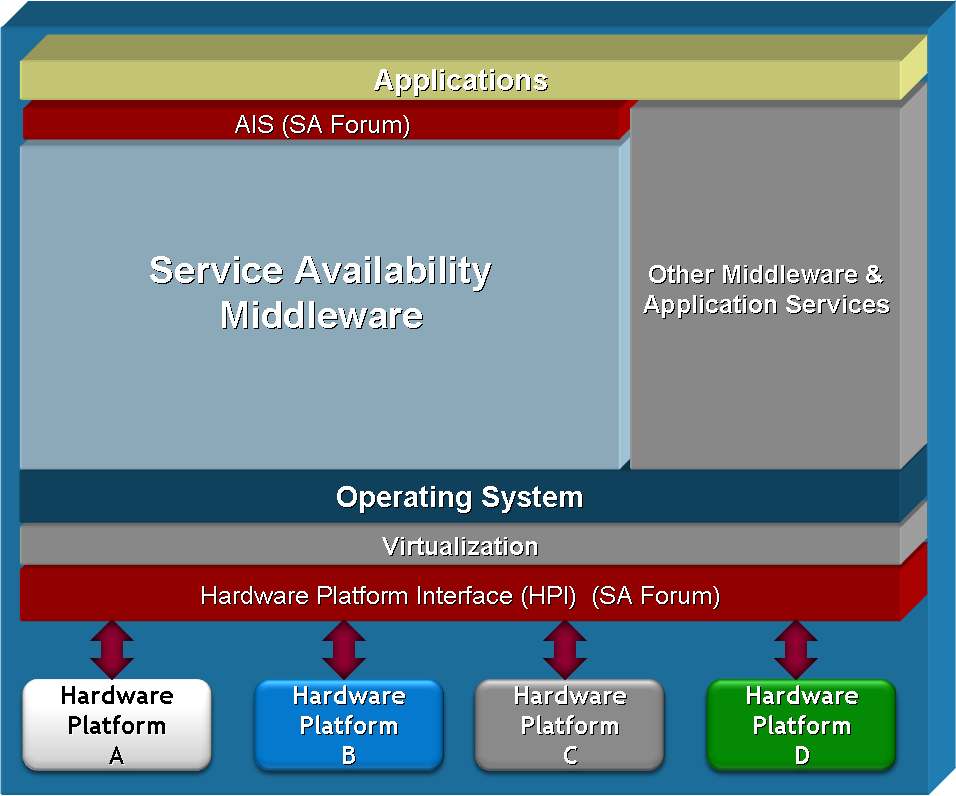
Specifications for carrier-grade service availability include:
- Hardware Platform Interface (HPI)
- Application Interface Specification (AIS)
- Mapping Specifications
- Java Mapping Specifications
- HPI-to-AdvancedTCA Mapping Specifications
Educational resources

The SA Forum free educational materials enable self-guided training the SA Forum specifications:
- Application Webcasts
- Tutorials
- Whitepapers
References
References
- (2011). "Mapping Specifications". saforum.org.
- (2011). "Application Webcast Series". saforum.org.
- (2011). "Specification Tutorials". saforum.org.
- (2011). "Featured Whitepaper: The Software Management Framework". saforum.org.
This article was imported from Wikipedia and is available under the Creative Commons Attribution-ShareAlike 4.0 License. Content has been adapted to SurfDoc format. Original contributors can be found on the article history page.
Ask Mako anything about Service Availability Forum — get instant answers, deeper analysis, and related topics.
Research with MakoFree with your Surf account
Create a free account to save articles, ask Mako questions, and organize your research.
Sign up freeThis content may have been generated or modified by AI. CloudSurf Software LLC is not responsible for the accuracy, completeness, or reliability of AI-generated content. Always verify important information from primary sources.
Report