From Surf Wiki (app.surf) — the open knowledge base
Serpents in the Bible
none
none
Serpents () are referred to in both the Hebrew Bible and the New Testament. The symbol of a serpent or snake played important roles in the religious traditions and cultural life of ancient Greece, Egypt, Mesopotamia, and Canaan. The serpent was a symbol of evil power and chaos from the underworld as well as a symbol of fertility, life, healing, and rebirth.
Nāḥāš (), Hebrew for "snake", is also associated with divination, including the verb form meaning "to practice divination or fortune-telling". Nāḥāš occurs in the Torah to identify the serpent in the Garden of Eden. Throughout the Hebrew Bible, it is also used in conjunction with seraph to describe vicious serpents in the wilderness. The tannin, a dragon monster, also occurs throughout the Hebrew Bible. In the Book of Exodus, the staves of Moses and Aaron are turned into serpents, a nāḥāš for Moses, a tannin for Aaron. In the New Testament, the Book of Revelation makes use of ancient serpent and the Dragon several times to identify Satan or the Devil
- (; ). The serpent is most often identified with the hubristic Satan, and sometimes with Lilith.
The narrative of the Garden of Eden and the fall of humankind constitute a mythological tradition shared by all the Abrahamic religions, with a presentation more or less symbolic of Abrahamic morals and religious beliefs, which had an overwhelming impact on human sexuality, gender roles, and sex differences both in the Western and Islamic civilizations. In mainstream (Nicene) Christianity, the doctrine of the Fall is closely related to that of original sin or ancestral sin. Unlike Christianity, the other major Abrahamic religions, Judaism and Islam, do not have a concept of "original sin", and instead have developed varying other interpretations of the Eden narrative.
Hebrew Bible
Main article: Genesis creation narrative, Jewish mythology

In the Hebrew Bible, the Book of Genesis refers to a serpent who triggered the expulsion of Adam and Eve from the Garden of Eden (). Serpent is also used to describe sea monsters. Examples of these identifications are in the Book of Isaiah where a reference is made to a serpent-like dragon named Leviathan (), and in the Book of Amos where a serpent resides at the bottom of the sea (). Serpent figuratively describes biblical places such as Egypt (), and the city of Dan (). The prophet Jeremiah also compares the King of Babylon to a serpent ().
Eden
The Hebrew word נָחָשׁ (Nāḥāš) is used in the Hebrew Bible to identify the serpent that appears in Genesis , in the Garden of Eden. In the first book of the Torah, the serpent is portrayed as a deceptive creature or trickster, who promotes as good what God had forbidden and shows particular cunning in its deception. (cf. and ) The serpent has the ability to speak and to reason: "Now the serpent was more subtle (also translated as "cunning") than any beast of the field which the Lord God had made". There is no indication in the Book of Genesis that the serpent was a deity in its own right, although it is one of only two cases in the Torah of animals that talk, the other being Balaam's donkey.
God placed Adam in the Garden of Eden to tend it and warned Adam not to eat the fruit of the Tree of Knowledge of Good and Evil, "for in the day that thou eatest thereof thou shalt surely die." The serpent tempts Eve to eat of the tree, but Eve tells the serpent what God had said. The serpent replies that she would not surely die () and that if she eats the fruit of the tree "then your eyes shall be opened, and ye shall be as gods, knowing good and evil." () Eve eats the fruit, and gives some to Adam who also eats. God, who was walking in the Garden, learns of their transgression. To prevent Adam and Eve from eating the fruit of the Tree of Life and living forever, they are banished from the garden upon which God posts an angelic guard. The serpent is punished for its role in the Fall, being cursed by God to crawl on its belly and eat dust.
There is a debate about whether the serpent in Eden should be viewed figuratively or as a literal animal. According to one midrashic interpretation in Rabbinic literature, the serpent represents sexual desire; another interpretation is that the snake is the yetzer hara. Modern Rabbinic ideas include interpreting the story as a psychological allegory where Adam represents reasoning faculties, Eve the emotional faculties, and the serpent the hedonic sexual/physical faculties. Voltaire, drawing on Socinian influences, wrote: "It was so decidedly a real serpent, that all its species, which had before walked on their feet, were condemned to crawl on their bellies. No serpent, no animal of any kind, is called Satan, or Belzebub, or Devil, in the Pentateuch."
20th-century scholars such as W. O. E. Oesterley (1921) were cognizant of the differences between the role of the Edenic serpent in the Hebrew Bible and its connections with the "ancient serpent" in the New Testament. Modern historiographers of Satan such as Henry Ansgar Kelly (2006) and Wray and Mobley (2007) speak of the "evolution of Satan", or "development of Satan".
According to Gerhard von Rad, Old Testament scholar, Lutheran theologian and University of Heidelberg professor, who applied form criticism as a supplement to the documentary hypothesis of the Hebrew Bible, the snake in the Eden's narrative was more an expedient to represent the impulse to temptation of mankind (that is, disobeying God's law) rather than an evil spirit or the personification of the Devil, as the later Christian literature erroneously depicted it; moreover, von Rad himself states that the snake is neither a supernatural being nor a demon, but one of the wild animals created by God (), and the only thing that differentiates it from the others in Eden is the ability to speak:
Since ancient Hebrew had no written vowels, the letters comprising נָחָשׁ (Nāḥāš) can also be translated as deceiver or diviner. As the root of adjective, the word could indicate a noun translated to mean luminous/shining one. A derivation of this word was used in number of places in the Bible to refer to the shine of brass, which is a feature that is generally associated with angels or God in the Bible. The International Standard Version of the Bible translates נָחָשׁ (Nāḥāš) as "the Shining One", with "the diviner" and "the serpent" as alternative readings, observing that the word "connotes one who falsely claims to reveal God’s word". Therefore, the serpent in Genesis is often interpreted as a serpentine angel, Seraph(שָׂרָף).
The biblical statement that the serpent will "crawl on your belly" is paralleled by frequent spells in Pyramid Texts that call on the snake to lie down, fall down, get down or crawl away (Pyramid Text 226, 233, 234, 298, 386). These parallels suggest that when the serpent is commanded to crawl on his belly, it does not refer to losing limbs. Instead, it is referring to being sent away in a docile position instead of upright in an attack position. The Pyramid Texts also refer to commands of vanishing serpents to the dust (Pyramid Text 227, 230, 237). In both the Epic of Gilgamesh and Job 16:17, the underworld is referred to as the house of dust. Thus, it is likely that the curse of eating dust refers to being cast out to the underworld.
Moses and Aaron
When God had revealed himself to the prophet Moses in , Moses recognized that the call of God was for him to lead the people of Israel out of slavery, but anticipated that people would deny or doubt his calling. In , Moses asked God how to respond to such doubt, and God asked him to cast the rod which he carried (possibly a shepherd's crook) onto the ground, whereupon it became a serpent (a nachash). Moses fled from it, but God encouraged him to come back and take it by the tail, and it became a rod again.
Later in the Book of Exodus (Exodus 7), the staffs of Moses and Aaron were turned into serpents, a nachash for Moses, a tanniyn for Aaron.
Fiery serpents
"Fiery serpent" ( sārāf; "burning") occurs in the Torah to describe a species of vicious snakes whose venom burns upon contact. According to Wilhelm Gesenius, saraph corresponds to the Sanskrit Sarpa (Jawl aqra), serpent; sarpin, reptile (from the root srip, serpere). These "burning serpents"(YLT) infested the great and terrible place of the desert wilderness (Num.21:4-9; Deut.8:15). The Hebrew word for "poisonous" literally means "fiery", "flaming" or "burning", as the burning sensation of a snake bite on human skin, a metaphor for the fiery anger of God (Numbers 11:1).
The Book of Isaiah expounds on the description of these fiery serpents as "flying saraphs"(YLT), or "flying dragons", in the land of trouble and anguish (Isaiah 30:6). Isaiah indicates that these saraphs are comparable to vipers,(YLT) worse than ordinary serpents (Isaiah 14:29). The prophet Isaiah also sees a vision of seraphim in the Temple itself: but these are divine agents, with wings and human faces, and are probably not to be interpreted as serpent-like so much as "flame-like".
Serpent of bronze
In the Book of Numbers, while Moses was in the wilderness, he mounted a serpent of bronze on a pole that functioned as a cure against the bite of the "seraphim", the "burning ones" (). The phrase in Numbers 21:9, "a serpent of bronze", is a wordplay as "serpent" (nehash) and "bronze" (nehoshet) are closely related in Hebrew, nehash nehoshet.
Mainstream scholars suggest that the image of the fiery serpent served to function like that of a magical amulet. Magic amulets or charms were used in the ancient Near East to practice a healing ritual known as sympathetic magic in an attempt to ward off, heal or reduce the impact of illness and poisons. Copper and bronze serpent figures have been recovered, showing that the practice was widespread. A Christian interpretation would be that the bronze serpent served as a symbol for each individual Israelite to take their confession of sin and the need for God's deliverance to heart. Confession of sin and forgiveness was both a community and an individual responsibility. The plague of serpents remained an ongoing threat to the community and the raised bronze serpent was an ongoing reminder to each individual for the need to turn to the healing power of God. It has also been proposed that the bronze serpent was a type of intermediary between God and the people that served as a test of obedience, in the form of free judgment, standing between the dead who were not willing to look to God's chosen instrument of healing, and the living who were willing and were healed. Thus, this instrument bore witness to the sovereign power of Yahweh even over the dangerous and sinister character of the desert.
In , a bronze serpent, alleged to be the one Moses made, was kept in Jerusalem's Temple sanctuary. The Israelites began to worship the object as an idol or image of God, by offering sacrifices and burning incense to it, until Hezekiah was made King. Hezekiah referred to it as Nehushtan and had torn it down. Scholars have debated the nature of the relationship between the Mosaic bronze serpent and Hezekiah's Nehushtan, but traditions happen to link the two.
New Testament
Gospels
In the Gospel of Matthew, John the Baptist calls the Pharisees and Saducees, who were visiting him, a "brood of vipers" (). Jesus also uses this imagery, observing: "Ye serpents, ye generation of vipers, how can ye escape the damnation of hell?" (). Alternatively, Jesus also presents the snake with a less negative connotation when sending out the Twelve Apostles. Jesus exhorted them, "Behold, I send you forth as sheep in the midst of wolves: be ye therefore wise as serpents, and harmless as doves" (). Wilhelm Gesenius notes that even amongst the ancient Hebrews, the serpent was a symbol of wisdom.
In the Gospel of John, Jesus made mention of the Mosaic serpent when he foretold his crucifixion to a Jewish teacher. Jesus compared the act of raising up the Mosaic serpent on a pole, with the raising up of the Son of Man on a cross ().
Temptation of Christ
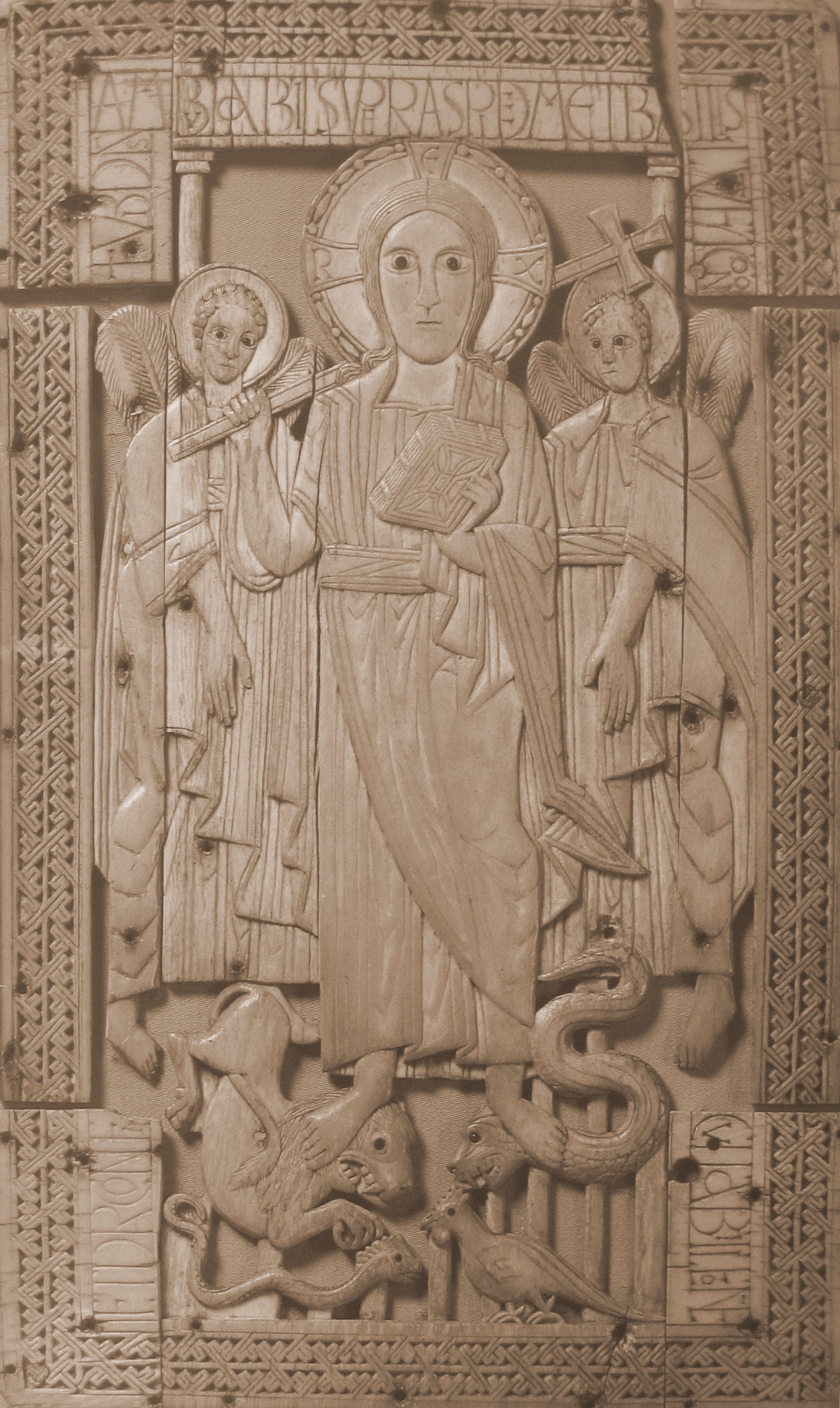
In the temptation of Christ, the Devil cites , "for it is written, He shall give his angels charge concerning thee: and in [their] hands they shall bear thee up, lest at any time thou dash thy foot against a stone." He cuts off before verse 13, "Thou shalt tread upon the lion and adder: the young lion and the dragon (tanniyn) shalt thou trample under feet."
The serpent in Psalm 91:13 is identified as Satan by Christians: "super aspidem et basiliscum calcabis conculcabis leonem et draconem" in the Latin Vulgate, literally "The asp and the basilisk you will trample under foot; you will tread on the lion and the dragon". This passage is commonly interpreted by Christians as a reference to Christ defeating and triumphing over Satan. The passage led to the Late Antique and Early Medieval iconography of Christ treading on the beasts, in which two beasts are often shown, usually the lion and snake or dragon, and sometimes four, which are normally the lion, dragon, asp (snake) and basilisk (which was depicted with varying characteristics) of the Vulgate. All represented the devil, as explained by Cassiodorus and Bede in their commentaries on Psalm 91. The serpent is often shown curled round the foot of the cross in depictions of the crucifixion of Jesus from Carolingian art until about the 13th century; often it is shown as dead. The crucifixion was regarded as the fulfillment of God's curse on the serpent in Genesis 3:15. Sometimes it is pierced by the cross and in one ivory is biting Christ's heel, as in the curse.
Ancient serpent
Serpent (Greek: ὄφις; Trans: Ophis, ; "snake", "serpent") occurs in the Book of Revelation as the "ancient serpent" or "old serpent"(YLT) used to describe "the dragon",[20:2] Satan the Adversary,(YLT) who is the devil.[12:9, 20:2] This serpent is depicted as a red seven-headed dragon having ten horns, each housed with a diadem. The serpent battles Michael the Archangel in a War in Heaven which results in this devil being cast out to the earth. While on earth, he pursues the Woman of the Apocalypse and gives power and authority to the Beast. Unable to obtain her, he wages war with the rest of her seed (Revelation 12:1–18). He who has the key to the abyss and a great chain over his hand, binds the serpent for a thousand years. The serpent is then cast into the abyss and sealed within until he is released (Revelation 20:1–3).
In Christian tradition, the "ancient serpent" is commonly identified with the Genesis serpent and as Satan. This identification redefined the Hebrew Bible's concept of Satan ("the Adversary", a member of the Heavenly Court acting on behalf of God to test Job's faith), so that Satan/Serpent became a part of a divine plan stretching from Creation to Christ and the Second Coming.
Religious views
Biblical apocrypha and deuterocanonical books
The first deuterocanonical source to connect the serpent with the devil may be Wisdom of Solomon. The subject is more developed in the pseudepigraphal-apocryphal Apocalypse of Moses (Vita Adae et Evae) where the devil works with the serpent.
Christianity

Following the imagery of chapter 12 of the Book of Revelation, Bernard of Clairvaux had called Mary the "conqueror of dragons", and she was long to be shown crushing a snake underfoot, also a reference to her title as the "New Eve".
Gnosticism
Main article: Gnosticism
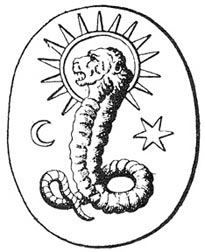
Gnosticism originated in the late 1st century CE in non-rabbinical Jewish and early Christian sects. In the formation of Christianity, various sectarian groups, labeled "gnostics" by their opponents, emphasised spiritual knowledge (gnosis) of the divine spark within, over faith (pistis) in the teachings and traditions of the various communities of Christians. Gnosticism presents a distinction between the highest, unknowable God, and the Demiurge, "creator" of the material universe. The Gnostics considered the most essential part of the process of salvation to be this personal knowledge, in contrast to faith as an outlook in their worldview along with faith in the ecclesiastical authority.
In Gnosticism, the biblical serpent in the Garden of Eden was praised and thanked for bringing knowledge (gnosis) to Adam and Eve and thereby freeing them from the malevolent Demiurge's control. Gnostic Christian doctrines rely on a dualistic cosmology that implies the eternal conflict between good and evil, and a conception of the serpent as the liberating savior and bestower of knowledge to humankind opposed to the Demiurge or creator god, identified with the Hebrew God of the Old Testament. Gnostic Christians considered the Hebrew God of the Old Testament as the evil, [false god and creator of the material universe, and the Unknown God of the Gospel, the father of Jesus Christ and creator of the spiritual world, as the true, good God. In the Archontic, Sethian, and Ophite systems, Yaldabaoth (Yahweh) is regarded as the malevolent Demiurge and false god of the Old Testament who generated the material universe and keeps the souls trapped in physical bodies, imprisoned in the world full of pain and suffering that he created.
However, not all Gnostic movements regarded the creator of the material universe as inherently evil or malevolent. For instance, Valentinians believed that the Demiurge is merely an ignorant and incompetent creator, trying to fashion the world as good as he can, but lacking the proper power to maintain its goodness. All Gnostics were regarded as heretics by the proto-orthodox Early Church Fathers.
References
Works cited
References
- (2018). "Round Trip to Hades in the Eastern Mediterranean Tradition: Visits to the Underworld from Antiquity to Byzantium". [[Brill Publishers]].
- {{harvnb. Olson. 1996
- (June 2003). "Religion and Sexuality: The Perversion of a Natural Marriage". [[Springer Verlag]].
- (1983). "Satan's Tragedy and Redemption: Iblīs in Sufi Psychology". [[Brill Publishers]].
- Mahmoud, Muhammad. (1995). "The Creation Story in 'Sūrat Al-Baqara," with Special Reference to Al-Ṭabarī's Material: An Analysis". Journal of Arabic Literature.
- "Catholic Encyclopedia: Adam".
- (2020). "Thinking about God: Jewish Views". [[University of Nebraska Press]]/[[Jewish Publication Society]].
- Kolatch, Alfred J.. (2021). "Issues in Jewish Ethics: Judaism's Rejection of Original Sin". American–Israeli Cooperative Enterprise (AICE).
- (2017). "Roads to Paradise: Eschatology and Concepts of the Hereafter in Islam". [[Brill Publishers]].
- (2006). "Fall of Man". [[Brill Publishers]].
- {{bibleverse. Genesis. 3:1. HE
- von Rad, Gerhard. (1973). "Genesis: A Commentary". [[Westminster John Knox Press]].
- {{bibleverse. Genesis. 2:17. HE
- {{bibleverse. Genesis. 3:3. HE
- Barton, SO "Midrash Rabba to Genesis", sec 20, p. 93
- Hakira, Vol. 5: Reclaiming the Self: Adam’s Sin and the Human Psyche By Menachem Krakowski
- {{harvnb. Gorton. Voltaire. 1824
- Oesterley ''Immortality and the Unseen World: a study in Old Testament religion'' (1921) "... moreover, not only an accuser but one who tempts to evil. With the further development of Satan as the arch-fiend and head of the powers of darkness we are not concerned here, as this is outside the scope of the Old Testament."
- Kelly, Henry Ansgar. (2006). "Satan : a biography". Cambridge University Press.
- Mobley, T.J. Wray, Gregory. (2005). "The birth of Satan : tracing the devil's biblical roots". Palgrave Macmillan.
- Num 21:9; Deut 8:9; Josh 6:19, 22:8; Jud 16:21; 1 Sam 17:5; 2 Sam 8:10
- Daniel 10:6; Ezekiel 1:7
- {{bibleverse. Genesis. 3:1-2. ISV: ISV
- ISV Foundation, [https://www.biblegateway.com/passage/?search=Genesis%203%3A1-2&version=ISV#fen-ISV-57a Footnote a at Genesis 3:1 in the ISV], accessed on 25 November 2025
- Ben Stanhope, The Reception of the Winged Serpent Motif on Hebrew Seals of the Late Monarchy and the Biblical Seraphim.
- John Walton, "The Lost World of Adam and Eve", pp. 129-130.
- Ben Stanhope - The Reception of the Winged Serpent Motif on Hebrew Seals of the Late Monarchy and the Biblical Seraphim.
- [[Carl Friedrich Keil]] and [[Franz Delitzsch]], [http://biblehub.com/commentaries/kad/exodus/4.htm Keil and Delitzsch OT Commentary] on Exodus 4, accessed on 9 October 2015
- (8 January 2016). "A tale of two staffs". Israel National News.
- Gesenius, Wilhelm & Samuel Prideaux Tregelles. (1893). "Genenius's Hebrew and Chaldee lexicon to the Old Testament Scriptures". J. Wiley & Sons.
- {{harvnb. Olson. 1996
- {{harvnb. Hendel. 1999
- {{harvnb. Nelson. 2008
- {{harvnb. Noth. 1968
- {{harvnb. Olson. 1996
- {{harvnb. Noth. 1968
- Joines, Karen Randolph. (1968). "The Bronze Serpent in the Israelite Cult The Bronze Serpent in the Israelite Cult". JOBL, 87.
- Gesenius, Wilhelm & Samuel Prideaux Tregelles. (1893). "Genenius's Hebrew and Chaldee lexicon to the Old Testament Scriptures". J. Wiley & Sons.
- C. H. Spurgeon, [http://www.spurgeon.org/sermons/0153.htm "The Mysteries of the Brazen Serpent"] {{webarchive. link. (2013-02-12 , 1857)
- [[:File:Wenceslas Hollar - The basilisk and the weasel.jpg. The basilisk and the weasel]] by [[Wenceslas Hollar]]
- {{bibleref. Matthew. 4:6. KJV)
- [[Strong's Concordance]]: '''H8577'''
- ({{bibleref. Psalm. 91:13. KJV KJV)
- Whittaker, H.A. ''Studies in the Gospels'' "Matthew 4" Biblia, Cannock 1996
- Psalm 91 in the Hebrew/Protestant numbering, 90 in the Greek/Catholic liturgical sequence – see [[Psalms#Numbering]]
- Hilmo, Maidie. ''Medieval images, icons, and illustrated English literary texts: from Ruthwell Cross to the Ellesmere Chaucer'', Ashgate Publishing, Ltd., 2004, p. 37, {{ISBN
- Schiller, I, pp. 112–13, and many figures listed there. See also Index.
- [[Strong's Concordance]]: '''G3789'''
- From the [[Greek language. Greek]]: ἀρχαῖος, ''archaios'' ({{IPA. /arˈxɛ.os/) – [[Strong's Concordance]] Number '''G744'''
- Σατανᾶς, ''[[Satan]]as'', ({{IPA. /sa.taˈnas/) – of [[Aramaic]] origin corresponding to Σατάν (G4566) – [[Strong's Concordance]] Number '''G4567'''
- [[Stephen L Harris. Harris, Stephen L.]], Understanding the Bible. Palo Alto: Mayfield. 1985.
- Alfred von Rohr Sauer, Concordia Theological Monthly 43 (1972): "The Wisdom of Solomon deserves to be remembered for the fact that it is the first tradition to identify the serpent of Genesis 3 with the devil: 'Through the devil's envy death entered the world' (2:24)".
- The Old Testament Pseudepigrapha: Expansions of the "Old ... James H. Charlesworth – 1985 "He seeks to destroy men's souls (Vita 17:1) by disguising himself as an angel of light (Vita 9:1, 3; 12:1; ApMos 17:1) to put into men "his evil poison, which is his covetousness" (epithymia, ..."
- [[Gertrud Schiller. Schiller, Gertrud]], ''Iconography of Christian Art, Vol. I'', p. 108 & fig. 280, 1971 (English trans. from German), Lund Humphries, London, {{ISBN. 0-85331-270-2
- Magris, Aldo. (2005). "Gnosticism: Gnosticism from its origins to the Middle Ages (further considerations)". [[Macmillan Inc.]].
- (2008). "The Cambridge History of Christianity, Volume 1: Origins to Constantine". [[Cambridge University Press]].
- Ehrman, Bart D.. (2005). "Lost Christianities: The Battles for Scripture and the Faiths We Never Knew". [[Oxford University Press]].
- Brakke, David. (2010). "The Gnostics: Myth, Ritual, and Diversity in Early Christianity". [[Harvard University Press]].
- Layton, Bentley. (1999). "Doctrinal Diversity: Varieties of Early Christianity". Garland Publishing, Inc.
- (1999). "Eve and Adam: Jewish, Christian, and Muslim Readings on Genesis and Gender". [[Indiana University Press]].
- {{cite EB1911. Bousset, Wilhelm
- (2016). "Desiring Divinity: Self-deification in Early Jewish and Christian Mythmaking". [[Oxford University Press]].
- Fischer-Mueller, E. Aydeet. (January 1990). "Yaldabaoth: The Gnostic Female Principle in Its Fallenness". [[Brill Publishers]].
- {{Catholic Encyclopedia. John Peter. Arendzen
- (2002). "The Early Christian World". [[Routledge]].
This article was imported from Wikipedia and is available under the Creative Commons Attribution-ShareAlike 4.0 License. Content has been adapted to SurfDoc format. Original contributors can be found on the article history page.
Ask Mako anything about Serpents in the Bible — get instant answers, deeper analysis, and related topics.
Research with MakoFree with your Surf account
Create a free account to save articles, ask Mako questions, and organize your research.
Sign up freeThis content may have been generated or modified by AI. CloudSurf Software LLC is not responsible for the accuracy, completeness, or reliability of AI-generated content. Always verify important information from primary sources.
Report