From Surf Wiki (app.surf) — the open knowledge base
Series expansion
Expression of a function as an infinite sum of simpler functions
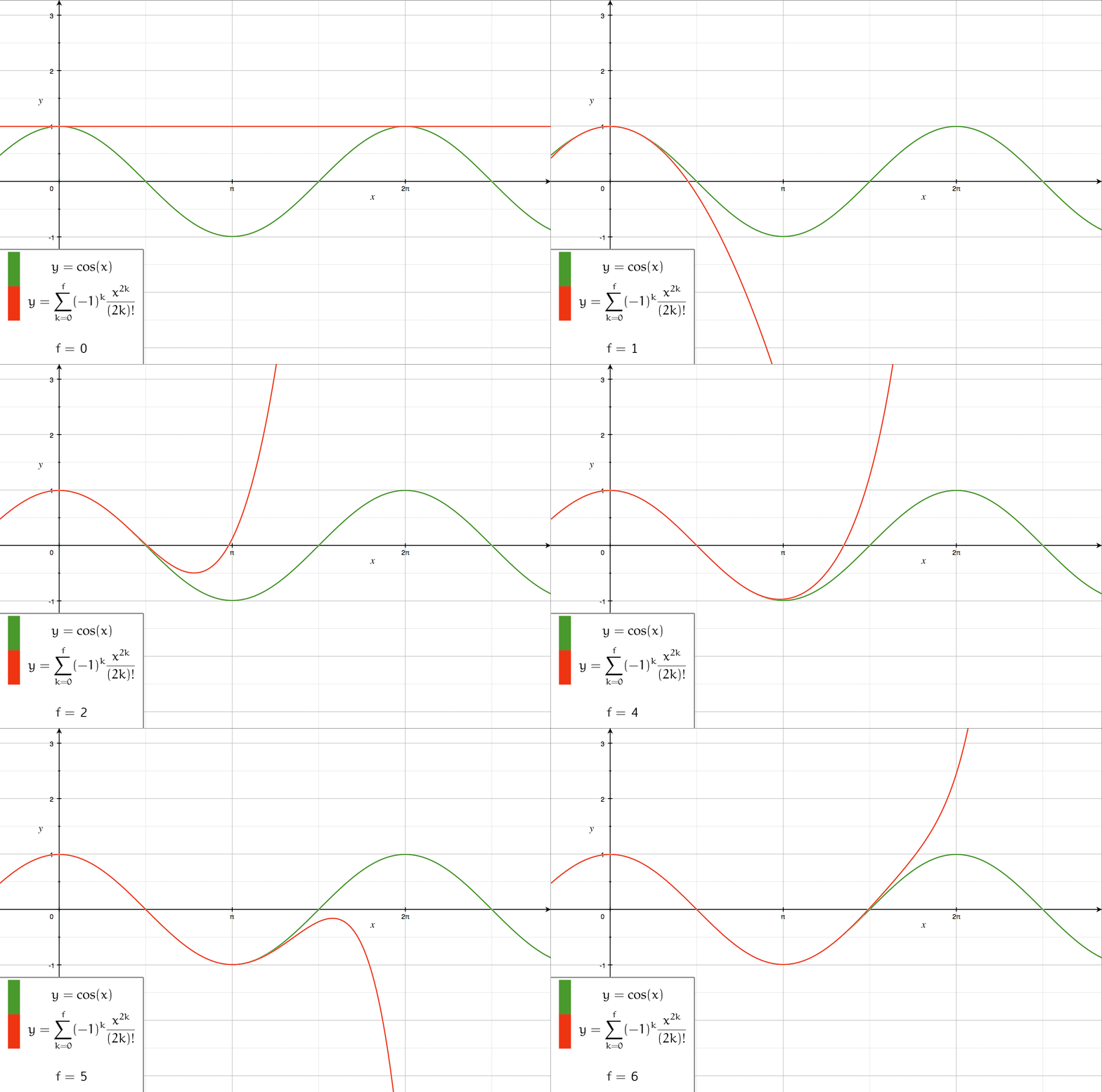
Expression of a function as an infinite sum of simpler functions
In mathematics, a series expansion is a technique that expresses a function as an infinite sum, or series, of simpler functions. It is a method for calculating a function that cannot be expressed by just elementary operators (addition, subtraction, multiplication and division).
The resulting so-called series often can be limited to a finite number of terms, thus yielding an approximation of the function. The fewer terms of the sequence are used, the simpler this approximation will be. Often, the resulting inaccuracy (i.e., the partial sum of the omitted terms) can be described by an equation involving Big O notation (see also asymptotic expansion). The series expansion on an open interval will also be an approximation for non-analytic functions.
Types of series expansions
There are several kinds of series expansions, listed below.
Taylor series
A Taylor series is a power series based on a function's derivatives at a single point. More specifically, if a function f: U\to\R is infinitely differentiable around a point x_0, then the Taylor series of f around this point is given by
: \sum_{n=0}^\infty \frac{f^{(n)}(x_0)}{n!}(x - x_0)^n
under the convention 0^0 := 1. The Maclaurin series of a function f is a special case of its Taylor series about x_0 = 0.
Laurent series
A Laurent series is a generalization of the Taylor series, allowing terms with negative exponents; it takes the form \sum_{k = -\infty}^{\infty} c_k (z - a)^k and converges in an annulus. In particular, a Laurent series can be used to examine the behavior of a complex function near a singularity by considering the series expansion on an annulus centered at the singularity.
Dirichlet series

A general Dirichlet series is a series of the form \sum_{n = 1}^{\infty} a_ne^{-\lambda_n s}. One important special case of this is the ordinary Dirichlet series \sum_{n = 1}^{\infty}\frac{a_n}{n^s}. Used in number theory.
Fourier series
A Fourier series is an expansion of periodic functions as a sum of many sine and cosine functions. More specifically, the Fourier series of a function f(x) of period 2L is given by the expressiona_0 + \sum_{n = 1}^{\infty} \left[a_n\cos\left(\frac{n\pi x}{L}\right) + b_n\sin\left(\frac{n\pi x}{L}\right)\right]where the coefficients are given by the formulae\begin{align} a_n &:= \frac{1}{L}\int_{-L}^L f(x)\cos\left(\frac{n\pi x}{L}\right)dx, \[5pt] b_n &:= \frac{1}{L}\int_{-L}^L f(x)\sin\left(\frac{n\pi x}{L}\right)dx. \end{align}
Other series
-
In acoustics, e.g., the fundamental tone and the overtones together form an example of a Fourier series.
-
Newtonian series
-
Legendre polynomials: Used in physics to describe an arbitrary electrical field as a superposition of a dipole field, a quadrupole field, an octupole field, etc.
-
Zernike polynomials: Used in optics to calculate aberrations of optical systems. Each term in the series describes a particular type of aberration.
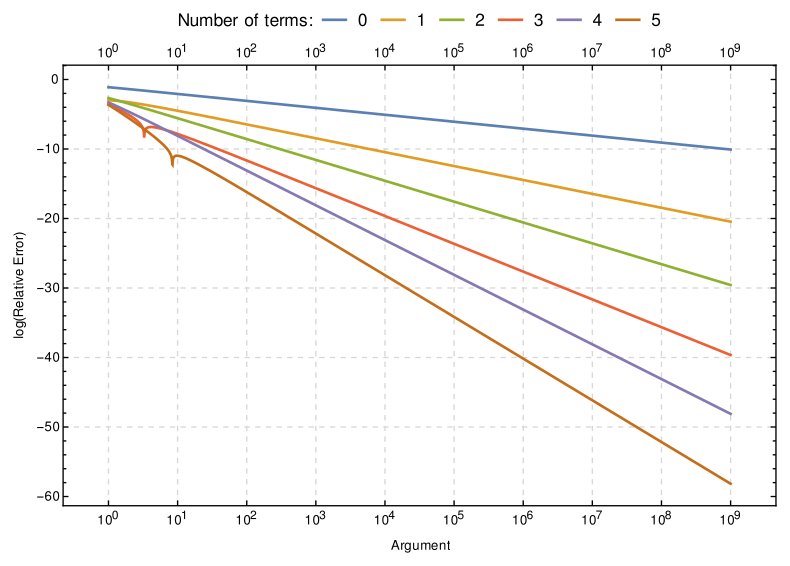
- The Stirling series\operatorname{Ln}\Gamma(z)\sim\left(z-\tfrac{1}{2}\right)\ln z-z+\tfrac{1}{2}\ln(2\pi)+\sum_{k=1}^\infty \frac{B_{2k}}{2k(2k-1)z^{2k-1}}is an approximation of the log-gamma function.
Examples
The following is the Taylor series of the exponential function e^x:e^x=\sum^\infty_{n=0}\frac{x^n}{n!}= 1 + x + \frac{x^2}{2} + \frac{x^3}{6}+\cdots
The Dirichlet series of the Riemann zeta function is\zeta(s) := \sum_{n = 1}^\infty \frac{1}{n^s} = \frac{1}{1^s} + \frac{1}{2^s} + \cdots
References
References
- (2013-11-07). "Series and Expansions".
- (2007-01-01). "Numerical Methods for Special Functions". SIAM.
- (27 December 2013). "Taylor series - Encyclopedia of Mathematics".
- (2008). "Elementary Differential Equations with Boundary Value Problems". Pearson/Prentice Hall.
- Weisstein, Eric W.. "Maclaurin Series".
- "Laurent series - Encyclopedia of Mathematics".
- (26 January 2022). "Dirichlet series - Encyclopedia of Mathematics".
- "Fourier series - Encyclopedia of Mathematics".
- (2008). "Elementary Differential Equations with Boundary Value Problems". Pearson/Prentice Hall.
- "DLMF: 5.11 Asymptotic Expansions".
- Weisstein, Eric W.. "Exponential Function".
- (5 June 2020). "Exponential function - Encyclopedia of Mathematics".
This article was imported from Wikipedia and is available under the Creative Commons Attribution-ShareAlike 4.0 License. Content has been adapted to SurfDoc format. Original contributors can be found on the article history page.
Ask Mako anything about Series expansion — get instant answers, deeper analysis, and related topics.
Research with MakoFree with your Surf account
Create a free account to save articles, ask Mako questions, and organize your research.
Sign up freeThis content may have been generated or modified by AI. CloudSurf Software LLC is not responsible for the accuracy, completeness, or reliability of AI-generated content. Always verify important information from primary sources.
Report