From Surf Wiki (app.surf) — the open knowledge base
SERF
Type of magnetometer

Type of magnetometer
A spin exchange relaxation-free (SERF) magnetometer is a type of magnetometer developed at Princeton University in the early 2000s. SERF magnetometers measure magnetic fields by using lasers to detect the interaction between alkali metal atoms in a vapor and the magnetic field.
The name for the technique comes from the fact that spin exchange relaxation, a mechanism which usually scrambles the orientation of atomic spins, is avoided in these magnetometers. This is done by using a high (1014 cm−3) density of potassium atoms and a very low magnetic field. Under these conditions, the atoms exchange spin quickly compared to their magnetic precession frequency so that the average spin interacts with the field and is not destroyed by decoherence.{{cite journal
A SERF magnetometer achieves very high magnetic field sensitivity by monitoring a high density vapor of alkali metal atoms precessing in a near-zero magnetic field. The sensitivity of SERF magnetometers improves upon traditional atomic magnetometers by eliminating the dominant cause of atomic spin decoherence caused by spin-exchange collisions among the alkali metal atoms. SERF magnetometers are among the most sensitive magnetic field sensors and in some cases exceed the performance of SQUID detectors of equivalent size. A small 1 cm3 volume glass cell containing potassium vapor has reported 1 fT/ sensitivity and can theoretically become even more sensitive with larger volumes.
Spin-exchange relaxation
Spin-exchange collisions preserve total angular momentum of a colliding pair of atoms but can scramble the hyperfine state of the atoms. Atoms in different hyperfine states do not precess coherently and thereby limit the coherence lifetime of the atoms. However, decoherence due to spin-exchange collisions can be nearly eliminated if the spin-exchange collisions occur much faster than the precession frequency of the atoms. In this regime of fast spin-exchange, all atoms in an ensemble rapidly change hyperfine states, spending the same amounts of time in each hyperfine state and causing the spin ensemble to precess more slowly but remain coherent. This so-called SERF regime can be reached by operating with sufficiently high alkali metal density (at higher temperature) and in sufficiently low magnetic field. | name-list-style=amp
| thumb | none | 300px | Alkali metal atoms with hyperfine state indicated by color precessing in the presence of a magnetic field experience a spin-exchange collision which preserves total angular momentum but changes the hyperfine state, causing the atoms to precess in opposite directions and decohere. | thumb | none | 300px | Alkali metal atoms in the spin-exchange relaxation-free (SERF) regime with hyperfine state indicated by color precessing in the presence of a magnetic field experience two spin-exchange collisions in rapid succession which preserves total angular momentum but changes the hyperfine state, causing the atoms to precess in opposite directions only slightly before a second spin-exchange collision returns the atoms to the original hyperfine state. |
|---|
The spin-exchange relaxation rate R_{se} for atoms with low polarization experiencing slow spin-exchange can be expressed as follows: : R_{se} = \frac{1}{2 \pi T_{se}} \left( \frac{2 I(2 I -1)}{3(2I+1)^2} \right) where T_{se} is the time between spin-exchange collisions, I is the nuclear spin, \nu is the magnetic resonance frequency, \gamma_e is the gyromagnetic ratio for an electron.
In the limit of fast spin-exchange and small magnetic field, the spin-exchange relaxation rate vanishes for sufficiently small magnetic field: : R_{se} = \frac{\gamma_e^2 B^2 T_{se} }{2 \pi} \frac{1}{2}\left( 1-\frac{(2I+1)^2}{Q^2} \right) where Q is the "slowing-down" constant to account for sharing of angular momentum between the electron and nuclear spins: | name-list-style=amp :Q(I=3/2)=4\left( 2 - \frac{4}{3+P^2} \right)^{-1} :Q(I=5/2)=6\left( 3 - \frac{48(1+P^2)}{19+26 P^2+3 P^4} \right)^{-1} :Q(I=7/2)=8\left( \frac{4(1+7P^2+7P^4+P^6)}{11+35P^2+17P^4+P^6} \right)^{-1} where P is the average polarization of the atoms. The atoms suffering fast spin-exchange precess more slowly when they are not fully polarized because they spend a fraction of the time in different hyperfine states precessing at different frequencies (or in the opposite direction).
Sensitivity
The sensitivity \delta B of atomic magnetometers are limited by the number of atoms N and their spin coherence lifetime T_2 according to :\delta B = \frac{1}{\gamma} \sqrt{\frac{2 R_{tot} Q}{F_z N} } where \gamma is the gyromagnetic ratio of the atom and F_z is the average polarization of total atomic spin F = I+S. | name-list-style=amp
In the absence of spin-exchange relaxation, a variety of other relaxation mechanisms contribute to the decoherence of atomic spin: :R_{tot} = R_D + R_{sd,self} + R_{sd,\mathrm{He}} + R_{sd,\mathrm{N_2}} where R_D is the relaxation rate due to collisions with the cell walls and R_{sd,X} are the spin destruction rates for collisions among the alkali metal atoms and collisions between alkali atoms and any other gasses that may be present.
In an optimal configuration, a density of 1014 cm−3 potassium atoms in a 1 cm3 vapor cell with ~3 atm helium buffer gas can achieve 10 aT Hz−1/2 (10−17 T Hz−1/2) sensitivity with relaxation rate R_{tot} ≈ 1 Hz.
Typical operation

Alkali metal vapor of sufficient density is obtained by simply heating solid alkali metal inside the vapor cell. A typical SERF atomic magnetometer can take advantage of low noise diode lasers to polarize and monitor spin precession. Circularly polarized pumping light tuned to the D_1 spectral resonance line polarizes the atoms. An orthogonal probe beam detects the precession using optical rotation of linearly polarized light. In a typical SERF magnetometer, the spins merely tip by a very small angle because the precession frequency is slow compared to the relaxation rates.
Advantages and disadvantages
SERF magnetometers compete with SQUID magnetometers for use in a variety of applications. The SERF magnetometer has the following advantages:
- Equal or better sensitivity per unit volume
- Cryogen-free operation
- All-optical measurement limits enables imaging and eliminates interference Potential disadvantages:
- Can only operate near zero field
- Sensor vapor cell must be heated
Applications
Applications utilizing high sensitivity of SERF magnetometers potentially include:
- High-performance magnetoencephalographic imaging | name-list-style=amp
- Sample magnetization measurement, especially rock samples
History
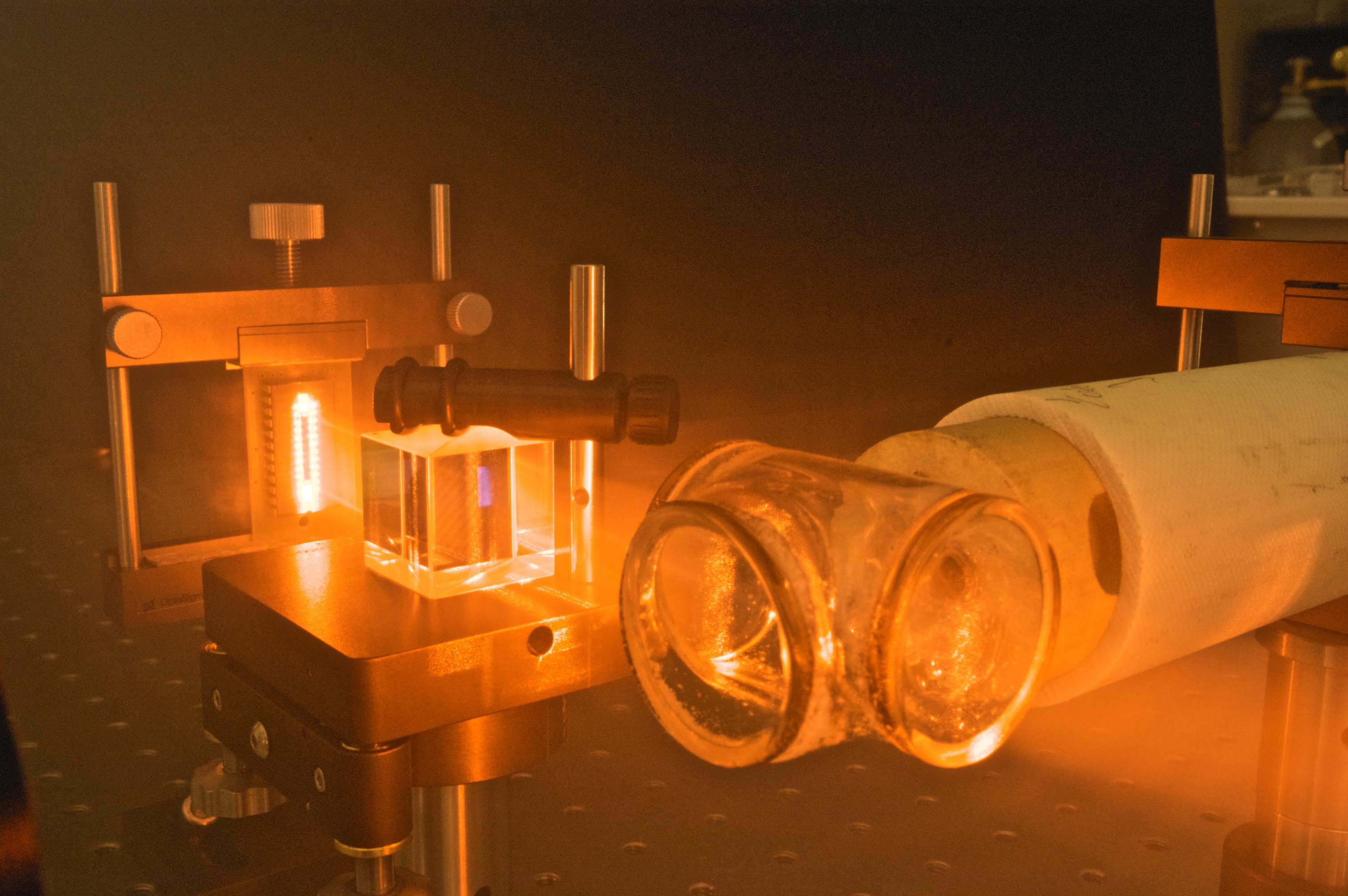
The SERF magnetometer was developed by Michael V. Romalis at Princeton University in the early 2000s. but the application to magnetic field measurement was not explored at that time. The name "SERF" was partially motivated by its relationship to SQUID detectors in a marine metaphor.
References
References
- 王子隆. (2025). "Magnetic Field Regulation and Demodulation of Three-axis SERF Atomic Magnetometer". 电子科技大学.
- (2025-02-25). "SERF态效应用零磁场环境实现技术研究进展". 激光与光电子学进展.
This article was imported from Wikipedia and is available under the Creative Commons Attribution-ShareAlike 4.0 License. Content has been adapted to SurfDoc format. Original contributors can be found on the article history page.
Ask Mako anything about SERF — get instant answers, deeper analysis, and related topics.
Research with MakoFree with your Surf account
Create a free account to save articles, ask Mako questions, and organize your research.
Sign up freeThis content may have been generated or modified by AI. CloudSurf Software LLC is not responsible for the accuracy, completeness, or reliability of AI-generated content. Always verify important information from primary sources.
Report