From Surf Wiki (app.surf) — the open knowledge base
Serengeti
Geographical region in Tanzania

Geographical region in Tanzania

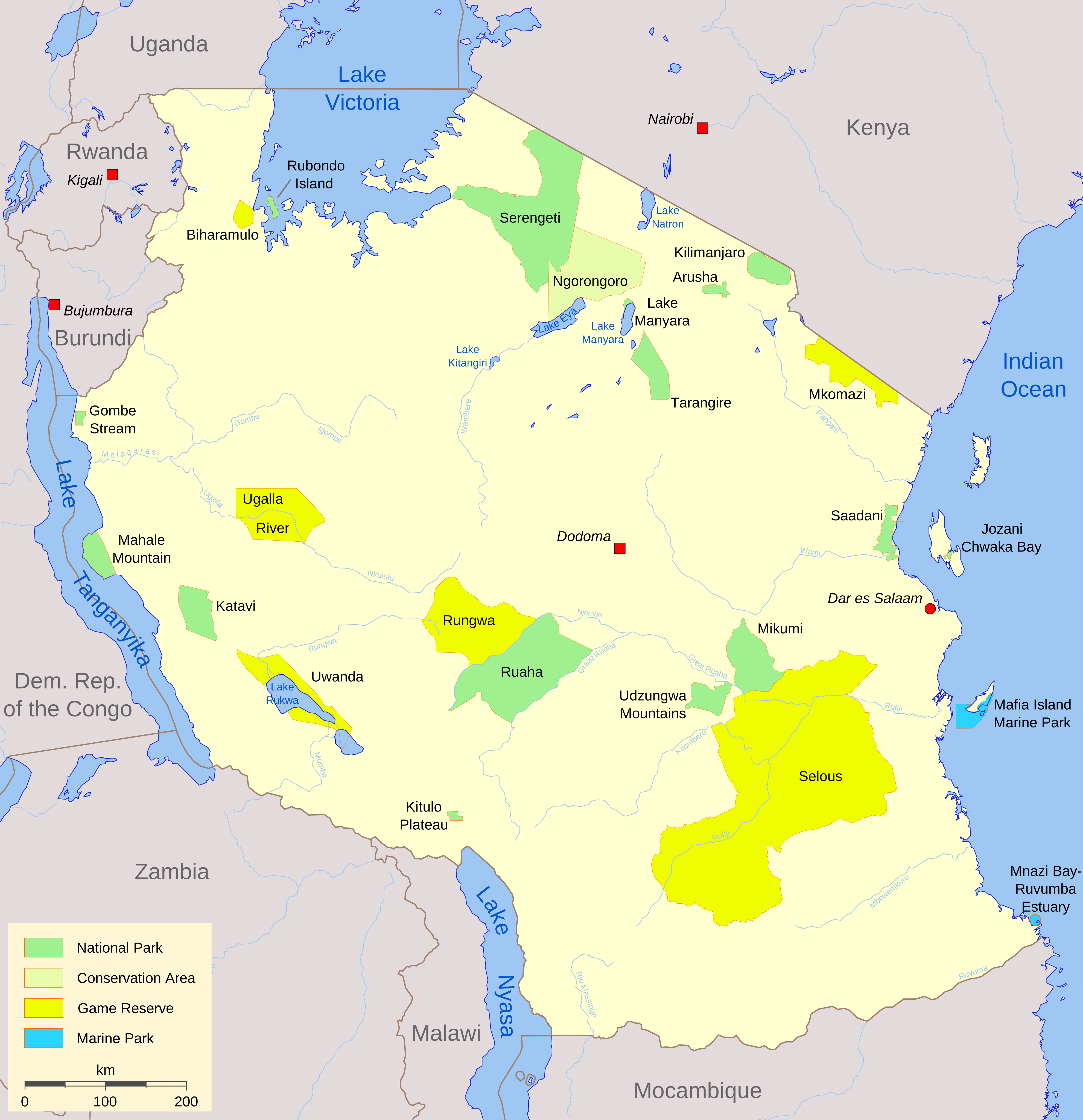
The Serengeti ( ) ecosystem is a geographical region in Africa, spanning the Mara and Arusha Regions of Tanzania. The protected area within the region includes approximately 30000 km2 of land, including the Serengeti National Park and several game reserves. The Serengeti hosts one of the world's largest land animal migration (in terms of total body weight), which helps secure it as one of the Seven Natural Wonders of Africa.
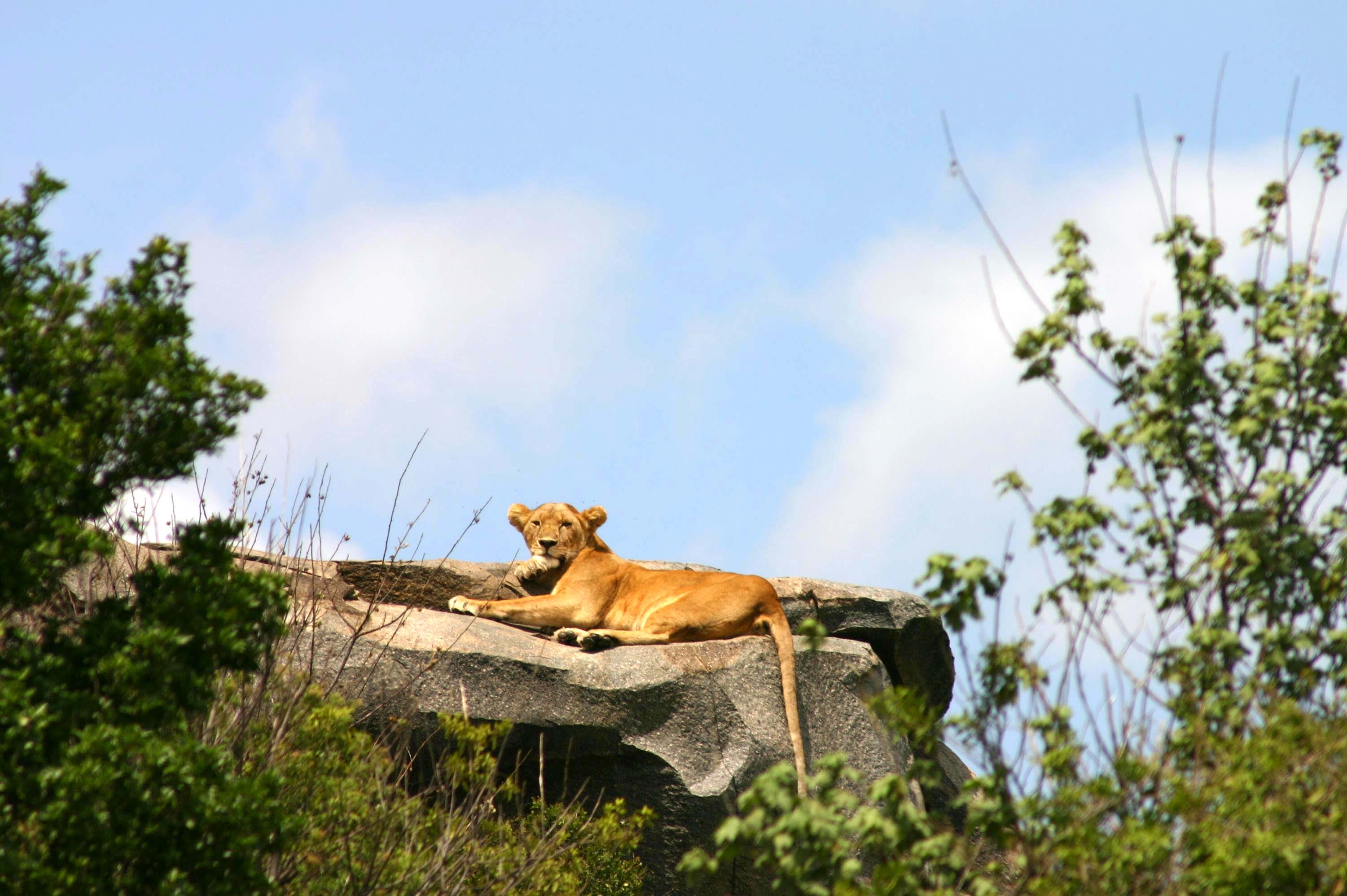
The Serengeti is also renowned for its large lion population and is one of the best places to observe prides in their natural environment. Approximately 70 large mammal and 500 bird species are found there. This high diversity is a function of diverse habitats, including riverine forests, swamps, kopjes, grasslands, and woodlands. Blue wildebeest, gazelles, zebras, and buffalos are some of the commonly found large mammals in the region. The Serengeti also contains the Serengeti District of Tanzania.
The name "Serengeti" is often said to be derived from the word "seringit" in Maa, meaning "endless plains". However, this etymology does not appear in Maa dictionaries.
History
For eons, African wildlife have roamed freely across the vast rolling plains of the Serengeti, which was sparsely inhabited by humans. This changed when nomadic pastoralists of the Maasai began to migrate to the area in the early 1800s.
The Maasai, however, were struck by drought and disease. Thousands died in the 1880s from a cholera epidemic and in 1892 from smallpox. Making matters worse, their cattle were wiped out by Rinderpest (a bovine viral disease). Later in the 20th century the Tanzanian government re-settled the Maasai around the Ngorongoro Crater. Poaching, and the absence of fires (which had been caused by humans), allowed dense woodlands and thickets to develop over the next 30–50 years. Tsetse fly populations now prevented any significant human settlement in the area.
By the mid-1970s, wildebeest and Cape buffalo populations had recovered and were increasingly cropping the grass, reducing the amount of fuel available for fires. The reduced intensity of fires has allowed acacia to once again become established.
In the 21st century, mass rabies vaccination programmes for domestic dogs in the Serengeti have not only indirectly prevented hundreds of human deaths, but also protected wildlife species such as the endangered African wild dog.
Great migration

Each year around the same time, the circular great wildebeest migration begins in the Ngorongoro Conservation Area of the southern Serengeti in Tanzania and loops clockwise through the Serengeti National Park and north towards the Masai Mara reserve in Kenya. This migration is naturally caused by the availability of grazing. The initial phase lasts from about January to March, when the calving season begins – a time when there is plenty of rain-ripened grass available for the 260,000 zebras that precede 1.7 million wildebeest and the following hundreds of thousands of other plains game, including around 470,000 gazelles.
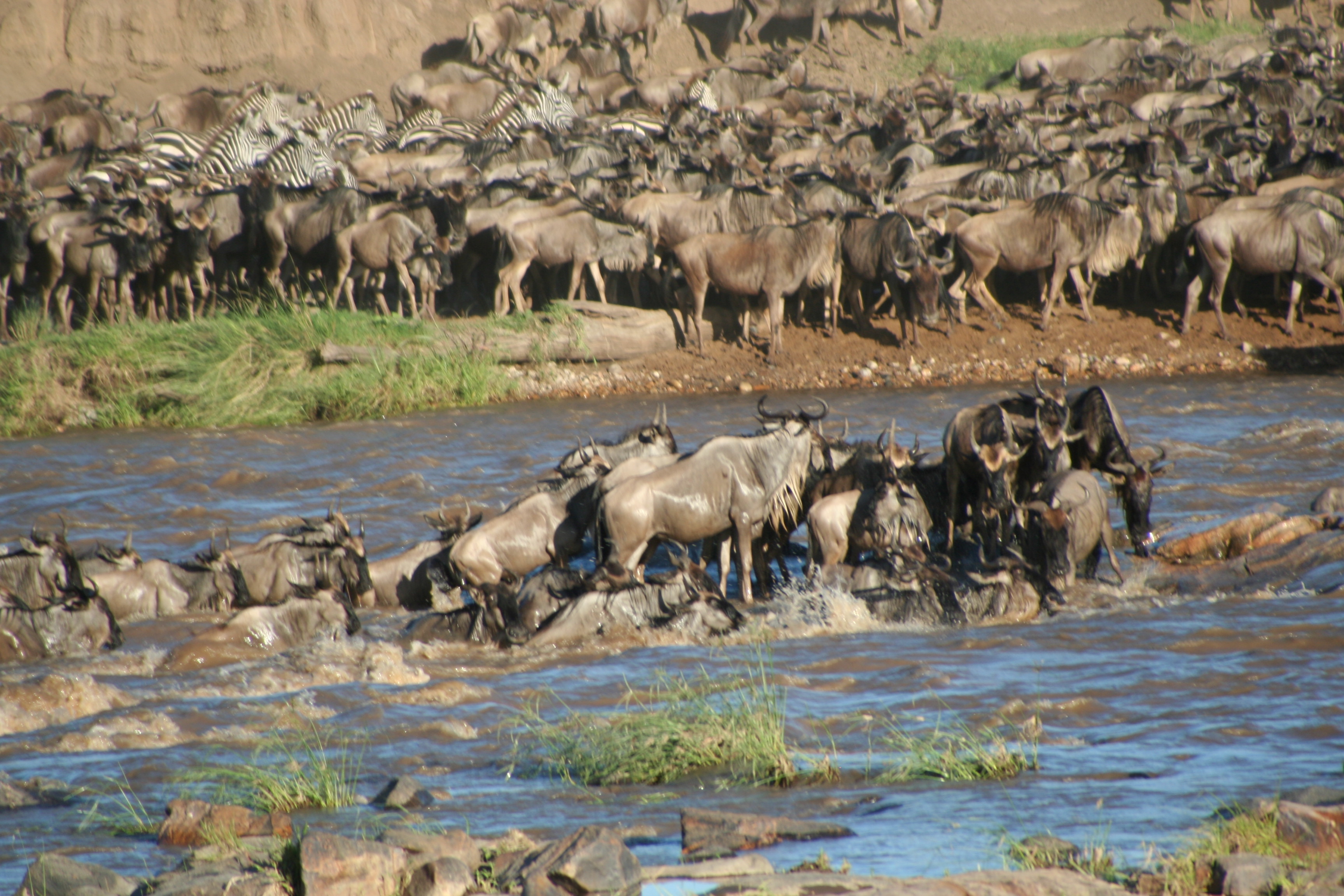
During February, the wildebeest are on the short grass plains of the southeast part of the ecosystem, grazing and giving birth to approximately 500,000 calves in 2 to 3 weeks. Few calves are born ahead of time and of these, hardly any survive, largely because very young calves are more noticeable to predators when mixed with older calves from the previous year. As the rains end in May, the animals start moving northwest into the areas around the Grumeti River, where they typically remain until late June. The crossings of the Grumeti and Mara rivers beginning in July are a popular safari attraction because crocodiles are lying in wait. The herds arrive in Kenya in late July / August, where they stay for the rest of the dry season, except that the Thomson's and Grant's gazelles move only east/west. In early November, with the start of the short rains, the migration starts moving south again, to the short grass plains of the southeast, usually arriving in December in plenty of time for calving in February.
About 250,000 wildebeests die during the journey from Tanzania to the Maasai Mara National Reserve in southwestern Kenya, of 800 km. Death is usually from thirst, hunger, exhaustion, or predation, including by big cats.
Ecology

The Serengeti has some of East Africa's finest wildlife areas. Besides being known for the great migration, the Serengeti is also famous for its abundant large predators. The ecosystem is home to over 3,000 lions, 1,000 African leopards, and 7,700 to 8,700 spotted hyenas (Crocuta crocuta). The East African cheetah is also present in Serengeti.
African wild dogs are relatively scarce in much of the Serengeti. This is particularly true in places such as Serengeti National Park (where they became extinct in 1992), in which lions and spotted hyenas, predators that steal wild dog kills and are a direct cause of wild dog mortality, are abundant.
The Serengeti is also home to a diversity of grazers, including Cape buffalo, African elephant, warthog, Grant's gazelle, eland, waterbuck, and topi. The Serengeti can support this remarkable variety of grazers only because each species, even those closely related, has a different diet. For example, wildebeests prefer to consume shorter grasses, while plains zebras prefer taller grasses. Similarly, dik-diks eat the lowest leaves of a tree, impalas eat the leaves that are higher up, and giraffes eat leaves that are even higher.
.jpg)
The governments of Tanzania and Kenya maintain a number of protected areas, including national parks, conservation areas, and game reserves, that give legal protection to over 80 percent of the Serengeti. Despite this, the ecosystem is now just 60 per cent of its original size, due to human encroachment.
Near Lake Victoria, floodplains have developed from ancient lakebeds.
In the far northwest, acacia woodlands are replaced by broadleaved Terminalia-Combretum woodlands, caused by a change in geology. This area has the highest rainfall in the system and forms a refuge for the migrating ungulates at the end of the dry season.
Altitudes in the Serengeti range from 920 to with mean temperatures varying from 15 to. Although the climate is usually warm and dry, rainfall occurs in two rainy seasons: March to May, and a shorter season in October and November. Rainfall amounts vary from a low of 508 mm in the lee of the Ngorongoro highlands to a high of 1200 mm on the shores of Lake Victoria.
The area is also home to the Ngorongoro Conservation Area, which contains Ngorongoro Crater and the Olduvai Gorge, where some of the oldest hominin fossils have been found.
In media
- In 1993, soft rock artist Dan Fogelberg recorded a song titled "Serengeti Moon" for his studio album River of Souls. It is an African-themed love song about a couple making love underneath the Serengeti moon.
- Canadian guitarist Sonny Greenwich recorded a song titled "Serengeti" on his 1994 album Hymn to the Earth with vocals by Ernie Nelson.
- Serengeti, a six-episode BBC series, chronicles the life of some of the animals in the Serengeti.
- The 1982 song "Africa" by the American rock band Toto, originally released on their album Toto IV, includes a reference to the Serengeti. The song inaccurately describes Mount Kilimanjaro as "ris(ing) like Olympus above the Serengeti"; Kilimanjaro is actually located hundreds of miles to the east of the Serengeti.
- The American rock band the Grateful Dead included the track "Serengetti", an instrumental dual drum solo, on their 1978 album Shakedown Street, interrupting the disco and soft rock-inspired sound with a tribal jam.
References
References
- Zimmermann, Kim Ann. (23 June 2017). "The Serengeti: Plain Facts about National Park & Animals".
- Schmaltz, Jeff. (9 January 2006). "Serengeti".
- "14 of the Greatest Animal Migrations".
- (4 June 2017). "The Serengeti Migration {{!}} Seven Natural Wonders of Africa".
- Nolting, Mark. (2012). "Africa's Top Wildlife Countries". Global Travel Publishers Inc..
- "serengeti".
- Briggs, Phillip. (2006). "Northern Tanzania: The Bradt Safari Guide with Kilimanjaro and Zanzibar". Bradt Travel Guides.
- Richmond, Charles. (1940). "Maasai Dictionary". Archives & Reprint Series (Imprint).
- "Maa (Maasai) Dictionary".
- (2012-06-29). "Serengeti, Heartbreak on the Serengeti". National Geographic Magazine.
- Cartwright, Mark. "Maasai People".
- Morell, Virginia. (1997). "Return of the Forest". [[Science (journal).
- (1995). "Serengeti II: Dynamics, Management, and Conservation of an Ecosystem". University of Chicago Press.
- (September 2008). "Trevor Blackburn Award 2008". British Veterinary Association.
- (2017). "The Great Wildebeest Migration: Exploring Africa's biggest wildlife phenomenon".
- (2013). "How to Get There, Ngorongoro Crater". Ngorongoro Crater Tanzania.
- "Ngorongoro Conservation Area". United Nations Educational, Scientific and Cultural Organization – World Heritage Centre.
- Anouk Zijlma. "The Great Annual Wildlife Migration – The Great Migration of Wildebeest and Zebra". About.com.
- (2000). "Serengeti's Great Migration". Abbeville Press.
- Partridge, Frank. (20 May 2006). "The fast show". The Independent (London).
- Pavitt, Nigel. (2001). "Africa's Great Rift Valley". Harry N. Abrams.
- "Cheetahs on the Edge - Pictures, More From National Geographic Magazine".
- "Mpala Live! Field Guide: Spotted Hyena {{!}} MpalaLive".
- "Cheetahs in Tanzania".
- Angier, Natalie. (11 August 2014). "African Wild Dogs, True Best Friends". The New York Times.
- Kideghesho, Jafari R.. (September 2010). "'Serengeti Shall Not Die': Transforming an Ambition into a Reality". Tropical Conservation Science.
- "Being a responsible safari tourist - Horizon Guides".
- "Travellers' guide to Serengeti_National_Park".
- (2008). "Serengeti III: Human Impacts on Ecosystem Dynamics". University of Chicago Press.
- (2007). "Long-Term Ecosystem Dynamics in the Serengeti: Lessons for Conservation". Conservation Biology.
- "The Serengeti National Park". Glcom.com.
- (June 8, 2015). "A one-million-year-old hominid distal ulna from Olduvai Gorge, Tanzania". American Journal of Physical Anthropology.
- (4 July 2019). "Serengeti review – the Made in Chelsea of nature documentary". [[The Guardian]].
- "Toto – Africa".
This article was imported from Wikipedia and is available under the Creative Commons Attribution-ShareAlike 4.0 License. Content has been adapted to SurfDoc format. Original contributors can be found on the article history page.
Ask Mako anything about Serengeti — get instant answers, deeper analysis, and related topics.
Research with MakoFree with your Surf account
Create a free account to save articles, ask Mako questions, and organize your research.
Sign up freeThis content may have been generated or modified by AI. CloudSurf Software LLC is not responsible for the accuracy, completeness, or reliability of AI-generated content. Always verify important information from primary sources.
Report