From Surf Wiki (app.surf) — the open knowledge base
Serbophilia
Love of Serbian culture, language or people

Love of Serbian culture, language or people
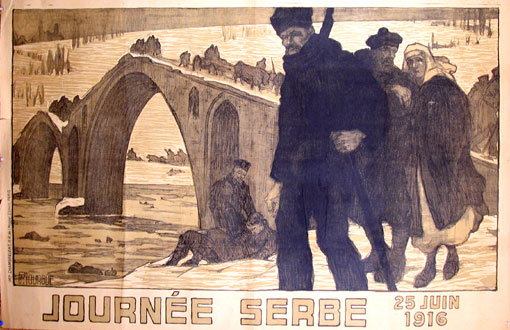
Serbophilia () is the admiration, appreciation and/or emulation of a non-Serbian person who expresses a strong interest, positive predisposition or appreciation for the Serbs, Serbia, Republika Srpska, Serbian language, culture or history. Its opposite is Serbophobia.
History
20th century
World War I
During World War I, Serbophilia was present in western countries.
Breakup of Yugoslavia
Political scientist Sabrina P. Ramet writes that Serbophilia in France during the 1990s was "traditional", partly as a response to the closeness between Germany and Croatia. Business ties continued during the war and fostered a desire for economic normalization.
Serbophiles
- Jacob Grimm — German philologist, jurist and mythologist. Learnt Serbian in order to read Serbian epic poetry.
- Archibald Reiss — German-Swiss publicist, chemist, forensic scientist, a professor at the University of Lausanne.
- Victor Hugo — French poet, novelist, and dramatist of the Romantic movement. Hugo wrote the speech Pour la Serbie.
- Alphonse de Lamartine — French author, poet, and statesman.
- Helen of Anjou — French noblewoman who became queen consort of the Serbian Kingdom.
- Mircea I and Vlad III Dracula
- Several notable composers used motifs from Serbian folk music and composed works inspired by Serbian history or culture, such as:
- Johannes Brahms— German composer, pianist, and conductor of the Romantic period.
- Franz Liszt — Hungarian composer, virtuoso pianist, conductor, music teacher, arranger, and organist of the Romantic era.
- Arthur Rubinstein — Polish-American classical pianist.
- Antonín Dvořák — Czech composer, one of the first to achieve worldwide recognition.
- Pyotr Ilyich Tchaikovsky — Russian composer of the Romantic period (See Serbo-Russian March).
- Nikolai Rimsky-Korsakov — Russian composer, and a member of the group of composers known as The Five (See Fantasy on Serbian Themes).
- Franz Schubert — Austrian composer of the late Classical and early Romantic eras.
- Hans Huber — Swiss composer. Between 1894 and 1918, he composed five operas.
- Rebecca West (1892–1983) — British travel writer. Was described by American media as having a pro-Serbian stance.
- Flora Sandes — British Irish volunteer in World War I.
- Ruth Mitchell — American volunteer in the Chetniks, World War II. Sister of Billy Mitchell.
- Richard Grenell — American diplomat, public official, and Trump administration official.
- Robert De Niro — American actor
- Johnny Depp — American actor and musician
- John Challis — English actor best known for portraying Terrance Aubrey "Boycie" Boyce in the BBC Television sitcom Only Fools and Horses (1981–2003) and its sequel/spin-off The Green Green Grass (2005–2009)
- Peter Handke — Austrian novelist and playwright, Nobel Prize winner. Supported Serbia in the Yugoslav Wars.
- Eduard Limonov — Russian writer and poet.
- Ángel Pulido — Spanish physician, publicist and politician, who stood out as prominent philosephardite during the Restoration
- Essad Pasha Toptani — Ottoman Albanian politician.
- Anna Dandolo— Venetian noblewoman who became Queen of Serbia.
- Józef Bartłomiej Zimorowic — Polish poet and historian of the Baroque era.
- Adam Jerzy Czartoryski — Polish nobleman, statesman, diplomat and author.
- Pavel Jozef Šafárik — Slovakian philologist, poet, literary historian, historian and ethnographer in the Kingdom of Hungary. He was one of the first scientific Slavistics.
- Ján Kollár — Slovakian writer (mainly poet), archaeologist, scientist, politician, and main ideologist of Pan-Slavism.
- Ľudovít Štúr — Slovakian revolutionary politician and writer.
- Henry Bax-Ironside — British diplomat.
- Eleftherios Venizelos — Greek statesman and a prominent leader of the Greek national liberation movement.
- Dimitrios Karatasos — Greek armatolos who participated in the Greek War of Independence, and several other rebellions, seeking to liberate his native Greek Macedonia.
- Herbert Vivian — British journalist and author of Servia: The Poor Man's Paradise and The Servian Tragedy: With Some Impressions of Macedonia.
- Alexander Kolchak — Imperial Russian admiral, military leader and polar explorer.
- Yu Hua — Chinese author.
- František Zach — Czech soldier and military theorist.
- Viktor Orbán - Prime Minister of Hungary.{{cite web |access-date=21 December 2025 |access-date=21 December 2025
Gallery
File:Chain of Friendship cartoon.jpg|"A Threatening Situation", a comic published in the American newspaper the Brooklyn Eagle in July 1914 File:Gallipoli4.jpg|Departure for Serbia File:Kosovo day.jpg|WWI poster - Kosovo Day, June 28, 1916, published in solidarity with the Serb allies File:Save Serbia poster 1915.jpg|WWI poster - Save Serbia (1915) File:Boardman Robinson WWI poster 1.jpg|American poster of the Serbian Relief Fund, organised by Mabel Grouitch, asking for donations to help Serbia on the brink of famine.
References
Sources
- Sells, David (1997). Serb 'Demons' Strike Back (Royal Institute of International Affairs) Vol. 53, No. 2
References
- (11 June 2000). "Blood Bath". Washington Post.
- (2018). "Balkan Babel: The Disintegration Of Yugoslavia From The Death Of Tito To The Fall Of Milosevic". Routledge.
- Donald Haase. (2008). "The Greenwood Encyclopedia of Folktales and Fairy Tales: G-P". Greenwood Publishing Group.
- Selvelli, Giustina. "The Cultural Collaboration between Jacob Grimm and Vuk Karadžić. A fruitful Friendship Connecting Western Europe to the Balkans".
- (2017). "Yugoslavia and Macedonia Before Tito: Between Repression and Integration". Bloomsbury Publishing.
- (28 November 2012). "How Serbia stunned Alphonse de Lamartine".
- (19 March 2021). "Pourquoi la Serbie aime tant la France et la langue française".
- Ion Pătroiu. (1987). "Marele Mircea Voievod". Editura Academiei Repubvlicii Socialiste România.
- Victoria Glendinning. (1988). "Rebecca West: A Life". Fawcett Columbine.
- (2010). "Memoirs of conflict: British women travellers in the Balkans". Studies in Travel Writing.
- (1946). "War". Atlantic Monthly Company.
- Kurapovna, Marcia.''Shadows on the Mountain: The Allies, the Resistance, and the Rivalries that Doomed WWII Yugoslavia''. John Wiley & Sons, 2009, pp. 71–72.
- Mirkovic, Alexander. [http://worldhistoryconnected.press.illinois.edu/9.2/mirkovic.html "Angels and Demons: Yugoslav Resistance in the American Press 1941–1945"]. ''World History Connected'', University of Illinois website, 2012.
- (11 May 2024). "Richard Grenell, a favoured figure of Serbian authorities".
- (3 February 2016). "How did Robert De Niro fall in love with Serbia".
- TheSrpskaTimes. (2020-02-25). "Johnny Depp for RTS: Ćevapčići and Serbian Colleagues Are Fantastic - The Srpska Times".
- "Nisu svi kao Anđa". NOVOSTI.
- Barlovac, Bojana. (2010-01-13). "Johnny Depp Arrives in Serbia Amid Fanfare".
- Ranković, Dragica. (2020-09-30). "Johnny Depp speaks Serbian in Monte Carlo! Prounces "I love you" perfectly, praises Serbia and Serbs".
- Bored_Nele. (2024-11-30). "Johnny Depp's Weird Obsession With Serbia".
- (28 July 2020). "Boycie in Belgrade".
- K. Stuart Parkes. (January 2009). "Writers and Politics in Germany, 1945–2008". Camden House.
- (16 November 1992). "Limonov & Co.". Vreme News Digest.
- (22 September 2011). "LIMONOV Junak našeg doba".
- "in [[Serbia]] at [[Belgrade]] told him "I am not Spanish from there [Spain], but Spanish from the East." Andreu, Miguel Rodríguez (31 January 2017). "Serbia fuera del radar estratégico de España". esglobal. https://www.esglobal.org/serbia-del-radar-estrategico-espana {{Webarchive. link. (25 October 2020 Retrieved 8 June 2018.)
- (1966). "The Ottoman Empire and Its Successors, 1801 -1927". CUP Archive.
- Даница 2009, Вукова задужбина, ''О породичним приликама краља Владислава'', Душан Спасић, 253–263, Београд, 2009
- [[Józef Bartłomiej Zimorowic]] (1857). "Śpiewacy" {{in lang. pl. Kazimierz Józef Turowski, ed. ''Sielanki Józefa Bartłomieja i Syzmona Zimorowiczów''. The [[Internet Archive]]. [https://archive.org/stream/sielankijzefab00zimouoft#page/n42/mode/1up p.39]
- (1971). "Greece and the Entente, August 1, 1914-September 25, 1916".
- Lambros Koutsonikas (1863). Genikē historia tēs Hellēnikēs Epanastaseōs. p. 121. OCLC 679320348.
- (2001). "Europe and the Eastern Question (1878–1923): Political and Organizational Changes". Istorijski institut SANU.
- Acović, Dragomir. (2012). "Slava i čast: Odlikovanja među Srbima, Srbi među odlikovanjima". Službeni Glasnik.
- Serbia, RTS, Radio televizija Srbije, Radio Television of. "Ју Хуа за РТС: Волим Србију, долазим чим прође пандемија".
- (2010). "Czech Foreign Policy in 2007-2009: Analysis". Ústav mezinárodních vztahů.
This article was imported from Wikipedia and is available under the Creative Commons Attribution-ShareAlike 4.0 License. Content has been adapted to SurfDoc format. Original contributors can be found on the article history page.
Ask Mako anything about Serbophilia — get instant answers, deeper analysis, and related topics.
Research with MakoFree with your Surf account
Create a free account to save articles, ask Mako questions, and organize your research.
Sign up freeThis content may have been generated or modified by AI. CloudSurf Software LLC is not responsible for the accuracy, completeness, or reliability of AI-generated content. Always verify important information from primary sources.
Report