From Surf Wiki (app.surf) — the open knowledge base
Sendai Airport
International airport in Miyagi Prefecture, Japan

International airport in Miyagi Prefecture, Japan
| Field | Value |
|---|---|
| name | Sendai Airport |
| nativename-a | |
| nativename-r | Sendai Kūkō |
| image | Sendai airport.svg |
| image-width | 250 |
| image2 | 211028 Sendai Airport Sendai Miyagi prefecture Japan01bs.jpg |
| image2-width | 250 |
| IATA | SDJ |
| ICAO | RJSS |
| type | Public |
| operator | Sendai International Airport Co., Ltd. |
| city-served | Sendai |
| location | Natori, Miyagi |
| hub | Ibex Airlines |
| elevation-f | 6 |
| coordinates | |
| pushpin_map | Japan Miyagi Prefecture#Japan |
| pushpin_label | SDJ/RJSS |
| pushpin_map_caption | Location in Miyagi Prefecture |
| website | sendai-airport.co.jp |
| metric-rwy | Y |
| r1-number | 09/27 |
| r1-length-m | 3,000 |
| r1-surface | Asphalt concrete |
| r2-number | 12/30 |
| r2-length-m | 1,200 |
| r2-surface | Asphalt concrete |
| stat-year | 2015 |
| stat1-header | Passengers |
| stat1-data | 3,152,569 |
| stat2-header | Cargo (metric tonnes) |
| stat2-data | 5,979 |
| stat3-header | Aircraft movement |
| stat3-data | 50,877 |
| footnotes | Source: Japanese Ministry of Land, Infrastructure, Transport and Tourism |
| nativename-a = | nativename-r = Sendai Kūkō | image-width = 250 | image2-width = 250 | city-served = Sendai | elevation-f = 6 | metric-rwy = Y | r1-number = 09/27 | r1-length-m = 3,000 | r1-surface = Asphalt concrete | r2-number = 12/30 | r2-length-m = 1,200 | r2-surface = Asphalt concrete | stat-year = 2015 | stat1-header = Passengers | stat1-data = 3,152,569 | stat2-header = Cargo (metric tonnes) | stat2-data = 5,979 | stat3-header = Aircraft movement | stat3-data = 50,877
Sendai Airport is an international airport located in Natori of Miyagi Prefecture, 13.6 km south-southeast of Sendai, Japan. The airport is the largest in Tōhoku region. The airport's annual passenger numbers have been around 3.6 million in recent years, competing with Kobe Airport for 10th place in Japan. The airport sustained serious damage in 2011 Tōhoku earthquake and tsunami.
Ibex Airlines, a regional airline, is based at the airport.
History
In 1940, the Imperial Japanese Army built Sendai Airport in order to use it for the Kumagaya Army Flight School, Masda Branch School Trainee Training Center. It was called by several names: Natory Airfield, Masda Airfield, and Yatory Airfield. In 1943, the Miho Army Flight Center moved into Sendai Airport and facilities were expanded and later reformed into the Sendai Army Flight School.
At the end of World War II, the United States Army took control of the airport and its operations. In 1956, it was returned to Japan and transferred to the Ministry of Defense. The Ministry of Transport was designated to administer and use it.
In 1957, the runway was extended to 1200 m and Nippon Helicopter Transport (now All Nippon Airways) established a route from Tokyo's (Haneda Airport) to Sendai. When the airport began to service commercial jets on 14 February 1970, runway 09/27 was extended to 2000 m. Also, the flight school of Japan Ground Self Defense Force moved into North Utsunomiya Army Post.
Beginning 6 April 1990, Asiana Airlines established a route from Seoul (Gimpo International Airport) to Sendai, thus beginning international service from the airport. Air China began scheduled service to Beijing via Dalian in 1994, which was followed by services to Shanghai and Changchun.
In 1992, Runway 09/27 was extended further to 2500 m and 5 years later, in 1997, a new terminal was opened and the runway was extended further to 3000 m.
Due to the 1997 Asian Financial Crisis, Singapore Airlines suspended services in Sendai.
The Sendai Airport Line rail link was completed on 18 March 2007 and began service between and Sendai Airport Station. The "Smile Terrace" observation deck opened on 19 March 2010.
2011 Tōhoku earthquake and aftermath
Main article: 2011 Tōhoku earthquake and tsunami
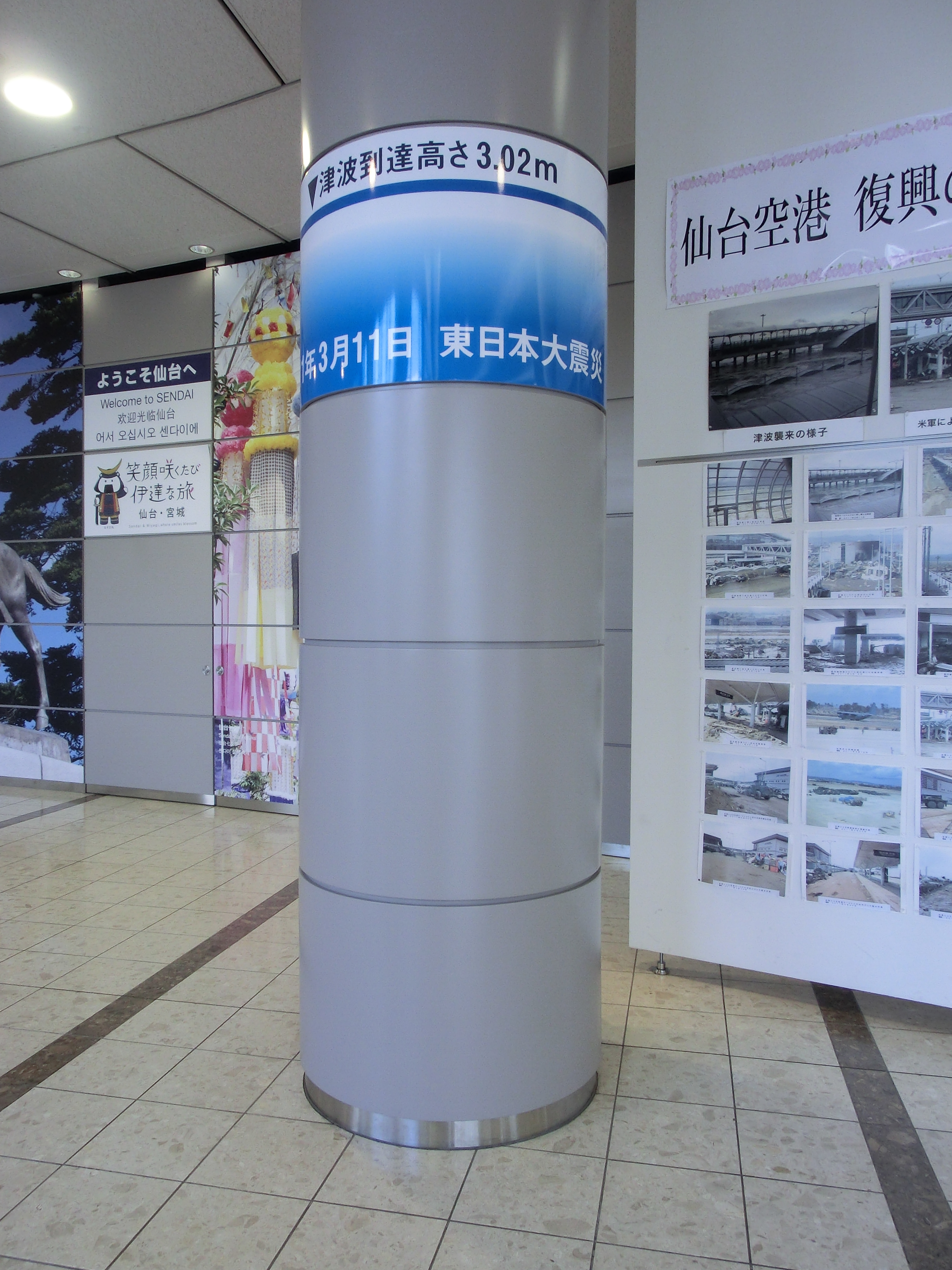
On 11 March 2011, the airport was damaged by the 2011 Tōhoku earthquake and then substantially flooded by the subsequent tsunami. In addition to submerging the apron, taxiways and runway, the floodwaters reached up to parts of the 2nd level of the passenger terminal, rendering electrical equipment, transformers and safety equipment inoperable. Operations at Sendai as well as Odate-Noshiro Airport and Sado Airport, which had been controlled by Sendai Airport control tower, were suspended. Some 1,300 people were stranded within the terminal until 13 March 2011, when they were evacuated. By 17 March 2011, military engineers partially opened the airport for tsunami response flights.
To reopen the airport, on 16 March 2011, a U.S. Air Force MC-130P Combat Shadow from the 17th Special Operations Squadron infiltrated a team from the 320th Special Tactics Squadron from Kadena Air Base into Matsushima, Miyagi, then moved overland to the airport. With assistance from Japan Self-Defense Forces, enough debris was removed in a few days to allow an MC-130H Combat Talon II aircraft to begin landing with more equipment, personnel, and supplies. After further cleanup with help from additional US and Japanese military units, on 20 March 2011, a US Air Force C-17 landed at the airport with 40 metric tons of relief supplies. Thereafter, the airport served as a transit location for airlifted supplies, totaling approximately 2 million tons of such items as blankets, water, and food. The US military set up and operated air traffic control operations for the airport until shortly before commercial traffic resumed, at which point air traffic control responsibility was resumed by Japanese controllers.
The airport reopened to limited commercial traffic on 13 April 2011. Japan Airlines and ANA conducted a total of six flights a day to Tokyo Haneda Airport upon resumption of services, with Japan Airlines also offering limited flights to Osaka Itami airport.
Due to damage caused by the earthquake and tsunami, all scheduled service (except for humanitarian flights) were suspended from 11 March 2011 until 13 April 2011. Limited services resumed on 13 April 2011, although not all original Sendai destinations were served. Regular domestic flights resumed on 25 July 2011 and most international flights resumed in October 2011. Although most international services from Sendai came back online following the 2011 disaster, most services between Sendai and China were suspended or cancelled between 2012 and 2013 due to worsened Sino-Japanese relations. Asiana Airlines also reduced the frequency of its Sendai-Seoul service in September 2013. Despite the reduction in China and Korea service, 2013 saw new service from Sendai to Bangkok and Honolulu as well as new charter service to Taipei. The global COVID-19 pandemic also resulted in greatly reduced passenger traffic.
Facilities
The main passenger terminal building was designed by Japanese American architect Gyo Obata, of the St. Louis architecture firm Hellmuth, Obata & Kassabaum.
There are four floors in the terminal:
- G1: arrivals area (domestic and international), baggage claim, customs, central Plaza – G1
- M2 – arrivals concourse, atrium, customs control area
- 2 – departure area (domestic and international), airline offices, check-in counters, lounges and waiting area.
- 3 – retail shops (4), business lounge, waiting area and access to observation deck
The airport has eight jet bridges to handle aircraft coming and leaving the airport. The west end of the terminal services domestic routes and the east side international routes. The control tower, Tokyo Regional Civil Aviation Bureau office and Air Cargo Terminal are located on the west side of the main terminal building. To the south side of the airport are the facilities for small private aircraft, helipads (4) and aircraft hangars.
Airlines and destinations
| Air China | Shanghai–Pudong | Air Do | Sapporo–Chitose | All Nippon Airways | Naha, Osaka–Itami | ANA Wings | Nagoya–Centrair, Osaka–Itami, Sapporo–Chitose | Asiana Airlines | Seoul–Incheon | EVA Air | Taipei–Taoyuan | Fuji Dream Airlines | Fukuoka | Greater Bay Airlines | Hong Kong | HK Express | Hong Kong | Ibex Airlines | Fukuoka, Hiroshima, Nagoya–Centrair, Osaka–Itami, Sapporo–Chitose | J-Air | Osaka–Itami, Sapporo–Chitose | Peach | Nagoya–Centrair, Osaka–Kansai, Sapporo–Chitose | Skymark Airlines | Kobe | StarFlyer | Fukuoka | Starlux Airlines | Taipei–Taoyuan | Thai AirAsia X | Bangkok–Don Mueang | Tigerair Taiwan | Kaohsiung, Taipei–Taoyuan
Statistics
Ground transportation
The Sendai Airport Line, which connects the airport to Sendai Station, opened on 18 March 2007. The journey to the downtown core of the city takes 17–25 minutes. After the earthquake and tsunami, service was suspended until 1 October of that year.
The airport can be accessed by car via the Sendai–Tōbu Road via Route 20. There are two car parks located near the terminal building (Parking 1 with 970 spots) and east side of the airport property (Parking 2 with 250 spots).
Buses and taxis also service the airport and are located outside the Domestic Terminal:
Route and highway buses
| Bus stop | Name | Via | Destination | Company | Note | 1 | 2 | 3 |
|---|---|---|---|---|---|---|---|---|
| Sendai-Kūkō-Yamagata Line | Yamagata Kencho-mae | Yamagata Station | Miyagi kōtsū・YamaKō bus | |||||
| Tsuruoka・Sakata Line | Sendai Station・Sagae Station・Kisakata Station | Ugo-Honjo Station | Shonaikotsu | |||||
| Sendai -kūkō ー Fukushima ー Aizu-Wakamatsu Line | Sōma Station・Fukushima Station・Nihonmatsu Station | Aizu-Wakamatsu Station | Aizu bus | |||||
| Sendai-kūkō -Zao Line | Non stop | Zaō Onsen | Sendai bus | Runs only during winter | ||||
| Matsushima Line | Matsushima-Kaigan Station | Matsushima Station | Iwamate-Kenpoku-Jidosya | |||||
| Sendai Airport Limousine | Non stop | Sendai Station | Takeyakoutu ・Sendai bus | |||||
| KūKō Line | circular-route | Iwanuma Station | Community bus | |||||
| Rinku-Jyunkan bus | circular-route | Tatekoshi Station | Sendai bus |
- Taxis – Sendai City and Tatekoshi JR Station
Accidents and incidents
- In 1963, All Nippon Airways Flight 802 missed its approach and crashed at the airport, but there were no fatalities.
References
References
- "Sendai Airport". Japanese [[Ministry of Land, Infrastructure, Transport and Tourism]].
- link. (19 October 2013)
- "Sendai Airport". Sendai International Airport.
- Andrew. (2025-02-25). "The Lost Cities: Routes Singapore Airlines left behind".
- (19 April 2010). "仙台空港に屋上展望デッキ「スマイルテラス」-パノラマの景色を一望". 仙台経済新聞.
- (11 March 2011). "News: Tsunami rolls through Pacific, Sendai Airport under water, Tokyo Narita closed, Pacific region airports endangered". Avherald.com.
- (13 March 2011). "Satellite Photos – Japan Before and After Tsunami". The New York Times.
- "宮城県/空港臨空地域課".
- (17 March 2011). "Japan's Sendai Airport Opens Runway For Relief Efforts".
- ''[[Sankei Shimbun]]'', "Elite U.S. airborne unit dropped over an airport and restores it", 27 March 2011.
- Fackler, Martin. (2011-04-13). "U.S. Airmen Quietly Reopen Wrecked Airport in Japan". The New York Times.
- (8 April 2011). "Tsunami-hit Japan airport set to reopen".
- Koh, Yoree. (8 April 2011). "Sendai Airport Back in Business April 13". The Wall Street Journal.
- [[Kyodo News]], "Sendai Airport partially resumes domestic flights after quake", 13 April 2011.
- "Sendai overseas flights resume {{!}} The Japan Times Online".
- "Photos: 10 Years Since the Great East Japan Earthquake - the Atlantic".
- Johnson, Julia M.. (4 March 2005). "Obata keeps HOK's focus on meeting people's needs". St. Louis Business Journal.
- "Seoul, Korea Republic Of SEL".
- "Asiana Airlines Resumes Sendai Service in late-April 2023".
- "Taipei, Chinese Taipei TPE".
- (27 October 2022). "EVA Air Resumes Sendai Service From Jan 2023".
- "Fuji Dream Assumes 2 J-Air Fukuoka Routes in NW25".
- "Hong Kong (SAR) China HKG".
- "Greater Bay Airlines 4Q24 Japan Network Expansion".
- "HK Express Schedules Sendai 1Q25 Launch".
- "StarFlyer Schedules Fukuoka – Sendai From Oct 2025".
- "Starlux Airlines Schedules Sendai Launch in 2Q23".
- (16 September 2025). "Thai AirAsia X Adds Bangkok – Sendai From Dec 2025".
- Liu, Jim. (6 May 2025). "tigerair Taiwan Schedules Kaohsiung – Sendai 3Q25 Launch".
- "Tigerair Taiwan NS23 Japan Operations – 10MAR23".
- (8 April 2011). "Tsunami-hit Japan airport set to reopen". Herald Sun/AFP.
This article was imported from Wikipedia and is available under the Creative Commons Attribution-ShareAlike 4.0 License. Content has been adapted to SurfDoc format. Original contributors can be found on the article history page.
Ask Mako anything about Sendai Airport — get instant answers, deeper analysis, and related topics.
Research with MakoFree with your Surf account
Create a free account to save articles, ask Mako questions, and organize your research.
Sign up freeThis content may have been generated or modified by AI. CloudSurf Software LLC is not responsible for the accuracy, completeness, or reliability of AI-generated content. Always verify important information from primary sources.
Report