From Surf Wiki (app.surf) — the open knowledge base
Self-similarity
Whole of an object being mathematically similar to part of itself

Whole of an object being mathematically similar to part of itself

In mathematics, a self-similar object is exactly or approximately similar to a part of itself (i.e., the whole has the same shape as one or more of the parts). Many objects in the real world, such as coastlines, are statistically self-similar: parts of them show the same statistical properties at many scales. Self-similarity is a typical property of fractals. Scale invariance is an exact form of self-similarity where at any magnification there is a smaller piece of the object that is similar to the whole. For instance, a side of the Koch snowflake is both symmetrical and scale-invariant; it can be continually magnified 3x without changing shape.
Peitgen et al. explain the concept as such:
If parts of a figure are small replicas of the whole, then the figure is called self-similar....A figure is strictly self-similar if the figure can be decomposed into parts which are exact replicas of the whole. Any arbitrary part contains an exact replica of the whole figure.}}Since mathematically, a fractal may show self-similarity under arbitrary magnification, it is impossible to recreate this physically. Peitgen et al. suggest studying self-similarity using approximations:{{Quote
This vocabulary was introduced by Benoit Mandelbrot in 1964.
Self-affinity
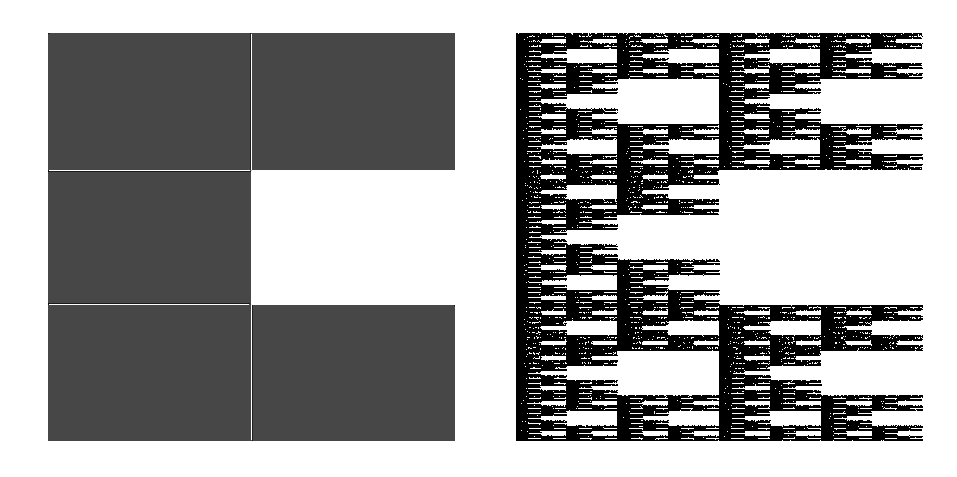
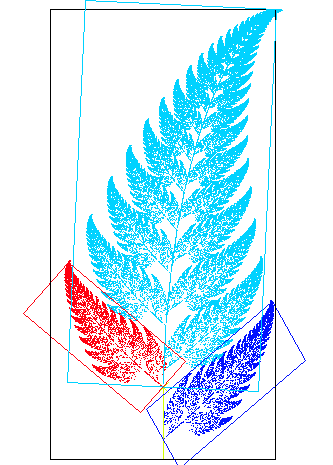
In mathematics, self-affinity is a feature of a fractal whose pieces are scaled by different amounts in the x and y directions. This means that to appreciate the self-similarity of these fractal objects, they have to be rescaled using an anisotropic affine transformation.
Definition
A compact topological space X is self-similar if there exists a finite set S indexing a set of non-surjective homeomorphisms { f_s : s\in S } for which
:X=\bigcup_{s\in S} f_s(X)
If X\subset Y, we call X self-similar if it is the only non-empty subset of Y such that the equation above holds for { f_s : s\in S } . We call.
:\mathfrak{L}=(X,S,{ f_s : s\in S } )
a self-similar structure. The homeomorphisms may be iterated, resulting in an iterated function system. The composition of functions creates the algebraic structure of a monoid. When the set S has only two elements, the monoid is known as the dyadic monoid. The dyadic monoid can be visualized as an infinite binary tree; more generally, if the set S has p elements, then the monoid may be represented as a p-adic tree.
The automorphisms of the dyadic monoid is the modular group; the automorphisms can be pictured as hyperbolic rotations of the binary tree.
A more general notion than self-similarity is self-affinity.
Examples
The Cantor discontinuum is self-similar since any of its closed subsets is a continuous image of the discontinuum.
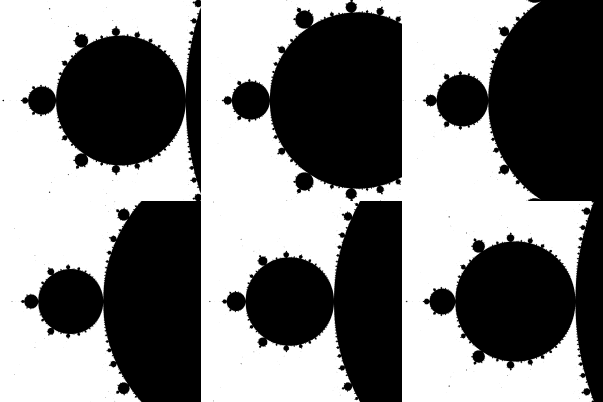
The Mandelbrot set is also self-similar around Misiurewicz points.
Self-similarity has important consequences for the design of computer networks, as typical network traffic has self-similar properties. For example, in teletraffic engineering, packet switched data traffic patterns seem to be statistically self-similar. This property means that simple models using a Poisson distribution are inaccurate, and networks designed without taking self-similarity into account are likely to function in unexpected ways.
Similarly, stock market movements are described as displaying self-affinity, i.e. they appear self-similar when transformed via an appropriate affine transformation for the level of detail being shown.{{cite magazine | url=https://www.scientificamerican.com/article/multifractals-explain-wall-street/ | title=How Fractals Can Explain What's Wrong with Wall Street | author=Benoit Mandelbrot | magazine=Scientific American| date=February 1999| author-link=Benoit Mandelbrot}} Andrew Lo describes stock market log return self-similarity in econometrics.
Finite subdivision rules are a powerful technique for building self-similar sets, including the Cantor set and the Sierpinski triangle.
Some space filling curves, such as the Peano curve and Moore curve, also feature properties of self-similarity.

In cybernetics
The viable system model of Stafford Beer is an organizational model with an affine self-similar hierarchy, where a given viable system is one element of the System One of a viable system one recursive level higher up, and for whom the elements of its System One are viable systems one recursive level lower down.
In nature

Self-similarity can be found in nature, as well. Plants, such as Romanesco broccoli, exhibit strong self-similarity.
In music
- Strict canons display various types and amounts of self-similarity, as do sections of fugues.
- A Shepard tone is self-similar in the frequency or wavelength domains.
- The Danish composer Per Nørgård made use of a self-similar integer sequence named the infinity series in much of his music.
- In the research field of music information retrieval, self-similarity commonly refers to the fact that music often consists of parts that are repeated in time. In other words, music is self-similar under temporal translation, rather than (or in addition to) under scaling.
References
References
- Mandelbrot, Benoit B. (1982). ''The Fractal Geometry of Nature'', p.44. {{ISBN. 978-0716711865.
- Mandelbrot, Benoit B.. (5 May 1967). "How long is the coast of Britain? Statistical self-similarity and fractional dimension". [[Science (journal).
- Peitgen, Heinz-Otto; Jürgens, Hartmut; Saupe, Dietmar; Maletsky, Evan; Perciante, Terry; and Yunker, Lee (1991). ''Fractals for the Classroom: Strategic Activities Volume One'', p.21. Springer-Verlag, New York. {{ISBN. 0-387-97346-X and {{ISBN. 3-540-97346-X.
- Peitgen, et al (1991), p.2-3.
- Comment j'ai découvert les fractales, Interview de [[Benoit Mandelbrot]], La Recherche https://www.larecherche.fr/math%C3%A9matiques-histoire-des-sciences/%C2%AB-comment-jai-d%C3%A9couvert-les-fractales-%C2%BB
- Arneodo, A.. (2000). "A wavelet-based method for multifractal image analysis. I. Methodology and test applications on isotropic and anisotropic random rough surfaces". The European Physical Journal B.
- "Self-similar carpets over finite fields".
- "Self-similar carpets over finite fields".
- [[Kazimierz Kuratowski]] (1972) Leo F. Boron, translator, ''Introduction to Set Theory and Topology'', second edition, ch XVI, § 8 The Cantor Discontinuum, page 210 to 15, [[Pergamon Press]]
- (January 1995). "On the self-similar nature of Ethernet traffic (extended version)". IEEE/ACM Transactions on Networking.
- Campbell, Lo and MacKinlay (1991) "[[Econometrics]] of Financial Markets ", Princeton University Press! {{ISBN. 978-0691043012
- Salazar, Munera. (1 July 2016). "Self-Similarity of Space Filling Curves".
- (30 October 1999). "Proceedings of the seventh ACM international conference on Multimedia (Part 1)".
- (April 2011). "On Musical Self-Similarity: Intersemiosis as Synecdoche and Analogy". International Semiotics Institute at Imatra; Semiotic Society of Finland.
This article was imported from Wikipedia and is available under the Creative Commons Attribution-ShareAlike 4.0 License. Content has been adapted to SurfDoc format. Original contributors can be found on the article history page.
Ask Mako anything about Self-similarity — get instant answers, deeper analysis, and related topics.
Research with MakoFree with your Surf account
Create a free account to save articles, ask Mako questions, and organize your research.
Sign up freeThis content may have been generated or modified by AI. CloudSurf Software LLC is not responsible for the accuracy, completeness, or reliability of AI-generated content. Always verify important information from primary sources.
Report