From Surf Wiki (app.surf) — the open knowledge base
Self-similar process
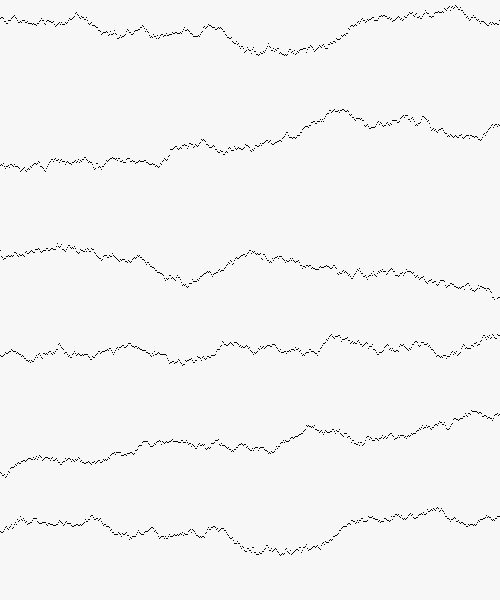
Self-similar processes are stochastic processes satisfying a mathematically precise version of the self-similarity property. Several related properties have this name, and some are defined here.
A self-similar phenomenon behaves the same when viewed at different degrees of magnification, or different scales on a dimension. Because stochastic processes are random variables with a time and a space component, their self-similarity properties are defined in terms of how a scaling in time relates to a scaling in space.
Distributional self-similarity
Definition
A continuous-time stochastic process (X_t){t\ge0} is called self-similar with parameter H0 if for all a0, the processes (X{at}){t\ge0} and (a^HX_t){t\ge0} have the same law.
Examples
- The Wiener process (or Brownian motion) is self-similar with H=1/2.
- The fractional Brownian motion is a generalisation of Brownian motion that preserves self-similarity; it can be self-similar for any H\in(0,1).
- The class of self-similar Lévy processes are called stable processes. They can be self-similar for any H\in1/2,\infty).
Second-order self-similarity
Definition
A [wide-sense stationary process (X_n){n\ge0} is called exactly second-order self-similar with parameter H0 if the following hold: :(i) \mathrm{Var}(X^{(m)})=\mathrm{Var}(X)m^{2(H-1)}, where for each k\in\mathbb N_0, X^{(m)}k = \frac 1 m \sum{i=1}^m X{(k-1)m + i}, :(ii) for all m\in\mathbb N^+, the autocorrelation functions r and r^{(m)} of X and X^{(m)} are equal. If instead of (ii), the weaker condition :(iii) r^{(m)} \to r pointwise as m\to\infty holds, then X is called asymptotically second-order self-similar.
Connection to long-range dependence
In the case 1/2, asymptotic self-similarity is equivalent to long-range dependence. Self-similar and long-range dependent characteristics in computer networks present a fundamentally different set of problems to people doing analysis and/or design of networks, and many of the previous assumptions upon which systems have been built are no longer valid in the presence of self-similarity.
Long-range dependence is closely connected to the theory of heavy-tailed distributions. A distribution is said to have a heavy tail if : \lim_{x \to \infty} e^{\lambda x}\Pr[Xx] = \infty \quad \mbox{for all } \lambda0., One example of a heavy-tailed distribution is the Pareto distribution. Examples of processes that can be described using heavy-tailed distributions include traffic processes, such as packet inter-arrival times and burst lengths.
Examples
- The Tweedie convergence theorem can be used to explain the origin of the variance to mean power law, 1/f noise and multifractality, features associated with self-similar processes.
- Ethernet traffic data is often self-similar. Empirical studies of measured traffic traces have led to the wide recognition of self-similarity in network traffic.
References
Sources
- {{citation
References
- §1.4.2 of Park, Willinger (2000)
- Park, Willinger (2000)
- §1.4.1 of Park, Willinger (2000)
- (February 1994). "On the Self-similar Nature of Ethernet Traffic (Extended Version)". [[IEEE]].
- "The Self-Similarity and Long Range Dependence in Networks Web site". Cs.bu.edu.
- (2011-12-27). "Tweedie convergence: A mathematical basis for Taylor's power law, 1/f noise, and multifractality". American Physical Society (APS).
- (2022). "Stable Lévy Processes via Lamperti-Type Representations". [[Cambridge University Press]].
- (1994). "Stable Non-Gaussian Random Processes". Chapman & Hall.
- (1991). "Brownian Motion and Stochastic Calculus". [[Springer Verlag]].
This article was imported from Wikipedia and is available under the Creative Commons Attribution-ShareAlike 4.0 License. Content has been adapted to SurfDoc format. Original contributors can be found on the article history page.
Ask Mako anything about Self-similar process — get instant answers, deeper analysis, and related topics.
Research with MakoFree with your Surf account
Create a free account to save articles, ask Mako questions, and organize your research.
Sign up freeThis content may have been generated or modified by AI. CloudSurf Software LLC is not responsible for the accuracy, completeness, or reliability of AI-generated content. Always verify important information from primary sources.
Report