From Surf Wiki (app.surf) — the open knowledge base
Select committee (United Kingdom)
Parliamentary committee in the UK
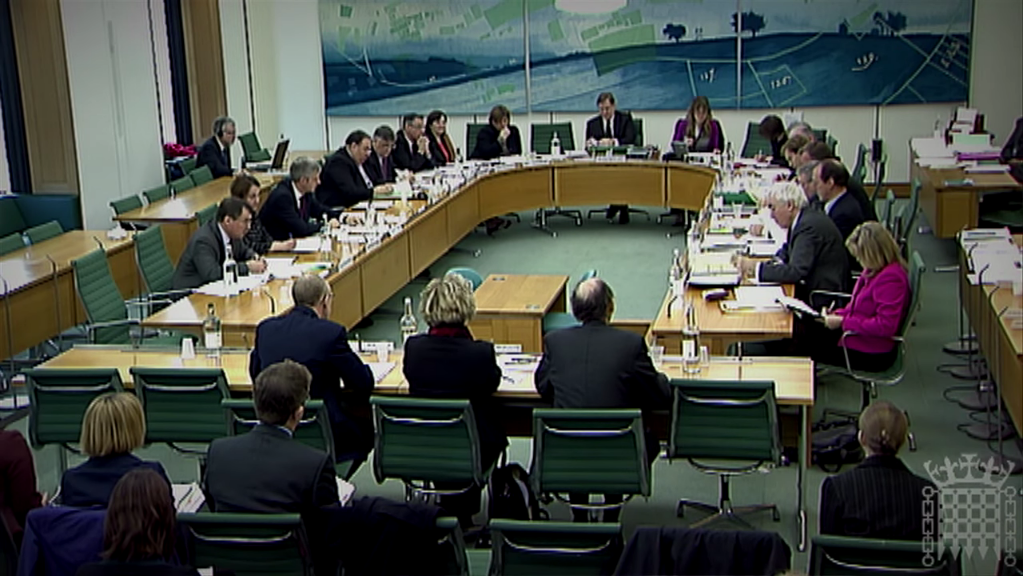
Parliamentary committee in the UK
In British politics, parliamentary select committees are cross-party groups of MPs or Lords which investigate specific issues or scrutinise the work of the Government of the United Kingdom.
They can be appointed from the House of Commons, from the House of Lords, or as a joint committee of Parliament drawn from both. Committees may be constituted as "sessional" committees – i.e. be near-permanent – or as "ad-hoc" committees with a specific deadline by which to complete their work, after which they cease to exist.
House of Commons select committees are generally responsible for overseeing the work of government departments and agencies, whereas Lords select committees look at general issues, such as the constitution or the economy. Select committees are also one of Parliament's mechanisms for holding the private sector to account.
Following the 2024 United Kingdom general election, most of the new chairs of the 26 select committees were elected in September 2024.
Some English local authorities also have a select committee system, as part of their Overview and Scrutiny arrangements.
How select committees work and governing rules
Select committees in the House of Commons are governed by the Standing Orders. The powers of departmental select committees are set out in standing order 152.
Committees often open investigations, called inquiries, into topics within their remit. As part of these inquiries they gather information from government officials and interested people, groups, and organisations. At the end of inquiries they often publish a report with their findings, to which the government must respond in writing.Committees have no legal power to compel people to appear before them. Rupert Murdoch and Mike Ashley are two examples of witnesses who initially declined before agreeing to appear. Mark Zuckerberg, for example, declined to appear in front of a committee at all.
Typically, a departmental committee has 11 members, though some, like Public Accounts, are larger. Committee membership and chairs are divided based on parties' seats in the House of Commons and reappointed after elections By tradition, the Public Accounts Committee is led by a member of the opposition party, while a member of the governing party leads the Treasury Select Committee.
The Osmotherly Rules set out guidance on how civil servants should respond to parliamentary select committees.
Types of select committees
House of Commons select committees
Following the dissolution of parliament that preceded the 2024 election, all select committees were disbanded. The House of Commons allocated which parties would hold each Chair in advance of the summer recess on 30 July 2024. Nominations for Chairs ran until 9 September. Ballots took place on 11 September.
Departmental select committees
| Committee | Chair | Responsibility | Name | Since | |
|---|---|---|---|---|---|
| Business and Trade Select Committee | Labour Party (UK)}}" | Liam Byrne | 2023 | Department for Business and Trade and related bodies | |
| Culture, Media and Sport Committee | Conservative Party (UK)}}" | Caroline Dinenage | 2023 | Department for Culture, Media and Sport | |
| Defence Select Committee | Labour Party (UK)}}" | Tan Dhesi | 2024 | Ministry of Defence | |
| Education Select Committee | Labour Party (UK)}}" | Helen Hayes | 2024 | Department for Education and related bodies | |
| Energy Security and Net Zero Select Committee | Labour Party (UK)}}" | Bill Esterson | 2024 | Department for Energy Security and Net Zero and related bodies | |
| Environment, Food and Rural Affairs Select Committee | Liberal Democrats (UK)}}" | Alistair Carmichael | 2024 | Department for Environment, Food and Rural Affairs and associated bodies | |
| Foreign Affairs Select Committee | Labour Party (UK)}}" | Emily Thornberry | 2024 | Foreign, Commonwealth and Development Office and associated bodies | |
| Health and Social Care Select Committee | Liberal Democrats (UK)}}" | Layla Moran | 2024 | Department of Health and Social Care and related bodies | |
| Home Affairs Select Committee | Conservative Party (UK)}}" | Karen Bradley | 2024 | Home Office and related bodies | |
| Housing, Communities and Local Government Committee | Labour Party (UK)}}" | Florence Eshalomi | 2024 | Ministry of Housing, Communities and Local Government | |
| International Development Select Committee | Labour Co-operative}}" | Sarah Champion | 2020 | Foreign, Commonwealth and Development Office and associated bodies | |
| Justice Select Committee | Labour Party (UK)}}" | Andy Slaughter | 2024 | Ministry of Justice, related agencies including the Crown Prosecution Service, and other agencies that report to the Lord Chancellor | |
| Northern Ireland Affairs Committee | Labour Party (UK)}}" | Tonia Antoniazzi | 2024 | The work of the devolved government and the Northern Ireland Office | |
| Science, Innovation and Technology Committee | Labour Party (UK)}}" | Chi Onwurah | 2024 | Government Office for Science, Department for Science, Innovation and Technology and related bodies | |
| Scottish Affairs Committee | Labour Party (UK)}}" | Patricia Ferguson | 2024 | The work of the devolved government and the Scotland Office | |
| Transport Select Committee | Labour Party (UK)}}" | Ruth Cadbury | 2024 | Department for Transport | |
| Treasury Select Committee | Labour Party (UK)}}" | Meg Hillier | 2024 | Treasury and HM Revenue and Customs | |
| Welsh Affairs Select Committee | Labour Party (UK)}}" | Ruth Jones | 2024 | The Wales Office and UK Government policies which impact Wales | |
| Women and Equalities Select Committee | Labour Party (UK)}}" | Sarah Owen | 2024 | The Government Equalities Office and policies which affect equality law and policy | |
| Work and Pensions Select Committee | Labour Co-operative}}" | Debbie Abrahams | 2024 | Department for Work and Pensions |
Cross-cutting select committees
| Committee | Chair | Responsibility | Name | Since | |
|---|---|---|---|---|---|
| Environmental Audit Select Committee | Labour Party (UK)}}" | Toby Perkins | 2024 | Examines the contribution of government policies to environmental protection and sustainable development | |
| Liaison Committee | Labour Party (UK)}}" | Meg Hillier | 2024 | Examines the work of select committees in general, as well as hearing annual evidence from the Prime Minister | |
| Public Accounts Select Committee | Conservative Party (UK)}}" | Geoffrey Clifton-Brown | 2024 | Examines government and parliamentary expenditure to ensure honesty and fairness | |
| Public Administration and Constitutional Affairs Select Committee | Conservative Party (UK)}}" | Simon Hoare | 2024 | Examines the work and administration of the Civil Service, as well as reports from the Parliamentary Ombudsman | |
| Select Committee on Statutory Instruments | Conservative Party (UK)}}" | Bernard Jenkin | 2024 | Examines all statutory instruments laid before the Commons | |
| Petitions | Liberal Democrats (UK)}}" | Jamie Stone | 2024 | Oversees petitions submitted to Parliament |
Internal select committees
| Committee | Chair | Responsibility | Name | Since | |
|---|---|---|---|---|---|
| Administration Committee | Labour Party (UK)}}" | Nick Smith | 2024 | Examines the services offered to members of the Commons, as well as services offered to the public | |
| Backbench Business Committee | Conservative Party (UK)}}" | Bob Blackman | 2024 | Determines business to be debated at certain times set aside for backbenchers | |
| Finance Committee | Conservative Party (UK)}}" | Steve Barclay | 2024 | Examines the budget and expenditure of the House of Commons, including the administration budget | |
| Committee on Standards | Conservative Party (UK)}}" | Alberto Costa | 2024 | Oversees Parliamentary standards and members' interests and conduct | |
| Committee of Privileges | Conservative Party (UK)}}" | Alberto Costa | 2025 | Considers specific matters relating to privileges referred to it by the House | |
| Procedure Committee | Labour Party (UK)}}" | Cat Smith | 2024 | Examines the practice and procedures of the Commons in dealing with public business | |
| Committee of Selection | Labour Party (UK)}}" | Jessica Morden | 2024 | Recommends the appointment of members to parliamentary committees |
House of Lords select committees
House of Lords select committees include:
- The Constitution Committee
- The Economic Affairs Committee
- The Science and Technology Committee (House of Lords)
- The Communications and Digital Committee
These committees run inquiries into and publish reports on topics within their remit.
History
Specialised committees of investigation existed within Parliament since the Tudor period. In the sixteenth century, committees revised bills and considered constitutional and religious questions.
The committees system was further developed during the mid-1960s by Richard Crossman as Leader of the House of Commons.
The modern system of departmental select committees in the UK came into being in 1979, following the recommendations of a 1978 Procedure Select Committee report. It recommended the appointment of a series of select committees covering all the main departments of state, with wide terms of reference, and with power to appoint specialist advisers as the committees deemed appropriate. It also suggested that committee members should be selected independently of the party whips, as chosen by the Select Committee of Selection. The fourteen new committees began working in 1980 after the 1979 general election.
Since then, Parliament has organised House of Commons committees into three main types:
- Departmental committees: Each committee scrutinises a specific government department. For example, the Education Select Committee watches over the Department for Education.
- Cross-cutting committees: These committees focus on broader topics that don’t belong to any single department. For example, the Science and Technology Select Committee, and Women and Equalities Select Committee.
- Domestic committees: These committees manage issues within Parliament itself, like procedures and standards.
In July 2005, the Administration Select Committee was created to replace five previous committees. It covers services in the House, including catering, the House of Commons Library, digital services, and visitor services.
Sometimes, committees from the House of Commons or joint standing committees (which include members of both Houses) review individual bills in detail. Most bills go to public bill committees. Before 2006, these were called standing committees.
In 2009, the Wright Committee was formed to improve the procedures and relevance of Parliament. Changes made based on the committee's recommendations included limiting the number of members per committee to 11, requiring those members and chairs to be elected by the House, and a reduction in the number of committees. The recommendations of the Wright committee were widely understood to have a positive impact on the constructiveness and productivity of Parliament. Tony Wright believed the reforms gave committees "new confidence and authority", particularly because they were now elected, and "their activities restored the reputation of the Commons". Hannah White, 21 May 2015, Institute for Government.
The Backbench Business Committee was created in 2010 as a non-ministerial committee to cover non-government business, following recommendations from the Reform the House of Commons report under the Wright Committee.
Since June 2010, most committee chairs are elected by the whole House. Before this, each party appointed members and chose chairs within the group.
Impact and influence
Select committees recommendations often focus on changes to government policy. One study estimates that 30–40% of select committee recommendations become policy.
In popular culture
A select committee evidence session is featured in season 3, episode 5 of Industry. In the episode, Robert is sent to represent Pierpoint as part of the committee's inquiry into the collapse and bailout of Lumi, a green energy tech company.
A 2015 select committee inquiry into the Horizon computer system features in Mr Bates vs The Post Office.
In series 2, episode 3 of British satirical comedy The Thick of It, Hugh Abbot gives evidence to the Education select committee, chaired by Claire Ballentine. He lies during the session, causing himself to appear in front of the committee a second time.
References
References
- "Select committees". Institute for Government.
- (2019). "How to Survive a Select Committee". Biteback Publishing.
- (11 September 2024). "Select committee Chair elections". UK Parliament.
- "Standing Orders of the House of Commons - Public Business".
- "152. Select committees relating to government departments". UK Parliament.
- "Lords select committees".
- (2 May 2021). "Give MPs legal right to call witnesses, says committee". BBC News.
- Gay, Oonagh. (4 August 2005). "The Osmotherly Rules (Standard Note: SN/PC/2671)". [[House of Commons of the United Kingdom.
- "Select Committees: What happens when Government Departments change?".
- Commons, House of. (30 July 2024). "Order Paper for Tuesday 30 July 2024".
- (2024-07-31). "Far-right thugs hijack Southport vigil".
- (2019). "How to Survive a Select Committee". Biteback Publishing.
- (March 2019). "'The Effectiveness and Influence of the Select Committee System Inquiry' Submission of Evidence to the Liaison Committee".
- Jones et al. (2001) '''Politics UK''' 4th Edition, pp. 359–363
- [https://www.parliament.uk/business/committees/committees-a-z/commons-select/administration-committee/role/ Role - Administration Committee - UK Parliament]. Parliament.uk.
- (2013). "Parliament in British Politics". PalgraveMacmillan.
- Legacy Report. HoC Liaison Committee, published on 24 March 2015 by authority of the House of Commons. [https://publications.parliament.uk/pa/cm201415/cmselect/cmliaisn/954/954.pdf]
- "Select Committees".
- "Rebuilding the House". House of Commons Reform Committee.
- [http://www.parliament.uk/business/news/2010/06/results-of-elections-for-select-committee-chairs-announced/ Results of elections for select committee chairs announced - News from Parliament - UK Parliament]. Parliament.uk (10 June 2010). Retrieved on 2013-08-12.
- [https://publications.parliament.uk/pa/cm200809/cmselect/cmrefhoc/1117/111706.htm#a10 House of Commons - Rebuilding the House - House of Commons Reform Committee]. Publications.parliament.uk. Retrieved on 12 August 2013.
- (2019). "How to Survive a Select Committee". Biteback.
- (June 2011). "Selective Influence: The Policy Impact of House of Commons Select Committees". UCL Constitution Unit.
- "Tory MP Nadhim Zahawi plays himself in Post Office scandal TV drama".
- "The Thick of It - Series 2: Episode 3".
This article was imported from Wikipedia and is available under the Creative Commons Attribution-ShareAlike 4.0 License. Content has been adapted to SurfDoc format. Original contributors can be found on the article history page.
Ask Mako anything about Select committee (United Kingdom) — get instant answers, deeper analysis, and related topics.
Research with MakoFree with your Surf account
Create a free account to save articles, ask Mako questions, and organize your research.
Sign up freeThis content may have been generated or modified by AI. CloudSurf Software LLC is not responsible for the accuracy, completeness, or reliability of AI-generated content. Always verify important information from primary sources.
Report