From Surf Wiki (app.surf) — the open knowledge base
Sejm
Lower house of the parliament of Poland
Lower house of the parliament of Poland
| Field | Value | |
|---|---|---|
| name | Sejm of the Republic of Poland | |
| native_name | Sejm Rzeczypospolitej Polskiej | |
| legislature | 10th term | |
| coa_pic | Sejm RP logo and wordmark.svg | |
| coa_res | 200px | |
| house_type | Lower house | |
| body | Polish parliament | |
| foundation | {{plainlist | |
| leader1_type | Marshal of the Sejm | |
| leader1 | Włodzimierz Czarzasty | |
| party1 | NL | |
| election1 | 18 November 2025 | |
| leader2_type | Deputy Marshal of the Sejm | |
| leader2 | Monika Wielichowska, KO | |
| Dorota Niedziela, KO | ||
| Piotr Zgorzelski, PSL | ||
| Krzysztof Bosak, RN | ||
| election2 | 13 November 2023 Szymon Hołownia, PL2050 | |
| since 18 November 2025 | ||
| leader3_type | Senior Marshal | |
| leader3 | Marek Sawicki | |
| party3 | PSL | |
| election3 | 13 November 2023 | |
| leader4_type | Prime Minister | |
| leader4 | Donald Tusk | |
| party4 | KO | |
| election4 | 13 December 2023 | |
| leader5_type | Leader of the Opposition | |
| leader5 | Jarosław Kaczyński | |
| party5 | PiS | |
| election5 | 13 December 2023 | |
| members | 460 deputies (231 majority) | |
| structure1 | 10th Term Sejm of Poland (updated).svg | |
| structure1_res | 250px | |
| political_groups1 | Government (240) | |
| committees1 | {{Collapsible list | |
| title | 31 | |
| titlestyle | font-weight: normal | |
| bullets | true | |
| voting_system1 | Open-list proportional representation in 41 constituencies (5% national election threshold) | |
| last_election1 | 15 October 2023 | |
| next_election1 | On or before 11 November 2027 | |
| session_room | Zgromadzenie Narodowe 4 czerwca 2014 Kancelaria Senatu 01.JPG | |
| session_res | 240px | |
| session_alt | The Sejm's Session Hall in National Assembly June 4, 2014 | |
| meeting_place | The Sejm and Senate Complex, Warsaw | |
| website | ||
| constitution | The Constitution of the Republic of Poland | |
| rules | Resolution of the Sejm of the Republic of Poland of 30 July 1992. Rules of Procedure of the Sejm of the Republic of Poland with subsequent amendments | |
| footnotes | 8% for coalitions, 0% for ethnic minority electoral committees |
- 1493 (historical)
- 1918 (contemporary) Dorota Niedziela, KO Piotr Zgorzelski, PSL Krzysztof Bosak, RN since 18 November 2025
- KO (156){{efn|
- KO (153)
- Greens (2)
- AU (1)}}
- KP (32){{efn|
- PSL (28)
- CdP (3)
- Independent (1)}}
- PL2050 (31)
- The Left (21){{efn|
- NL (18)
- Independent (3)}} Supported by (3)
- Non-aligned (3) Opposition (217)
- PiS (188){{efn|
- PiS (179)
- ONRP (6)
- Independent (3)}}
- KWiN (16){{efn|
- NN (8)
- RN (7)
- Independent (1)}}
- Razem (4)
- WR (4){{efn|
- K'15 (2)
- WiD (1)
- Independent (1)}}
- KKP (3)
- Non-aligned (2) | Administration and Internal Affairs | Agriculture and Rural Development | Children and Youth Affairs | Constitutional Accountability | Culture and Media | Deputies' Ethics | Deregulation Affairs | Digitization, Innovation and Modern Technology | Economy and Development | Education and Science | Energy, Climate and State Assets | Environment Protection, Natural Resources and Forestry | European Union Affairs | Family and Women Rights | Foreign Affairs | Health | Infrastructure | Justice and Human Rights | Legislative | Liaison with Poles Abroad | Local Self-Government and Regional Policy | Maritime Economy and Inland Navigation | National and Ethnic Minorities | National Defense | Physic Education and Sport | Public Finances | Rules and Deputies' Affairs | Senior Policy | Social Policy and Family | Special Services | State Control
The Sejm (), officially known as the Sejm of the Republic of Poland (), is the lower house of the bicameral parliament of Poland.
The Sejm has been the highest governing body of the Third Polish Republic since the transition of government in 1989. Along with the upper house of parliament, the Senate, it forms the national legislature in Poland known as National Assembly (). The Sejm comprises 460 deputies (singular poseł, rarely deputowany), elected every four years by universal ballot. The Sejm is presided over by a speaker, the Marshal of the Sejm (Marszałek Sejmu).
In the Kingdom of Poland, the term Sejm referred to the entire bicameral parliament, comprising the Chamber of Deputies (Izba Poselska) and the Senate, with the King presiding. It was thus a three-estate parliament. The 1573 Henrician Articles strengthened the assembly's jurisdiction, making Poland a constitutional elective monarchy. Since the Second Polish Republic (1918–1939), Sejm has referred only to the lower house of parliament.
During the existence of the Polish People's Republic, the Sejm, then a unicameral parliament, was the supreme organ of state power in the country. It was the only government branch in the state, and per the principle of unified power, all state organs were subservient to it. However, in practice it was widely considered to be a rubber stamp legislature which existed to approve decisions made by the ruling party, the Polish United Workers' Party (PZPR) as a formality, and which had little or no real power of its own. After the collapse of communism in 1989, the Sejm was restored as a bicameral, democratically elected parliament under the current Third Polish Republic.
History
Kingdom of Poland
Main article: Sejm of the Kingdom of Poland
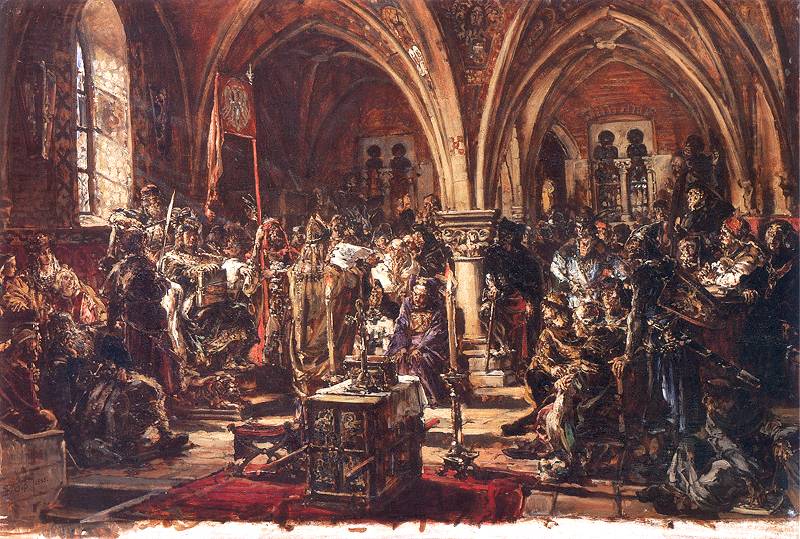
Sejm (an ancient Proto-Lechitic word meaning "gathering" or "meeting") traces its roots to the King's Councils – wiece – which gained authority during the time of Poland's fragmentation (1146-1295). The 1180 Sejm in Łęczyca (known as the 'First Polish parliament') was the most notable, in that it established laws constraining the power of the ruler. It forbade arbitrary sequestration of supplies in the countryside and takeover of bishopric lands after the death of a bishop. These early Sejms only convened at the King's behest.
Following the 1493 Sejm in Piotrków, it became a regularly convening body, to which indirect elections were held every two years. The bicameral system was also established; the Sejm then comprised two chambers: the Senat (Senate) of 81 bishops and other dignitaries; and the Chamber of Deputies, made up of 54 envoys elected by smaller local sejmik (assemblies of landed nobility) in each of the Kingdom's provinces. At the time, Poland's nobility, which accounted for around 10% of the state's population (then the highest amount in Europe), was becoming particularly influential, and with the eventual development of the Golden Liberty, the ''Sejm'''s powers increased dramatically.
Polish–Lithuanian Commonwealth
Main article: Sejm of the Polish–Lithuanian Commonwealth

The Union of Lublin in 1569, united the Kingdom of Poland and the Grand Duchy of Lithuania as one single state, the Polish–Lithuanian Commonwealth, and thus the Sejm was supplemented with new envoys from among the Lithuanian nobility. The Commonwealth ensured that the state of affairs surrounding the three-estates system continued, with the Sejm, Senate and King forming the estates and supreme deliberating body of the state. In the first few decades of the 16th century, the Senate had established its precedence over the Sejm; however, from the mid-1500s onwards, the Sejm became a very powerful representative body of the szlachta ("middle nobility"). Its chambers reserved the final decisions in legislation, taxation, budget, and treasury matters (including military funding), foreign policy, and the confirment of nobility.
The 1573 Warsaw Confederation saw the nobles of the Sejm officially sanction and guarantee religious tolerance in Commonwealth territory, ensuring a refuge for those fleeing the ongoing Reformation and Counter-Reformation wars in Europe.
Until the end of the 16th century, unanimity was not required, and the majority-voting process was the most commonly used system for voting. Later, with the rise of the Polish magnates and their increasing power, the unanimity principle was re-introduced with the institution of the nobility's right of liberum veto (Latin: "free veto"). Additionally, if the envoys were unable to reach a unanimous decision within six weeks (the time limit of a single session), deliberations were declared void and all previous acts passed by that Sejm were annulled. From the mid-17th century onward, any objection to a Sejm resolution, by either an envoy or a senator, automatically caused the rejection of other, previously approved resolutions. This was because all resolutions passed by a given session of the Sejm formed a whole resolution, and, as such, was published as the annual "constituent act" of the Sejm, e.g. the "Anno Domini 1667" act. In the 16th century, no single person or small group dared to hold up proceedings, but, from the second half of the 17th century, the liberum veto was used to virtually paralyze the Sejm, and brought the Commonwealth to the brink of collapse.
The liberum veto was abolished with the adoption of the Constitution of 3 May 1791, a piece of legislation which was passed as the "Government Act", and for which the Sejm required four years to propagate and adopt. The constitution's acceptance, and the possible long-term consequences it may have had, is arguably the reason that the powers of Habsburg Austria, Russia and Prussia then decided to partition the Polish–Lithuanian Commonwealth, thus putting an end to over 300 years of Polish parliamentary continuity. It is estimated that between 1493 and 1793, a Sejm was held 240 times, the total debate-time sum of which was 44 years.
Partitions
After the fall of the Duchy of Warsaw, which existed as a Napoleonic client state between 1807 and 1815, and its short-lived Sejm of the Duchy of Warsaw, the Sejm of Congress Poland was established in Congress Poland of the Russian Empire; it was composed of the king (the Russian emperor), the upper house (Senate), and the lower house (Chamber of Deputies). Overall, during the period from 1795 until the re-establishment of Poland's sovereignty in 1918, little power was actually held by any Polish legislative body and the occupying powers of Russia, Prussia (later united Germany) and Austria propagated legislation for their own respective formerly-Polish territories at a national level. File:Jan_Matejko_-Upadek_Polski(Reytan).jpg|Tadeusz Rejtan tries to prevent the legalisation of the first partition of Poland by preventing the members of the Sejm from leaving the chamber (1773). Painting by Jan Matejko
Congress Poland
Main article: Sejm of Congress Poland
The Chamber of Deputies, despite its name, consisted not only of 77 envoys (sent by local assemblies) from the hereditary nobility, but also of 51 deputies, elected by the non-noble population. All deputies were covered by Parliamentary immunity, with each individual serving for a term of office of six years, with third of the deputies being elected every two years. Candidates for deputy had to be able to read and write, and have a certain amount of wealth. The legal voting age was 21, except for those citizens serving in the military, the personnel of which were not allowed to vote. Parliamentary sessions were initially convened every two years, and lasted for (at least) 30 days. However, after many clashes between liberal deputies and conservative government officials, sessions were later called only four times (1818, 1820, 1826, and 1830, with the last two sessions being secret). The Sejm had the right to call for votes on civil and administrative legal issues, and, with permission from the king, it could also vote on matters related to the fiscal policy and the military. It had the right to exercise control over government officials, and to file petitions. The 64-member Senate on the other hand, was composed of voivodes and kasztelans (both types of provincial governors), Russian envoys, diplomats or princes, and nine bishops. It acted as the Parliamentary Court, had the right to control "citizens' books", and had similar legislative rights as did the Chamber of Deputies.
Germany and Austria-Hungary
In the Free City of Cracow (1815–1846), a unicameral Assembly of Representatives was established, and from 1827, a unicameral provincial sejm existed in the Grand Duchy of Poznań. Poles were elected to and represented the majority in both of these legislatures; however, they were largely powerless institutions and exercised only very limited power. After numerous failures in securing legislative sovereignty in the early 19th century, many Poles simply gave up trying to attain a degree of independence from their foreign master-states. In the Austrian partition, a relatively powerless Sejm of the Estates operated until the time of the Spring of Nations. After this, in the mid to late 19th century, only in autonomous Galicia (1861–1914) was there a unicameral and functional National Sejm, the Sejm of the Land. It is recognised today as having played a major and overwhelming positive role in the development of Polish national institutions.
In the second half of the 19th century, Poles were able to become members of the parliaments of Austria, Prussia and Russia, where they formed Polish Clubs. Deputies of Polish nationality were elected to the Prussian Landtag from 1848, and then to the German Empire's Reichstag from 1871. Polish Deputies were members of the Austrian State Council (from 1867), and from 1906 were also elected to the Russian Imperial State Duma (lower chamber) and to the State Council (upper chamber).
Second Polish Republic
After the First World War and re-establishment of Polish independence, the convocation of parliament, under the democratic electoral law of 1918, became an enduring symbol of the new state's wish to demonstrate and establish continuity with the 300-year Polish parliamentary traditions established before the time of the partitions. Maciej Rataj emphatically paid tribute to this with the phrase: "There is Poland there, and so is the Sejm".
During the interwar period of Poland's independence, the first Legislative Sejm of 1919, a Constituent Assembly, passed the Small Constitution of 1919, which introduced a parliamentary republic and proclaimed the principle of the *Sejm'''s sovereignty. This was then strengthened, in 1921, by the March Constitution, one of the most democratic European constitutions enacted after the end of World War I. The constitution established a political system which was based on Montesquieu's doctrine of separation of powers, and which restored the bicameral Sejm consisting of a chamber of deputies (to which alone the name of "Sejm" was from then on applied) and the Senate. In 1919, Roza Pomerantz-Meltzer, a member of the Zionist party, became the first woman ever elected to the *Sejm''.
The legal content of the March Constitution allowed for Sejm supremacy in the system of state institutions at the expense of the executive powers, thus creating a parliamentary republic out of the Polish state. An attempt to strengthen executive powers in 1926 (through the August Amendment) proved too limited and largely failed in helping avoid legislative grid-lock which had ensued as a result of too-great parliamentary power in a state which had numerous diametrically-opposed political parties sitting in its legislature. In 1935, the parliamentary republic was weakened further when, by way of, Józef Piłsudski's May Coup, the president was forced to sign the April Constitution of 1935, an act through which the head of state assumed the dominant position in legislating for the state and the Senate increased its power at the expense of the Sejm.
On 2 September 1939, the Sejm held its final pre-war session, during which it declared Poland's readiness to defend itself against invading German forces. On 2 November 1939, the President dissolved the Sejm and the Senate, which were then, according to plan, to resume their activity within two months after the end of the Second World War; this, however, never happened. During wartime, the National Council (1939–1945) was established to represent the legislature as part of the Polish Government in Exile. Meanwhile, in Nazi-occupied Poland, the Council of National Unity was set up; this body functioned from 1944 to 1945 as the parliament of the Polish Underground State. With the cessation of hostilities in 1945, and subsequent rise to power of the Communist-backed Provisional Government of National Unity, the Second Polish Republic legally ceased to exist. File:Dubois w Sejmie. 1-A-849-4.jpg|Stanisław Dubois speaking to envoys and diplomats in the Sejm, 1931 File:Beck przemówienie.jpg|Józef Beck, Minister of Foreign Affairs, delivers his famous Honour Speech in the Sejm, 5 May 1939.
Polish People's Republic
The Sejm in the Polish People's Republic had 460 deputies throughout most of its history. At first, this number was declared to represent one deputy per 60,000 citizens (425 were elected in 1952), but, in 1960, as the population grew, the declaration was changed: The constitution then stated that the deputies were representative of the people and could be recalled by the people, but this article was never used, and, instead of the "five-point electoral law", a non-proportional, "four-point" version was used. Legislation was passed with majority voting.
Under the 1952 Constitution, the Sejm was defined as "the highest organ of State authority" in Poland, as well as "the highest spokesman of the will of the people in town and country." On paper, it was vested with great lawmaking and oversight powers. For instance, it was empowered with control over "the functioning of other organs of State authority and administration," and ministers were required to answer questions posed by deputies within seven days. In practice, it did little more than rubber-stamp decisions already made by the Communist Polish United Workers' Party and its executive bodies. This was standard practice in nearly all Communist regimes due to the principle of democratic centralism.
The Sejm voted on the budget and on the periodic national plans that were a fixture of communist economies. The Sejm deliberated in sessions that were ordered to convene by the State Council.
The Sejm also chose a Prezydium ("presiding body") from among its members. The Prezydium was headed by the speaker, or Marshal, who was always a member of the United People's Party. In its preliminary session, the Sejm also nominated the Prime Minister, the Council of Ministers of Poland, and members of the State Council. It also chose many other government officials, including the head of the Supreme Chamber of Control and members of the State Tribunal and the Constitutional Tribunal, as well as the Ombudsman (the last three bodies of which were created in the 1980s).
When the Sejm was not in session, the State Council had the power to issue decrees that had the force of law. However, those decrees had to be approved by the Sejm at its next session. In practice, the principles of democratic centralism meant that such approval was only a formality.
The Senate was abolished by the referendum in 1946, after which the Sejm became the sole legislative body in Poland.
Third Polish Republic
After the end of communism in 1989, the Senate was reinstated as the second house of a bicameral national assembly, while the Sejm remained the first house. The Sejm is now composed of 460 deputies elected by proportional representation every four years.
Between 7 and 20 deputies are elected from each constituency using the d'Hondt method (with one exception, in 2001, when the Sainte-Laguë method was used), their number being proportional to their constituency's population. Additionally, a threshold is used, so that candidates are chosen only from parties that gained at least 5% of the nationwide vote (candidates from ethnic-minority parties are exempt from this threshold).
Image:Sejm RP.jpg|The Sejm building in Warsaw File:PolskiSejm007.jpg|The ''Sejm'''s main hall File:PolskiSejm101.jpg|Sessions chamber in the Sejm File:Sejm Plenary Hall viewed from the rostrum.JPG|Sessions chamber viewed from the rostrum Marshal's chair Sejm Plenary Hall.JPG|Marshal's chair in the sessions chamber File:Sejm cross.JPG|Sejm cross File:PolskiSejm010.jpg|Column hall in the Sejm
Historical composition of the Sejm
[[Second Polish Republic|Second Republic]] (1918–1939)
|- |
| Polish Socialist Party}}; width: 8.88%" | 35 | National Workers' Union (Poland)}}; width: 8.12%" | 32 | Polish People's Party "Left"}}; width: 3.05%" | 12 | Polish People's Party "Wyzwolenie"}}; width: 14.97%" | 59 | Polish People's Party "Piast"}}; width: 11.68%" | 46 | Polish People's Union}}; width: 8.88%" | 35 | 11 | German Minority Electoral Committee}}; width: 0.51%" | 2 | Independent politician}}; width: 1.02%" | 4 | Catholic People's Party (Poland)}}; width: 4.57%" | 18 | Christian Union of National Unity}}; width: 35.53%" | 140 |
|---|
|- | 1922 |
| Communist Party of Poland}}; width: 0.45%" | 2 | Polish Socialist Party}}; width: 9.23%" | 41 | National Workers' Party}}; width: 4.05%" | 18 | Polish People's Party "Left"}}; width: 0.45%" | 2 | Polish People's Party "Wyzwolenie"}}; width: 11.04%" | 49 | Polish People's Party "Piast"}}; width: 15.77%" | 70 | Bloc of National Minorities}}; width: 14.86%" | 66 | 18 | 5 | Independent politician}}; width: 2.25%" | 10 | Christian Union of National Unity}}; width: 36.71%" | 163 |
|---|
|- | 1928 |
| Communist Party of Poland}}; width: 1.13%" | 5 | Polish Socialist Party}}; width: 14.41%" | 64 | National Workers' Party}}; width: 2.48%" | 11 | Peasant Party (Poland)}}; width: 5.86%" | 26 | Polish People's Party "Wyzwolenie"}}; width: 9.01%" | 40 | Bloc of National Minorities}}; width: 12.39%" | 55 | 6 | 17 | Independent politician}}; width: 5.18%" | 23 | Polish Christian Democratic Party}}; width: 7.66%" | 34 | Christian Union of National Unity}}; width: 8.56%" | 38 | Nonpartisan Bloc for Cooperation with the Government}}; width: 28.15%" | 125 |
|---|
|- | 1930 |
| Communist Party of Poland}}; width: 0.90%" | 4 | Centrolew}}; width: 17.79%" | 79 | Bloc of National Minorities}}; width: 1.13%" | 5 | 7 | 21 | Independent politician}}; width: 0.45%" | 2 | Polish Christian Democratic Party}}; width: 3.15%" | 14 | Nonpartisan Bloc for Cooperation with the Government}}; width: 56.08%" | 249 | National Party (Poland)}}; width: 14.19%" | 63 |
|---|
|- | 1935 |
| Bloc of National Minorities}}; width: 12.14%" | 25 | Nonpartisan Bloc for Cooperation with the Government}}; width: 87.86%" | 181 |
|---|
|- | 1938 |
| 5 | 18 | Independent politician}}; width: 10.10%" | 21 | Camp of National Unity}}; width: 78.85%" | 164 |
|---|
|}
[[Polish People's Republic|PRL]] (1945–1989)
|- |
| Polish United Workers' Party}}; width: 25.68%" | 114 | Polish Socialist Party}}; width: 26.13%" | 116 | United People's Party (Poland)}}; width: 24.55%" | 109 | Polish People's Party "Nowe Wyzwolenie"}}; width: 1.58%" | 7 | Alliance of Democrats (Poland)}}; width: 9.23%" | 41 | Polish People's Party (1945–1949)}}; width: 6.31%" | 28 | Independent politician}}; width: 0.68%" | 3 | Labour Faction (1937)}}; width: 2.70%" | 12 |
|---|
|- | 1952 |
| Polish United Workers' Party}}; width: 64.24%" | 273 | United People's Party (Poland)}}; width: 21.18%" | 90 | Alliance of Democrats (Poland)}}; width: 5.88%" | 25 | Independent politician}}; width: 8.71%" | 37 |
|---|
|- | 1957 |
| Polish United Workers' Party}}; width: 52.07%" | 239 | United People's Party (Poland)}}; width: 25.71%" | 118 | Alliance of Democrats (Poland)}}; width: 8.50%" | 39 | Independent politician}}; width: 12.64%" | 58 | 5 |
|---|
|- | 1961 |
| Polish United Workers' Party}}; width: 55.65%" | 256 | United People's Party (Poland)}}; width: 25.43%" | 117 | Alliance of Democrats (Poland)}}; width: 8.48%" | 39 | Independent politician}}; width: 8.04%" | 37 | PAX Association}}; width: 0.65%" | 3 | 3 | 5 |
|---|
|- | 1965 |
| Polish United Workers' Party}}; width: 55.43%" | 255 | United People's Party (Poland)}}; width: 25.43%" | 117 | Alliance of Democrats (Poland)}}; width: 8.48%" | 39 | Independent politician}}; width: 7.83%" | 36 | PAX Association}}; width: 1.09%" | 5 | 3 | 5 |
|---|
|- | 1969 |
| Polish United Workers' Party}}; width: 55.43%" | 255 | United People's Party (Poland)}}; width: 25.43%" | 117 | Alliance of Democrats (Poland)}}; width: 8.48%" | 39 | Independent politician}}; width: 8.04%" | 37 | PAX Association}}; width: 1.09%" | 5 | 2 | 5 |
|---|
|- | 1972 |
| Polish United Workers' Party}}; width: 55.43%" | 255 | United People's Party (Poland)}}; width: 25.43%" | 117 | Alliance of Democrats (Poland)}}; width: 8.48%" | 39 | Independent politician}}; width: 8.04%" | 37 | PAX Association}}; width: 1.09%" | 5 | 2 | 5 |
|---|
|- | 1976 |
| Polish United Workers' Party}}; width: 56.74%" | 261 | United People's Party (Poland)}}; width: 24.57%" | 113 | Alliance of Democrats (Poland)}}; width: 8.04%" | 37 | Independent politician}}; width: 8.04%" | 37 | PAX Association}}; width: 1.09%" | 5 | 2 | 5 |
|---|
|- | 1980 |
| Polish United Workers' Party}}; width: 56.74%" | 261 | United People's Party (Poland)}}; width: 24.57%" | 113 | Alliance of Democrats (Poland)}}; width: 8.04%" | 37 | Independent politician}}; width: 6.96%; | 32 | PAX Association}}; width: 1.52%" | 7 | 5 | 5 |
|---|
|- | 1985 |
| Polish United Workers' Party}}; width: 53.26%" | 245 | United People's Party (Poland)}}; width: 23.04%" | 106 | Alliance of Democrats (Poland)}}; width: 7.61%" | 35 | Independent politician}}; width: 11.52%" | 53 | PAX Association}}; width: 1.96%" | 9 | 7 | 5 |
|---|
|- | 1989 |
| Polish United Workers' Party}}; width: 37.61%" | 173 | United People's Party (Poland)}}; width: 16.52%" | 76 | Alliance of Democrats (Poland)}}; width: 5.87%" | 27 | Solidarity Citizens' Committee}}; width: 35.00%" | 161 | PAX Association}}; width: 2.17%" | 10 | 8 | 5 |
|---|
|}
Third Republic (since 1989)
|- |
| Democratic Left Alliance (Poland)}}; width: 13.04%" | 60 | Solidarity (Polish trade union)}}; width: 5.87%" | 27 | Polish People's Party}}; width: 10.43%" | 48 | German Minority Electoral Committee}}; width: 1.52%" | 7 | 36 | Democratic Union (Poland)}}; width: 13.49%" | 62 | Polish Beer-Lovers' Party}}; width: 3.48%" | 16 | Liberal Democratic Congress}}; width: 8.04%" | 37 | Peasants' Agreement}}; width: 6.09%" | 28 | Centre Agreement}}; width: 9.57%" | 44 | Christian National Union}}; width: 10.65%" | 49 | Confederation for an Independent Poland}}; width: 10.00%" | 46 |
|---|
|- | 1993 |
| Labour Union (Poland)}}; width: 8.91%" | 41 | Democratic Left Alliance (Poland)}}; width: 37.17%" | 171 | Polish People's Party}}; width: 28.70%" | 132 | German Minority Electoral Committee}}; width: 0.87%" | 4 | Nonpartisan Bloc for Support of Reforms}}; width: 3.48%" | 16 | Democratic Union (Poland)}}; width: 16.09%" | 74 | Confederation for an Independent Poland}}; width: 4,78%" | 22 |
|---|
|- | 1997 |
| Democratic Left Alliance (Poland)}}; width: 35.65%" | 164 | Polish People's Party}}; width: 5.87%" | 27 | German Minority Electoral Committee}}; width: 0.43%" | 2 | 6 | Freedom Union (Poland)}}; width: 13.04%" | 60 | Solidarity Electoral Action}}; width: 43,70%" | 201 |
|---|
|- | 2001 |
| Self-Defence of the Republic of Poland}}; width: 11.52%" | 53 | Democratic Left Alliance (Poland)}}; width: 46.96%" | 216 | Polish People's Party}}; width: 9.13%" | 42 | German Minority Electoral Committee}}; width: 0.43%" | 2 | Civic Platform}}; width: 14.13%" | 65 | Law and Justice}}; width: 9.57%" | 44 | League of Polish Families}}; width: 8.26%" | 38 |
|---|
|- | 2005 |
| Self-Defence of the Republic of Poland}}; width: 12.17%" | 56 | Democratic Left Alliance (Poland)}}; width: 11.96%" | 55 | Polish People's Party}}; width: 5.43%" | 25 | German Minority Electoral Committee}}; width: 0.43%" | 2 | Civic Platform}}; width: 28.91%" | 133 | Law and Justice}}; width: 33.70%" | 155 | League of Polish Families}}; width: 7.39%" | 34 |
|---|
|- | 2007 |
| Democratic Left Alliance (Poland)}}; width: 11.52%" | 53 | Polish People's Party}}; width: 6.74%" | 31 | German Minority Electoral Committee}}; width: 0.22%" | 1 | Civic Platform}}; width: 45.43%" | 209 | Law and Justice}}; width: 36.09%" | 166 |
|---|
|- | 2011 |
| Democratic Left Alliance (Poland)}}; width: 5.87%" | 27 | Palikot's Movement}}; width: 8.70%" | 40 | German Minority Electoral Committee}}; width: 0.22%" | 1 | Civic Platform}}; width: 45.00%" | 207 | Polish People's Party}}; width: 6.09%" | 28 | Law and Justice}}; width: 34.13%" | 157 |
|---|
|- | 2015 |
| German Minority Electoral Committee}}; width: 0.22%" | 1 | Civic Platform}}; width: 30.00%" | 138 | Polish People's Party}}; width: 3.48%" | 16 | Modern (political party)}}; width: 6.09%" | 28 | Law and Justice}}; width: 51.09%" | 235 | Kukiz'15}}; width: 9.13%" | 42 |
|---|
|- | 2019 |
| Democratic Left Alliance (Poland)}}; width: 10.65%" | 49 | German Minority Electoral Committee}}; width: 0.22%" | 1 | Civic Platform}}; width: 29.13%" | 134 | Polish People's Party}}; width: 6.52%" | 30 | Law and Justice}}; width: 51.09%" | 235 | Confederation Liberty and Independence}}; width: 2.39%" | 11 |
|---|
|- | 2023 |
| Democratic Left Alliance (Poland)}}; width: 5.65%" | 26 | Civic Platform}}; width: 34.13%" | 157 | Polish People's Party}}; width: 14.13%" | 65 | Law and Justice}}; width: 42.17%" | 194 | Confederation Liberty and Independence}}; width: 3.91%" | 18 |
|---|
|}
Standing committees
The Sejm has several standing committees with responsibilities in particular areas. Permanent committees
- Administration and Internal Affairs
- Agriculture and Rural Development
- Constitutional Accountability
- Culture and Media
- Deputies' Ethics
- Digitization, Innovation and Modern Technology
- Economy and Development
- Education, Science and Youth
- Energy, Climate and State Assets
- Environment Protection, Natural Resources and Forestry
- European Union Affairs
- Foreign Affairs
- Health
- Infrastructure
- Justice and Human Rights
- Legislative
- Liaison with Poles Abroad
- Local Self-Government and Regional Policy
- Maritime Economy and Inland Navigation
- National and Ethnic Minorities
- National Defense
- Petition
- Physical Education and Sport
- Public Finances
- Rules and Deputies' Affairs
- Senior Policy
- Social Policy and Family
- Special Services
- State Control Extraordinary committees
- For changes in codification
- To consider draft laws regarding the right to terminate pregnancy Investigative committees
- To investigate the legality, correctness, and purposefulness of actions taken with the goal of preparing and holding the Polish Presidential Elections in 2020 in the form of postal voting
- To investigate the legality, correctness and purposefulness of actions, as well as the occurrence of abuse, neglect, and omissions regarding the legalisation of stay for foreigners within the territory of the Republic of Poland between 12 November 2019 and 20 November 2023
- To investigate the legality, correctness, and purposefulness of operational and reconnaissance activities taken among others with the use of the "Pegasus" software by the members of the council of ministers, special forces, police, tax control authorities and customs control authorities, bodies established to prosecute criminals, and the proscecutor's office between 16 November 2015 and 20 November 2023
Current standings
Notes
References
References
- "Poznaj Sejm".
- Davies, Norman. (1982). "God's Playground: A History of Poland". Columbia University Press.
- Strauss, Herbert Arthur. (1993). "Hostages of Modernization: Studies on Modern Antisemitism, 1870-1933/39". Walter de Gruyter.
- [http://libr.sejm.gov.pl/tek01/txt/kpol/e1952a-r3.html Chapter 3] of 1952 Constitution
- [http://countrystudies.us/poland/80.htm Poland: a country study]. [[Library of Congress]] Federal Research Division, December 1989.
- The Associated Press. (22 October 1992). "Romuald Bukowski; Polish Legislator, 64". The New York Times.
- Gerber, Alexandra. (2011). "Being Polish/Becoming European: Gender and The Limits of Diffusion in Polish Accession to the European Union". University of Michigan.
- Szustakiewicz, Przemysław. (2010). "Ideologia Polskiego Stronnictwa Ludowego na początku XXI wieku". Instytut Nauk Politycznych Uniwersytetu Warszawskiego.
- "Komisje stałe - Sejm Rzeczypospolitej Polskiej".
- "Komisje nadzwyczajne - Sejm Rzeczypospolitej Polskiej".
- "Komisje śledcze - Sejm Rzeczypospolitej Polskiej".
This article was imported from Wikipedia and is available under the Creative Commons Attribution-ShareAlike 4.0 License. Content has been adapted to SurfDoc format. Original contributors can be found on the article history page.
Ask Mako anything about Sejm — get instant answers, deeper analysis, and related topics.
Research with MakoFree with your Surf account
Create a free account to save articles, ask Mako questions, and organize your research.
Sign up freeThis content may have been generated or modified by AI. CloudSurf Software LLC is not responsible for the accuracy, completeness, or reliability of AI-generated content. Always verify important information from primary sources.
Report