From Surf Wiki (app.surf) — the open knowledge base
Sega development studios
Internal video game studios of Sega

Internal video game studios of Sega
This is a list of development studios owned by Sega, a Japanese video game developer and publisher based in Tokyo, Japan. Sega itself is a development studio of Sega Sammy Holdings, a company formed in 2004 after it merged with Sammy. Accompanied with the list is their history of game development. Also included are the companies that Sega has acquired over the years. For a full list of games developed and published by Sega, see List of Sega video games, List of Sega mobile games and List of Sega arcade games.
1960–1990
During the early 1960s, Sega had around 40 developers. One of the developers was Hisashi Suzuki, who previously was in charge of autodesign at Tokyu Kogyu Kurogane, he changed jobs to Sega in 1964, which then was called Nihon Goraku Bussan. As the company grew, Suzuki recalls about eight departments dedicated to development, which were arcades, arcade cabinets and consumer products. Sega rarely outsourced their games, much like Namco and Taito, as it was hard to find other companies that could do design, manufacturing, marketing and maintenance all at once.[[File:Sega Office Third.jpg|thumb|A new building for development was established in 1985.|left]]
Another early developer was Hideki Sato, who joined 1971. Sato has recalled that when he joined Sega, they were making pinball tables and electro-mechanical games, however still mainly sold jukeboxes. He became part of a development team that mainly had around 20 people. Sato was initially assigned to the part that made pinball tables, which were imported from America, but had modifications done to them so they would be more fun.
Sega at that time was owned by a foreign company and led by David Rosen. Rosen brought Pong from Atari to the Japanese offices, which impressed Sato. The developers quickly researched how games with TV's were made, and thus Sega quickly brought its first video game to market with Pong Tron in 1973. Hayao Nakayama, who later became president, joined Sega after the purchase of game distribution company Esco Trading. According to Sato, Nakayama was more than just a manager, he had helpful input into games like Monaco GP as well, as he firmly understood the business of games and that the development division is the most important part of a company.
Sega learned a lot about programming and software after purchasing Gremlin Industries in 1978, which was located in San Diego. It was because of this purchase that Sega began using printed circuit boards for games. Sega's first arcade board was the System 1, which debuted with Star Jacker. It was developed by Sato and was their first standardized arcade board; before then, each game had individually customized hardware. Sato remained in charge of all hardware aspects of Sega.
Home computers became an interest of Nakayama, as the MSX was becoming popular. Consequently, a small team of three people were involved in creating the SC-3000. The game capabilities of it were turned into the SG-1000, the first home console of Sega, which was made after Sega learned about Nintendo's plans to release the Famicom. At the same time the System 2 arcade hardware was developed, this time by hardware engineer Hiroshi Yagi. Yagi had first worked at Sega during the 1970s on early solid state-based pinball, but briefly left to work at Honda, before returning with the full approval of Sato. The new console Sega Mark III, called Sega Master System overseas, was made with the purpose that System 1 and 2 arcade games could easily be ported. It was thought that spreading home hardware while also developing more powerful arcade hardware would make players go to an actual arcade, and that this would create a virtuous cycle.
System 2 was also able to display multiple screens, a capability which was used in a horse racing medal game called Super Derby. This was useful for the development of the Sega Game Gear, which released in 1990. Since 1985, the Motorola 68000 was used in arcades, and it was modified to suit home consoles, which resulted in the Mega Drive in 1988, called Sega Genesis in North America when it released a year later. According to Sato this was when Sega began sharing the know-how between arcade and home hardware. Sega also increased the amount of female customers in arcades with the UFO Catcher, an improved type of crane game that existed before, and acquiring the Tetris license for arcades.[[File:Outrun-sit-down-cabinet.jpg|thumb|OutRun sit down cabinet|left]] In terms of software developers, Yoji Ishii joined 1978, and was involved in sound engineering on various titles like Monaco GP and Zaxxon, before being involved in the planning section working on early arcade titles like Up'n Down, Sindbad Mystery, Flicky, Teddy Boy Blues and Fantasy Zone. He also worked with Yu Suzuki on his titles later on, and then moved on to management duties. Yu Suzuki joined in 1983, and after a year of doing chores and developing Champion Boxing, he was developing big sensory cabinet games like Hang-On, Space Harrier, OutRun and After Burner. Each took about six months. According to Hisashi Suzuki, it was the environment of being able to do everything in-house that made these kind of cabinets possible.
Yuji Naka joined the company alongside Hiroshi Kawaguchi, and was part of the team that developed software for the SC-3000, the PC Division, which according to Naka had about fifteen developers. Only some games were outsourced to Compile, all the software was done in-house. Software developers were only around 50 people at most, 20 or 30 for hardware-related matters. The pace of software development was to develop one game every one to two months, Yuji Naka recalls bragging with Yu Suzuki who worked more overtime, and it was usual to work at weekends too, as they were essentially living at the company. Mark Cerny, the only foreigner in development, recalls the company was very much a sweatshop, saying "It's one programmer, one artist, three months. That's a game. The Tokyo group made about 40 games, from which about only two could be played and enjoyed". Hideki Sato said much of the same, saying that the company was lagging behind the arcade experience of the company.
Naka already had a reputation as a great programmer early on. He desired to make games that were not possible on Nintendo hardware, or to port arcade games from more powerful hardware. Examples of this include the 3D Dungeons of Phantasy Star, the Mark III version of Hokuto no Ken (overseas known as Black Belt) or ports of the arcade games Space Harrier, Super Thunder Blade and the Capcom game Ghouls 'n Ghosts. However it was the development plan of making "a game to beat Mario" that caught the attention of a superior of Naka, which started the development of Sonic the Hedgehog. The Genesis generally marked a turning point were more original software for consoles began development such as Alex Kidd in the Enchanted Castle, The Revenge of Shinobi, Phantasy Star II and Sword of Vermillion.
Early development
| Department | Headed By | Notable Titles/Products | Production & Engineering | PC Division |
|---|---|---|---|---|
| David Rosen | ||||
| Unknown |
1983–1990
| Department | Division | Headed By | Notable Titles/Products | R&D1 | R&D, | R&D2 | R&D3 | R&D4 | R&D5 | R&D6 | R&D7 | R&D8 | R&D9 | ||
|---|---|---|---|---|---|---|---|---|---|---|---|---|---|---|---|
| Hisashi Suzuki, Yoji Ishii | {{columns-list | colwidth=18em | Altered Beast* | ||||||||||||
| Mamoru Shigeta, Minoru Kanari | {{columns-list | colwidth=18em | Alex Kidd* series | ||||||||||||
| Hideki Sato | |||||||||||||||
| Unknown | |||||||||||||||
| Yu Suzuki | {{columns-list | colwidth=18em | |||||||||||||
| Unknown |
1991–1999

Yu Suzuki was the first to branch out, with his own studio called Studio 128. After that, many more departments followed, all of which had their roots in R&D1. Hisao Oguchi recalls up to six departments; according to him the environment was extremely competitive. Hisashi Suzuki often asked "what's new?" and had a desire of the development teams to be "first in the world" when looking at their game pitches. Hayao Nakayama had harsh opinions on the developers that didn't make money in the arcades, and thus supported developers like Yu Suzuki, who created many hits. Nakayama gave an order to develop a title better than Street Fighter II by Capcom*.* Namco had also paced ahead in the arcade industry with Winning Run. To catch up, Sega was motivated to move ahead in 3D graphics, and while most developers were still rooted in sprite graphics, Yu Suzuki was the only willing developer to go forward in this direction. He purchased SGI IRIS workstations from Silicon Valley to develop Virtua Racing, which in turn led to Virtua Fighter, and both satisfied Nakayama's expectations. In collaboration with GE, the Sega Model 2 and Sega Model 3 arcade hardware was made possible, and produced further games with very advanced graphics such as Daytona USA, building on newer AM2 hire Toshihiro Nagoshi's previous experience directing Virtua Racing. Multiplayer action and sports titles were also made possible with Virtua Striker, Virtua Cop and SpikeOut.

On the opposite trend, Hisao Oguchi of AM3, which broke away from AM1 following AM2's success, was aiming to make games for couples, as well as aiming for a "cool" rather than otaku-like feel. AM3 developer Mie Kumagai, who later garnered attention later on as a female manager of a development department, shared this sentiment, believing "the future of arcades cannot be boys only". Rail Chase, Jurassic Park, Jambo! Safari, Top Skater and a variety of sports games such as Virtua Tennis, were part of this direction. However, most of the income at arcades in Japan still came from core players rather than casuals, with AM3 scoring one of its biggest hits in the form of Virtual On: Cyber Troopers. AM3 also succeeded by establishing Tetsuya Mizuguchi and Kenji Sasaki in game development at Sega on the acclaimed Sega Rally Championship; they had both previously made ride films for Sega's large AS-1 motion simulator, and broke off into their very own unit, AM Annex, following the popularity of Rally (a benefit similarly given to Nagoshi for SpikeOut). After their success with UFO Catcher prize games and Tetris, Sega's next hit in the arcade market with women ultimately came in the Print Club photo booths, co-developed by the arcade cabinet team AM4 with Atlus. This established purikura in Japan.
Sega's arcade hardware development side additionally grew, with teams splitting off from the existing AM4 department in a similar way to AM2 and AM3. These included AM5, whose personnel at first originated a line of kiddie rides with monitors, but went on to instead make large scale attractions for Sega's attempts at the theme park business with Joypolis, SegaWorld London and Sega World Sydney, led by Nakayama in another effort to compete with Namco, as well as Disney. Building off of the motion base of the AS-1 simulator, their attractions included the VR-1, an early example of Virtual Reality made with support from AM4, 3, and Virtuality. Masao Yoshimoto, who joined in 1987, and developed the R360 among many other arcade cabinets, recalled this period as the golden age of Sega, when both advanced graphics and big motion sensitive simulators such as the ones for Manx TT Superbike and WaveRunner were made possible.
Putting to use what Naka learned by porting Ghouls 'n Ghosts to the Genesis, he went on to develop Sonic the Hedgehog, along with artist Naoto Ohshima and designer Hirokazu Yasuhara. Sonic had a much bigger development period than other Sega games at the time, with Mark Cerny recalling it having ten months development time, and three core developers instead of two. Naka himself worked on it for one year and a half, and did not work on any other games in the meantime, in contrast to the frequent releases he had before. Sega of America marketing strategies made Sonic the Hedgehog a success for Sega, causing them to have 61% market share in North America with their Genesis consoles. Naka quit Sega due to him feeling that he did not get enough appreciation for his work on Sonic, but then was invited by Mark Cerny to join his development group, the Sega Technical Institute, and he along with ten other developers went to Sega of America and developed the sequels Sonic 2, Sonic 3 and Sonic & Knuckles. In addition to STI, Sega Interactive, Sega Midwest Studio and Sega Multimedia Studio were other studios that Sega of America established at this time, though their game development never progressed to the same capacity as Japan.
As part of a concerted effort by Hayao Nakayama to supply the Mega Drive with more quality software funded by Sega, Japanese game development also expanded externally with second party studios such as SIMS, which was previously Sanritsu, Treasure, which consisted of ex-Konami developers and debuted with the highly praised Gunstar Heroes, and Sonic Software Planning!, which often worked with Climax Entertainment. Other worldwide successes developed by the inhouse Japanese development group were Streets of Rage II and Phantasy Star IV which were appreciated in all parts of the world.
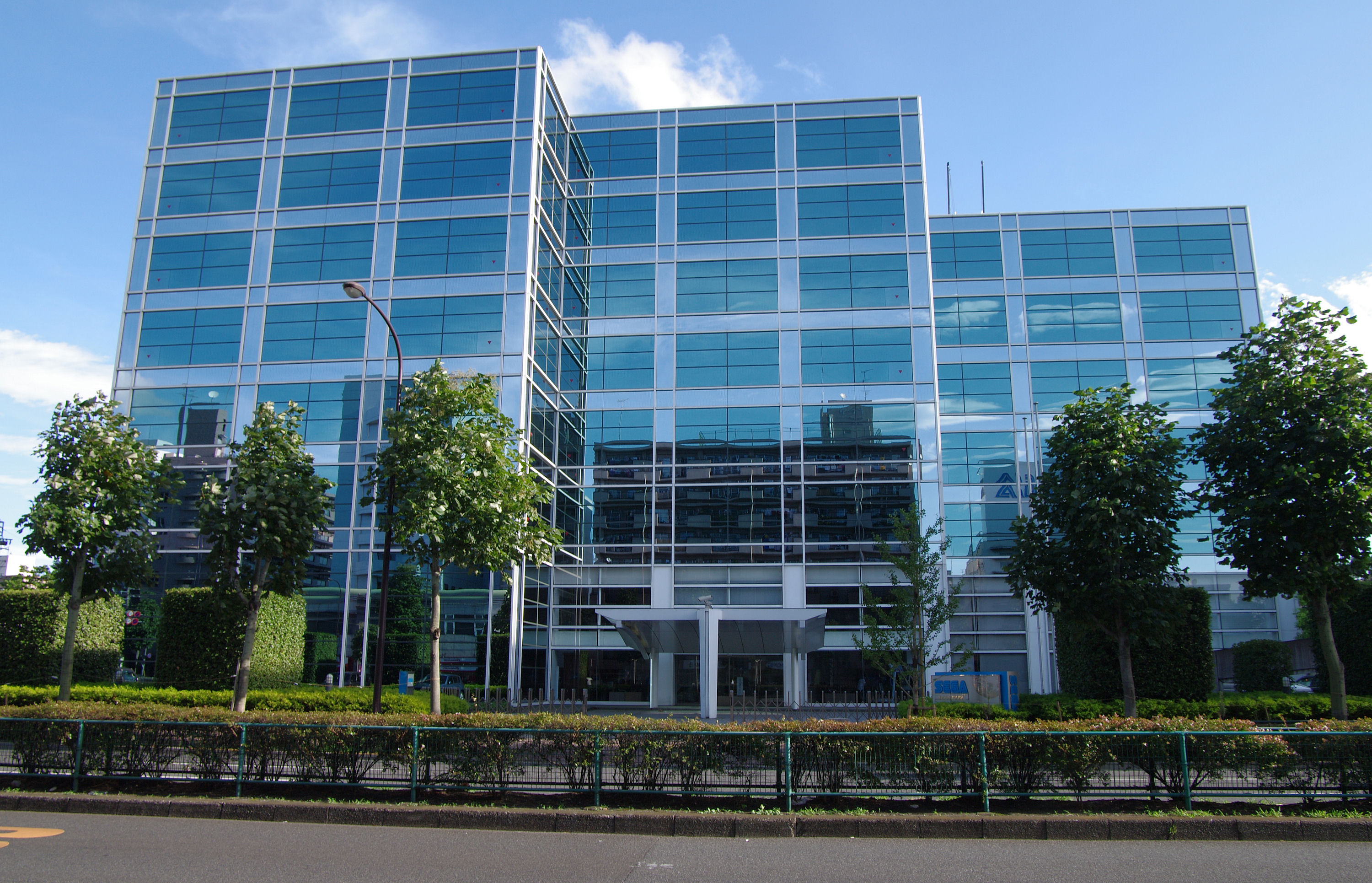
The Mega CD was developed to get ahead in Japan, as the PC Engine was more popular and also had a CD drive. According to hardware developer Masami Ishikawa, Sega was able to increase performance and storage capacity, and thus became able to release better RPGs on it. The most famous title for the Mega CD was Sonic CD, developed in Japan without the involvement of Yuji Naka, although ideas were exchanged. CD was mainly developed by Naoto Ohshima, alongside staff gathered from all over Sega, many of them young. RPGs remained the most popular on consoles in Japan, and Game Arts' works were an important asset for Sega; however, those games as well as Sega's own Shining and Phantasy Star series were unable to truly compete with Dragon Quest, Final Fantasy and Ys I&II. This later led to their use of Virtua Fighter to create an RPG, since it was Sega's most popular IP in Japan, with the project eventually becoming Shenmue.
Being behind on console in Japan motivated Sega to put resources into the Sega Saturn. The development team of the Saturn was the same that developed the System 32 arcade board. Sato regrets that he did not go with the Model 1 arcade hardware as a base, as he was too concerned of leaving all the developers behind that were focused on sprites rather than 3D, which were still the majority of developers outside of AM2. At one time Sega were supporting five different console hardwares, with the first and second CS departments focusing on Sega Saturn, the third and fourth on the Mega Drive as well as 32X and Mega CD. A fifth development department existed for Game Gear development and a sixth department existed for RPG's. Another department of about 40 people dedicated to porting games to PC was also established, as Windows 95 became widespread in Japan. Including overseas staff and arcade developers, over 1000 developers were engaged in development at Sega.
Sega Saturn projects were much larger in comparison to other teams at the time, scaling up from the five or ten people involved in Master System or Genesis games. An early large project was Panzer Dragoon, for which 30 people were involved. Yoji Ishii was transferred from arcade to console development by Nakayama in 1993, and many others from the arcades followed, making it up to several hundred developers involved in Sega Saturn software development. AM2 created a development environment for the Saturn, called the Sega Graphic Library, due to the console being difficult to make games for out of the box. Early on, the 3D capabilities were not shown off well with a lacking port of Daytona USA as well as Clockwork Knight, which was mainly 2D. By 1995, the Saturn could compete very well with PlayStation in Japan with ports of Virtua Fighter 2, Virtua Cop and Sega Rally Championship. Particularly Virtua Fighter 2 became the first million-seller for Sega in Japan. RPG's like Sakura Wars, Magic Knight Rayearth and Dragon Force, anime license games such as Neon Genesis Evangelion and sports games also did very well in Japan. Yuji Naka returned to Japan and wanted to develop 3D games, after being sent videotapes of the games that Yu Suzuki was developing. Naka had no desire to develop for the Sega 32X, which was mainly spearheaded by Sega of America.
Game producer Takayuki Kawagoe called the line-up for the 32X quite weak, as games like Knuckles Chaotix were previously just 16-bit titles, but praised the original titles such as Metal Head. Naka, along with Naoto Ohshima developed NiGHTS Into Dreams and Burning Rangers, with the latter not having as much involvement from Naka. Much like how Sonic was made to succeed in America, NiGHTS was made to succeed in Europe, although that was the desire by the development team, rather than marketing. According to manager Hisashi Suzuki, the turning point was the release of Final Fantasy VII. It and the influence of Dragon Quest was far too great for Sega to overcome. It did not only influence the fortune of Sega in console development, but also the relevancy of arcades was put into question as well, with Fighters Megamix only being made for Saturn against a tight Christmas 1996 deadline to capitalize on a delay in its development. To combat Final Fantasy VII, Team Andromeda, the team behind Panzer Dragoon was instructed to develop an RPG, which was Panzer Dragoon Saga.
At the time, Sega was involved with Vivendi and Universal on GameWorks, and thus had a connection to Steven Spielberg, who visited the Sega offices and saw the prototype of Shenmue, which was something that he was very impressed with. This caused Sega management to further support it. However, according to Hisashi Suzuki this meant Yu Suzuki leaving the arcade business to develop console projects, and no one was able to tame Yu Suzuki, which meant that the project went out of control. Shenmue went over budget and was rumored to have cost Sega over $50 million.[[File:Mega Drive II (PAL) + Mega-CD II (PAL) + 32X (PAL).png|thumb|Sega Genesis with all add-ons attached]]Isao Okawa, the chairman of CSK, which was the parent company of Sega, said "let's try one more time", in regard to Sega hardware. Sonic Adventure, Virtua Fighter 3, an early version of Skies of Arcadia and Shenmue moved from Saturn to the new Dreamcast and in-house development for Sega Saturn completely halted in 1998. The NAOMI arcade hardware was developed to make porting titles to the Dreamcast without loss of quality. Therefore, home and arcade hardware became equal. Isao Okawa personally instructed Yuji Naka, to create an online game for the new Dreamcast. Experiments with online functionality goes back to the Mega Modem of the Genesis. Naka released Chu Chu Rocket as a test for the online capabilities for the Dreamcast. The turnover of staff was the largest at Sega since 1986, as staff began to establish new companies such as Artoon. Visual Concepts was acquired by Sega of America to develop sports titles, while No Cliche was established by Sega Europe.
1991–1995
| Department | Division | Members From | Headed by | Notable Titles/Products | AM1 | Amusement R&D, | AM2 | AM3 | AM4 | AM5 | AM6 | AM7 | CS1 | Consumer R&D, | CS2 | CS3 | CS4 | CS5 | RPG Production | Sega Technical Institute | Sega of America | ||||||||
|---|---|---|---|---|---|---|---|---|---|---|---|---|---|---|---|---|---|---|---|---|---|---|---|---|---|---|---|---|---|
| Sega R&D1 | Rikiya Nakagawa | {{columns-list | Golden Axe: The Revenge of Death Adder* | ||||||||||||||||||||||||||
| Studio 128 | Yu Suzuki | {{columns-list | Virtua Cop* series | ||||||||||||||||||||||||||
| Sega R&D1 | Hisao Oguchi | {{columns-list | Manx TT Superbike* | title=ヒットメーカー(旧AM3研)の開発してきたゲームタイトルの一覧です | trans-title=This is a list of game titles developed by Hitmaker (formerly AM3 Lab) | language=ja | website=Hitmaker WEB | url=http://www.hitmaker.co.jp/site/comphistory.html | url-status=dead | archive-url=https://web.archive.org/web/20040610032406/http://www.hitmaker.co.jp/site/comphistory.html | archive-date=10 June 2004}} | ||||||||||||||||||
| Sega R&D4, | |||||||||||||||||||||||||||||
| Sega R&D5 | Masao Yoshimoto | url=https://retrocdn.net/images/8/87/Sega_Magazine_JP_Issue_09_199709.pdf | title=SEGA Magazine | language=Japanese | date=1997 | archive-url=https://web.archive.org/web/20250126051940/https://retrocdn.net/images/8/87/Sega_Magazine_JP_Issue_09_199709.pdf | archive-date=26 January 2025 | url-status=live}} | |||||||||||||||||||||
| Tokinori Kaneyasu | date=2021-05-07 | title=『むかしセガ・エンタープライゼスという会社があった』 (4) - テーマパーク VR アトラクション のトリビア。歪珠から近未来 | work=goo blog | url=https://blog.goo.ne.jp/lemon6868/e/964683a1754808ef332712561e51b4c0 | access-date=2025-01-05 | archive-url=https://web.archive.org/web/20210507020520/https://blog.goo.ne.jp/lemon6868/e/964683a1754808ef332712561e51b4c0 | archive-date=7 May 2021 }} | ||||||||||||||||||||||
| Tomoji Miyamoto | date=October 1, 1994 | title=パワーあふれるAMチームはセガサターンの強い味方!! | trans-title=The Powerful AM teams are strong allies of the Sega Saturn! | url=https://retrocdn.net/images/2/21/BeepMD_JP_1994-10.pdf | access-date=March 26, 2025 | magazine=Beep! MegaDrive | page=94 | issue=118}} | |||||||||||||||||||||
| Unknown | |||||||||||||||||||||||||||||
| Sega R&D2, | |||||||||||||||||||||||||||||
| Sega R&D6 | Makoto Oshitani, | ||||||||||||||||||||||||||||
| Yoji Ishii | |||||||||||||||||||||||||||||
| Hiroshi Aso, | |||||||||||||||||||||||||||||
| Makoto Oshitani | |||||||||||||||||||||||||||||
| Koichi Nagata | |||||||||||||||||||||||||||||
| Motoshige Hokoyama | |||||||||||||||||||||||||||||
| Tomio Takami | |||||||||||||||||||||||||||||
| Yuji Naka |
1996–1999
| Department | Division | Members From | Headed By | Notable Titles/Products | AM1 | Amusement R&D, | AM2 | AM3 | AM4 | AM5 | AM11 | AM Annex/AM12 | CS1 | Consumer R&D, | CS2 | CS3 | CS4 | Sega PC | Sega Digital Studio | AM1 (US Team) | Sega of America | ||
|---|---|---|---|---|---|---|---|---|---|---|---|---|---|---|---|---|---|---|---|---|---|---|---|
| Same | Rikiya Nakagawa | {{columns-list | Harley Davidson & L.A. Riders* | ||||||||||||||||||||
| Yu Suzuki | {{columns-list | Fighters Megamix* | |||||||||||||||||||||
| Hisao Oguchi | {{columns-list | Decathlete* | |||||||||||||||||||||
| Masao Yoshimoto | |||||||||||||||||||||||
| Tokinori Kaneyasu | |||||||||||||||||||||||
| Sega AM2 | Toshihiro Nagoshi | ||||||||||||||||||||||
| Sega AM3 | Tetsuya Mizuguchi | {{columns-list | Sega Rally 2* | ||||||||||||||||||||
| Makoto Oshitani | {{columns-list | Dragon Force* | |||||||||||||||||||||
| Noriyoshi Oba | {{columns-list | Atsumare! Guru Guru Onsen* | |||||||||||||||||||||
| Yuji Naka | {{columns-list | Burning Rangers* | |||||||||||||||||||||
| Tetsuya Mizuguchi | |||||||||||||||||||||||
| New | Hiroyuki Okata | ||||||||||||||||||||||
| New | Yukifimi Makino | ||||||||||||||||||||||
| Sega AM1 | Roger Hector, | ||||||||||||||||||||||
| Makoto Uchida | title=SEGA VOICE | url=https://www.sega.jp/fb/segavoice/050120/01.html | access-date=2023-11-25 | website=www.sega.jp}} |
2000–2004
.jpg)
Sega's software development teams were split off into separate companies on April 21, 2000. Each were headed by their own president with their own philosophies, and they were responsible for their own finances. A year later, Sega officially announced their withdrawal from the console hardware market on January 31, 2001, to develop games for other hardware. All the different companies established supported different consoles after ending support for the Dreamcast, with the Xbox being supported by WOW Entertainment, Hitmaker and Smilebit, the GameCube being supported by Sonic Team and Amusement Vision and the PlayStation 2 being supported by Overworks, AM2, United Game Artists and Smilebit. Tetsuya Mizuguchi, head of United Game Artists, saw this initially as a move of Sega of being more similar to Hollywood, where distribution and development were becoming more and more separated. Toshihiro Nagoshi recalls this period as labour of love from Sega, "teaching the creatives the way of managing a business". Hisao Oguchi who lead Hitmaker, however, had a suspicion that this structure was made to ultimately separate the creators who were able to make profit and the ones who didn't, as they were many projects that didn't hit the mark, and at one point Sega was hiring hundreds of developers a year, effecting costs that were no longer manageable. Nonetheless, journalists praised the innovation of Sega's titles during this period as a "brief moment of remarkable creativity*. Dreamcast games Rez, Jet Set Radio and *Shenmue'' are considered as some of the best games of all time.

In the end, Yuji Naka, who lead Sonic Team, was considered to be the most successful in home software development, with Oguchi at Hitmaker being the arcade counterpart. Sonic Team produced the high selling Sonic games and Phantasy Star Online, which won several awards within the Japanese game industry*.* Hitmaker originated the successful genre of card-based arcade games in Japan, which started with Derby Owners Club's support for game progression via IC cards, and continued with World Club Champion Football, which advanced the concept with a flat panel reader and library of cards for football players, giving it the added dimension of trading, among other titles like The Key of Avalon.
The card concept was subsequently adopted by other Sega teams for arcade games, with AM2 integrating IC card based progression into Virtua Fighter 4 alongside additional early support for internet infrastructure under Hiroshi Kataoka, whilst the Mirai R&D department (headed by former Joypolis attraction developer Hiroshi Uemura) made the child-focused trading card titles Mushiking: The King of Beetles and Love & Berry: Dress up and Dance!. Mushiking and Love & Berry particularly supported Sega with very strong sales in the Japanese market. Experiments with using cards to take with you, go back to the Sega Card format that was developed in the 80's, but ended up being used as a cartridge format for home consoles only.
Amusement Vision, led by Toshihiro Nagoshi, was not very involved with Dreamcast games, however landed a hit with Super Monkey Ball on the Nintendo GameCube and was involved with Nintendo management when dealing with them for the development of F-Zero GX. Nagoshi observed Nintendo management from the bottom all the way to the top, and was very surprised with how uniform the opinions at the company were, saying "no wonder we lost!". This activity also made him very favourable for a management position within Sega. However, Nagoshi saw himself as sort of an in-between of Oguchi and Naka, and not on the same level as them.
Sega did not make any further custom hardware on its own after the Sega Hikaru arcade board, however many tenured engineers continued to work on Sega arcade technologies such as its card systems, internet infrastructure and future arcade boards such as the Xbox-based Chihiro. Many hardware developers also joined pachinko and pachislot company Sammy Corporation, who soon merged with Sega. Hideki Sato pushed for leftover Dreamcast parts being used as displays in the machines that Sammy develops, including the very successful Fist of the North Star pachinko machines.
In 2003, Oguchi became president of Sega, and multiple studios were merged into another, as several developers left Sega during the era of spinning off their development studios. These included Rikiya Nakagawa from WOW Entertainment (which took on Overworks) and Mizuguchi from United Game Artists (which merged into Sonic Team). Though responsible for the successful Initial D: Arcade Stage, Sega Rally director Kenji Sasaki's studio Sega Rosso was also merged, returning to AM3 successor Hitmaker; Sasaki left Sega by 2005 to form his own independent studio Bitster, and went on to collaborate with Sega again in subsequent decades. Yu Suzuki departed AM2 to form his own studio, Digital Rex, but within Sega. The development studios merged back into Sega on July 1, 2004.
Visual Concepts was sold to Take Two Interactive in 2005.
2000–2002
| Studio | Division | Members From | Headed By | Notable Titles | WOW Entertainment Inc. | R&D Holdings, | Sega AM2 Co., Ltd./AM2 of CRI | Hitmaker Co., Ltd. | Amusement Vision Ltd. | Sega Rosso Co., Ltd. | Smilebit Corporation | Overworks Ltd. | Sonic Team Ltd. | United Game Artists Co., Ltd. | Wave Master Inc. | Sega Mechatro | Mirai R&D | Sonic Team USA | Sega of America | WOW Entertainment (US Team) | |||||||
|---|---|---|---|---|---|---|---|---|---|---|---|---|---|---|---|---|---|---|---|---|---|---|---|---|---|---|---|
| Sega AM1 R&D | Rikiya Nakagawa | {{columns-list | colwidth=18em | Sega GT* series | title=Sega's new beginning | url=https://retrocdn.net/images/9/9f/Edge_UK_089.pdf | access-date=22 August 2017 | magazine=Edge | pages=68–78 | number=89}} | |||||||||||||||||
| Same as before | Yu Suzuki | {{columns-list | colwidth=18em | Shenmue* series | date=2004-06-30 | title=SEGA-AM2 | url=http://www.sega-am2.co.jp/ | access-date=2025-01-06 | archive-url=https://web.archive.org/web/20040630040721/http://www.sega-am2.co.jp/ | archive-date=30 June 2004 }} | |||||||||||||||||
| Sega AM3 R&D | Hisao Oguchi | {{columns-list | colwidth=18em | Crazy Taxi* series | date=2004-06-29 | title=Hitmaker WEB | url=http://www.hitmaker.co.jp/site/index.html | access-date=2025-01-06 | archive-url=https://web.archive.org/web/20040629001328/http://www.hitmaker.co.jp/site/index.html | archive-date=29 June 2004 }} | |||||||||||||||||
| Sega AM11 R&D | Toshihiro Nagoshi | {{columns-list | colwidth=18em | Daytona USA 2001* | date=2004-06-29 | title=AMUSEMENT VISION | url=http://www.amusementvision.com/ | access-date=2025-01-06 | archive-url=https://web.archive.org/web/20040629025229/http://www.amusementvision.com/ | archive-date=29 June 2004 }} | |||||||||||||||||
| Sega AM12 R&D | Kenji Sasaki | {{columns-list | colwidth=18em | Cosmic Smash* | date=2003-09-22 | title=+++ SEGAROSSO.COM +++ | url=http://www.segarosso.com/ | access-date=2025-01-06 | archive-url=https://web.archive.org/web/20030922214245/http://www.segarosso.com/ | archive-date=22 September 2003 }} | |||||||||||||||||
| Sega PC | Shun Arai | {{columns-list | colwidth=18em | Pro Soccer Club o Tsukurou! * | date=2004-06-09 | title=株式会社スマイルビット | url=http://www.smilebit.com/index.html | access-date=2025-01-06 | archive-url=https://web.archive.org/web/20040609212523/http://www.smilebit.com/index.html | archive-date=9 June 2004 }} | |||||||||||||||||
| CS2 | Noriyoshi Oba | {{columns-list | colwidth=18em | date=2003-04-16 | title=OverWorks Official Web Site | url=http://www.o-works.co.jp/owshp/pc.html | access-date=2025-01-06 | archive-url=https://web.archive.org/web/20030416153901/http://www.o-works.co.jp/owshp/pc.html | archive-date=16 April 2003 }} | ||||||||||||||||||
| Same as before | Yuji Naka | {{columns-list | colwidth=18em | Phantasy Star Online* | date=2002-08-02 | title=SONICTEAM | url=http://www.sonicteam.com/index.html | access-date=2025-01-06 | archive-url=https://web.archive.org/web/20020802162347/http://www.sonicteam.com/index.html | archive-date=2 August 2002 }} | |||||||||||||||||
| New | Tetsuya Mizuguchi | {{columns-list | colwidth=18em | date=2003-04-04 | title=United Game Artists home | url=http://www.u-ga.com/jp/home/index.html | access-date=2025-01-06 | archive-url=https://web.archive.org/web/20030404043155/http://www.u-ga.com/jp/home/index.html | archive-date=4 April 2003 }} | ||||||||||||||||||
| New | Yukifimi Makino | ||||||||||||||||||||||||||
| AM4 + AM6 | Tomoji Miyamoto | title=StarHorse 公式サイト | trans-title=Official site of StarHorse | language=ja | url=http://www.sega-mechatro.com/ | access-date=2025-01-06 | archive-url=https://web.archive.org/web/20090926232128/http://www.sega-mechatro.com/ | archive-date=2009-09-26}} | |||||||||||||||||||
| AM5 | Hiroshi Uemura | ||||||||||||||||||||||||||
| Sonic Team Ltd. | Takashi Iizuka | date=2001-06-04 | title=Interview With Sonic Adventure 2 Director Takashi Iizuka | website=IGN | url=https://www.ign.com/articles/2001/06/04/interview-with-sonic-adventure-2-director-takashi-iizuka | access-date=2025-01-07}} | |||||||||||||||||||||
| AM1, WOW Entertainment Inc. | Makoto Uchida |
2003–2004
| Department | Division | Members From | Headed By | Notable Titles | Sega WOW Inc. | R&D, | Sega AM2 Co., Ltd. | Digital Rex Co., Ltd. | Hitmaker Co., Ltd. | Amusement Vision Ltd. | Smilebit Corporation | Sonic Team Ltd. | Wave Master Inc. | Sega Mechatro | Mirai R&D | Sonic Team USA | Sega of America | |||||||
|---|---|---|---|---|---|---|---|---|---|---|---|---|---|---|---|---|---|---|---|---|---|---|---|---|
| WOW Entertainment Inc. | Rikiya Nakagawa | {{columns-list | colwidth=18em | Dragon Treasure* | date=2004-06-02 | title=SEGA WOW INC. | url=http://www.segawow.com/index.shtml | access-date=2025-01-07 | archive-url=https://web.archive.org/web/20040602234209/http://www.segawow.com/index.shtml | archive-date=2 June 2004 }} | ||||||||||||||
| Same as before | Hiroshi Kataoka | {{columns-list | colwidth=18em | Quest of D* series | ||||||||||||||||||||
| Sega AM2 Co., Ltd. | Yu Suzuki | |||||||||||||||||||||||
| Hitmaker Co., Ltd. | Mie Kumagai | {{columns-list | colwidth=18em | Avalon no Kagi* series | ||||||||||||||||||||
| Amusement Vision Ltd. | Toshihiro Nagoshi | {{columns-list | colwidth=18em | F-Zero GX* | ||||||||||||||||||||
| Amusement Vision Ltd. | Takayuki Kawagoe | {{columns-list | colwidth=18em | Pro Soccer Club o Tsukurou! * | ||||||||||||||||||||
| Sonic Team Ltd. | Yuji Naka | {{columns-list | colwidth=18em | Billy Hatcher and the Giant Egg* | ||||||||||||||||||||
| Same | Yukifimi Makino | |||||||||||||||||||||||
| Same | Masao Yoshimoto | |||||||||||||||||||||||
| Same | Hiroshi Uemura | |||||||||||||||||||||||
| Same | Takashi Iizuka |
2005–2008
.jpg)
In 2005 a new structure of game development was announced, after Sega became a subsidiary of Sega Sammy Holdings, and was under new management, with Hajime Satomi from Sammy Corporation at the top. The Consumer Business Group Division contained the Global Entertainment R&D and New Entertainment R&D departments, which all together were divided into six departments, each focusing on something different, such as network, sports, cinematic and character based games. Particularly the Yakuza / Like a Dragon games by the New Entertainment department already became a franchise for Sega in 2006, and they were motivated to develop it into a character brand similarly to Sonic the Hedgehog, Mushiking and Love & Berry. According to the now former manager Hisashi Suzuki, the Like a Dragon series was only possible due to the experience of Shenmue, and it also inherited elements of the SpikeOut arcade games. Next generation console development with PlayStation 3 exclusives Ryū ga Gotoku Kenzan! by NE and Valkyria Chronicles by GE2, and the multi-platform Sonic the Hedgehog 2006 by Sonic Team, also became a focus. Later, developer Takashi Iizuka admitted that Sonic Team had prioritized shipping games over quality during this period, resulting into several poorly received games in the Sonic the Hedgehog series. Sega also showcased the Lindbergh arcade board along with Virtua Fighter 5 and Virtua Tennis 3, both of which were ported to PlayStation 3 soon after. Sega Europe president Mike Hayes said that Japanese origin IP became less popular around 2004, with Sega of America president Simon Jeffery showing a similar sentiment. Specifically there was motivation to be seen less like just like another Japanese company by Sega of America, with them being more picky what to bring over from the Japanese studios since 2005. This was a conscious decision on Japanese management.[[File:Initial D Arcade Stage 8 Infinity Japanese cabinet.jpg|thumb|The Initial D arcade game series is successful in Japan, but did not appeal as much to the western arcade market.]]Tastes for arcade games changed on both sides of the world, with Masao Yoshimoto saying that potential new employees mentioned in interviews that the newer arcade games with flat panel card readers are their reason for joining Sega, rather than machines like the R360. Large driving game cabinets became less appealing to the Japanese youth, whilst retaining some success overseas. Western arcades became focused on casual players, while core players remained in Asia. This motivated Sega to establish a development base to develop games that better suited the Western markets, housed within sales subsidiary Sega Amusements Europe. Trading card arcade games continued to be successful for Sega in Japan, with the latest example being Sangokushi Taisen, being developed by developers previously engaged in console games such as Sakura Wars. The Nintendo DS versions of kids arcade games Mushiking, Love & Berry and Dinosaur King were released, and particularly Love & Berry was successful as it became the first million-seller for Sega in Japan since Virtua Fighter 2.
Yuji Naka left during this period in 2006, with Yu Suzuki following in 2011, in the wake of his second post-AM2 studio, AM Plus, disbanding after producing only one title that made it to market (Sega Race TV).
| Department | Division | Members From | Headed by | Notable Titles | GE1 (includes | Consumer R&D, | GE2 | GE3 (includes | NE | Sports Design | AM1 | Amusement R&D, | AM2 | AM3 | AM Plus | Family Entertainment | Products | Sega Amusement Europe | Sega Studios Shanghai | Sega of China | Sega Studio USA | Sega of America | |||||||
|---|---|---|---|---|---|---|---|---|---|---|---|---|---|---|---|---|---|---|---|---|---|---|---|---|---|---|---|---|---|
| Sonic Team | Akinori Nishiyama | {{columns-list | Puyo Puyo* series | ||||||||||||||||||||||||||
| Sega WOW | Akira Nishino | ||||||||||||||||||||||||||||
| Sonic Team | Takao Miyoshi | {{columns-list | colwidth=18em}} | ||||||||||||||||||||||||||
| Amusement Vision | Toshihiro Nagoshi | {{columns-list | Super Monkey Ball* series | ||||||||||||||||||||||||||
| Smilebit | Takaya Segawa | {{columns-list | Pro Soccer Club o Tsukurou! * series | ||||||||||||||||||||||||||
| Sega WOW | Yasuhiro Nishiyama | {{columns-list | Answer X Answer* series | ||||||||||||||||||||||||||
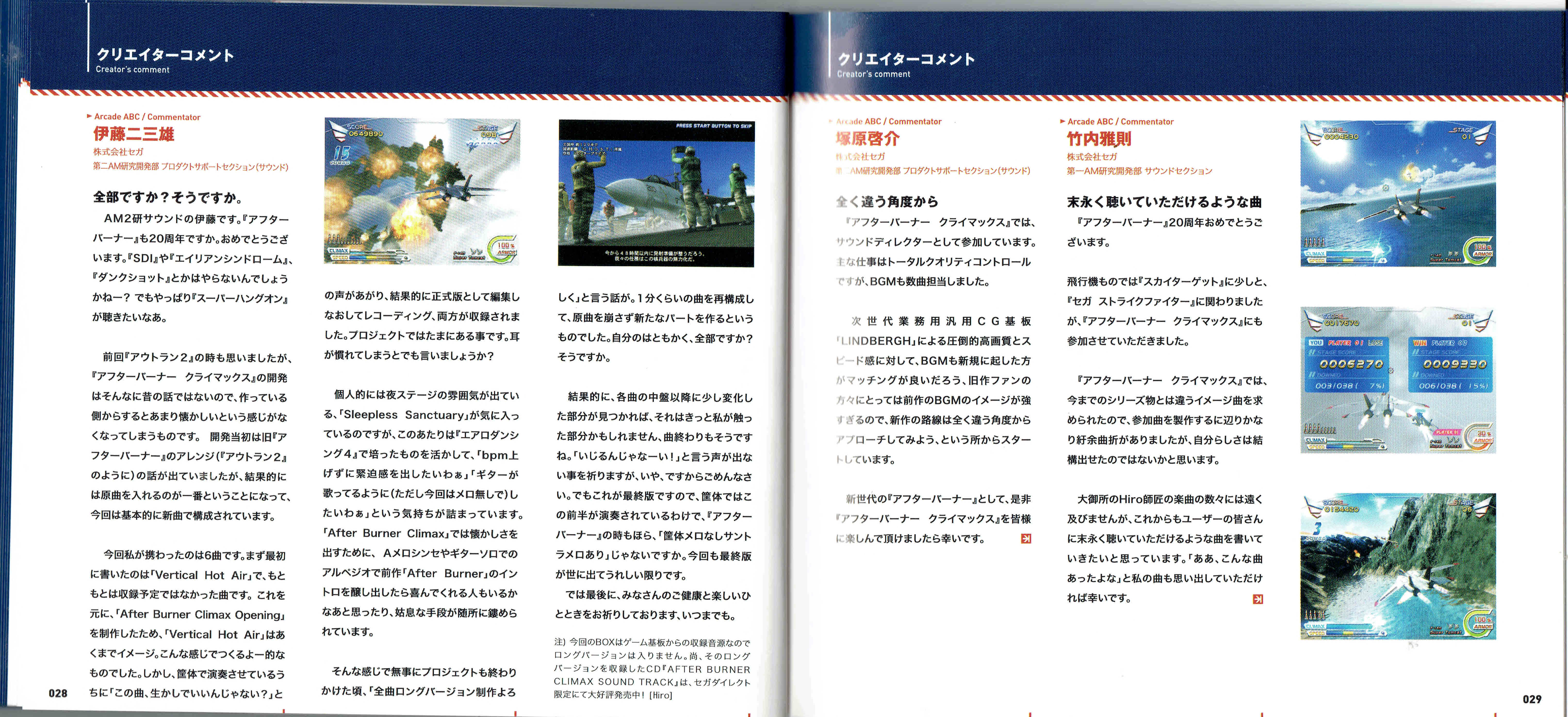
| Sega-AM2 | Hiroshi Kataoka | {{columns-list | After Burner Climax* | ||||||||||||||||||||||||||
| Hitmaker | Mie Kumagai | {{columns-list | Initial D Arcade Stage* series | ||||||||||||||||||||||||||
| Sega-AM2 | Yu Suzuki | url=https://ircms.irstreet.com/contents/data_file.php?template=39&brand=93&folder_contents=11197&src_data=39764&filename=pdf_file.pdf | title=当社子会社(株式会社セガ)の人事異動および組織変更に関するお知らせ | date=31 March 2005 | publisher=SEGA | website=ircms.irstreet.com | archive-url=https://web.archive.org/web/20240429160111/https://ircms.irstreet.com/contents/data_file.php?template=39&brand=93&folder_contents=11197&src_data=39764&filename=pdf_file.pdf | archive-date=29 April 2024 | url-status=live}} | ||||||||||||||||||||
| Mirai R&D | Hiroshi Uemura | ||||||||||||||||||||||||||||
| Sega Mechatro | Masao Yoshimoto | ||||||||||||||||||||||||||||
| Cardiff R&D | Patrick Michael | url=https://segaretro.org/images/c/cf/SegaAmusements_Catalogue_EAG_2011.pdf | title=SEGA Amusement Catalogue | publisher=SEGA | archive-url=https://web.archive.org/web/20250107094540/https://segaretro.org/images/c/cf/SegaAmusements_Catalogue_EAG_2011.pdf | archive-date=7 January 2025 | url-status=live}} | ||||||||||||||||||||||
| Sega WOW | Makoto Uchida | ||||||||||||||||||||||||||||
| Sonic Team USA | Takashi Iizuka | date=2023-11-18 | title=ソニックチャンネル/クリエイターズ インタビュー/003:榊原 武 | url=http://sonic.sega.jp/SonicChannelOld/creators/003/002.html | access-date=2025-01-07 | archive-url=https://web.archive.org/web/20231118163018/http://sonic.sega.jp/SonicChannelOld/creators/003/002.html | archive-date=18 November 2023 }} |
2009–2017

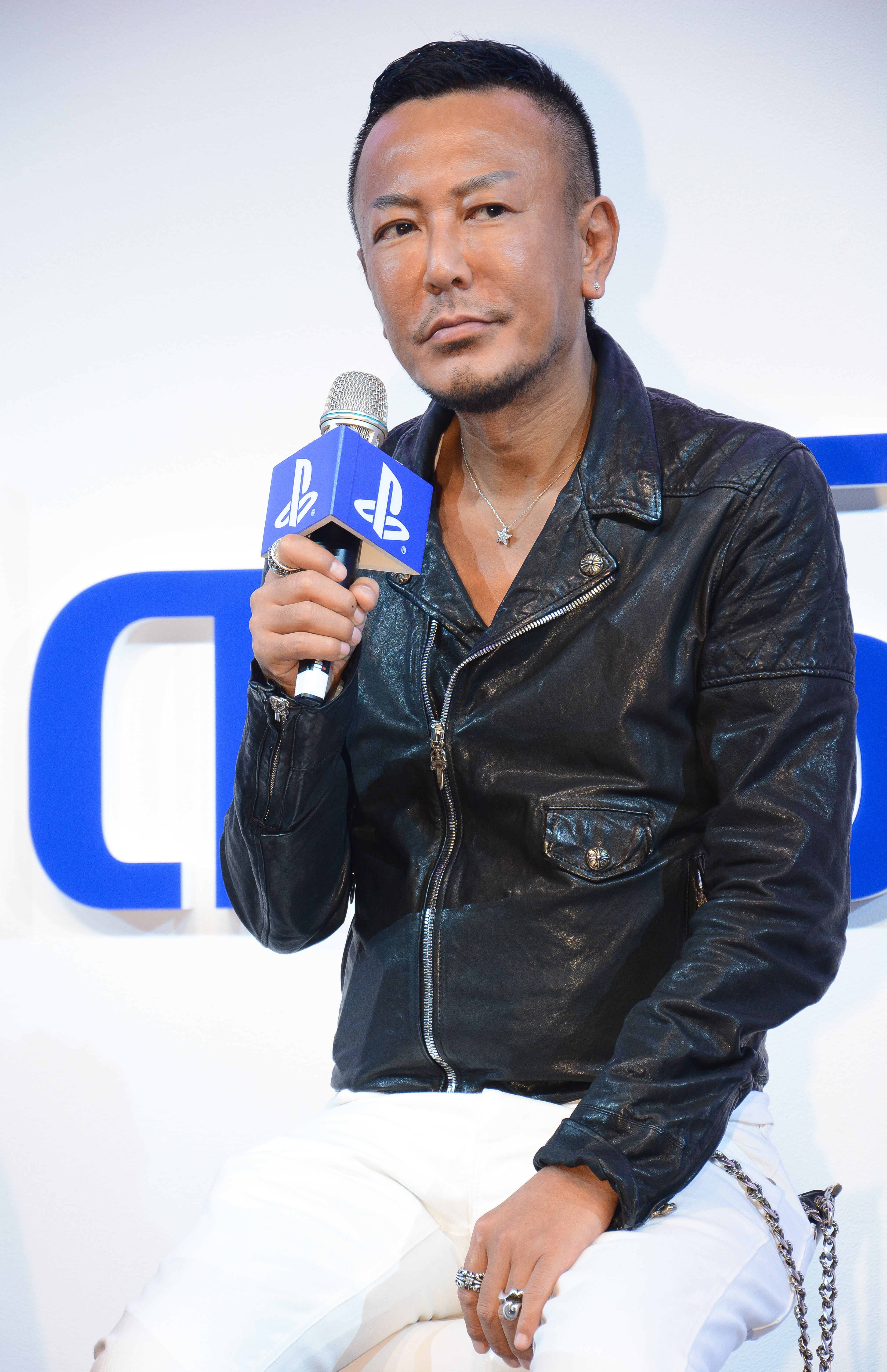
The markets in North America and Europe were seen as very "tough", with Sega taking sight on the wider Asian market instead. In 2012 Sega announced that for the West they would focus on fewer franchises which were Sonic the Hedgehog, Total War, Football Manager and Aliens, with Sonic being the only Japanese IP. Atlus became part of Sega in 2013, with the acquisition of Atlus USA being finalized in 2016. Atlus USA made it possible to localize Japanese Sega IP such as Yakuza and Hatsune Miku: Project DIVA to the western market. With the new policy of increasing localized titles again, the "bridge team" was founded in 2017, to better support communication between Sega of America and Japan.
Profits for arcade games were still higher than for console, mobile and PC games all the way to the fiscal year of 2014. According to AM2 developer Makoto Osaki, Sega shifted its focus to internet games in the arcades rather than huge cabinets after server maintenance costs went down. Border Break became a huge success being supported for many years in arcades. Port requests for Border Break have been there since the beginning, however Sega remained concerned that people stop going to the arcade if it didn't remain arcade exclusive, only after the decrease of arcades across Japan and receiving player comments that they needed to drive several hours to get to an arcade, it was decided that the game would receive a PlayStation 4 port. Music games became another area of success for Sega with Hatsune Miku: Project Diva Arcade and Maimai, both of which received many updates, and subsequent titles made by the same team as the latter such as Chunithm. Long time musician Takenobu Mitsuyoshi has said that the arcade industry in Japan is "fundamentally not strong" right now, mentioning that music games have developed long standing popularity against those odds. Ports of arcade games were developed primarily as downloadable games for PlayStation 3 and Xbox 360 with Virtua Fighter 5: Final Showdown, Daytona USA (previously Sega Racing Classic) and After Burner Climax, among others.
| Department | Division | Members From | Headed by | Notable Titles | CS1 | Consumer R&D, | CS2 | CS3 | Sega Networks | Online | AM1 | Amusement R&D, | AM2 | Products | N.Pro | Sega Amusements Europe | Sega Studios Shanghai | Sega of China | |||||||
|---|---|---|---|---|---|---|---|---|---|---|---|---|---|---|---|---|---|---|---|---|---|---|---|---|---|
| NE R&D | Toshihiro Nagoshi | {{columns-list | Binary Domain* | ||||||||||||||||||||||
| GE1 R&D | Takashi Iizuka, | ||||||||||||||||||||||||
| Osamu Ohashi | {{columns-list | Mario & Sonic* series | |||||||||||||||||||||||
| GE2 R&D | Akira Nishino | {{columns-list | Hatsune Miku: Project DIVA* series | ||||||||||||||||||||||
| NE R&D | Masayoshi Kikuchi | date=2012-07-02 | title=Sega Networks | url=http://andriasang.com/objo0f/sega_networks/ | url-status=dead | archive-url=https://web.archive.org/web/20130919011902/http://andriasang.com/objo0f/sega_networks/ | archive-date=2013-09-19 | access-date=2013-05-23 | website=Andriasang.com}} | ||||||||||||||||
| GE3 R&D | Takaya Segawa | {{columns-list | Phantasy Star Online 2* | ||||||||||||||||||||||
| AM1 | Yasuhiro Nishiyama | {{columns-list | Code of Joker* series | ||||||||||||||||||||||
| AM2 | Hiroshi Kataoka | {{columns-list | Border Break* series | ||||||||||||||||||||||
| Same as before | Unknown | ||||||||||||||||||||||||
| Products R&D | Yuji Sugimori | ||||||||||||||||||||||||
| Same as before | Paul Willams | ||||||||||||||||||||||||
| Makoto Uchida |
2018–present

The COVID-19 pandemic caused Sega to restructure their arcade business and place some of its developers onto console and smartphone games.
Sega plans to release "Super Game", a framework of game development that has the following requirements: online, IP utilization, multi-platform, multi-language, simultaneous worldwide release and AAA. According to Sega Sammy CEO Haruki Satomi, Lost Judgment and Phantasy Star Online 2: New Genesis are first steps into fulfilling this framework. Additionally, this Super Game development team will be a hybrid of developers that were previously involved in console, mobile and arcade games that eventually will add up to several hundred people. Unreal Engine 5 will be used, with Unreal Engine 4 already utilized other development teams. The latter was first used by the arcade divisions during the late 2010s on Sega World Drivers Championship and House of the Dead: Scarlet Dawn, and then Ryu Ga Gotoku Studio with its remake of Like A Dragon: Ishin!. Sega plans to resurrect past examples of IP for these projects, with Virtua Fighter 5: Ultimate Showdown an early example. The first game of this category is scheduled to release by the fiscal year of 2026. The name Super Game was chosen to differentiate it from the Metaverse. In an investors Q&A for the second quarter of the 2026 fiscal year, Sega has mentioned that several aspects of "Super Game" are currently under review due to "community features" adding cost and the current market environment.
Of the four development divisions, the 3rd is confirmed to be developing these titles, with over 600 employees who have experience developing GaaS type titles, including Phantasy Star Online 2 as well as various mobile and arcade games. Division 1 and 2 are mainly focused on developing the Like a Dragon and Sonic the Hedgehog games, respectively, with additional capacity for other series' releases such as Virtua Fighter, Super Monkey Ball, Puyo Puyo, and RPGs, while Division 4 focuses on mobile. Division 2 is also overseeing the development of smaller outsourced projects utilizing Sega IP, including Shinobi: Art of Vengance by Lizardcube, which has had guidance from veteran Sakura Wars and Sangokushi Taisen developer Toru Ohara.
A secondary development base called Sega Sapporo Studio was established in 2021.
Nagoshi and Daisuke Sato left Ryu Ga Gotoku Studio in 2021.
In a 2024 interview, Sega executive Shuji Utsumi mentioned that the dedicated arcade development division in Japan was closed, with the vast majority of its video game-focused developers merged into the remaining four divisions. Developers associated with AM2 brand titles such as Virtua Fighter generally appear to have been working at Division 1, whilst those from AM1 are under Division 2, with the Maimai and Initial D teams confirmed to be assisting the development of Samba de Amigo: Party Central and Sonic Racing: CrossWorlds whilst continuing to update their games. Others more focused on UFO Catchers, medal games, photo booths and other non-video game arcade products have remained in separate departments, moving to Sega Fave upon its 2024 formation.
Sega Amusements International was sold in 2021 via a management buyout, but has retained its inhouse R&D studio in Cardiff, Wales for work with external developers, as well as the continued rights to the Sega brand and Western sales of certain remaining Japan-developed arcade games (such as House of the Dead: Scarlet Dawn and from 2025 Maimai DX) through a royalty agreement.
2018 - 2020
| Department | Division | Members From | Headed by | Notable Titles | J&A (Japan & Asia) Studio 1 | Consumer R&D, | J&A Studio 2 | J&A Studio 3 | J&A Studio 4 | J&A Studio 5 #1 | Amusement R&D, | J&A Studio 5 #2 | J&A Studio 5 #3 | J&A | Sega Amusements International | Sega Studios Shanghai | Sega of China | |||||||
|---|---|---|---|---|---|---|---|---|---|---|---|---|---|---|---|---|---|---|---|---|---|---|---|---|
| Toshihiro Nagoshi | {{columns-list | Super Monkey Ball: Banana Blitz HD* | ||||||||||||||||||||||
| Eigo Kasahara | {{columns-list | Mario & Sonic at the Olympic Games Tokyo 2020* | ||||||||||||||||||||||
| Takaya Segawa | {{columns-list | |||||||||||||||||||||||
| Masayoshi Kikuchi | {{columns-list | SEGA Pocket Club Manager* | url=https://www.segasammy.co.jp/cms/wp-content/uploads/pdf/en/ir/19th_meeting_qa-en_final.pdf | title=Summary of Questions and Answers in the 19th Annual General Meeting of Shareholders | date=22 June 2023 | publisher=SEGA-Sammy Holdings | archive-url=https://web.archive.org/web/20240225213827/https://www.segasammy.co.jp/cms/wp-content/uploads/pdf/en/ir/19th_meeting_qa-en_final.pdf | archive-date=25 February 2024 | url-status=live}} | |||||||||||||||
| Yasuhiro Nishiyama | ||||||||||||||||||||||||
| Hiroshi Kataoka | ||||||||||||||||||||||||
| Unknown | ||||||||||||||||||||||||
| Same as before | ||||||||||||||||||||||||
| Sega Amusements Europe | Patrick Michael, | |||||||||||||||||||||||
| Shinichi Osagawara | ||||||||||||||||||||||||
| Same as before | Makoto Uchida |
2021 - current
| Department | Division | Members From | Headed by | Notable Titles | Div. 1 | R&D, | Div. 2 | Div. 2 | Div. 3 | Div. 4 | Sega Sapporo Studio | Sega Fave | Sega Amusements International | Kaizen Entertainment | ||||||
|---|---|---|---|---|---|---|---|---|---|---|---|---|---|---|---|---|---|---|---|---|
| (2021–present) | Sega Studios Shanghai | Sega of China | ||||||||||||||||||
| Masayoshi Yokoyama | {{columns-list | Super Monkey Ball* series | ||||||||||||||||||
| Osamu Ohashi | {{columns-list | Puyo Puyo* series | ||||||||||||||||||
| Yuya Kimura | {{columns-list | Crazy Taxi* | ||||||||||||||||||
| Katsutoshi Kioka | {{columns-list | 404 GAME RE:SET* | ||||||||||||||||||
| New | Takaya Segawa | |||||||||||||||||||
| Products | Unknown | title=UFOキャッチャーシリーズ 企画STAFF募集! アルバイト採用情報 | url=https://www.sega.co.jp/recruit/parttime/entry/parttime41.html | access-date=2025-01-07 | website=採用サイト株式会社セガ -【SEGA CORPORATION】 | language=ja}} | ||||||||||||||
| Same as before | Patrick Michael, | |||||||||||||||||||
| Shinichi Osagawara | ||||||||||||||||||||
| Makoto Uchida |
Acquired/founded studios
| Studio | Division | Year of purchase | |||||||||
|---|---|---|---|---|---|---|---|---|---|---|---|
| /founding | Notable titles | Creative Assembly | Sports Interactive | Hardlight | Atlus | Play Heart | Two Point Studios | Rovio Entertainment | |||
| Sega Europe | 2005 | {{columns-list | Alien: Isolation* | ||||||||
| 2006 | {{columns-list | Eastside Hockey Manager* series | |||||||||
| 2012 | {{columns-list | Sonic the Hedgehog* series | |||||||||
| Sega Corporation | 2013 | {{columns-list | Megami Tensei* series | ||||||||
| Sega Corporation, Mobile | 2015 | ||||||||||
| Sega Europe | 2019 | {{columns-list | Two Point Campus* | ||||||||
| 2023 |
Former studios
| Studio | Division | Year of purchase | |||||||||||||||||||||
|---|---|---|---|---|---|---|---|---|---|---|---|---|---|---|---|---|---|---|---|---|---|---|---|
| /founding | Year of release | ||||||||||||||||||||||
| /dissolution | Fate | Notable titles | Gremlin Industries | Sega Technical Institute | SONIC! Software Planning | CRI | SIMS | Sega Interactive | Sega Midwest Studio | Sega Multimedia Studio | SegaSoft | No Cliché | Visual Concepts | Sega Racing Studio | Sega Studios San Francisco | Sega Studios Australia | Three Rings Design | Relic Entertainment | Demiurge Studios | Amplitude Studios | |||
| Sega Enterprises | 1978 | 1983 | Sold and Merged into Bally Manufacturing | ||||||||||||||||||||
| Sega of America | 1990 | 1996 | Dissolved | ||||||||||||||||||||
| Sega | 1991 | 1995 | Merged into Camelot Software Planning | ||||||||||||||||||||
| 2004 | Remained with CSK following their divestiture of Sega | ||||||||||||||||||||||
| Dissolved | |||||||||||||||||||||||
| Sega of America | 1992 | 2000 | |||||||||||||||||||||
| 1995 | |||||||||||||||||||||||
| 1997 | |||||||||||||||||||||||
| 1995 | 2000 | Initially created as a joint venture with CSK. Dissolved in 2000 and remaining staff moved to the Sega.com entity | |||||||||||||||||||||
| Sega Europe | 1999 | 2004 | Dissolved | ||||||||||||||||||||
| Sega of America | 1999 | 2005 | Sold to Take-Two Interactive | ||||||||||||||||||||
| Sega Europe | 2005 | 2008 | Sold and Merged into Codemasters | ||||||||||||||||||||
| Sega of America | 2006 | 2010 | Dissolved | ||||||||||||||||||||
| Sega Europe | 2006 | 2013 | Dissolved | ||||||||||||||||||||
| Sega of America | 2011 | 2016 | |||||||||||||||||||||
| Sega Europe | 2013 | 2024 | Became independent with assistance from external investor | ||||||||||||||||||||
| Sega of America, Mobile development | 2015 | 2020 | Sold back to co-founder and then to Embracer Group under Saber Interactive | ||||||||||||||||||||
| Sega Europe | 2016 | 2024 | Management buyout |
Notes
Table references
References
References
- (21 December 2021). "『Beep21』特別企画「セガ歴史写真館」Vol.1{{pipe}}Beep21{{pipe}}note".
- (19 December 2021). "セガハードの父・佐藤秀樹 特別インタビュー『セガハードヒストリア』コンプリート版{{pipe}}Beep21{{pipe}}note".
- 株式会社インプレス. (2016-05-23). "「Game On」トークイベント「セガハードの歴史を語り尽くす」レポート 歴代セガハードの生みの親が集結した夢のキャスティングが実現!".
- "RESEARCH LIBRARY リサーチ ライブラリ|一橋大学イノベーション研究センター".
- "理想を追求したゲームギア,時代の先端を行ったアーケード基板......セガのハードに込められた矢木 博氏の矜持 ビデオゲームの語り部たち:第21部".
- (2021-05-07). "『むかしセガ・エンタープライゼスという会社があった』 (2) - テーマパーク VR アトラクション のトリビア。歪珠から近未来".
- (20 July 2022). "発掘!セガのDNA 【第1回】 石井洋児インタビュー(前編) 鶴見六百 with 堀井直樹 / 奥成洋輔{{pipe}}Beep21{{pipe}}note".
- (10 August 2022). "発掘!セガのDNA【第1回】石井洋児インタビュー(中編) 鶴見六百 with 堀井直樹 / 奥成洋輔{{pipe}}Beep21{{pipe}}note".
- (2 April 2022). "セガレジェンドクリエイター・鈴木裕 特別インタビュー『セガハードヒストリア』コンプリート版{{pipe}}Beep21{{pipe}}note".
- "ビデオゲームの語り部たち 第11部:鈴木久司氏が魂を注いだセガのアーケードゲーム黄金時代".
- (10 August 2022). "セガレジェンドクリエイター・中裕司 特別インタビュー『セガハードヒストリア』コンプリート版{{pipe}}Beep21{{pipe}}note".
- shmuplations. (2021-12-28). "The History of Sega Console Hardware - shmuplations.com".
- (30 November 2012). "CHM Revolutionaries: Game Changers- Mark Cerny with EA's Rich Hilleman".
- 奥成洋輔. (2022-06-10). "セガの名機 メガドライブの軌跡① メガドライブの誕生".
- "セガハード大百科".
- "History MENU".
- "名作アルバム - 『アレックスキッドのミラクルワールド』 - 2".
- "GDRI".
- "家泉 享吏 (デザイナー)".
- (2020-09-04). "Roppyaku Tsurumi on Twitter: "第一研究開発部がAM1研・AM3研に分かれたのが1990年か1991年あたりだったかな。それ以前の開発作が第1AM研究開発部であるわけがない。 ゴールデンアックスは第一研究開発部だけど、エイリアンストームは第1AM研究開発部。内田刑事長が安田倉庫2階で難易度調整してたの、いまだに覚えてる。"".
- (2021-02-14). "Astro City Mini and Game Design (Part 1) – One Million Power".
- (2022-02-25). "『Beep21』-セガハード列伝- #0回 メガドライブの秘密を追え!".
- "SEGA Consumer History".
- (11 May 2019). "セガ・名越稔洋が語るクリエイター活動30年史。200億稼いだ『デイトナUSA』開発秘話と、初めて明かす師・鈴木裕への想い【特別企画 前編】 {{pipe}} ゲーム・エンタメ最新情報のファミ通.com".
- "名作アルバム - 『アレックスキッドのミラクルワールド』 - 2".
- "名作アルバム -『アドバンスド大戦略 ドイツ電撃作戦』-".
- (30 June 2004). "Sega-AM2 – Games : 最新のAM2作品 -".
- (2021-12-12). "After Burner II – Developer Interviews - shmuplations.com".
- (2019-10-10). "Tales from inside Sega AM2's top-secret studio". Eurogamer.net.
- "Yuichi Toyama / 外山 雄一 on X: "3DソニックDL記念、ソニックの思い出1:'90年3月~4月、某HELP仕事のた...".
- "名作アルバム -『アドバンスド大戦略 ドイツ電撃作戦』-".
- (10 August 2022). "『Beep21』創刊3号・特別企画 小口久雄氏インタビュー{{pipe}}Beep21{{pipe}}note".
- "RESEARCH LIBRARY リサーチ ライブラリ|一橋大学イノベーション研究センター".
- (26 May 2017). "ゲームプロデューサー熊谷美恵さんの「セガ入社秘話、そしてAM3研時代」——ゲーム業界、彼女の履歴書".
- (30 June 2017). "ゲームプロデューサー熊谷美恵さんの「セガ子会社社長兼クリエイターとして」——ゲーム業界、彼女の履歴書".
- Booths, Planet. (2022-11-10). "Planet Booths".
- "Surviving selfies: Japan's purikura photo booths cling on - Art & Culture".
- (2021-05-07). "『むかしセガ・エンタープライゼスという会社があった』 (4) - テーマパーク VR アトラクション のトリビア。歪珠から近未来".
- "究極の体感ゲーム筐体「R360」の開発メンバーが次代に託すセガの遺伝子。ビデオゲームの語り部たち 第19部".
- "Interview:Jim Reichert - GDRI :: Game Developer Research Institute".
- (2015-12-03). "Interview: Steven Lashower (2007-08-14)".
- (2015-12-03). "Interview: Doug Lanford (2011-03-01)".
- Harrison, John. (August 2023). "Legends of 16-Bit Game Development". Raster Scroll.
- (2013-09-18). "Sega's Original Hardware Developer Talks About The Company's Past Consoles".
- Manson, Leonard. (2021-12-29). "New Saturn Development Details: "I Regret Not Basing It On The Model 1".".
- (October 1997). "Sega's PC Connection". EDGE.
- (20 December 2021). "『Beep21』創刊記念企画・大島直人 特別インタビュー{{pipe}}Beep21{{pipe}}note".
- (24 June 2016). "『ソニック・ザ・ヘッジホッグ』誕生・ヒット・新生の真実をソニックチームのレジェンドクリエイターが、25周年のいま明かす 秘蔵資料満載の永久保存版!".
- (2018-04-30). "Panzer Dragoon Saga: An oral history".
- "ビデオゲームの語り部たち 第11部:鈴木久司氏が魂を注いだセガのアーケードゲーム黄金時代".
- Kolan, Patrick. (August 7, 2007). "''Shenmue'': Through the Ages".
- Mott, Tony. (2013). "1001 Video Games You Must Play Before You Die". Universe Publishing.
- Kent, Steven L.. (2001). "[[The Ultimate History of Video Games: The Story Behind the Craze that Touched our Lives and Changed the World]]". Prima Publishing.
- 実存. (2019-10-15). "セガ社員と「創業からのセガの歴史」を振り返ってみた【PR】".
- (2019-04-26). "'My Childhood Dream Had Come True': A Belated Interview With Skies Of Arcadia's Producer".
- shmuplations. (2021-12-28). "The History of Sega Console Hardware - shmuplations.com".
- "セガサターン".
- "セガハード大百科".
- Charnock, Tom. "An Interview With Bernie Stolar".
- (January 2000). "In the hot seat with David Chomard".
- [https://retrocdn.net/images/c/c3/SSM_JP_19960614_1996-09.pdf Production History and mention of studios in Japanese Magazines], ''Sega Saturn Magazine'', Vol. 9, pages 138–145.
- (25 June 2003). "ワウ エンターテイメント / 製品情報 /1998年以前のゲーム".
- (June 1994). "Yu Suzuki: Sega's driving force".
- "ヒットメーカー(旧AM3研)の開発してきたゲームタイトルの一覧です".
- (1997). "SEGA Magazine".
- (2021-05-07). "『むかしセガ・エンタープライゼスという会社があった』 (4) - テーマパーク VR アトラクション のトリビア。歪珠から近未来". goo blog.
- (October 1, 1994). "パワーあふれるAMチームはセガサターンの強い味方!!".
- 奥成洋輔. (2021-06-25). "セガサターンとふり返るあの時代① セガサターン発売".
- (1994). "5.6".
- [https://retrocdn.net/images/c/c3/SSM_JP_19960614_1996-09.pdf ''Sega Saturn Magazine'', Vol. 9.]{{page needed. (January 2025)
- (1991). "FAN".
- (January 1992). "FAN".
- (2023-06-20). ""セガが好きすぎるセガ社員"奥成さんってどんな人? セガのやり過ぎ(!?)企画の裏につねにこの人あり!".
- (1993). "5.6".
- (2023-08-23). "第1回『クライング 亜生命戦争』1992年 - SiFi-TZKのゲームデザイン再訪記".
- (2022-03-30). "GDRI on Twitter: "Here are the CS names and job titles...... "".
- (1993). "9.10".
- "Katsuyoshi Nitta {{!}} Work and education".
- (2023-08-19). "セガサターンとふり返るあの時代① セガサターン発売".
- "まぢん on Twitter: "@nobunaga_ ん?MD版VRは、内作だったはずですよ。当時のCS3のプログラマが、こぞってAM2に出張して作ってたと思います。同期がいたので間違いないかとw"".
- "#30 岡村峰子".
- "[Copy-n-paste fails]".
- "ちばみなとjp⚓️千葉市ネタゆるメディア auf Twitter: "ゲームギアといえば、晩年に「ゲームボーイ」というゲーム総合誌が、とにかくゲームギア&ソフト開発部隊のCS5研に注力していて面白かった記憶があるのだけど、雑誌もCS5研もマニアックすぎるのかネット上にほぼ情報が見つからない。。 https://t.co/HyE7Cxf8VY #ゲームギアミクロ #ゲームギア30周年"".
- (2023-11-26). "プログラム {{!}} CEDEC 2013 {{!}} Computer Entertainment Developers Conference".
- (July 1994). "MegaDrive".
- "Dragon Force POCX-1019".
- (25 June 2003). "ワウ エンターテイメント / 製品情報 /1998年以前のゲーム".
- (2000). "10/13".
- (1999). "11/19.26".
- "SBG:セガがソフトウェア研究開発部門を分社化".
- (2000). "12/15".
- (1998). "9/11.18".
- [https://retrocdn.net/images/9/98/SSM_JP_19980123_1998-03.pdf ''Sega Saturn Magazine''], page 22, just CS1-3
- (1999). "12/31".
- (1998). "1/23".
- (2001-08-19). "オーバーワークス -Overworks-".
- (2022-11-11). "「スペースチャンネル 5 ウキウキ ミュージック フェスティバル オンライン」開催2周年記念(?)インタビュー。うらら&モロ星人誕生のヒミツを,2人のデザイナーが振り返る".
- (2023-11-15). "YumikoMiyabe宮部由美子 on X: "うららですけど。監督の湯田さんからデザインを任命されて、おぉぉ、苦節○年、セガでキャラク...".
- (2000). "8/4.11".
- "SEGA VOICE".
- (2001-06-05). "Sega Conference: All the Sega Developers".
- "EDGE".
- Takeuchi, Takuya. (2020-06-02). "SEGA 60th Anniversary Special Presentation: Interview with Toshihiro Nagoshi".
- Fahs, Travis. (2010-09-10). "IGN Presents the History of Dreamcast".
- "The 100 best games of all time {{!}} GamesRadar".
- Staff, Polygon. (2017-11-27). "The 500 best games of all time: 500-401".
- "The 100 Best Games To Play Today". EDGE Magazine.
- (13 December 2020). "「セガい共通テスト」公式対策オンライン講座「セガゼミ」 第3回 アーケード 西村先生".
- (2024-01-10). "『Beep21』片岡洋特別インタビュー 〜クリエイター・リユニオン・ファイルVol.7〜|Beep21".
- (13 December 2020). "「セガい共通テスト」公式対策オンライン講座「セガゼミ」 第3回 アーケード 西村先生".
- "RESEARCH LIBRARY リサーチ ライブラリ|一橋大学イノベーション研究センター".
- "セガ・名越稔洋が語るクリエイター活動30年史。200億稼いだ『デイトナUSA』開発秘話と、初めて明かす師・鈴木裕への想い【特別企画 前編】 {{!}} ゲーム・エンタメ最新情報の".
- (3 June 2016). "セガのハードに込められた熱意が語られた Game Onトークイベント"セガハードの歴史を語り尽くす"詳細リポート".
- (13 August 2013). ""Sega Consumer 30th Anniversary Book" ゲームギア編/"生みの親"である矢木氏が開発秘話を語る!".
- (2023-11-21). "『Beep21』2つのセガサターン最初のモックアップを本邦初公開! 真・セガハード列伝─セガサターンデザイン秘話【前編】{{pipe}}Beep21".
- (2003-06-30). "Oguchi inaugurated as Sega president".
- "セガ、開発スタジオ再編の詳細を発表。現9社を6社に再編し、新会社1社を設立 - 電撃オンライン".
- (30 July 2003). "Notice of R&D Studios' Reorganization". SEGA.
- (2003-12-17). "Nakagawa Leaves Sega Wow".
- "株式会社ビットスター".
- "鈴木裕氏が社長のセガ開発子会社の正式名称が「デジタルレックス」に決定! - 電撃オンライン".
- (2004-05-18). "Notice on Reorganization of the Company's R&D Subsidiaries".
- "Sega's new beginning".
- (2003-08-11). "ワウ エンターテイメント".
- (2004-06-30). "SEGA-AM2".
- (2004-06-29). "Hitmaker WEB".
- (2004-06-29). "AMUSEMENT VISION".
- (2003-09-22). "+++ SEGAROSSO.COM +++".
- (2004-06-09). "株式会社スマイルビット".
- (2003-04-16). "OverWorks Official Web Site".
- (2002-08-02). "SONICTEAM".
- (2003-04-04). "United Game Artists > home".
- "StarHorse 公式サイト".
- (2000). "6/23".
- "フィッシュライフ - Index".
- (2001-06-04). "Interview With Sonic Adventure 2 Director Takashi Iizuka".
- (2004-06-02). "SEGA WOW INC.".
- "セガの開発会社が10月1日付けで再編。役割を明確にし、商品力の強化を狙う - 電撃オンライン".
- "ソニックチャンネル/クリエイターズ インタビュー/026:大橋 修".
- (2007-03-05). "csjob.sega.jp".
- (2016-07-01). "Like A Dragon: Yakuza PS2 SEGA Masayoshi Kikuchi interview from 1UP.com".
- (2005). "Annual Report 2005". Sega Sammy Holdings.
- "セガが最強の新作3タイトルを一挙紹介!「セガコンシューマ新作発表会」レポート - 電撃オンライン".
- (August 2007). "CSR Report 2007". Sega Sammy Holdings.
- "Annual Report 2006". Sega Sammy Holdings.
- (4 April 2013). "E3 2005 Sega Footage".
- Hester, Blake. (2016-02-08). "Sonic the Hedgehog's long, great, rocky history".
- "Sega unveils Lindbergh games".
- "Kikizo {{!}} Sega AM2: The Complete Virtua Fighter Interview - Makoto Osaki, March 2007".
- "Virtua Tennis 3 Comes to PS3, 360".
- arcadeattack. (2017-05-08). "Mike Hayes (SEGA/Nintendo) - Interview".
- Sheffield, Brandon. (2008-07-18). "Jeffery: Sega Not Trying To Be 'A Japanese Company In The West'".
- (2004-11-02). "Sega slashes Altered Beast for US". Eurogamer.net.
- "Sega Brings Two DS Games to America - News".
- (2008-08-11). "The Evolution Of Sega: A Conversation With Simon Jeffery".
- (2014-02-16). "Sega's arcade redemption". Eurogamer.net.
- (8 May 2006). "Yuji Naka confirmed to be leaving Sega to form Prope".
- (2011-06-27). "Yu Suzuki to leave Sega this September".
- "もっと夢と感動を! 株式会社セガ様/第一GE研究開発部(旧:株式会社ソニックチーム)".
- "ソニックチャンネル/クリエイターズ インタビュー/011:岸本 守央&須永 江身子".
- (29 April 2006). "[第一GE研究開発部]システムエンジニアの契約社員募集!".
- (31 March 2005). "Notice of Personnel and Organizational Changes of Our Subsidiary". SEGA.
- (October 17, 2007). "「新作ゲームプロモーションイベント」開催". 株式会社セガ×総合学園ヒューマンアカデミー [Sega Corporation x Human Academy].
- 徹也, 稲元. (19 September 2007). "PS3の新たな表現の可能性に挑戦! セガの最新作『戦場のヴァルキュリア』に着目<開発者インタビュー>【TGS2007】".
- (12 January 2006). "[第二GE研究開発部]グラフィックデザイナーの契約社員募集!".
- (2011-02-06). "ドラゲーム 史上最強『ドラえもん のび太の恐竜2006 Ds』 {{pipe}} セガボイス {{pipe}} Sega".
- (2008-10-07). "アハ体験でひらめき力を強化!『脳に快感 アハ体験!』 {{pipe}} セガボイス {{pipe}} Sega".
- "Kaseki Play (2007) Windows credits".
- (2006-08-25). "(メモ) ネットワークゲームの作り方".
- (2007-09-17). "Cedec 2006 {{pipe}} スポンサーシップセッション".
- (May 7, 2007). "シリコンスタジオ、「Game Tools & Middleware Forum 2007」". Silicon Studio Corp..
- (16 December 2005). "[NEソフト研究開発部] サウンド制作アシスタント募集!".
- (2017-08-22). "『龍が如く 見参!』インタビュー". CRI Middleware.
- (2009-12-19). "『モバってますか!?』コラムニスト スケジュール{{pipe}}セガモバ".
- (2008-05-31). "4Gamer.net — "コンセプト通りの正常進化"。開発者が語る,基本プレイ料金が無料化された「プロ野球チームをつくろう!ONLINE 2」(プロ野球チームをつくろう!ONLINE 2)".
- (2007-10-24). "4Gamer.net — "プロ野球ファンに向けたコミュニケーションツールでありたい"開発者が語る「プロ野球チームをつくろう!ONLINE」とは(プロ野球チームをつくろう!ONLINE)".
- (2008-09-21). "会員増加に対応できる拡張性:自分のリプレイ動画を配信『三国志大戦 演武場』——セガの動画サービスを支えるブレードサーバ - ITmedia エンタープライズ".
- (2011-02-14). "アーケードで大人気の対戦型カードゲーム「三国志大戦」はいかにして作られたか".
- (2017-02-22). "第1回ゲームミュージックコンポーザー座談会:ゲーム音楽制作 株式会社ノイジークローク".
- (2008-04-01). "『三国志大戦』見参!(前編) {{pipe}} セガボイス {{pipe}} Sega".
- (2008-10-08). "ゾンビがいっぱい『Hod4』 {{pipe}} セガボイス {{pipe}} Sega".
- (2008-04-01). "正義か悪か『シャドウ・ザ・ヘッジホッグ』 {{pipe}} セガボイス {{pipe}} Sega".
- (2008-03-08). "知識よりも知恵で勝負!『ネットワーク対戦クイズ Answer×Answer』 {{pipe}} セガボイス {{pipe}} SEGA".
- "Creator's Comment".
- "Creator's Comment".
- (2008-10-08). "対戦麻雀の最高峰『Mj3』 {{pipe}} セガボイス {{pipe}} Sega".
- (2008-10-07). "19年を経て甦る爽快感!『アフターバーナー クライマックス』 {{pipe}} セガボイス {{pipe}} Sega".
- (2008-10-07). "3D対戦格闘の究極進化系『バーチャファイター5』 {{pipe}} セガボイス {{pipe}} Sega".
- (2009-04-01). "Hiro師匠&光吉猛修インタビュー2/4回".
- (20 November 2005). "[第三AM研究開発部] 企画アシスタント募集!".
- "Let's Go Away". Sound Shock.
- (2008-04-01). "進化を続ける『WCCF』 {{pipe}} セガボイス {{pipe}} Sega".
- (2008-10-07). "初心者からマニアまで楽しめる本格テニスゲーム『パワースマッシュ3』 {{pipe}} セガボイス {{pipe}} Sega".
- (2009-04-01). "キミと恐竜が世界を救う!Ds『古代王者 恐竜キング 7つのかけら』{{pipe}} セガボイス {{pipe}} Sega".
- (31 March 2005). "当社子会社(株式会社セガ)の人事異動および組織変更に関するお知らせ". SEGA.
- (2009-12-19). "『モバってますか!?』コラムニスト スケジュール{{pipe}}セガモバ".
- "甲虫王者ムシキングの3DCGプログラマーアシスタント募集中!". SEGA.
- (2008-03-08). "5周年記念の集大成!『甲虫王者ムシキング スーパーコレクション』 {{pipe}} セガボイス {{pipe}} Sega".
- "SEGA Amusement Catalogue". SEGA.
- (2003-10-07). "世嘉我悟软件(上海)有限公司".
- "前田雅尚访谈:分担开发风险投靠休闲游戏与大作__游戏 :: 游民星空 GamerSky.com".
- GameCentral. (2019-07-05). "Toshihiro Nagoshi Yakuza interview – 'an authentic Japanese experience'".
- 日経クロステック(xTECH). (May 2013). ""根強いファン"を抱える、セガならではの次の一手".
- (2013-10-21). "開発ウラ話 {{!}} このサイトでは、株式会社セガのアーケードタイトルを中心に、おすすめのタイトルやコンテンツを紹介しています。".
- 株式会社インプレス. (2013-07-16). "セガネットワークス編成局副部長 秋山隆利氏インタビュー ソーシャル、アーケード、オンラインのノウハウを活かした「チェインクロニクル」の魅力に迫る!".
- (24 March 2017). "セガAM2研が贈るスマホ向けファンタジーRPG『Soul Reverse Zero』大型アップデートver1.2を実装!マルチモードの改修や新イベント「マールコット防衛戦線」を開催!".
- emilygera. (2012-06-28). "Sega shutting down offices throughout Europe and Australia".
- (2 December 2013). ""新生"インデックス、アトラスブランドの未来は!? セガ/インデックス社長・鶴見尚也氏にインタビュー".
- "先輩社員インタビュー {{!}} 社員紹介".
- "FY Ending March 2015 3rd Quarter Results Presentation". SEGA-Sammy Holdings.
- "Kikizo {{!}} Virtua Fighter 5 R: The ONLY Interview, with SEGA AM2's Makoto Osaki".
- "「ボーダーブレイク」の10年を開発者とゲストが振り返る,「10周年だヨ!ボダりな祭」レポート。12月のPS4版アップデートも一部が明らかに".
- 徹也, 稲元. (September 19, 2019). "「ボーダーブレイク」の10年を開発者とゲストが振り返る,「10周年だヨ!ボダりな祭」レポート。12月のPS4版アップデートも一部が明らかに".
- (2018-12-30). "百渓 曜【前編】 {{!}} 株式会社セガ・インタラクティブ". 株式会社セガ・インタラクティブ.
- (11 December 2017). "『初音ミク』の10年と、『ディーヴァ』シリーズの歩みを振り返る。クリプトン佐々木氏&セガ大崎氏インタビュー".
- "検索ページ".
- (2013-03-31). "Interview: Takenobu Mitsuyoshi {{!}} TSSZ News".
- (2014-03-28). "AM移植チーム オフィシャル風ブログ {{!}} 第二研究開発本部で移植ばっかりしてるチームのブログ".
- "技術から語る「龍が如く」の10年 ~ 今世代で何が変わるのか ~ – 公式サイト – CEDEC 2016 – Computer Entertainment Developers Conference".
- (2010-08-23). "アルバイト採用詳細 – ニュースリリース – 会社情報". SEGA.
- (c)SEGA. (17 November 2023). "[第1CSスタジオ]『龍が如く』シリーズ サウンドチーム サウンド制作募集 {{pipe}}アルバイト採用{{pipe}}株式会社セガゲームス -【Sega Games Co., Ltd.】".
- (2015-07-30). "【ファミキャリ!会社探訪(27)】極上のエンターテインメント作品『龍が如く』シリーズを手がけるセガゲームス コンシューマ・オンラインカンパニーを訪問".
- (2016-02-02). "Sega's inhouse training/seminar program {{!}} CEDEC 2010 {{!}} CESA Developers Conference".
- (2011-09-09). "Programming {{!}} CEDEC 2011 {{!}} Computer Entertaintment Developers Conference".
- (2010-07-15). "サカつく6{{pipe}}株式会社セガ".
- (2017-08-08). "セガ、DS「サカつくDS ワールドチャレンジ2010」".
- "スペシャル対談{{pipe}}横山昌義氏 間瀬秀一氏 田中晃氏 木村正明氏 佐久間悟氏 中村義昭氏".
- (2023-12-18). "人気ゲームの世界観を創造 分散処理技術でゲーム開発に"時間"を創出 {{!}} INSIGHT HUB".
- (2015-03-05). "SF特攻空母ベルーガ(16ビット版)SPECIAL INTERVIEW{{pipe}}有限会社エムツー".
- (2016-08-15). "「GTMF2009レポート」1年1作リリースという驚異的な開発速度を誇る「龍が如く」シリーズの秘密".
- (2013-04-24). "名越稔洋氏率いるクリエイター集団が新しい設計での「龍が如く5」の開発を決定!「バイナリー ドメイン」のゲーム概要も発表「龍が如くスタジオ」発足記者発表会{{pipe}}Gamer".
- (2023-12-18). "CG-ARTS教育リポート 日本と世界のCG教育のいまが見える".
- (2012-10-28). "EIZO×SEGAの強力タッグで開発:"音"がよくなると、ゲームの腕前も上がる!?——「FORIS FX2301TV」開発者は語る (1/3) - ITmedia PC USER".
- (2014-07-14). "龍が如く 維新! - CRI Middleware".
- "2Dと3Dで究極のソニックに挑戦!『ソニック ワールドアドベンチャー』インタビュー – インサイド".
- "プロデューサーの飯塚 隆氏が語る,「ソニック ジェネレーションズ 白の時空/青の冒険」制作秘話とソニックシリーズ20年の歩み".
- "ソニックチャンネル/クリエイターズ インタビュー/026:大橋 修".
- 株式会社インプレス. "セガ、「リズム怪盗R 皇帝ナポレオンの遺産」 インプレッション&ミニインタビュー!! リズム怪盗R 皇帝ナポレオンの遺産".
- "【CEDEC2014】『ぷよぷよ』総合プロデューサーが9年間で得た「極意」が明らかに!".
- (15 December 2011). "すべては、面白いゲームをつくるため。大・小2つのチームワークが、クオリティを上げる。{{pipe}}ニュース&リポート{{pipe}}専門学校 HAL".
- (2010-12-15). "アルバイト採用詳細 – ニュースリリース – 会社情報". SEGA.
- Higham, Rupert. (October 6, 2010). "Interview: Sonic Team's Takashi Iizuka".
- Mullen, Sam. (August 15, 2019). "Because Sonic Team ! = CS2, but is made up of people from what was known as CS2. Your understanding isn't incorrect but it's not something that can be unpacked in a tweet. Sonic Team isn't making Sakura Wars.".
- (2021-01-22). "Static analysis recognized by Sega: How to remove bugs from game development {{!}} CEDEC 2010 {{!}} CESA Developers Conference".
- (2021-06-30). "まぢん on Twitter: "ProjectDivaはAM2とCS3がガッツリ組んで作ってたからねー。ここまでスタッフの割合が半々レベルで絡んだプロジェクトはセガの歴史の中でも異例かもしれない。... "".
- (2017-08-08). "「ファンタシースターオンライン2」プロデューサー酒井智史氏インタビュー - GAME Watch".
- (2013-08-03). "往年のセガファン感涙必至! 名曲尽くしの『セガ SG-1000 30th アニバーサリーコレクション』が実現に至るまで".
- (2021-01-19). "昔感じた衝撃を立体視で再現--セガ3D復刻プロジェクト・アーカイブスのキーマンに聞く - CNET Japan".
- (2012-06-27). "プログラム {{!}} CEDEC 2012 {{!}} Computer Entertaintment Developers Conference".
- "2012 winter Sega Sammy report". Sega Sammy Holdings.
- (2012-07-02). "Sega Networks".
- (2012-11-20). "アルバイト採用詳細 – ニュースリリース – 会社情報". SEGA.
- (2023-11-26). "今年は総勢151名。ゲーム業界著名人に聞く2013年の注目タイトルと2014年へのメッセージ".
- (2023-11-26). "Panel discussion {{!}} CEDEC 2011 {{!}} Computer Entertaintment Developers Conference".
- (2017-09-15). "ニュース {{!}} セガR&D1公式サイト".
- (2017-09-15). "タイトル一覧 {{!}} セガR&D1公式サイト".
- (2012-04-04). "4Gamer.net — [AOU2012]手の動きで「舞い」を表現し,「踊ってみた」動画を録画/投稿できる「maimai」ステージイベントレポ&ミニインタビュー".
- (2013-12-19). "『頭文字D パーフェクトシフト ONLINE』開発スタッフインタビュー完全版".
- 株式会社インプレス. (2012-12-28). "AC「maimai」開発チーム楽曲配信Vol.2記念インタビュー 洗濯機(?)の形はなぜ生まれたか? など聞いてみた".
- (2023-10-29). "押忍!Softimage マニアクス {{!}} コラム {{!}} Autodesk :: AREA JAPAN".
- (2023-11-26). "テクニカルアーティストラウンドテーブル2012 Final".
- (2023-11-26). "アーケードゲーム「WORLD CLUB Champion Football」のスクラム導入への取り組み".
- (2014-09-06). "セガ第一研究開発本部 〜 セガの考えるゲームプランナーとは? R&D1運営室 企画統括マネージャー 小田隆志氏の場合 {{!}} キャリア・ラボラトリー".
- (2023-11-20). "勝つべくして勝つための企画書作成テクニック ~百戦錬磨の企画マンになるために~".
- (September 2018). "Sega Sammy Group CSR Booklet 2018". Sega Sammy Holdings.
- (2017-12-06). "R&D1セガ新人日記。".
- (2017-07-18). "佐藤直行【前篇】1/3{{!}}株式会社セガ・インタラクティブ".
- (2016-11-01). "松永純 [前篇] 1/3{{!}}株式会社セガ・インタラクティブ".
- (November 2015). "CSR Report 2015". Sega Sammy Holdings.
- (2023-11-12). "アップデートで巻き返しを図る「SOUL REVERSE」クリエイターインタビュー。バランス調整が施されたVer.1.2の狙い......のその前に,苦戦の理由を聞いてみた".
- (2019-05-18). "ゲーム質問状:「初音ミク Project mirai 2」 ミクたちの可愛さ&ゲーム内容に自信あり! - MANTANWEB(まんたんウェブ)".
- "FFCG-9001 {{!}} BORDER BREAK SOUNDTRACK COMPLETE CD-BOX - VGMdb".
- "ソウルリバース ゼロ公式".
- (2019-07-01). "初音ミク Project DIVA MEGA39's{{!}}セガ".
- "「艦これアーケード」4月26日正式稼働開始!{{pipe}}艦これアーケード セガ公式サイト{{pipe}}艦隊育成型カードゲーム".
- "Makoto Osaki". LinkedIn.
- (2016-07-24). "青木盛治 [前篇] 1/3{{!}}株式会社セガ・インタラクティブ".
- (2018-06-15). "株式会社セガ・インタラクティブの導入事例:超高負荷かつ高速なレスポンスが求められる通信対戦ゲームを Google Cloud Platform を駆使して効率的に運用".
- (2023-11-26). "第5回:救世主は1000人分の"おしっこ"(上)(2ページ目) {{!}} 日経クロステック(xTECH)".
- (2017-06-24). "深澤光晴【後篇】1/3{{!}}株式会社セガ・インタラクティブ".
- "Fiscal 2018 Business Report". SEGA-Sammy Holdings.
- (2023-11-22). "セガのキッズ向け遊具「え〜でる すなば」開発陣にインタビュー。"絵が出る不思議な砂遊び"を生み出したNプロ研究開発部の狙いを聞いた".
- "2014 Winter SEGA Sammy Report". SEGA-Sammy Holdings.
- (2013-08-12). ""Sega Consumer 30th Anniversary Book"メガドライブ編/開発を手掛けた石川氏が当時を振り返る!".
- arcadehero. (2019-02-20). "Sega Officially Unveils Daytona Championship USA SDLX".
- arcadehero. (2024-05-09). "Interview: Shinichi Ogasawara and Pang Shu on Sega Amusements, Apex Rebels, & 3MindWave".
- "セガ、ゲームセンター事業は撤退するも、店舗名に"セガ"は継承。アーケードゲーム開発は継続しつつ、家庭用ゲーム機に注力 {{!}} ゲーム・エンタメ最新情報の".
- Special, 日経ビジネス電子版. "セガサミーが目指すエンタテインメントの未来 - 日経ビジネス電子版 Special".
- "『SuperGame』インタビュー".
- (2018-11-26). "20年オヤジのUnreal Engine 4 TIPS".
- Square, Push. (2022-09-15). "Like a Dragon Dev RGG Studio Considering a Move to Unreal Engine 5".
- Narita, Seiji. (2022-04-11). "セガが「SuperGame」構想の詳細を明かしていた。UE5で作るAAA級オンラインタイトル".
- Sickr. (2023-11-01). "SEGA planning to release first "Super Game" by the end of March 2026".
- (15 November 2023). "Sega's Super Game Features "User-Generated Content"".
- "20251203_q2_major_QA_e".
- "第1事業部インタビュー".
- "第4事業部インタビュー".
- (2025-02-12). "First look at Shinobi: Art of Vengeance, out Aug 29 on PS5 and PS4".
- (2023-04-10). "セガ札幌スタジオ公式サイト{{pipe}}SEGA".
- Wen, Alan. (2021-10-08). "'Yakuza' creator Toshihiro Nagoshi has left Sega".
- Mielke, James. (2024-12-13). "Putting the mega drive back into Sega: how the company wants to return to creating video game "rock & roll", compared to Nintendo's "pop music"".
- (2023-09-21). "'Samba De Amigo Party-To-Go' Apple Arcade Interview – Shun Nakamura on Reviving Amigo, Song Choices, Motion Controls on Nintendo Switch, and More – TouchArcade".
- V, Amber. (2025-02-14). "Initial D arcade developers involved in Sega's new Sonic racing game".
- "HOUSE OF THE DEAD SCARLET DAWN THEATER {{!}} Arcade Game for Sale {{!}} Buy Now {{!}} SEGA".
- "MAIMAI DX TWIN {{!}} Arcade Game for Sale {{!}} Buy Now {{!}} Sega".
- "Management Buy Out at SEGA Amusements International Ltd".
- (2024-11-27). "1st Development Division Interview {{!}} SEGA Careers Site{{pipe}}SEGA CORPORATION".
- (2024-12-10). "セガ 第1事業部 の求人一覧".
- "セガ プロデューサー・ディレクター 松並 桂一氏による特別講義!ゲーム業界を目指す学生たちへ直接アドバイスをいただきました{{pipe}}HAL大阪".
- (2018-12-21). "セガゲームスが求めるものとは? 『龍が如く』、『ソニック』シリーズや『PSO2』のプロデューサーおよびディレクター陣が登壇した中途採用説明会の様子をリポート".
- (2024-12-10). "2nd Development Division Interview {{!}} SEGA Careers Site{{pipe}}SEGA CORPORATION".
- (2024-12-10). "【株式会社セガ】【第2事業部】プランナー(新規コンシューマタイトル)_求人No. 732 {{!}} セガ".
- (2024-12-07). "対戦ゲーム(英傑大戦)の開発スタッフ募集! {{!}} アルバイト採用情報 {{!}} 採用サイト{{pipe}}株式会社セガ -【SEGA CORPORATION】".
- (2024-08-06). "ドライブゲームの開発ドライバー {{!}} アルバイト採用情報 {{!}} 採用サイト{{pipe}}株式会社セガ -【SEGA CORPORATION】".
- (2022-11-14). "「オンゲキ」「CHUNITHM」「maimai」の企画アシスタント募集! {{!}} アルバイト採用情報 {{!}} 採用サイト{{pipe}}株式会社セガ -【SEGA CORPORATION】".
- (2021-07-09). "ドライブゲーム企画 {{!}} アルバイト採用情報 {{!}} 採用サイト{{pipe}}株式会社セガ -【SEGA Co., Ltd.】".
- "セガ SuperGame の求人一覧".
- (2023-06-08). "株式会社セガ{{pipe}}TECH×TALK{{pipe}}京都デザイン&テクノロジー専門学校".
- (2024-07-01). "仮想ファイルシステムを導入して開発環境のストレージ課題を解消する! {{!}} CEDEC2024".
- "セガ 第3事業部 の求人一覧".
- (22 June 2023). "Summary of Questions and Answers in the 19th Annual General Meeting of Shareholders". SEGA-Sammy Holdings.
- (2024-12-10). "4th Development Division Interview {{!}} SEGA Careers Site{{pipe}}SEGA CORPORATION".
- "150人のゲーム業界著名人が2015年を振り返り,2016年へのメッセージを語る。恒例の年末企画をお届け". Aetas, Inc..
- (2016-06-17). "小早川賢 [前篇] 1/3{{!}}株式会社セガ・インタラクティブ".
- (2017-09-28). "山下祐人【後篇】1/3{{!}}株式会社セガ・インタラクティブ".
- (2017-06-06). "新卒入社3年目 座談会【前篇】1/3{{!}}株式会社セガ・インタラクティブ".
- (2018-02-28). "サウンドクリエイター・ボーカリスト 光吉猛修【前篇】1/3{{!}}株式会社セガ・インタラクティブ".
- (2018-11-30). "『シェンムー I&II』発売記念! 松風雅也、櫻井孝宏など出演者&冲方 丁、光吉猛修など制作陣から到着したコメントを公開!".
- (2021-07-09). "ドライブゲーム企画 {{!}} アルバイト採用情報 {{!}} 採用サイト{{pipe}}株式会社セガ -【SEGA Co., Ltd.】".
- "UFOキャッチャーシリーズ 企画STAFF募集! {{!}} アルバイト採用情報".
- "Company Of Heroes Developer Relic Entertainment Is An Independent Studio Again".
- Sinclair, Brendan. (April 2, 2020). "Demiurge co-founder buys the studio back from Sega". [[GamesIndustry.biz]].
- Romano, Sal. (August 18, 2021). "Embracer Group acquires Demiurge Studios, Fractured Byte, and SmartPhone Labs".
- Dealessandri, Marie. (2024-11-08). "Amplitude Studios regains independence from Sega".


This article was imported from Wikipedia and is available under the Creative Commons Attribution-ShareAlike 4.0 License. Content has been adapted to SurfDoc format. Original contributors can be found on the article history page.
Ask Mako anything about Sega development studios — get instant answers, deeper analysis, and related topics.
Research with MakoFree with your Surf account
Create a free account to save articles, ask Mako questions, and organize your research.
Sign up freeThis content may have been generated or modified by AI. CloudSurf Software LLC is not responsible for the accuracy, completeness, or reliability of AI-generated content. Always verify important information from primary sources.
Report