From Surf Wiki (app.surf) — the open knowledge base
Seersucker
Textured cotton fabric

Textured cotton fabric
Seersucker, hickory stripe or railroad stripe is a thin, puckered, cotton fabric, usually striped or chequered, used to make clothing for hot weather. The word originates from the Persian words شیر fa and شکر fa, literally meaning "milk and sugar", from the gritty texture ("sugar") on the otherwise smooth ("milk") cloth. This lightweight silk originated in colonial India and was introduced to the wider world from there. Seersucker is woven in such a way that some threads bunch together, giving the fabric a wrinkled or puckered appearance. This effect is often achieved during weaving by feeding the warp threads for the puckered bands at a greater rate than the warp threads of the smooth stripes. (These are often of different colors but do not need to be.) The unevenness causes the fabric to be mostly held away from the skin rather than being plastered on it when wet with sweat, facilitating heat dissipation and air circulation. It also means that ironing is not necessary.
Common items made from seersucker include suits, shorts, shirts, dresses, and robes. In the United States, it is often made in white and blue stripes; however, it is produced in a wide variety of colors, usually with narrow plain and puckered stripes in different colors.
History

Seersucker originated in colonial India, taking its name from the Persian phrase shir o shekar, meaning 'milk and sugar,' referring to its mix of smooth and rough textures. At the time, it was valued as a workingman’s fabric.
Worn from the 19th century by the Spanish Army in the Philippines and later Morocco, it was known to them as rayadillo. During the British colonial period, seersucker was also a popular material in Britain's hot-weather colonies such as British India. When seersucker was introduced in the United States it was used for many garments. For suits, the material was considered a mainstay of the summer wardrobe of gentlemen, especially in the hot and humid South before air conditioning.
During the American Civil War, this material was used to make cheap but durable haversacks and some uniform items, such as the famous baggy pants of Confederate Zouaves such as the Louisiana Tigers. From the mid-Victorian era until the early 20th century, seersucker was also known as bed ticking due to its widespread use in mattresses, pillow cases and nightshirts during the hot summers in the Southern US and Britain's overseas colonies.
The fabric was originally worn by the poor in the U.S. until preppy undergraduate students began wearing it in the 1920s in an act of reverse snobbery.{{cite news |access-date = 14 March 2009
Seersucker's comfort and easy laundering made it the choice of Captain Anne A. Lentz for the summer service uniforms of the first female United States Marines. Lentz was one of the first female officers selected to run the Marine Corps Women's Reserve during the Second World War.{{Cite web |access-date = 14 March 2009 |url-status = dead |archive-url = https://web.archive.org/web/20090223023548/http://med-dept.com/anc.php |archive-date = 23 February 2009
Hickory stripe
In the days of the Old West, a type of heavyweight indigo or navy blue seersucker known as hickory stripe was used to make the overalls, work jackets and peaked caps of train engineers and railroad workers such as George "Stormy" Kromer and Casey Jones. It was later worn by butchers and employees of the gasoline companies, most notably Standard Oil. [[File:Steamtown NHS-27527-1.jpg|thumb|right|[[Steam locomotive]] [[train engineer|driver]] wearing a popular shade of light blue-and-white striped seersucker [[overalls]] and engineer cap]] This cotton fabric was durable like denim, cheap to produce, and kept the wearer cooler in the hot cab of the steam locomotive. Even today, the uniforms of American Union Pacific train drivers include "railroad stripe" caps based on those from the steam age.
In fashion
About 1909, New Orleans clothier Joseph Haspel, Sr. started making men's suits out of seersucker fabric, which soon became regionally popular as more comfortable and practical than other types of suits for the hot and humid southern climate.
During the 1950s, cheap railroad stripe overalls were worn by many young boys until they were old enough to wear jeans. This coincided with the popularity of train sets, and films such as The Great Locomotive Chase. At the same time, seersucker formal wear continued to be worn by many professional adults in the Southern and Southwestern US. College professors were known to favor full suits with red bow ties, although 1950s Ivy League and 21st century preppy students usually restricted themselves to a single seersucker garment such as a blazer paired with khaki chino trousers. Menswear brands famous for manufacturing seersucker at this time included Brooks Brothers, Macy's, Sears, and Joseph Haspel of New Orleans.
In the 1970s, seersucker trousers were popular among young urban African Americans seeking to connect to their rural American heritage. The fabric made a comeback among teenage girls in the 1990s, and again in the 2010s.
Beginning in 1996, the US Senate held a Seersucker Thursday in June, where the participants dress in traditionally Southern clothing, but the tradition was discontinued in June 2012. It was revived by members of the US Senate in 2014.
2010 to present
From 2012 onwards, seersucker blazers and trousers made a comeback among American men due to a resurgence of interest in preppy clothing and the 1920s fashion showcased in the 2013 film version of The Great Gatsby. Although pale blue and dark blue stripes remained the most popular choice, alternative colors included green, red, black, grey, beige, yellow, orange, purple, pink, and brown. The traditional two-button blazer was updated with a slimmer cut and Edwardian-inspired lapel piping, and double-breasted jackets became available during the mid-2010s. Since 2010, "Seersucker Social" events have been held in major cities across the United States, where participants wear vintage clothes and ride vintage bicycles. Such events are the summer equivalent of a Tweed Run, which is traditionally held in the fall.
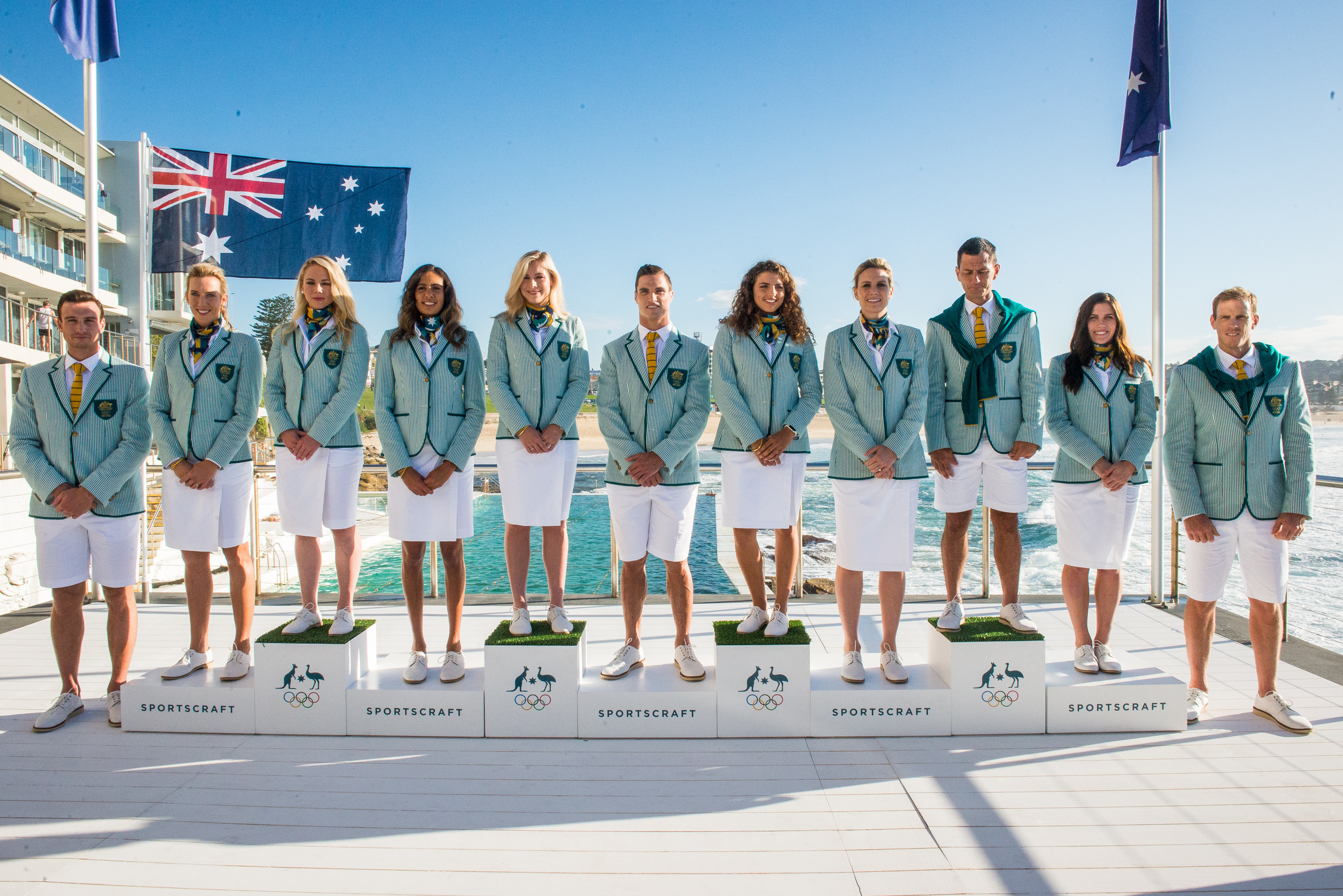
In the 2016 Olympics hosted by Brazil, the Australian Olympic team received green and white seersucker blazers and Toms Shoes rather than the traditional dark green with gold trim. At the same time, seersucker pants, skirts, espadrilles, blouses, and even bikinis were worn as casual attire by many fashion conscious young women in America.
Weaving process
Seersucker is made by slack-tension weave. The threads are wound onto the two warp beams in groups of 10 to 16 for a narrow stripe. The stripes are always in the warp direction and on grain. Today, seersucker is produced by a limited number of manufacturers. It is a low-profit, high-cost item because of its slow weaving speed.
Gallery
File:Seersucker02.jpg|Green/white checkered seersucker fabric File:Seersucker shirt.JPG|Shirt from green/white seersucker fabric File:Seersucker-sample1.jpg|Blue/white striped seersucker fabric File:Seersucker01.jpg|Green/white striped seersucker fabric File:Wikimania 2012 2226.JPG|David Ferriero, speaking at Wikimania 2012, wearing a seersucker suit Seersucker Day at US Capitol - 2019.jpg|Members of the United States Senate on Seersucker Day 2019 File:Seersucker Day 2024.jpg|US Senators on Seersucker Thursday 2024
References
References
- "The American Heritage Dictionary entry: seersucker". Houghton Mifflin Harcourt Publishing Company.
- Solomon, Michael. "The Seersucker Suit". Forbes.
- (30 April 2015). "How to Wear a Seersucker Suit". The Art of Manliness.
- (2006). "Don Troiani's Civil War Zouaves, Chasseurs, Special Branches, and Officers". Stackpole Books.
- Basso, Hamilton. (3 November 1947). "The Roosevelt Legend". Time Inc.
- (January 1866). "The Atlantic Monthly". Atlantic Monthly Company.
- Brayley, Martin. (20 February 2012). "World War II Allied Nursing Services". Bloomsbury Publishing.
- Russell, Tim. (2007). "Fill 'er Up!". Voyageur Press.
- Devine, J. P.. (3 July 2015). "All hail the man in the seersucker suit". Central Maine.
- Workers of the Writers' Program of the Works Progress Administration in the State of Arizona. (1940). "Arizona, the Grand Canyon State: A State Guide". Best Books on.
- "The Origin of the Blue and White Striped Engineer's Cap". Union Pacific Railroad Museum.
- Mazur, Jacqueline. (21 April 2016). "The history of the seersucker suit begins right here in New Orleans". WGNO.
- Taylor, Jessica. (11 June 2015). "#TBT A Brief History Of (Political) Seersucker". NPR.
- (2000). "Texas A&M University Kingsville". Arcadia Publishing.
- Schneider, Adam P.. (11 April 2007). "Suck It, Seersucker!". [[The Harvard Crimson]].
- Green, Dennis. (15 July 2015). "The big problem with seersucker is that guys have been wearing it all wrong". Business Insider.
- Marcus, Lilit. (23 June 2010). "How to Wear Seersucker Properly If You Are Not Actually Southern". The Gloss.
- Brasted, Chelsea. (5 February 2014). "Haspel family wants to make seersucker cool again, relaunches its iconic brand". NOLA.
- (September 1969). "Ebony". Johnson Publishing Company.
- Kruspe, Dana. (10 April 2014). "Trendspotting: Railroad Stripes". Fashionista.
- Davis, Jess. (22 June 2007). "Stuffy Senate smiles at seersucker suits". Scripps Howard Foundation Wire.
- Schwab, Nikki. (11 June 2015). "Trent Lott Just Can't Resist a 'Seersucker Thursday'". U.S. News & World Report.
- "9. Seersucker". AskMen.
- "Summer Pants Pick: Nautica Pants, Seersucker Pants". AskMen.
- (12 May 2014). "When Can I Wear a Seersucker Suit?". Men's Health.
- Genevieve. "How to Wear a Seersucker Suit". TheIdleMan.
- Corsillo, Liza. (11 June 2015). "How to Wear a Seersucker Suit, According to the Brand That Invented Them". Condé Nast.
- "Style Essentials #6: Blazers & Suits {{!}} Nautical Blazer Pick: Tallia Orange Seersucker Sportcoat". AskMen.
- "Brooks Bros jacket". AskMen.
- Nania, Rachel. (11 June 2015). "Parasols, picnics and pedaling: A dandy weekend for the Seersucker Social". WTOP.
- Browning, Jennifer. (29 March 2016). "Australia releases 'retro candy stripe' Rio Olympics uniform". ABC News.
- (30 March 2016). "Sportscraft unveils 2016 Opening Ceremony uniform". Australian Olympic Committee.
- Wilson, Julee. (21 May 2015). "How To Wear Seersucker Without Looking Like You're At A Country Club". The Huffington Post.
- Poland, Tom. (2019). "The Last Sunday Drive: Vanishing Traditions in Georgia and the Carolinas". The History Press.
This article was imported from Wikipedia and is available under the Creative Commons Attribution-ShareAlike 4.0 License. Content has been adapted to SurfDoc format. Original contributors can be found on the article history page.
Ask Mako anything about Seersucker — get instant answers, deeper analysis, and related topics.
Research with MakoFree with your Surf account
Create a free account to save articles, ask Mako questions, and organize your research.
Sign up freeThis content may have been generated or modified by AI. CloudSurf Software LLC is not responsible for the accuracy, completeness, or reliability of AI-generated content. Always verify important information from primary sources.
Report