From Surf Wiki (app.surf) — the open knowledge base
Second generation of video game consoles
Gaming generation from 1976 to 1992
Gaming generation from 1976 to 1992
In the history of video games, the second-generation era refers to computer and video games, video game consoles, and handheld video game consoles available from 1976 to 1992. Notable platforms of the second generation include the Fairchild Channel F, Atari 2600, Intellivision, Odyssey 2, and ColecoVision. The generation began in November 1976 with the release of the Fairchild Channel F. This was followed by the Atari 2600 in 1977, Magnavox Odyssey² in 1978, Intellivision in 1979 and then the Emerson Arcadia 2001, ColecoVision, Atari 5200, and Vectrex, all in 1982. By the end of the era, there were over 15 different consoles. It coincided with, and was partly fueled by, the golden age of arcade video games. The generation also included the entry of handheld consoles, chiefly led by Nintendo’s foray into gaming led by the Blue Ocean philosophy of Gunpei Yokoi and the release of the Game & Watch in 1980. This peak era of popularity and innovation for the medium resulted in many games for second generation home consoles being ports of arcade games. Space Invaders, the first "killer app" arcade game to be ported, was released in 1980 for the Atari 2600, though earlier Atari-published arcade games were ported to the 2600 previously.** Coleco packaged Nintendo's Donkey Kong with the ColecoVision when it was released in August 1982.
Built-in games, like those from the first generation, saw limited use during this era. Though the first generation Magnavox Odyssey had put games on cartridge-like circuit cards, the games had limited functionality and required TV screen overlays and other accessories to be fully functional. More advanced cartridges, which contained the entire game experience, were developed for the Fairchild Channel F, and most video game systems adopted similar technology. The first system of the generation and some others, such as the RCA Studio II, still came with built-in games while also being able to use cartridges. The popularity of game cartridges grew after the release of the Atari 2600. From the late 1970s to the mid-1990s, most home video game systems used cartridges until the technology was replaced by optical discs. The Fairchild Channel F was also the first console to use a microprocessor, which was the driving technology that allowed the consoles to use cartridges. Other technology such as screen resolution, color graphics, audio, and AI simulation was also improved during this era. The generation also saw the first handheld game cartridge system, the Microvision, which was released by toy company Milton Bradley in 1979.
In 1979, Activision was created by former Atari programmers and was the first third-party developer of video games. A small company through the 1980s, it gradually grew into a 21st century gaming giant. In the early 1980s, many large corporations, spurred by the success of the home video game industry and especially the VCS, launched or bought subsidiaries to produce video game console software. By 1982, the shelf capacity of toy stores was overflowing with an overabundance of consoles, over-hyped game releases, and low-quality games from new third-party developers. An over-saturation of consoles and games, coupled with poor knowledge of the market, saw the video game industry crash in 1983 and marked the start of the next generation. Beginning in December 1982 and stretching through all of 1984, the crash of 1983 caused major disruption to the North American market. Some developers collapsed and almost no new games were released in 1984. The market did not fully recover until the third generation. The second generation ended on January 1, 1992, with the discontinuation of the Atari 2600.
Background
The primary driver of the second generation of consoles was the introduction of the low-cost microprocessor. Arcade games and the first generation of consoles used discrete electronic components including simple logic chips such as transistor-transistor logic (TTL)-based integrated circuits (ICs). Custom application-specific integrated circuits (ASICs) like the AY-3-8500 were produced to replicate these circuits within a single chip, but still presented only a single fixed logic program. Once a game was shipped, there were only minimal variations that could be made by adjusting the positions of jumpers (effectively the behavior of the "cartridges" that shipped with the Magnavox Odyssey). As Atari, Inc. recognized, spending from and several months of development time on a hardware unit with a single dedicated game with only three-month shelf life before it was outdated by other competitors' offerings was not a practical business model, and instead some type of programmable console would be preferred.
Intel introduced the first microprocessor, the 4004, in 1971, a special computer chip that could be sent a simple instruction and provide its result. This allowed the ability to create software programs around the microprocessor rather than fix the logic into circuits and ICs. Engineers at both Atari, Inc. (via its Cyan Engineering subsidiary) and at Alpex Computer Corporation saw the potential to apply this to home consoles as prices for microprocessors became more affordable. Alpex's work led to partnership with semiconductor manufacturer Fairchild Camera and Instrument and lead to the release of the first such programmable home console, the Fairchild Channel F released in 1976, based on the Fairchild F8 microprocessor. The Channel F also established the use of ROM cartridges to provide the software for the programmable console, consisting of a ROM chip mounted on a circuit board within a hard casing that can withstand the physical insertion into the console and potential static electricity buildup. Atari's own programmable console, the Atari Video Computer System (Atari VCS or later known as the Atari 2600), was released in 1977 and based on the MOS Technology 6507 microprocessor, with a cartridge design influenced in part by the Channel F system. Other console manufacturers soon followed suit with the production of their own programmable consoles.
At the start of the second generation, all games were developed and produced in-house. Four former Atari programmers, having left from conflicts in management style after Atari was purchased by Warner Communications in 1976, established Activision in 1979 to develop their own VCS games, which included Dragster initially and the hits Kaboom! and Pitfall! later. Atari sued Activision and its founders on the basis of theft of trade secrets and violation of their non-disclosure agreements, and for Dragster allegedly infringing on the Drag Race arcade game from Atari's arm Kee Games; the cases were thrown out of court and the two companies settled in 1982, with Activision agreeing to pay Atari for a "technology license". This established Activision as the first third-party developer for a console. It also established a working model for other third-party developers, and several such companies followed in Activision's wake, partially contributing to the video game crash of 1983 due to oversaturation.
As the second generation of consoles coincided with the golden age of arcade video games, a common trend that emerged during the generation was licensing arcade video games for consoles. Many of them were increasingly licensed from Japanese video game companies by 1980, which led to Jonathan Greenberg of Forbes predicting in early 1981 that Japanese companies would eventually dominate the North American video game industry later in the decade.
At this stage, both consoles and game cartridges were intended to be sold for profit by manufacturers. However, by segregating games from the console, this approach established the use of the razorblade business model in future console generations, where consoles would be sold at or below cost while licensing fees from third-party games would bring in profits.
Fairchild Channel F
Main article: Fairchild Channel F
The Fairchild Channel F, also known early in its life as the Fairchild Video Entertainment System (VES), was released by Fairchild Semiconductor in November 1976 and was the first console of the second generation. It was the world's first CPU-based video game console, introducing the cartridge-based game-code storage format. The console featured a pause button that allowed players to freeze a game. This allowed them to take a break without the need to reset or turn off the console so they did not lose their current game progress. Fairchild released twenty-six cartridges for the system, with up to four games being on each cartridge. The console came with two pre-installed games, Hockey and Tennis.
Following the release of the Atari 2600, the Channel F's popularity waned quickly as the more action-driven games of the Atari 2600 drew more attention than the more educational and slow-paced games on the Channel F. By 1979, only an additional 100,000 units of the Channel F were sold for lifetime sales of 350,000.
In 1978, Fairchild redesigned the system into a new model, the Channel F System II. The System II streamlined some of the initial Channel F to reduce cost and improve consumer usage compared to the Atari 2600, such as improved controller connections and using the television speakers for audio output, but by the time it was released, the Atari 2600 had too much market advantage for Fairchild to overcome. After releasing 21 games for the system, Fairchild sold the Channel F technology to Zircon International in 1979, who then discontinued the system by 1983.
Atari 2600 and 5200
Main article: Atari 2600, Atari 5200
In 1977, Atari released its CPU-based console called the Video Computer System (VCS), later called the Atari 2600. Nine games were designed and released for the holiday season. Atari held exclusive rights to most of the popular arcade game conversions of the day. They used this key segment to support their older hardware in the market. This game advantage and the difference in price between the machines meant that each year, Atari sold more units than Intellivision, lengthening its lead despite inferior graphics. The Atari 2600 sold over 30 million units over its lifetime, considerably more than any other console of the second generation. In 1982, Atari released the Atari 5200 in an attempt to compete with the Intellivision. While superior to the 2600, poor sales and lack of new games meant Atari only supported it for two years before it was discontinued.
Early Atari 2600 cartridges contained 2 kilobytes of read-only storage. This limit grew steadily from 1978 to 1983: up to 16 kilobytes for Atari 5200 cartridges. The Atari 2600 directly supports up to 4 kilobytes (4096 bytes) of cartridge ROM. Bank switching, a technique that allows two or more different parts of the program to use the same memory addresses, was required for the larger cartridges to work. The Atari 2600 cartridges got as large as 32 kilobytes through this technique. The Atari 2600 has only 128 bytes of RAM available in the console. A few late game cartridges contain a combined RAM/ROM chip, or an additional separate RAM chip, thus adding another 256 bytes or more (up to 2 kilobytes) of RAM inside the cartridge itself. The Atari 2600 standard joystick is a digital controller with a single button, released in 1977. The Atari 2600 also supports 4 analog paddle controllers (or, in theory, 2 analog joysticks).
Bally Astrocade
Main article: Bally Astrocade
The Bally Astrocade was released in 1977 and was available only through mail order. It was originally referred to as the Bally Home Library Computer. Delays in the production meant that none of the units shipped until 1978. By this time, the machine had been renamed the Bally Professional Arcade. In this form, it sold mostly at computer stores and had little retail exposure, unlike the Atari VCS. The rights to the console were sold to Astrovision in 1981. They re-released the unit with the BASIC cartridge included for free; this system was known as the Bally Computer System. When Astrovision changed their name to Astrocade in 1982 they also changed the name of the console to the Astrocade to follow suit. It sold under this name until the video game crash of 1983 when it was discontinued.
Magnavox Odyssey 2
Main article: Magnavox Odyssey 2
In 1978, Magnavox released its microprocessor-based console, the Odyssey 2, in the United States and Canada. It was distributed by Philips Electronics in the European market and was released as the Philips G7000. A defining feature of the system was the speech synthesis unit add-on which enhanced music, sound effects and speech capabilities. The Odyssey² was also known for its fusion of board and video games. Some titles came with a game board and pieces which players had to use in conjunction to play the game. Although the Odyssey² never became as popular as the Atari consoles, it sold 2 million units throughout its lifetime. This made it the third best selling console of the generation. It was discontinued in 1984.
Intellivision
Main article: Intellivision
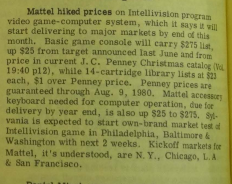
The Intellivision was introduced by Mattel to test markets in 1979 and nationally in 1980. The Intellivision console contained a 16-bit processor with 16-bit registers and 16-bit system RAM. This was long before the "16-bit era". Programs were however stored on 10-bit ROM. It also featured an advanced sound chip that could deliver output through three distinct sound channels. The Intellivision was the first console with a thumb-pad directional controller and tile-based playfields with vertical and horizontal scrolling. The system's initial production run sold out shortly after its national launch in 1980. Early cartridges were 4 kilobyte ROMs, which grew to 24 kilobytes for later games.
The Intellivision introduced several new features to the second generation. It was the first home console to use a 16-bit microprocessor and offer downloadable content through the PlayCable service. It also provided real-time human voices during gameplay. It was the first console to pose a serious threat to Atari's dominance. A series of TV advertisements featuring George Plimpton were run. They used side-by-side game comparisons to show the improved graphics and sound compared with those of the Atari 2600. It sold over 3 million units before being discontinued in 1990.
ColecoVision
Main article: ColecoVision
The ColecoVision was introduced by toy manufacturer Coleco in August 1982. It was more powerful than previous consoles, providing an experience that was closer to Arcades than what the 2600 could provide. The console launched with several arcade ports, including Sega's Zaxxon, and later saw third-party support from many developers such as Activision and even their competitor Atari. The ColecoVision is notable for its Atari 2600 expansion module, which enabled the console to play 2600 games, resulting in a lawsuit from Atari. The ColecoVision was a victim of the video game crash, ultimately being discontinued in 1985.
Vectrex
Main article: Vectrex
The Vectrex was released in 1982. It was unique among home systems of the time in featuring vector graphics and its own self-contained display (necessitated by the fact that a normal TV set cannot display vector graphics, since the TV is a raster display.) At the time, many of the most popular arcade games, such as Asteroids, used vector displays. Through a licensing deal with Cinematronics, GCE was able to produce high-quality versions of arcade games such as Space Wars and Armor Attack. Despite a strong library of games and good reviews, the Vectrex was ultimately a commercial failure. It was on the market for less than two years.
Comparison
| Name | Fairchild Channel F | Atari 2600 | Bally Astrocade | Magnavox Odyssey² | Intellivision | Manufacturer | Image(s) | Release date | Launch price | US$ | GBP | JP¥ | Media | Type | Regional lockout | Backward compatibility | Top-selling games | Accessories (retail) | CPU | Memory | Video | Resolution | Palette | Colors on Screen | Sprites | Other | Audio | |||||||||||||||||
|---|---|---|---|---|---|---|---|---|---|---|---|---|---|---|---|---|---|---|---|---|---|---|---|---|---|---|---|---|---|---|---|---|---|---|---|---|---|---|---|---|---|---|---|---|
| Fairchild Semiconductor | Atari | Bally Technologies | Magnavox | Mattel | ||||||||||||||||||||||||||||||||||||||||
| [[File:Fairchild-Channel-F.png | 120px]] | |||||||||||||||||||||||||||||||||||||||||||
| [[File:Fairchild-Channel-F-System-II-Console.png | 120px]] | [[File:Atari-2600-Wood-4Sw-Set.png | 120px]] | |||||||||||||||||||||||||||||||||||||||||
| [[File:Atari-2600-Console.jpg | 120px]] | [[File:Bally-Arcade-Console.png | 120px]] | [[File:Magnavox-Odyssey-2-Console-Set.png | 120px]] | [[File:Intellivision-Console-Set.png | 120px]] | |||||||||||||||||||||||||||||||||||||
| [[File:Intellivision-II-Console-Set.png | 120px]] | |||||||||||||||||||||||||||||||||||||||||||
| US$169.95 () | last=Dornbush | first=Jonathon | date=October 4, 2016 | title=Update: Comparing the Price of Every Game Console, With Inflation | url=https://www.ign.com/articles/2016/10/04/comparing-the-price-of-every-game-console-with-inflation | url-status=live | archive-url=https://web.archive.org/web/20190121064723/https://www.ign.com/articles/2016/10/04/comparing-the-price-of-every-game-console-with-inflation | archive-date=January 21, 2019 | access-date=January 20, 2019 | website=IGN | language=en-US}} () | US | 299 | r=-1 | 1977 | fmt=eq}}) | US$200 () | title=Television Digest | url=https://www.atariarchive.org/wp-content/uploads/2020/10/Weekly-Television-Digest-1979-10-15.png | access-date=25 October 2020 | date=1979-10-15}} () | |||||||||||||||||||||||
| () | () | |||||||||||||||||||||||||||||||||||||||||||
| JP¥49,800 () | () | |||||||||||||||||||||||||||||||||||||||||||
| Cartridge | Cartridge (and Cassette via special 3rd party attachment) | Cartridge and cassette/Floppy, available with ZGRASS unit | Cartridge | Cartridge | ||||||||||||||||||||||||||||||||||||||||
| Unrestricted | Unrestricted | Unrestricted | Unrestricted | Unrestricted | ||||||||||||||||||||||||||||||||||||||||
| Atari 2600 games through the System Changer module | ||||||||||||||||||||||||||||||||||||||||||||
| Videocart-17: Pinball Challenge | Pac-Man, 7 million (as of September 1, 2006) | Unknown | Unknown | Las Vegas Poker & Blackjack, 1.939 million | ||||||||||||||||||||||||||||||||||||||||
| Major League Baseball, 1.085 million (as of June 1983) | ||||||||||||||||||||||||||||||||||||||||||||
| 1.79 MHz (PAL 2.00 MHz) Fairchild F8 | 1.19 MHz MOS Technology 6507 | 1.789 MHz Zilog Z80 | 1.79 MHz Intel 8048 8-bit microcontroller | 2 MHz General Instrument CP1610 | ||||||||||||||||||||||||||||||||||||||||
| 64 bytes scratchpad in 3850 CPU | ||||||||||||||||||||||||||||||||||||||||||||
| Video RAM 2 kB (2×128×64 bits) | 128 bytes RAM within MOS Technology RIOT chip (additional RAM may be included in game cartridges) | Main RAM 4 kB (up to 64 kB with external modules in the expansion port) | CPU-internal RAM: 64 bytes | |||||||||||||||||||||||||||||||||||||||||
| Audio/video RAM: 128 bytes | 352 x 16-bit system RAM | |||||||||||||||||||||||||||||||||||||||||||
| Vertical and horizontal scrolling | ||||||||||||||||||||||||||||||||||||||||||||
| Mono audio with: | Mono audio with: | Mono audio with: | Mono audio with: | Mono audio with: |
| Name | Emerson Arcadia 2001 | ColecoVision | Atari 5200 | Vectrex | Manufacturer | Image(s) | Release date | Launch price | US$ | GBP | JP¥ | Media | Type | Regional lockout | Backward compatibility | Top-selling games | Accessories (retail) | CPU | Memory | Video | Resolution | Palette | Colors on Screen | Sprites | Other | Audio | ||||||||
|---|---|---|---|---|---|---|---|---|---|---|---|---|---|---|---|---|---|---|---|---|---|---|---|---|---|---|---|---|---|---|---|---|---|---|
| Emerson Radio Corporation | Coleco | Atari | General Consumer Electric and Milton Bradley | |||||||||||||||||||||||||||||||
| [[File:Emerson-Arcadia-2001.png | 120px]] | [[File:ColecoVision-wController-L.jpg | 120px]] | [[File:Atari-5200-Console-Set.png | 120px]] | [[File:Vectrex-Console-Set.png | 120px]] | |||||||||||||||||||||||||||
| US$200 () | US | 175 | 1982 | r=-1 | fmt=eq}}) | US | 270 | 1982 | r=-1 | fmt=eq}}) | US$199 () | |||||||||||||||||||||||
| () | ||||||||||||||||||||||||||||||||||
| JP¥19,800 () | ||||||||||||||||||||||||||||||||||
| Cartridge | Cartridge and Cassette, available with Expansion #3 | Cartridge | Cartridge | |||||||||||||||||||||||||||||||
| Unrestricted | Unrestricted | Unrestricted | Unrestricted | |||||||||||||||||||||||||||||||
| Compatible with Atari 2600 Via Expansion #1 | Atari 2600 games through the 2600 cartridge adapter | |||||||||||||||||||||||||||||||||
| N/A | Donkey Kong (pack-in) | N/A | N/A | |||||||||||||||||||||||||||||||
| N/A | ||||||||||||||||||||||||||||||||||
| 3.58 MHz Signetics 2650 CPU | 3.58 MHz Zilog Z80A | 1.79 MHz Custom MOS 6502C | 1.5 MHz Motorola 68A09 | |||||||||||||||||||||||||||||||
| 512 bytes RAM | Main RAM 1 kB | |||||||||||||||||||||||||||||||||
| Video RAM 16 kB | Main RAM 16 kB DRAM | Main RAM 1 kB | ||||||||||||||||||||||||||||||||
| Mono audio with: | Mono audio with: | Mono audio with: | Mono audio (built-in speaker) |
Sales standings
The best-selling console of the second generation was the Atari 2600 at 30 million units. As of 1990, the Intellivision had sold 3 million units. This is around 1 million higher than the Odyssey² and ColecoVision sales and eight times the number of purchases for the Fairchild Channel F, which was 350,000 units.
| Console | Units sold worldwide | |||||||||
|---|---|---|---|---|---|---|---|---|---|---|
| Atari 2600 | 30 million (as of 2004) | |||||||||
| Intellivision | url=http://www.intellivisiongames.com/history.php | title=Intellivision Productions Timeline | publisher=Intellivision Productions | access-date=November 3, 2008 | archive-url=https://web.archive.org/web/20131126074151/http://www.intellivisiongames.com/history.php | archive-date=November 26, 2013 | url-status=dead}} | |||
| ColecoVision | date=1983 | title=Coleco Industries, Inc. 1983 Annual Report | url=http://atariage.com/forums/topic/283473-coleco-industries-inc-annual-quarterly-reports-1981-to-1986/ | publisher=Coleco Industries, Inc. | page=3 | quote=The year's sales of 1.5 million ColecoVision units brought the installed base to over 2 million units worldwide. | access-date=January 17, 2019 | archive-url=https://web.archive.org/web/20190424052054/https://atariage.com/forums/topic/283473-coleco-industries-inc-annual-quarterly-reports-1981-to-1986/ | archive-date=April 24, 2019 | url-status=live}} |
| Magnavox Odyssey² | 2 million (as of 2005) | |||||||||
| Atari 5200 | last=Schrage | first=Michael | date=May 22, 1984 | title=Atari Introduces Game In Attempt for Survival | newspaper=Washington Post | page=C3 | quote=The company has stopped producing its 5200 SuperSystem games player, more than 1 million of which were sold.}} | |||
| Fairchild Channel F | 350,000 (as of 1979) | |||||||||
| Bally Astrocade | ||||||||||
| Emerson Arcadia 2001 | ||||||||||
| Vectrex |
Other consoles
File:RCA-Studio-II-FL.jpg|RCA Studio II (released in 1977) File:Acetronic-MPU-1000.png|1292 Advanced Programmable Video System (released in 1978) File:VC-4000-Console-Set.png|VC 4000 (released in 1978) File:APF-MP1000-FL.jpg|APF-MP1000 (released in 1978) File:Blank.svg|Unisonic Champion 2711 (released in 1978) File:Bandaisupervisionconsole.jpg|Bandai Super Vision 8000 (released in 1979) File:Epoch-Cassette-Vision-Console.png|Epoch Cassette Vision (released in 1981) File:CreatiVision-Console-Set.png|VTech CreatiVision (released in 1981) File:Compact Vision TV Boy, Gakken 01.png|Compact Vision TV Boy (released in 1983)
Handheld systems
Nintendo Game & Watch
Main article: Game & Watch
The Game & Watch was a series of 60 handheld consoles that contained a single game in each release. The first, titled "Ball" was released in 1980 and titles were released up until it was discontinued in 1991. Unlike the other handheld consoles in the second generation, the Game & Watch had a segmented LCD screen similar to a digital watch which limited the display to the configuration of the segments. The series sold a combined 43.4 million units, making it the most popular handheld of the generation.
Microvision
Main article: Microvision
The Microvision, manufactured and sold by Milton-Bradley. was released in 1979. It was the first handheld game console that used cartridges that could be swapped out and that contained their own processor as the console itself had no on-board processor. It had a small game library which was prone to damage from static electricity and the LCD screen could also rot. These two factors contributed to its discontinuation two years after release.
Entex Select-A-Game and Adventure Vision
Entex released two handheld systems in the second generation, the Select-A-Game and the Adventure Vision. There were 6 games available for the Select-A-Game but it was only available for a year until focus shifted to the Adventure Vision which was released in the following year.
The Adventure Vision was released only in North America in 1982 by Entex and was the successor to the Select-A-Game. It was unique among the consoles as it used a spinning mirror system for its built-in display and had to be used set down on a surface due to its size and shape. It was discontinued one year later in 1983 after selling just over fifty thousand units.
Palmtex Super Micro
Developed and manufactured by Palmtex, the Super Micro was released in 1984 and discontinued later that year. Due to financial problems between Palmtex and Home Computer Software, only three games were released for the system despite more being planned. It was criticized for its poor build quality and how easily it would break, and sold fewer than 37,000 units.
Epoch Game Pocket Computer
Main article: Epoch Game Pocket Computer
The Epoch Game Pocket Computer was released in Japan in 1984. Due to poor sales, only five games were made for it and was not released outside of Japan.
Comparison
| Console | Microvision | Entex Select-A-Game | Adventure Vision | Manufacturer | Image | Release date | Launch price | Units sold | Media | CPU | Memory | Video | Audio | |||
|---|---|---|---|---|---|---|---|---|---|---|---|---|---|---|---|---|
| Milton Bradley | Entex Industries | Entex Industries | ||||||||||||||
| **[[File:Milton-Bradley-Microvision-Handheld-FL.jpg | 120px]]** | **[[File:Entex-SelectAGame.jpg | 120px]]** | **[[File:Entex-AdventureVision.jpg | 120px]]** | |||||||||||
| November 1979 | 1981 | 1982 | ||||||||||||||
| US$49.99 () | US$59 () | US$79.99 () | ||||||||||||||
| Unknown | Unknown | 50,757 | ||||||||||||||
| Cartridge | Cartridge | Cartridge | ||||||||||||||
| 100 kHz TI TMS1100 or Intel 8021 within cartridge | Hitachi HD38800 within cartridge | 733 kHz Intel 8048 | ||||||||||||||
| 64 B RAM | 64 B RAM (on CPU) | |||||||||||||||
| 16 x 16 pixel LCD | 7 x 16 pixel VFD | 150 x 40 pixel spinning mirror system | ||||||||||||||
| Piezo Buzzer | National Semiconductor COP411L @ 52.6 kHz |
| Console | Super Micro | Epoch Game Pocket Computer | Game & Watch series | Manufacturer | Image | Release date | Launch price | Units sold | Media | Top-selling games | CPU | Memory | Video | Audio | |||
|---|---|---|---|---|---|---|---|---|---|---|---|---|---|---|---|---|---|
| Palmtex | Epoch | Nintendo | |||||||||||||||
| **[[File:Palmtex-SuperMicro.jpg | 120px]]** | **[[File:Epoch-Game-Pocket-Computer-FL.jpg | 120px]]** | **[[File:Game & Watch Ball.jpg | 120px]]** | ||||||||||||
| May 1984 | November 1984 | 1980-1991 | |||||||||||||||
| US$39.95 () | ¥12,800 () | ¥5,800 () | |||||||||||||||
| Fewer than 37,200 | Unknown | 43.4 million | |||||||||||||||
| Cartridge | Cartridge | 1 built in game per device | |||||||||||||||
| Unknown | Unknown | Donkey Kong (8 million) | |||||||||||||||
| None (CPU was contained within the cartridge) | 6 MHz NEC D78c06 | Sharp SM5xx series | |||||||||||||||
| 2KB RAM | 260B RAM | ||||||||||||||||
| 32 x 16 pixel LCD | 75 x 64 pixel LCD | Segmented LCD | |||||||||||||||
| Piezo Buzzer |
Software
Milestone titles
- Advanced Dungeons and Dragons: Cloudy Mountain (Intellivision) by Mattel Electronics won an award in the "1984 Best Adventure Videogame" category at the 5th Annual Arkie Awards. It was the first Intellivision cartridge to have more than 4K of ROM.
- Adventure (Atari 2600) by Atari, Inc. was the first action-adventure video game and first console fantasy game. It is considered to have played an important role in the advancement of home video games and one of the best Atari 2600 titles.
- Asteroids (arcade port) (Atari 2600) was the first game on the 2600 to utilize the bank-switching technique.
- Baseball (Intellivision) by Mattel was the console's best selling title with over one million copies sold.
- Demon Attack (Atari 2600) by Imagic was released in 1983. It won the 1983 Arcade Award for "Best Videogame of the Year". It was the company's best selling game and is considered a classic of the Atari 2600.
- Donkey Kong (arcade port) (ColecoVision) by Coleco was praised for being faithful to the original arcade game. Critics considered it the best version out of the ColecoVision, Atari and Intellivision ports.
- E.T. the Extra-Terrestrial (Atari 2600), released in 1982, is often credited as being one of the worst games of all time. Some believe the game played a significant role in the video game crash of 1983.
- Microsurgeon (Intellivision) by Imagic was praised for its originality. It was included in "The Art of Video Games" exhibit at the Smithsonian Institution in 2012.
- Missile Command (arcade port) (Atari 2600) by Atari, Inc. was released in 1981 and sold more than 2.5 million copies. This made it the third best selling game on the console.
- Pitfall! (Atari 2600) by Activision, released in 1982, was one of the best selling games for the Atari 2600, selling over 4 million copies. Pitfall popularized the side-scrolling platformer genre.
- Pitfall II: Lost Caverns (Atari 2600) by Activision, released in 1984, was one of the most technically impressive titles for the 2600. It came with a specialized audio chip on the cartridge that allowed for advanced music capabilities where music could be changed dynamically.
- River Raid (Atari 2600) by Activision was the first video game to be banned for minors in West Germany. Despite this, it was still one of the most popular titles for the Atari 2600 and won an award for "1984 Best Action Videogame".
- Space Invaders (arcade port) (Atari 2600) by Taito was the first official licensing of an arcade game and was the first "killer app" for video game consoles. Its release saw sales of the Atari 2600 quadruple
- Star Wars: The Empire Strikes Back (Atari 2600) by Parker Brothers was the first officially licensed video game of the Star Wars franchise.
- Utopia (Intellivision) by Don Daglow is often credited with being the first real-time strategy that laid the foundation for many games within the genre.
- Zaxxon (arcade port) (ColecoVision) by Sega was the first home console game to use isometric graphics.
References
References
- Leigh, Peter. (November 1, 2018). "The Nostalgia Nerd's Retro Tech: Computer, Consoles & Games". Octopus.
- Forster, Winnie. (2005). "The encyclopedia of consoles, handhelds & home computers 1972-2005". GAMEPLAN.
- Matthewson, David K.. (1982). "Beginner's Guide to Video". Butterworth.
- Wolf, Mark J. P.. (2012). "Encyclopedia of Video Games: The Culture, Technology, and Art of Gaming". ABC-CLIO.
- Barton, Matt and Loguidice, Bill. (2007). [https://www.gamedeveloper.com/design/a-history-of-gaming-platforms-the-vectrex A History of Gaming Platforms: The Vectrex] , Gamasutra.
- Campbell, Stuart. (September 2007). "The Definitive Space Invaders". [[Imagine Publishing]].
- Cohen, D. S.. (September 18, 2018). "Jerry Lawson - First Black Video Game Professional".
- Dillon, Roberto. (2011). "The Golden Age of Video Games". A K Peter/CRC Press.
- Kent, Steven L.. (2001). "[[The Ultimate History of Video Games]]". Three Rivers Press.
- Hardawar, Devindra. (February 20, 2015). "Jerry Lawson, a self-taught engineer, gave us video game cartridges".
- Weiss, Brett. (April 4, 2011). "Classic Home Video Games, 1972_1984: A Complete Reference Guide". McFarland.
- (December 26, 1982). "Stream of video games is endless". Milwaukee Journal.
- Kleinfield, N.R.. (October 17, 1983). "Video Games Industry Comes Down To Earth". [[The New York Times]].
- Dvorchak, Robert. (July 30, 1989). "NEC out to dazzle Nintendo fans". The Times-News.
- Wolf, Mark J. P.. (2008). "The Video Game Explosion: A History from PONG to Playstation and Beyond". ABC-CLIO.
- (2009). "[[Racing the Beam]]". [[MIT Press]].
- Fulton, Steve. (November 6, 2007). "The History of Atari: 1971-1977". [[Gamasutra]].
- Edwards, Benj. (January 22, 2015). "The Untold Story Of The Invention Of The Game Cartridge". [[Fast Company]].
- Flemming, Jeffrey. "The History Of Activision". Gamasutra.
- (December 2, 1981). "Atari v Activision suit dropped". The Los Angeles Times.
- "Atari: The Golden Years -- A History, 1978-1981".
- Hunter, William. (2025-04-14). "Activision".
- Greenberg, Jonathan. (April 13, 1981). "Japanese invaders: Move over Asteroids and Defenders, the next adversary in the electronic video game wars may be even tougher to beat".
- Ernkvist, Mirko. (2008). "History of Insolvancy and Bankruptcy". Södertörns högskola.
- (Spring 2004). "Use of a Game Over: Emulation and the Video Game Industry, A White Paper". Northwestern Journal of Technology and Intellectual Property.
- Manuela, Cruz-Cunha, Maria. (February 29, 2012). "Handbook of Research on Serious Games as Educational, Business and Research Tools". IGI Global.
- Wolf, Mark. (2008). "The Video Game Explosion: A History from PONG to Playstation and Beyond". Greenwood Press.
- Weiss, Brett. (December 20, 2011). "Classic Home Video Games, 1972-1984: A Complete Reference Guide". McFarland.
- Barton, Matt. (January 9, 2009). "The History Of Pong: Avoid Missing Game to Start Industry".
- Edwards, Benj. (January 22, 2015). "The Untold Story Of The Invention Of The Game Cartridge". [[Fast Company]].
- (February 28, 2008). "A History of Gaming Platforms: Atari 2600 Video Computer System/VCS". [[Gamasutra]].
- (May 8, 2008). "A History of Gaming Platforms: Mattel Intellivision".
- Dillon, Roberto. (April 19, 2016). "The Golden Age of Video Games: The Birth of a Multibillion Dollar Industry". CRC Press.
- Wolf, Mark J. P.. (2012). "Encyclopedia of Video Games: The Culture, Technology, and Art of Gaming". ABC-CLIO.
- (2009). "[[Racing the Beam: The Atari Video Computer System]]". [[MIT Press]].
- The Atari 2600 game cartridge Burgertime, from M-Network, contains 2 KB of RAM.
- (February 28, 2008). "A History of Gaming Platforms: Atari 2600 Video Computer System/VCS".
- Atari never sold a 2600-compatible analog joystick, and no known games for the 2600 supported an analog joystick. The Atari 5200, in contrast, has only analog joysticks which are non-centering (unsprung), unlike most arcade machine joysticks.
- (1977). "Scientific American Magazine".
- Weiss, Brett. (April 4, 2011). "Classic Home Video Games, 1972_1984: A Complete Reference Guide". McFarland.
- Wolf, Mark J. P.. (November 21, 2018). "The Routledge Companion to Media Technology and Obsolescence". Routledge.
- (May 2009). "Game Informer Magazine: For Video Game Enthusiasts". Sunrise Publications.
- Bernal-Merino, Miguel Á. (September 19, 2014). "Translation and Localisation in Video Games: Making Entertainment Software Global". Routledge.
- Goodman, Danny. (Spring 1983). "Home Video Games: Video Games Update".
- Forster, Winnie. (2005). "The encyclopedia of consoles, handhelds & home computers 1972 - 2005". GAMEPLAN.
- "The Odyssey2 Timeline! - The Odyssey² Homepage!".
- "Ask Hal: Frequently Asked Questions to the Blue Sky Rangers". Intellivision Productions.
- Barton, Matt and Loguidice, Bill. (May 8, 2008). [https://www.gamedeveloper.com/game-platforms/a-history-of-gaming-platforms-mattel-intellivision A History of Gaming Platforms: Mattel Intellivision] , Gamasutra.
- (May 1997). "No. 9 Games by Wire". [[Imagine Media]].
- "Mattel Intellivision — 1980–1984". IGN.
- Forster, Winnie. (2005). "The encyclopedia of consoles, handhelds & home computers 1972–2005". GAMEPLAN.
- Aeppel, Timothy. (December 10, 1982). "Zap! Pow! Video games sparkle in holiday market". Christian Science Monitor.
- "Galaxian (ColecoVision) - The Cutting Room Floor".
- (March 12, 1983). "Atari-Coleco Pact". the New York Times.
- Barton, Matt and Loguidice, Bill. (2007). [https://www.gamedeveloper.com/design/a-history-of-gaming-platforms-the-vectrex A History of Gaming Platforms: The Vectrex] , Gamasutra.
- Herman, Leonard. (January 1, 1997). "Phoenix: The Fall & Rise of Videogames". Rolenta Press.
- Weiss, Brett. (December 20, 2011). "Classic Home Video Games, 1972-1984: A Complete Reference Guide". McFarland.
- Wolf, Mark J. P.. (2012). "Encyclopedia of Video Games: The Culture, Technology, and Art of Gaming". ABC-CLIO.
- Dornbush, Jonathon. (October 4, 2016). "Update: Comparing the Price of Every Game Console, With Inflation".
- (1979-10-15). "Television Digest".
- (November 1, 1981). "Close Encounters of a Hazardous Kind".
- Mabuchi, Hiroaki. (December 29, 2016). "テレビテニスから始まった国内家庭用ゲーム機の移り変わり".
- NTSC games can display wrong colors, slow speed and sound on PAL systems and vice versa.
- Jeremy Reimer. (September 1, 2006). "EA's Madden 2007 sells briskly, but are games gaining on movies?".
- Kent, Steven. (2001). "The Ultimate History of Video Games". [[Three Rivers Press]].
- Fox, Matt. (December 1, 2012). "The Video Games Guide: 1,000+ Arcade, Console and Computer Games, 1962-2012, 2d ed.". McFarland.
- (1998). "Intellivision Lives CD PC/Mac". Intellivision Productions.
- Wolf, Mark J. P.. (June 15, 2012). "Before the Crash: Early Video Game History". Wayne State University Press.
- Vertical resolution is technically limited only by the TV raster format (NTSC 262 or 263 lines/frame) and the need for a vertical blanking interval.
- Cohen, Henry. (1982). "Electronic Games".
- Kent, Steven L.. (2000). "The First Quarter: A 25-Year History of Video Games". BWD Press.
- (July 1983). "Computers and Video Games".
- M.B. Mook. (2016). "Nostalgic Famicon Perfect Guide".
- (October 18, 2018). "Atari 8-bit Forever by Bostjan Gorisek".
- (December 1985). "Atari Fine Scrolling". Compute!.
- Ciesla, Robert. (July 19, 2017). "Mostly Codeless Game Development: New School Game Engines". Apress.
- "Mattel Intellivision – 1980–1984". [[IGN]].
- ^ Forster, Winnie (2005). The encyclopedia of consoles, handhelds & home computers 1972 – 2005. GAMEPLAN. p. 30. {{ISBN. 3-00-015359-4.
- (April 17, 1984). "Coleco Industries sales report". PR Newswire.
- "Intellivision Productions Timeline". Intellivision Productions.
- (1983). "Coleco Industries, Inc. 1983 Annual Report". Coleco Industries, Inc..
- Schrage, Michael. (May 22, 1984). "Atari Introduces Game In Attempt for Survival". Washington Post.
- Edwards, Benj. (October 27, 2017). "Rediscovering History's Lost First Female Video Game Designer". Fast Company.
- Lithner, Martin Tobias. (January 14, 2019). "Super Retro:id: A Collector's Guide to Vintage Consoles". BoD - Books on Demand.
- Fox, Matt. (2012-12-01). "The Video Games Guide: 1,000+ Arcade, Console and Computer Games, 1962-2012, 2d ed.". McFarland.
- Baker, Kevin. (May 23, 2013). "The Ultimate Guide to Classic Game Consoles". eBookIt.com.
- Weiss, Brett. (2007). "Classic Home Video Games, 1972-1984: A Complete Reference Guide". McFarland.
- Blythe, Daniel. (December 13, 2011). "Collecting Gadgets and Games from the 1950s-90s". Pen and Sword.
- Weiss, Brett. (December 20, 2011). "Classic Home Video Games, 1972-1984: A Complete Reference Guide". McFarland.
- Amos, Evan. (November 6, 2018). "The Game Console: A Photographic History from Atari to Xbox". No Starch Press.
- Amos, Evan. (November 6, 2018). "The Game Console: A Photographic History from Atari to Xbox". No Starch Press.
- コアムックシリーズNO.682『電子ゲーム なつかしブック』p.46.
- (1997). "Excitable Speech: A Politics of the Performative". Psychology Press.
- (February 19, 2014). "Milton Bradley Microvision – Pop Culture Maven".
- Amos, Evan. (November 6, 2018). "The Game Console: A Photographic History from Atari to Xbox". No Starch Press.
- (July 1983). "Hand-Held Cartridges". Publications International.
- 功, 山崎. (April 20, 2018). "懐かしの電子ゲーム大博覧会". 主婦の友社.
- (April 2010). "Iwata Asks".
- "Iwata Asks".
- (January 1984). "Arcade Alley: The Arcade Awards, Part 1". Reese Communications.
- Andersen, Helge. (December 1983). "Intellivision: Spiel Perfekt". [[TeleMatch]].
- Buchana, Levi. (August 26, 2008). "Top 10 Best-Selling Atari 2600 Games".
- Wolf, Mark J. P.. (2001). "The Medium of the Video Game". University of Texas Press.
- (2013). "The Video Game Theory Reader". Routledge.
- (January 29, 2004). "Hardware Hacking: Have Fun while Voiding your Warranty". Elsevier.
- (June 1983). "The Players Guide to Fantasy Games". Electronic Games.
- Weiss, Brett Alan. "Demon Attack". [[AllGame]].
- (February 1983). "Arcade Alley: The Fourth Annual Arcade Awards". Reese Communications.
- link. (March 23, 2018 ". ''[[Gamasutra]]''. February 28, 2008.)
- Katz, Arnie. (September 26, 1982). "Arcade Express". Reese Publishing Co..
- "E.T.™ NEEDS YOUR HELP!". [[Atari Age]].
- Guins, Raifrod. (2009). "Concrete and Clay: The Life and Afterlife of E.T. The Extra-Terrestrial for the Atari 2600". Design and Culture.
- (August 12, 1985). "Is the PCJr Doomed To Be Landfill?". [[InfoWorld]].
- "Exhibitions: The Art of Video Games / American Art". Americanart.si.edu.
- Wallis, Alistair. (November 23, 2006). "Playing Catch Up: Night Trap 's Rob Fulop".
- (August 26, 2008). "Top 10 Best-Selling Atari 2600 Games".
- Cifaldi, Frank. (September 6, 2012). "Living in Pitfall! 's shadow".
- (2009). "[[Racing the Beam: The Atari Video Computer System]]". [[MIT Press]].
- Morales, Aaron. (January 25, 2013). "The 10 best Atari games".
- "The Giant List of Classic Game Programmers".
- (January 1, 2008). "Top 25 Atari 2600 Games". Imagine Publishing Ltd.
- Santos, Wayne. (December 1, 2006). "GameAxis Unwired". SPH Magazines.
- Wolf, Mark J. P.. (January 1, 2012). "Encyclopedia of Video Games: A-L". ABC-CLIO.
- (February 1984). "Arcade Alley: The 1984 Arcade Awards, Part II". Reese Communications.
- Kent, Steven. (2001). "Ultimate History of Video Games". [[Three Rivers Press]].
- Weiss, Brett. (2007). "Classic home video games, 1972–1984: a complete reference guide". [[McFarland & Company.
- (2009). "[[Racing the Beam: The Atari Video Computer System]]". [[The MIT Press]].
- Moss, Richard. (September 15, 2017). "Build, gather, brawl, repeat: The history of real-time strategy games".
- (2009). "Vintage Games: An Insider Look at the History of Grand Theft Auto, Super Mario, and the Most Influential Games of All Time". [[Focal Press]].
- (October 8, 2013). "The Video Game Theory Reader". Routledge.
This article was imported from Wikipedia and is available under the Creative Commons Attribution-ShareAlike 4.0 License. Content has been adapted to SurfDoc format. Original contributors can be found on the article history page.
Ask Mako anything about Second generation of video game consoles — get instant answers, deeper analysis, and related topics.
Research with MakoFree with your Surf account
Create a free account to save articles, ask Mako questions, and organize your research.
Sign up freeThis content may have been generated or modified by AI. CloudSurf Software LLC is not responsible for the accuracy, completeness, or reliability of AI-generated content. Always verify important information from primary sources.
Report