From Surf Wiki (app.surf) — the open knowledge base
Seashell surface
Mathematical spiral-type surface
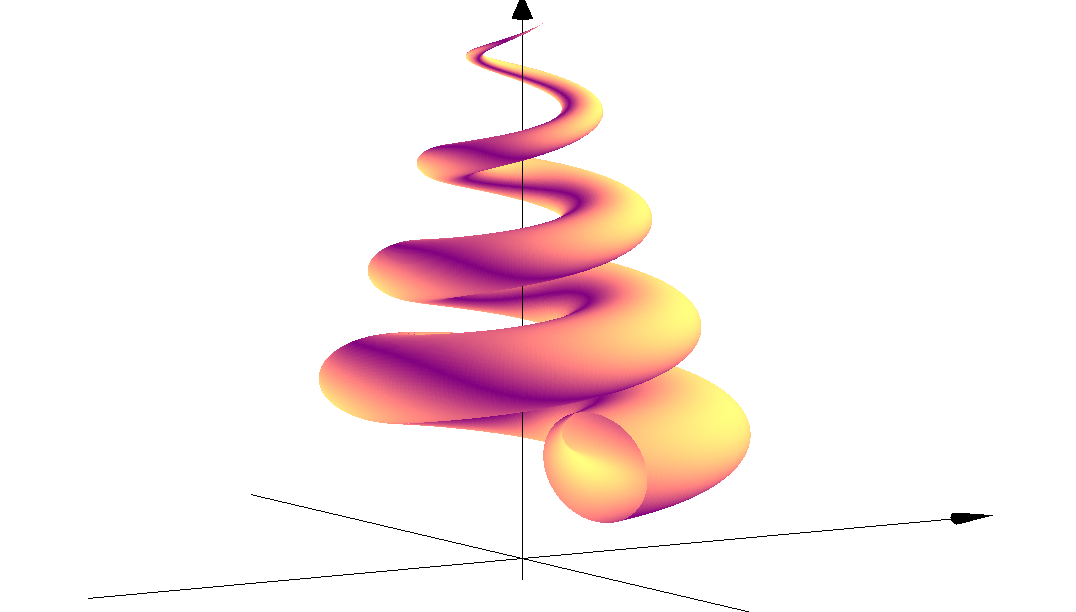
Mathematical spiral-type surface
In mathematics, a seashell surface is a surface made by a circle which spirals up the z-axis while decreasing its own radius and distance from the z-axis. Not all seashell surfaces describe actual seashells found in nature.
Parametrization
The following is a parameterization of one seashell surface:
:\begin{align} x & {} = \frac{5}{4}\left(1-\frac{v}{2\pi}\right)\cos(2v)(1+\cos u)+\cos 2v \ \ y & {} = \frac{5}{4}\left(1-\frac{v}{2\pi}\right)\sin(2v)(1+\cos u)+\sin 2v \ \ z & {} = \frac{10v}{2\pi}+\frac{5}{4}\left(1-\frac{v}{2\pi}\right)\sin(u)+15 \end{align}
where 0\le u and -2\pi\le v \
Various authors have suggested different models for the shape of shell. David M. Raup proposed a model where there is one magnification for the x-y plane, and another for the x-z plane. Chris Illert proposed a model where the magnification is scalar, and the same for any sense or direction with an equation like : \vec{F}\left( {\theta ,\varphi } \right) = e^{\alpha \varphi } \left( {\begin{array}{*{20}c} {\cos \left( \varphi \right),} & { - \sin (\varphi ),} & {\rm{0}} \ {\sin (\varphi ),} & {\cos \left( \varphi \right),} & 0 \ {0,} & } & 1 \ \end{array}} \right)\vec{F}\left( {\theta ,0} \right) which starts with an initial generating curve \vec{F}\left( {\theta ,0} \right) and applies a rotation and exponential magnification.
References
- C. Illert (Feb. 1983), "the mathematics of Gnomonic seashells", Mathematical Biosciences 63(1): 21-56.
- C. Illert (1987), "Part 1, seashell geometry", Il Nuovo Cimento 9D(7): 702-813.
- C. Illert (1989), "Part 2, tubular 3D seashell surfaces", Il Nuovo Cimento 11D(5): 761-780.
- C. Illert (Oct 1990),"Nipponites mirabilis, a challenge to seashell theory?", Il Nuovo Cimento 12D(10): 1405-1421.
- C. Illert (Dec 1990), "elastic conoidal spires", Il Nuovo Cimento 12D(12): 1611-1632.
- C. Illert & C. Pickover (May 1992), "generating irregularly oscillating fossil seashells", IEE Computer Graphics & Applications 12(3):18-22.
- C. Illert (July 1995), "Australian supercomputer graphics exhibition", IEEE Computer Graphics & Applications 15(4):89-91.
- C. Illert (Editor 1995), "Proceedings of the First International Conchology Conference, 2-7 Jan 1995, Tweed Shire, Australia", publ. by Hadronic Press, Florida USA. 219 pages.
- C. Illert & R. Santilli (1995), "Foundations of Theoretical Conchology", publ. by Hadronic Press, Florida USA. 183 pages plus coloured plates.
- Deborah R. Fowler, Hans Meinhardt, and Przemyslaw Prusinkiewicz. Modeling seashells. Proceedings of SIGGRAPH '92 (Chicago, Illinois, July 26–31, 1992), In Computer Graphics, 26, 2, (July 1992), ACM SIGGRAPH, New York, pp. 379–387.http://algorithmicbotany.org/papers/shells.sig92.html
- Callum Galbraith, Przemyslaw Prusinkiewicz, and Brian Wyvill. Modeling a Murex cabritii sea shell with a structured implicit surface modeler. The Visual Computer vol. 18, pp. 70–80. http://algorithmicbotany.org/papers/murex.tvc2002.html
References
- Dr Chris Illert was awarded his Ph.D. on 26 September 2013 at the University of Western Sydney http://www.uws.edu.au/__data/assets/image/0004/547060/2013_ICS_Graduates.jpg.
This article was imported from Wikipedia and is available under the Creative Commons Attribution-ShareAlike 4.0 License. Content has been adapted to SurfDoc format. Original contributors can be found on the article history page.
Ask Mako anything about Seashell surface — get instant answers, deeper analysis, and related topics.
Research with MakoFree with your Surf account
Create a free account to save articles, ask Mako questions, and organize your research.
Sign up freeThis content may have been generated or modified by AI. CloudSurf Software LLC is not responsible for the accuracy, completeness, or reliability of AI-generated content. Always verify important information from primary sources.
Report