From Surf Wiki (app.surf) — the open knowledge base
Sea pen
Order of colonial marine cnidarians

Order of colonial marine cnidarians
Sea pens are marine cnidarians belonging to the superfamily Pennatuloidea, which are colony-forming benthic filter feeders within the order Scleralcyonacea. The order comprises 16 families and 44 extant genera, with around 235 accepted species.
Sea pens have a cosmopolitan distribution, being found in tropical and temperate waters worldwide, from intertidal shallow waters to deep seas of more than 6100 m.
The earliest accepted sea pen fossils are known from the Cambrian-aged Burgess Shale (Thaumaptilon). Similar fossils from the Ediacaran may show the dawn of sea pens. Precisely what these early fossils are, however, is not decided.
Taxonomy
The superfamily Pennatulacea consists of the following families:
- Anthoptilidae Kölliker, 1880
- Balticinidae Balss, 1910
- Chunellidae Kükenthal, 1902
- Echinoptilidae Hubrecht, 1885
- Funiculinidae Gray, 1870
- Gyrophyllidae López-González,Drewery & Williams, 2022
- Kophobelemnidae Gray, 1860
- Pennatulidae Ehrenberg, 1834
- Protoptilidae Kölliker, 1872
- Pseudumbellulidae López-González in López-González & Drewery, 2022
- Renillidae Gray, 1870
- Scleroptilidae Jungersen, 1904
- Stachyptilidae Kölliker, 1880
- Umbellulidae Lindahl, 1874 (1840)
- Veretillidae Herklots, 1858
- Virgulariidae Verrill, 1868
Biology
Due to their wide geographic distribution and long evolutionary history, genetic variation within the different species of sea pen is quite large. Throughout evolution, most sea pens have kept their original mitochondrial gene order, but a certain clade of sea pens shown unique rearrangements through ancestral state reconstruction. There are many populations of sea pens found in mainly Indian waters. It is their polyps that are affected genetically, as they have dispersed within the different waters and islands, and how they use their polyps (tentacles) to protect themselves and other species.

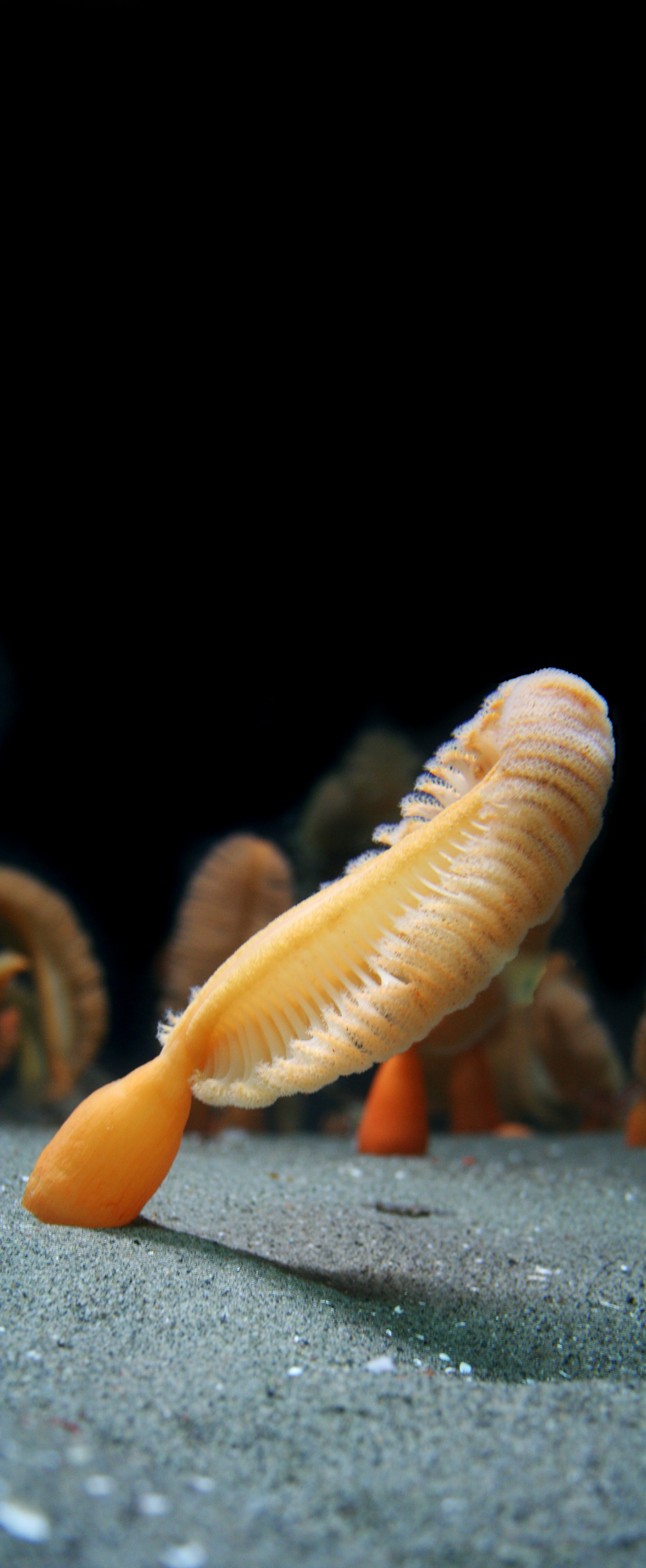
As octocorals, sea pens are colonial animals with multiple polyps (which look somewhat like miniature sea anemones), each with eight tentacles. Unlike other octocorals, however, a sea pen's polyps are specialized to specific functions: a single polyp develops into a rigid, erect stalk (the rachis) and loses its tentacles, forming a bulbous "root" or peduncle at its base. The other polyps branch out from this central stalk, forming water intake structures (siphonozooids), feeding structures (autozooids) with nematocysts, and reproductive structures. The entire colony is fortified by calcium carbonate in the form of spicules and a central axial rod.
Using their root-like peduncles to anchor themselves in sandy or muddy substrate, the exposed portion of sea pens may rise up to 2 m in some species, such as the tall sea pen (Funiculina quadrangularis). Sea pens are sometimes brightly coloured; the orange sea pen (Ptilosarcus gurneyi) is a notable example. Rarely found above depths of 10 m, sea pens prefer deeper waters where turbulence is less likely to uproot them. Some species may inhabit depths of 2000 m or more.
While generally sessile animals, sea pens are able to relocate and re-anchor themselves if need be. They position themselves favourably in the path of currents, ensuring a steady flow of plankton, the sea pens' chief source of food. Their primary predators are nudibranchs and sea stars, some of which feed exclusively on sea pens. The sea pens' ability to be clumped together and spatially unpredictable hinders sea stars' predation abilities. When touched, some sea pens emit a bright greenish light; this is known as bioluminescence. They may also force water out of their bodies for defence, rapidly deflating and retreating into their peduncle.
Like other anthozoans, sea pens reproduce by coordinating a release of sperm and eggs into the water column; this may occur seasonally or throughout the year. Fertilized eggs develop into larvae called planulae which drift freely for about a week before settling on the substrate. Mature sea pens provide shelter for other animals, such as juvenile fish. Analysis of rachis growth rings indicates sea pens may live for 100 years or more, if the rings are indeed annual in nature.
Some sea pens exhibit glide reflection symmetry, rare among extant animals.
Aquarium trade
Sea pens are sometimes sold in the aquarium trade. However, they are generally hard to care for because they need a very deep substrate and have special food requirements.
Gallery
Image:Actinoptilum molle at Windmill BeachPA111765.JPG|Actinoptilum molle (Echinoptilidae) Image:Sea Pansy - Flickr - Andrea Westmoreland (1).jpg|Renilla sp. (Renillidae) Image:Pennatula phosphorea.jpg|Pennatula phosphorea (Pennatulidae) Image:Veretillum sp. (Sea pen) at night.jpg|Veretillum sp. (Veretillidae) Image:Virgularia sp. (Purple sea pen).jpg|Virgularia sp. (Virgulariidae)
References
References
- "Pennatuloidea Ehrenberg, 1834".
- Williams, Gary C.. (2011-07-29 <!-- journal editors normally omitted --). "The Global Diversity of Sea Pens (Cnidaria: Octocorallia: Pennatulacea)". [[PLoS ONE]].
- "Pennatuloidea treeview".
- Antcliffe, J.B.. (2007). "Charnia and sea pens are poles apart". Journal of the Geological Society.
- Williams, Gary C.. "Aspects of the Evolutionary Biology of Pennatulacean Octocorals". Department of Invertebrate Zoology and Geology.
- (2008). "Charnia at 50: Developmental Models for Ediacaran Fronds". Palaeontology.
- (15 August 2015). "Fauna associated with cold water gorgonians and sea pens". Continental Shelf Research.
- Barnes, Robert D.. (1982). "Invertebrate Zoology". Holt-Saunders International.
- Birkeland, Charles. (February 1974). "Interactions between a Sea Pen and seven of its predators". Ecological Monographs.
- Zubi, Teresa. (2016-01-02). "Octocorals (Stoloniferans, soft corals, sea fans, gorgonians, sea pens) - Starfish Photos - Achtstrahlige Korallen (Röhrenkorallen, Weichkorallen, Hornkoralllen, Seefedern, Fächerkorallen)".
This article was imported from Wikipedia and is available under the Creative Commons Attribution-ShareAlike 4.0 License. Content has been adapted to SurfDoc format. Original contributors can be found on the article history page.
Ask Mako anything about Sea pen — get instant answers, deeper analysis, and related topics.
Research with MakoFree with your Surf account
Create a free account to save articles, ask Mako questions, and organize your research.
Sign up freeThis content may have been generated or modified by AI. CloudSurf Software LLC is not responsible for the accuracy, completeness, or reliability of AI-generated content. Always verify important information from primary sources.
Report