From Surf Wiki (app.surf) — the open knowledge base
Sea buckthorn oil
Vegetable oil
Vegetable oil
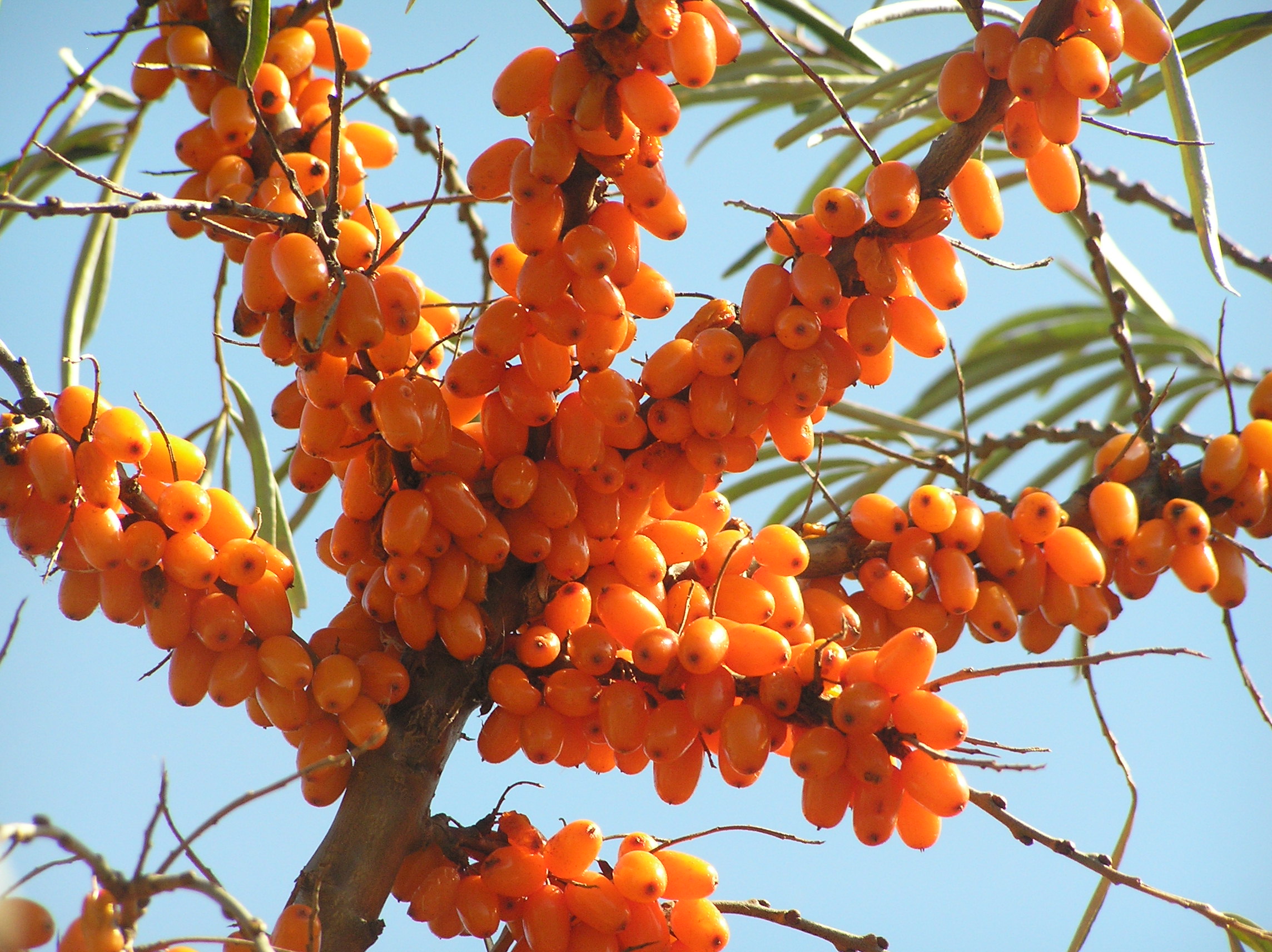
Sea buckthorn oil is a red-orange oil derived from sea buckthorn plants. The most commonly used species for this purpose is Hippophae rhamnoides. Species belonging to this genus accumulate lipids in the mesocarp (the fruit pulp), so the oil can be extracted from either the seeds or the pulp.
The resulting oils (seed oil and pulp oil, also called fruit or berry oil) are used in dietary supplements, nutraceuticals, cosmetics and skin care products.
Chemical constituents
Oil content in seeds of sea buckthorn is on average 7–11% while oil content of the fruit pulp is around 1.5–3% (per fresh weight).
Seed oil is characterized by high contents of polyunsaturated fatty acids while pulp oil contains monounsaturated fatty acids and carotenoids. Both oils also contain dense amounts of tocopherols, tocotrienols and plant sterols.
Fatty acids
Oils from sea buckthorn seeds and fruit pulp differ considerably in fatty acid composition. While linoleic acid and α-linolenic acid are the major fatty acids in seed oil, sea buckthorn pulp oil contains approximately 65% combined of the omega-7 monounsaturated fatty acid, palmitoleic acid, and the saturated fatty acid, palmitic acid. This results in a major difference between the sea buckthorn oil extracted from seeds and the sea buckthorn oil extracted from the fleshy part of the fruit, in term of appearance and consistency. Sea buckthorn fruit oil is dark orange in color and has a thick consistency (it is liquid at room temperature, but becomes much thicker if refrigerated), whereas the seed oil is pale yellow and does not solidify under refrigeration.
Few other vegetable oils contain a similar quantity of these fatty acids. The high proportion of unsaturated fatty acids are also responsible for the relatively poor shelf life, as they cause sea buckthorn oil to turn rancid quickly.
Tocopherols and tocotrienols
α-Tocopherol is the major vitamin E compound in sea buckthorn. Seed oil also contains considerable amounts of gamma-tocopherol. The total amount of tocopherols and tocotrienols is roughly 64–300 mg/100 g in seed oil and 100–481 mg/100 g in pulp oil.
Carotenoids
As carotenoids are the pigments that give sea buckthorn berry its distinctive orange-red color, these compounds are present in considerable amounts both in pulp oil and in seed oil; the average carotenoid content of pulp oil is 350 mg per 100 grams, as compared to 67.5 mg per 100 grams in seed oil. The total content of carotenoids in pulp oil varies greatly (300–2000 mg/100 g) between different growth locations and subspecies, and between components, where total carotenoids were up to 85 mg/100 g in seed oil, and up to 1000 mg/100 g in pulp oil. In general, the main carotenoids present in pulp oil are beta-carotene, zeaxanthin and lycopene.
Plant sterols
Both seed and pulp oil also contain considerable amounts of plant sterols (12–23 g/kg and 10–29 g/kg of oil, respectively). Beta-sitosterol is the major sterol compound throughout the berry which constitutes 57–83% of total sterols.
Uses

Sea buckthorn oil is frequently used in cosmetic products, especially topical products marketed for aging skin and dry skin. Sea buckthorn oil is used in some shampoos and other hair care products.
It has sometimes been used as a type of topical medication for skin disorders, although there is no high-quality research proving effectiveness or safety of any such uses. Taking sea buckthorn oil as a dietary supplement does not help with eczema.
It has been used in Asian and Russian traditional medicine for centuries. In a few East Asian countries, the fruit pulp oil is put on skin burns.
Research
Preliminary research on sea buckthorn oil has been conducted for its potential biological properties, but, , there is no high-quality evidence it has any confirmed clinical uses.
References
References
- (April 2001). "Fatty acid composition of lipids in sea buckthorn (''Hippophaë rhamnoides'' L.) berries of different origins". Journal of Agricultural and Food Chemistry.
- (January 2009). "Carotenoids in sea buckthorn ( Hippophae rhamnoides L.) berries during ripening and use of pheophytin a as a maturity marker". Journal of Agricultural and Food Chemistry.
- (April 2002). "Triacylglycerols, glycerophospholipids, tocopherols, and tocotrienols in berries and seeds of two subspecies (ssp. ''sinensis'' and ''mongolica'') of sea buckthorn (''Hippophaë rhamnoides'')". Journal of Agricultural and Food Chemistry.
- (March 2001). "Phytosterols in sea buckthorn (''Hippophaë rhamnoides'' L.) berries: identification and effects of different origins and harvesting times". Journal of Agricultural and Food Chemistry.
- (May 2017). "Abundance of active ingredients in sea-buckthorn oil". Lipids in Health and Disease.
- (2021-08-26). "Sea Buckthorn in Plant Based Diets. An Analytical Approach of Sea Buckthorn Fruits Composition: Nutritional Value, Applications, and Health Benefits". International Journal of Environmental Research and Public Health.
- (2011). "Sea buckthorn berries: a potential source of valuable nutrients for nutraceuticals and cosmoceuticals". Food Research International.
- (2017). "Sea Buckthorn Oil—A Valuable Source for Cosmeceuticals". Cosmetics.
- (February 2012). "Dietary supplements for established atopic eczema". The Cochrane Database of Systematic Reviews.
- (19 December 2022). "Sea buckthorn". Drugs.com.
This article was imported from Wikipedia and is available under the Creative Commons Attribution-ShareAlike 4.0 License. Content has been adapted to SurfDoc format. Original contributors can be found on the article history page.
Ask Mako anything about Sea buckthorn oil — get instant answers, deeper analysis, and related topics.
Research with MakoFree with your Surf account
Create a free account to save articles, ask Mako questions, and organize your research.
Sign up freeThis content may have been generated or modified by AI. CloudSurf Software LLC is not responsible for the accuracy, completeness, or reliability of AI-generated content. Always verify important information from primary sources.
Report