From Surf Wiki (app.surf) — the open knowledge base
Scyllatoxin
Scorpion toxin
Scorpion toxin
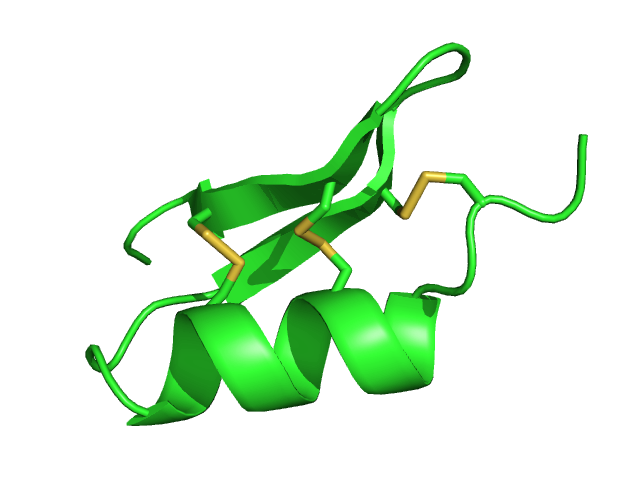
**Scyllatoxin ** (also leiurotoxin I) is a toxin, from the scorpion Leiurus quinquestriatus hebraeus, which blocks small-conductance Ca2+-activated K+ channels. It is named after Scylla, a sea monster from Greek mythology. Charybdotoxin is also found in the venom from the same species of scorpion, and is named after the sea monster Charybdis. In Greek mythology, Scylla and Charybdis lived on rocks on opposing sides of a narrow strait of water.
Sources
Scyllatoxin is one of the components of the venom of the Israeli scorpion ‘Leiurus quinquestriatus hebraeus’. It consists of only 0.02% of the total protein in crude venom.
Chemistry
Leiurotoxin I is a 31-residue peptide (sequence AFCNLRMCQLSCRSLGLLGKCIGDKCECVKH-NH2), with a helix and a short antiparallel β-sheet. This toxin is stabilized by disulfide bonds: Cys8-Cys26 and Cys12-Cys28 is bound to the β-sheet, while Cys3-Cys21 is bound to an N-terminal segment preceding the helix. Leiurotoxin adopts the ά/β motif. Especially the positively charged residues (Arg6 and Arg13, which are located in the ά helix) are important for the expression of toxin biological activities and for its receptor affinity.
Target
Scyllatoxin is a blocker of small-conductance Ca2+– activated K+ channels at 10−13–10−11 M concentrations in various cell types. This toxin shows similarity in its physiological activity and binding specificity to apamin, but both toxins show no structural similarity.
Mode of action
Scyllatoxin blocks the slow after-hyperpolarization that follows an action potential in some nerve cells.
Toxicity
Scyllatoxin induces spontaneous contractions in guinea pig taenia coli muscle cells that have been relaxed with epinephrine.
References
References
- (September 2002). "Role of disulfide bonds in folding and activity of leiurotoxin I: just two disulfides suffice". Biochemistry.
- (August 1996). "Synthesis and characterization of leiurotoxin I analogs lacking one disulfide bridge: evidence that disulfide pairing 3-21 is not required for full toxin activity". Biochemistry.
- (June 1997). "Characterization of a new family of toxin-like peptides from the venom of the scorpion ''Leiurus quinquestriatus hebraeus''. 1H-NMR structure of leiuropeptide II". The Journal of Peptide Research.
- (July 1988). "Purification and characterization of a unique, potent inhibitor of apamin binding from ''Leiurus quinquestriatus hebraeus'' venom". J. Biol. Chem..
- (January 1992). "Scyllatoxin, a blocker of Ca2+-activated K+ channels: structure-function relationships and brain localization of the binding sites". Biochemistry.
This article was imported from Wikipedia and is available under the Creative Commons Attribution-ShareAlike 4.0 License. Content has been adapted to SurfDoc format. Original contributors can be found on the article history page.
Ask Mako anything about Scyllatoxin — get instant answers, deeper analysis, and related topics.
Research with MakoFree with your Surf account
Create a free account to save articles, ask Mako questions, and organize your research.
Sign up freeThis content may have been generated or modified by AI. CloudSurf Software LLC is not responsible for the accuracy, completeness, or reliability of AI-generated content. Always verify important information from primary sources.
Report