From Surf Wiki (app.surf) — the open knowledge base
Scrotum
Sac of skin that protects the testicles
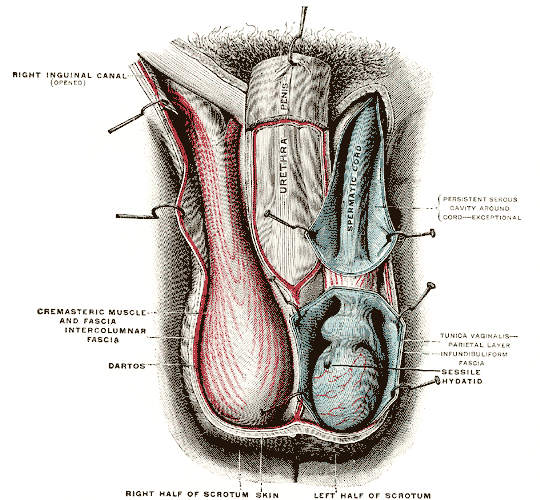
Sac of skin that protects the testicles
| Field | Value |
|---|---|
| Name | Scrotum |
| Latin | scrotum |
| Image | File:Scrotum - Hodensack.JPG |
| Caption | A human's scrotum in a relaxed state (left) and a tense state (right) |
| Precursor | Labioscrotal swellings |
| System | Reproductive system |
| Artery | Anterior scrotal artery, posterior scrotal artery, deep external pudendal artery, superficial external pudendal artery, internal pudendal artery |
| Vein | Posterior scrotal veins, internal pudendal veins |
| Nerve | Posterior scrotal nerves, anterior scrotal nerves, genital branch of genitofemoral nerve, perineal branches of posterior femoral cutaneous nerve, pudendal nerve, perineal nerve |
| Lymph | Superficial inguinal lymph nodes |
In most terrestrial mammals, the scrotum (: scrotums or scrota; possibly from Latin scortum, meaning "hide" or "skin") or scrotal sac is a part of the external male genitalia located at the base of the penis. It consists of a sac of skin containing the external spermatic fascia, testicles, epididymides, and vasa deferentia. The scrotum will usually tighten when exposed to cold temperatures.
The scrotum is homologous to the labia majora in females.
Structure
In regard to humans, the scrotum is a suspended two-chambered sac of skin and muscular tissue containing the testicles and the lower part of the spermatic cords. It is located behind the penis and above the perineum. The perineal raphe is a small, vertical ridge of skin that expands from the anus and runs through the middle of the scrotum front to back. The scrotum is also a distention of the perineum and carries some abdominal tissues into its cavity including the testicular artery, testicular vein, and pampiniform plexus.
Nerve supply
| Nerve | Surface |
|---|---|
| Genital branch of genitofemoral nerve | anterolateral |
| Anterior scrotal nerves (from ilioinguinal nerve) | anterior |
| Posterior scrotal nerves (from perineal nerve) | posterior |
| Perineal branches of posterior femoral cutaneous nerve | inferior |
Blood supply
| Blood vessels |
|---|
| Anterior scrotal artery |
| Posterior scrotal artery |
| Testicular artery |
Skin and glands
- Sebaceous glands
- Apocrine glands
- Smooth muscle
The skin on the scrotum is more highly pigmented in comparison to the rest of the body. The septum is a connective tissue membrane dividing the scrotum into two cavities.{{cite web | access-date = 2015-02-24
Lymphatic system
The scrotal lymph initially drains into the superficial inguinal lymph nodes, this then drains into the deep inguinal lymph nodes. The deep inguinal lymph nodes channel into the common iliac, which ultimately releases lymph into the cisterna chyli.
| Lymphatic vessels |
|---|
| title = VIII. The Lymphatic System. 5. The Lymphatics of the Lower Extremity. Gray, Henry. 1918. Anatomy of the Human Body. |
| Superficial inguinal lymph nodes |
| Popliteal lymph nodes |
Asymmetry
One testis is typically lower than the other, which is believed to function to avoid compression in the event of impact; in humans, the left testis is typically lower than the right. An alternative view is that testis descent asymmetry evolved to enable more effective cooling of the testicles.
Internal structure
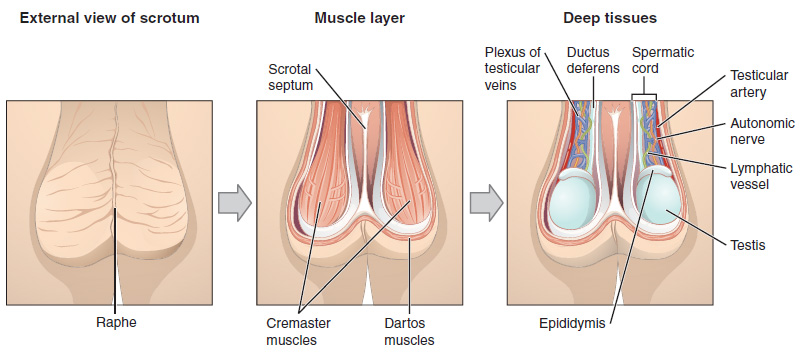
Additional tissues and organs reside inside the scrotum and are described in more detail in the following articles:
- Appendix of epididymidis
- Cremaster muscle
- Dartos fascia
- Efferent ductules
- Epididymis
- Leydig cell
- Lobules of testis
- Paradidymis
- Rete testes
- Scrotal septum
- Seminiferous tubule
- Sertoli cell
- Spermatic cord
- Testicle
- Tunica albuginea of testis
- Tunica vaginalis
- Tunica vasculosa testis
- Vas deferens
Development
Main article: Development of the reproductive system

During the fifth week after fertilization, the genital ridge grows behind the peritoneal membrane. By the sixth week, string-like tissues called primary sex cords form within the enlarging genital ridge. Externally, a swelling called the genital tubercule appears over the cloacal membrane.
Testosterone secretion starts during week eight, reaches peak levels during week 13 and eventually declines to very low levels by the end of the second trimester. The testosterone causes the masculinization of the labioscrotal folds into the scrotum. The scrotal raphe is formed when the embryonic, urethral groove closes by week 12.
Scrotal growth and puberty
Though the testes and scrotum form early in embryonic life, sexual maturation begins upon entering puberty. The increased secretion of testosterone causes the darkening of the skin and development of pubic hair on the scrotum.
Function
The scrotum regulates the temperature of the testicles and maintains it at 35 C, i.e. two or three degrees below the body temperature of 37 C. Higher temperatures affect spermatogenesis. Temperature control is accomplished by the smooth muscles of the scrotum moving the testicles either closer to or further away from the abdomen dependent upon the ambient temperature. This is accomplished by the cremaster muscle in the abdomen and the dartos fascia (muscular tissue under the skin that makes the scrotum appear wrinkly).
During sexual arousal, the scrotum will also tighten and thicken in the course of penile erection.
Having the scrotum and testicles situated outside the abdominal cavity may provide additional advantages. The external scrotum is not affected by abdominal pressure. This may prevent the emptying of the testes before the sperm were matured sufficiently for fertilization. Another advantage is it protects the testes from jolts and compressions associated with an active lifestyle. The scrotum may provide some friction during intercourse, helping to enhance the activity. The scrotum is also considered to be an erogenous zone.
Society and culture
Common slang terms for the scrotum are ballsack, nutsack, and teabag.
Some men will get a piercing on the skin of the scrotum, any of which is called a hafada (e.g., scrotal ladder). Side-to-side or front-to-back piercings that pass through the scrotum are known as transscrotal piercings.
Scrotoplasty is a sex reassignment surgery that creates a scrotum for trans men using tissue from the labia majora, or a plastic surgery that repairs or reconstructs the scrotum.
Cock and ball torture is a kink that may involve bringing pain to the scrotum. Beyond kink, a person (especially a man) may hit someone in the testicles as a gendered cultural practice known as sack tapping. This phenomenon is complex and contains many (often conflicting) meanings: it is used to both strengthen inclusive bonds and reinforce exclusive hierarchies, it is both humorous and violent, and both juvenile and present in male-dominated social spheres beyond those of adolescence.
Other animals
A scrotum is a synapomorphy of boreoeutherians. The anus is separated from the scrotum by the perineum in these mammals. The testicles remain in the body cavity in all other vertebrates, including both the cloacal animals.
It has been secondarially lost in hippopotamuses, rhinoceroses, hedgehogs, moles, pangolins, tapirs, numerous families of bats and rodents, the whales and dolphins, and seals.
Some male marsupials have a scrotum that is anterior to the penis, which is not homologous to the scrotum of placentals, although there are several marsupial species without an external scrotum.
Testicular of a bulldog cow Hoden eines Ochsen Venezuela P1140356.JPG|Scrotum of a bull File:Male-kangaroo.jpg|Scrotum of a kangaroo Red deer testicles.jpg|Scrotum of a red deer Jaguar 7374 (5000551901).jpg|Scrotum of a jaguar Camel's Testicles (3953363864).jpg|Scrotum of a camel Chlorocebus-pygerythrus-private-parts.JPG|Scrotum of a vervet monkey File:Giraffe (Giraffa camelopardalis) male genitals covered with ticks ... (51125861810).jpg|Scrotum of a giraffe
Clinical significance
Diseases and conditions
The scrotum and its contents can develop many diseases and can incur injuries. These include:
- Candidiasis (yeast infection)
- Sebaceous cyst
- Epidermal cyst
- Hydrocele testis
- Hematocele
- Molluscum contagiosum
- Spermatocele
- Paget's disease of the scrotum | access-date = 2015-02-24
- Varicocele - enlargement of the pampiniform venous complex
- Inguinal hernia
- Epididymo-orchitis
- Testicular torsion
- Pruritus scroti - irritation of the scrotum (itchiness)
- Genital warts - sexually transmitted infection
- Testicular cancer
- Dermatitis
- Undescended testes (also known as cryptorchidism)
- Chyloderma - swollen scrotum caused by a lymphatic obstruction
- Mumps
- Scabies
- Herpes - sexually transmitted infection
- Pubic lice
- Chancroid (Haemophilus ducreyi) - sexually transmitted infection
- Chlamydia (Chlamydia trachomatis) - sexually transmitted infection
- Gonorrhea (Neisseria gonorrhoeae) - sexually transmitted infection
- Granuloma inguinale or (Klebsiella granulomatis)
- Syphilis (Treponema pallidum) - sexually transmitted infection
- Scrotal eczema
- Polyorchidism - the presence of three or more testicles
- Scrotal psoriasis disease
- Riboflavin deficiency
- Chimney sweeps' carcinoma (scrotal cancer)
Bibliography
; Books
--
References
References
- van Driel, Mels. (2010). "Manhood: The Rise and Fall of the Penis". Reaktion Books.
- Spiegl, Fritz. (1996). "Fritz Spiegl's Sick Notes: An Alphabetical Browsing-Book of Derivatives, Abbreviations, Mnemonics and Slang for Amusement and Edification of Medics, Nurses, Patients and Hypochondriacs". Taylor & Francis.
- Moore, Keith. (2007). "Essential Clinical Anatomy, Third Edition". Lippincott Williams & Wilkins.
- {{NormanAnatomy. antthigh
- (1997). "Genital asymmetry in men". Human Reproduction.
- (2009). "On the Origin of Descended Scrotal Testicles: The Activation Hypothesis". Evolutionary Psychology.
- Jequier, Anne M.. (2008). "Male Infertility: A Guide for the Clinician". Wiley.
- (2013). "Human Reproductive Biology". [[Academic Press]].
- Redmon, George L.. (2002). "Sensual for Life". Kensington Publishing Corporation.
- Smith, C. Brian. (2018-07-31). "The Quick, Painful and ‘Totally Not Gay’ Cultural History of Sack Whacking".
- "Science : Bumpy lifestyle led to external testes - 17 August 1996 - New Scientist". New Scientist.
- (26 February 2009). "Encyclopedia of Marine Mammals". Academic Press.
- (2014). "Cool sperm: Why some placental mammals have a scrotum". Journal of Evolutionary Biology.
- (30 January 1987). "Reproductive Physiology of Marsupials". Cambridge University Press.
- Libbie Henrietta Hyman. (15 September 1992). "Hyman's Comparative Vertebrate Anatomy". University of Chicago Press.
- (2003). "Predators with Pouches: The Biology of Carnivorous Marsupials". Csiro Publishing.
- (1997). "Marsupial Biology: Recent Research, New Perspectives". UNSW Press.
- (17 August 2006). "Marsupials". Cambridge University Press.
- C. Hugh Tyndale-Biscoe. (2005). "Life of Marsupials". Csiro Publishing.
This article was imported from Wikipedia and is available under the Creative Commons Attribution-ShareAlike 4.0 License. Content has been adapted to SurfDoc format. Original contributors can be found on the article history page.
Ask Mako anything about Scrotum — get instant answers, deeper analysis, and related topics.
Research with MakoFree with your Surf account
Create a free account to save articles, ask Mako questions, and organize your research.
Sign up freeThis content may have been generated or modified by AI. CloudSurf Software LLC is not responsible for the accuracy, completeness, or reliability of AI-generated content. Always verify important information from primary sources.
Report