From Surf Wiki (app.surf) — the open knowledge base
Science Power Platform
Cancelled ISS module
Cancelled ISS module
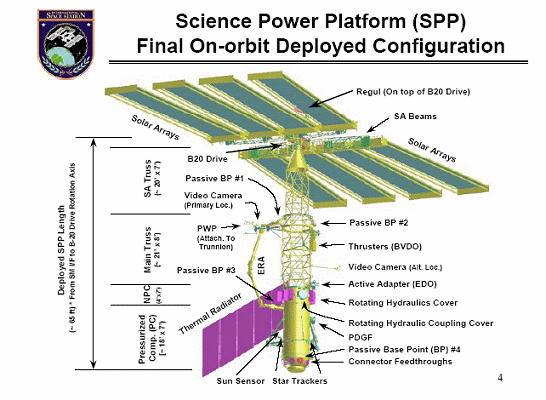
The Science Power Platform (SPP; , Sci-Energy Platform, also known by Russian initialism NEP) was a planned Russian element of the International Space Station (ISS) that was intended to be delivered to the ISS by a Russian Proton rocket or Zenit rocket (it was originally designed to be part of Mir-2) but was shifted to launch by Space Shuttle as part as a tradeoff agreement on other parts of the ISS.
History
It would have provided additional power for the ISS as well as roll axis control capability for the orbital facility. If the Science Power Platform had been delivered to the ISS, it would have been attached to the zenith port of Zvezda, a position currently occupied by Poisk. The SPP would have had eight solar arrays and a robotic arm provided by the European Space Agency (ESA) dedicated to maintaining the SPP.
The SPP's robotic arm (European Robotic Arm) was still added and is currently a part of the station, and launched together with the Russian Nauka Multipurpose Laboratory Module on 21 July 2021, after many delays.
An agreement was reached in March 2006 by the Russians and NASA in order to provide part of the power the Russian segments need from the four American solar arrays. Originally the SPP should have made the power supply of the four Russian modules independent from the power supply of the rest of the station. The already-made pressurised hull of a static test article for this component is now being used for the Russian Mini Research Module 1, which launched on STS-132 in 2010. Rassvet is docked to the Zarya nadir port.
RKK Energia, the manufacturer of the Russian Orbital Segment components, has proposed something similar to the original ISS plan with the addition of a nodal module (with six docking ports) and two additional science/energy modules called Science Power Module 1 and 2 to the segment around 2013-2015. The Science Power Modules would perform similar functions and would have solar arrays similar to the SPP, but unlike it the truss structure would be much smaller. As of 2021, the Science Power Module(s) (unknown whether one or two modules) is still being considered, but nothing has been launched. The nodal module, named Prichal, docked to the ISS on November 26, 2021.
References
References
- (26 October 2020). "ISS turns 20". Aviation Week and Space Technology (AWST).
- (2021-07-05). "Dutch robotic arm finally reaches into space".
- "European Robotic Arm is launched into space".
- (14 April 2008). "Russia Needs Billions More To Complete Its ISS Segment". Space-Travel.com.
- Sergei Shamsutdinov. (July 2008). "Program for Development of the Russian ISS Segment". Novosti Kosmonavtiki.
- "Russian port is safely in orbit".
This article was imported from Wikipedia and is available under the Creative Commons Attribution-ShareAlike 4.0 License. Content has been adapted to SurfDoc format. Original contributors can be found on the article history page.
Ask Mako anything about Science Power Platform — get instant answers, deeper analysis, and related topics.
Research with MakoFree with your Surf account
Create a free account to save articles, ask Mako questions, and organize your research.
Sign up freeThis content may have been generated or modified by AI. CloudSurf Software LLC is not responsible for the accuracy, completeness, or reliability of AI-generated content. Always verify important information from primary sources.
Report