From Surf Wiki (app.surf) — the open knowledge base
Science outreach

Science outreach, also called education and public outreach (EPO or E/PO) or simply public outreach, is an umbrella term for a variety of activities by research institutes, universities, and institutions such as science museums, aimed at promoting public awareness (and understanding) of science, including trust-building, and making informal contributions to science education.
Scope and history
While there have always been individual scientists interested in educating the public, science outreach has recently become more organized. For example, the National Aeronautics and Space Administration (NASA) now requires all of its projects to organize suitable outreach activities. Also working to inform the public are organizations such as Communicating Astronomy to the Public and the Washington Declaration on Communicating Astronomy to the Public that organize conferences for the public on science issues and make efforts to put outreach on a more general institutional footing.
Recently, an increasing number of projects have hired designated outreach scientists (part-time or full-time) that handle public relations for their project. There are also specialized outreach providers such as the Education branch of the Space Science Institute in Boulder, Colorado and the Education and Public Outreach Group at Sonoma State University which offer to organize a project's outreach activities on a contractual basis.
In addition to outreach by research institutions, an important part of informal science education are outreach programs such as science museums and science festivals.
Activities
Science outreach can take on a variety of forms.
Public talks, lectures, and discussions
Lectures are probably the oldest form of science outreach, dating back to the 1820s when Michael Faraday organized the first of the Royal Institution's Christmas Lectures.
Public talks can be part of a lecture series, given at a science festival or in cooperation with a special interest group such as a local astronomy club. Public presentations can have a variety of formats, including straightforward lecture formats with or without experimental demonstrations, guided live interviews, and discussions with several participants and a moderator. There are also less formal initiatives such as Café Scientifique, in which a café or bar is the venue for regular meetings involving guest scientists that come to talk about their work or take part in discussions with members of the public, and collaborations with museums
Visiting primary and secondary schools
School students and teachers are an important target group for science outreach. Outreach activities can include scientists visiting schools, giving talks at assemblies, discussions with students, or participation in events such as career fairs and science and technology camps. One organization that focuses on this kind of science outreach is Robogals. Many universities also have science outreach programs that are dedicated to building relationships between high school students, university scientists, and K–12 teachers. A few of the most prominent university science outreach programs include Carolina Science Outreach, the Vanderbilt Student Volunteers for Science, the Rockefeller University Science Outreach Program, the Present Your Ph.D. thesis to a 12-Year Old Outreach Project at University of Texas at Austin in Austin, Texas,{{cite journal
Workshops and schools for teachers or students

Inviting groups of school students to a research institution for a workshop is another popular form of outreach. Formats range from a one-day visit to more involved week-long events such as Perimeter Institute's International Summer School for Young Physicists, a two-week-long program for a total of a hundred Canadian and international students from grade 11.
Another method of science outreach invites school teachers to participate in workshops where they are able to learn effective strategies to engage students in science. This approach was especially embraced by the Canadian Space Agency (CSA) which held an annual "Space Educators" conference up until 2012 to provides teachers with access to resources to educate their students in space-related science.
Supporting science fairs and similar events
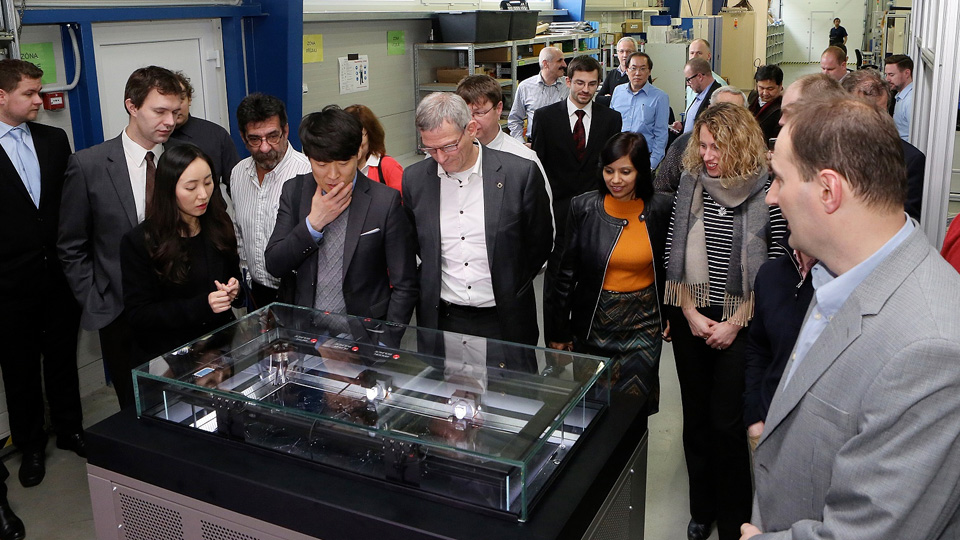
Besides organizing independent events, many outreach organizations sponsor existing events that promote sciences awareness. A notable examples are science fairs, public science events in which working scientists can participate both as judges and as sponsors of student projects.
Online aggregation of science activities, resources, and programs
The internet is a rich source of science activities, resources, and programs. For example, research laboratories often maintain educational outreach projects aimed at translating their science into something meaningful for the general public, often K–12 students, as an effort to increase research broader impacts required by funding agencies such as the National Science Foundation (NSF). These may include activities using fast-growing plants that exhibit distinctive mutants with unique phenotypes useful to teach K–12 students about both Mendelian and molecular genetics. Some institutions and organizations maintain large or small aggregations of their activity resources, outreach programs, upcoming events calendars, and partnering programs.
Awards
A number of awards honor commitment to science outreach. Examples include:
- Award for Public Understanding of Science and Technology, American Association for the Advancement of Science
- Descartes Prize for Excellence in Science Communication, European Commission
- Michael Faraday Prize for communicating science to a UK audience (Royal Society)
- Communicator award, Deutsche Forschungsgemeinschaft
- Synapse Mentorship Awards, often given for exceptional contributions to science outreach, Canadian Institutes of Health Research
- Nicholson Medal for Human Outreach, American Physical Society
- Charles A. Black Award, for exemplary contributions to public understanding of food and agricultural science
- Kalinga Prize for popularisation of science is an award given by UNESCO since 1952 for exceptional skill in presenting scientific ideas to lay people
References
References
- Curtis, Caitlin. (2023). "Teaching Science Students to Communicate: A Practical Guide". SpringerNature.
- Varner, Johanna. (2014). "Scientific outreach: toward effective public engagement with biological science". BioScience.
- "Communicating Astronomy to the Public".
- "Washington Declaration on Communicating Astronomy to the Public".
- "SSI - Education".
- "New Book Showcases ESO Images". ESO Announcements.
- "The RI Christmas Lectures (Royal Institution Website)".
- (2021). "Nights at the museum: integrated arts and microbiology public engagement events enhance understanding of science whilst increasing community diversity and inclusion". Access Microbiology.
- "Carolina Science Outreach".
- "Vanderbilt Student Volunteers for Science".
- "RockEDU: Rockefeller University's Science Outreach Program".
- "Present Your PhD {{!}} Bringing science to you: A guest speaker program connecting graduate students with the community".
- Ting, Jeffrey M.. (2017-11-14). "Polymer Day: Outreach Experiments for High School Students". Journal of Chemical Education.
- DeWilde, Joseph F.. (2019-02-28). "Evaluating Large-Scale STEM Outreach Efficacy with a Consistent Theme: Thermodynamics for Elementary School Students". ACS Omega.
- "Office of STEM Outreach".
- Bechara J. Saab, [http://www.hypothesisjournal.com/?p=902 "Engaging the Clutch of the Science Communication Continuum – Shifting Science Outreach into High Gear"], ''Hypothesis'', Volume 8, Issue 1 (September 2010)
- "ALMA Material for Teachers".
- "International Summer School for Young Physicists".
- (2017-07-10). "Canadian Space Agency Educators Resources".
- "Broader Impacts - National Science Foundation".
- "FPsc: genetics, evolution, modern genetic sciences".
- "Home {{!}} science.wisc.edu {{!}} University of Wisconsin–Madison".
- "Education and Outreach {{!}} Sanford Underground Research Facility".
- "Curriculum Modules {{!}} Sanford Underground Research Facility".
- "Outreach Programs {{!}} science.wisc.edu {{!}} University of Wisconsin–Madison".
- "Science / UW-Madison Events Calendar".
- "Science Alliance {{!}} science.wisc.edu {{!}} University of Wisconsin–Madison".
- [http://www.aaas.org/aboutaaas/awards/public/index.shtml Award for Public Understanding of Science and Technology], American Association for the Advancement of Science
- "CORDIS | European Commission".
- [https://www.dfg.de/en/research_funding/scientific_prizes/communicator_award.html Communicator award], Deutsche Forschungsgemeinschaft
- "Synapse Mentorship Awards".
- "Dwight Nicholson Medal for Outreach".
This article was imported from Wikipedia and is available under the Creative Commons Attribution-ShareAlike 4.0 License. Content has been adapted to SurfDoc format. Original contributors can be found on the article history page.
Ask Mako anything about Science outreach — get instant answers, deeper analysis, and related topics.
Research with MakoFree with your Surf account
Create a free account to save articles, ask Mako questions, and organize your research.
Sign up freeThis content may have been generated or modified by AI. CloudSurf Software LLC is not responsible for the accuracy, completeness, or reliability of AI-generated content. Always verify important information from primary sources.
Report