From Surf Wiki (app.surf) — the open knowledge base
Science-Fiction Plus
American science fiction magazine
American science fiction magazine
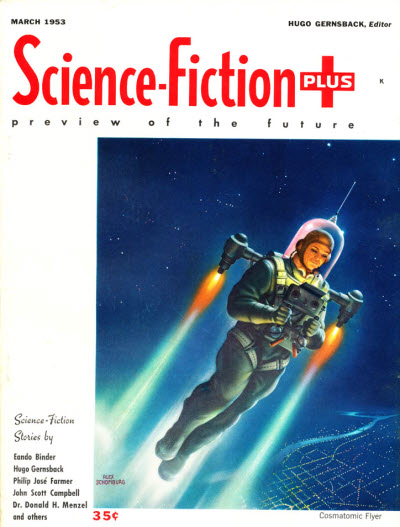
Science-Fiction Plus was an American science fiction magazine published by Hugo Gernsback for seven issues in 1953. In 1926, Gernsback had launched Amazing Stories, the first science fiction magazine, but he had not been involved in the genre since 1936, when he sold Wonder Stories. Science-Fiction Plus was initially in slick format, meaning that it was large-size and printed on glossy paper. Gernsback had always believed in the educational power of science fiction, and he continued to advocate his views in the new magazine's editorials. The managing editor, Sam Moskowitz, had been a reader of the early pulp magazines, and published many writers who had been popular before World War II, such as Raymond Z. Gallun, Eando Binder, and Harry Bates. Combined with Gernsback's earnest editorials, the use of these early writers gave the magazine an anachronistic feel.
Sales were initially good, but soon fell. For the last two issues Gernsback switched the magazine to cheaper pulp paper, but the magazine remained unprofitable. The final issue was dated December 1953.
In addition to the older writers he published, Moskowitz was able to obtain fiction from some of the better-known writers of the day, including Clifford Simak, Murray Leinster, Robert Bloch, and Philip José Farmer, and some of their stories were well-received, including "Spacebred Generations", by Simak, "Strange Compulsion", by Farmer, and "Nightmare Planet", by Leinster. He also published several new writers, but only one, Anne McCaffrey, went on to a successful career in the field. Science fiction historians consider the magazine a failed attempt to reproduce the early days of the science fiction pulps.
Publication history
The first science fiction (sf) magazine, Amazing Stories, was launched in 1926 by Hugo Gernsback at the height of the pulp magazine era. It helped to form science fiction as a separately marketed genre, and although Gernsback lost control of Amazing Stories in a bankruptcy in 1929, he quickly started several more sf magazines, including Air Wonder Stories and Science Wonder Stories. The two magazines were soon combined as Wonder Stories, which lasted until 1936, when Gernsback sold it to Ned Pines of Beacon Magazines. Gernsback remained in the publishing business as proprietor of several profitable magazines, but he did not return to the sf field for nearly seventeen years, when Science-Fiction Plus appeared.
Gernsback hired Sam Moskowitz to edit the new magazine, and produced a dummy issue in November 1952 that was never distributed or intended for sale; it was printed for trademark purposes, and contained only stories by Gernsback himself, under his own name and several pseudonyms. The first issue produced for sale was dated March 1953. It was a slick, meaning that it was in large format and was printed on high-quality paper; this was a step up from the cheap paper used in the leading science fiction magazines of the day, and sf historian Mike Ashley notes that in theory this should have given Gernsback a marketing edge. The price, 35 cents, was also competitive. Sales were initially good, and Science-Fiction Plus remained on a monthly schedule until June, but when the circulation began to slip, the magazine became bimonthly beginning with the August issue. Gernsback distributed Science-Fiction Plus along with his technical magazines, and if the circulation of the new magazine had been comparable to that of his other titles, it would have been profitable despite the more expensive slick paper, but sales were insufficient for it to continue. In October Gernsback cut costs by switching to cheaper pulp paper, but only one further issue, dated December 1953, appeared.
Contents and reception

The managing editor, Sam Moskowitz, also had a long history in the field, having helped organize the First World Science Fiction Convention in 1939. He too had strong views about what constituted good science fiction, though his views did not always coincide with those of his publisher: Gernsback's focus was on the educational potential of sf, while Moskowitz was a fan of the early writers in the field, from before the Golden Age. Moskowitz was the one in charge of obtaining stories, and he succeeded in acquiring work by many of the best-known names in sf, including Clifford Simak, Murray Leinster, Robert Bloch, James H. Schmitz, and Philip José Farmer, but he also bought many stories by writers from the early years of the genre, such as Raymond Gallun, Eando Binder, and Harry Bates. The result was a magazine that both Ashley and fellow sf historian Donald Lawler describe as old-fashioned, despite its smart appearance: in Ashley's words, Science-Fiction Plus had "a feeling of archaism", and he adds "for a magazine to be 'slick', it didn't just have to look slick, it had to feel it, but in the case of Science-Fiction Plus all that glittered clearly was not gold". Lawler agrees, describing the magazine as "an anachronism", and "dull from first to last". As part of Gernsback's attempt to encourage stories that contained plausible scientific predictions, he created a symbol made up of a sphere labeled "SF", with a five-pointed star atop it. He placed the first of these awards on a story of his own, "Exploration of Mars", in the first issue, in what Lawler describes as "a characteristic self-tribute".
Gernsback paid two to three cents per word for fiction, which was competitive with the leading magazines of the day, and despite the magazine's anachronistic approach, Moskowitz was able to publish some well-received stories. Lawler describes Simak's story, "Spacebred Generations", as a "gem", and cites Farmer's "Strange Compulsion" as "the high point in story quality for the entire run". Ashley praises the same two stories, and considers "Nightmare Planet", by Murray Leinster, from the June 1953 issue, as equal in quality. Moskowitz attempted to find and develop new writers, and published the first story by Anne McCaffrey, "Freedom of the Race", which appeared in the October 1953 issue. However, none of Moskowitz's other new writers lasted in the field, and he rejected McCaffrey's subsequent submissions.
As well as fiction, Gernsback included departments such as "Science Questions and Answers", "Science News Shorts", and other science-related non-fiction; these, like the fiction, were reminiscent of the Gernsback magazines of two decades earlier. In Ashley's opinion, the artwork was of variable quality; Frank R. Paul, who had worked with Gernsback on his earlier magazines, appeared in every issue, but although this brought back the ambience of the early science fiction magazines, Paul's work had not improved over the years. Ashley notes that Alex Schomburg, who was also a frequent contributor, did provide some high-quality covers.
Bibliographic details
| Jan | Feb | Mar | Apr | May | Jun | Jul | Aug | Sep | Oct | Nov | Dec | 1953 | |
|---|---|---|---|---|---|---|---|---|---|---|---|---|---|
| 1/1 | 1/2 | 1/3 | 1/4 | 1/5 | 1/6 | 1/7 | |||||||
| Issues of Science-Fiction Plus, identifying volume and issue numbers. Sam Moskowitz was | |||||||||||||
| editor throughout. |
References
Sources
References
- Ashley (2005), p. 385.
- (July 14, 2014). "Amazing Stories". Gollancz.
- (August 23, 2014). "SF Magazines". Gollancz.
- Ashley (2000), p. 91.
- Ashley (2005), pp. 58–59.
- (May 24, 2015). "Science-Fiction Plus". Gollancz.
- Ashley (2005), p. 381.
- Ashley (2000), p. 50.
- Ashley (2000), p. 54.
- Ashley (2004), p. 252.
- (April 9, 2015). "Golden Age of SF". Gollancz.
- Lawler (1985), pp. 541–545.
- "Science Fiction Plus v01n01".
- de Camp (1953), pp. 115–116.
- Stone (1985), pp. 537–539.
- Moskowitz (1983), p. 92.
This article was imported from Wikipedia and is available under the Creative Commons Attribution-ShareAlike 4.0 License. Content has been adapted to SurfDoc format. Original contributors can be found on the article history page.
Ask Mako anything about Science-Fiction Plus — get instant answers, deeper analysis, and related topics.
Research with MakoFree with your Surf account
Create a free account to save articles, ask Mako questions, and organize your research.
Sign up freeThis content may have been generated or modified by AI. CloudSurf Software LLC is not responsible for the accuracy, completeness, or reliability of AI-generated content. Always verify important information from primary sources.
Report